Pairs with the Flywheel Designer Canvas — a ready-to-use strategy tool. Included in the The Flywheel Casebook →
In 2009, Domino's did something almost no brand does on purpose: it broadcast its own customers calling the product terrible. "Cardboard crust." "Tastes like ketchup." The clips ran nationally, in a six-week, $75 million campaign, paired with 200,000 hours of employee retraining and a publicly redesigned recipe.5 Everyone remembers it as the moment a humble pizza chain reinvented itself as a tech darling. That story is true enough to be dangerous - because it points your eyes at the app while the money is somewhere else entirely.
The official story is that Domino's is a technology company that out-coded Pizza Hut and Papa John's, and that the flywheel runs on the app. The real story is that the flywheel runs on a pantry - a supply chain that franchisees are contractually required to buy through, turning every order, however it's placed, into a wholesale food sale that lands back at headquarters.
The biggest line item isn't an app - it's dough
Look at where the revenue actually comes from and the tech narrative quietly dissolves. About 99% of Domino's roughly 22,100 stores are owned by independent franchisees, and the single largest revenue segment is supply chain - $2.99 billion in FY2025, or 60.5% of consolidated revenue.2 That's not advertising fees or software licensing. That's Domino's selling dough, cheese, sauce, and boxes to the very franchisees flying its logo. The company's own results spell out the mechanism: supply chain revenue is directly tied to franchise retail sales.4 So when a customer taps "order" in the app, the cash doesn't mostly arrive as a royalty on the slice. It arrives later, upstream, as a wholesale food sale - because the franchisee had to buy the ingredients from headquarters to make that pizza in the first place.
This is the part the tech story skips. A franchisee can't shop around for cheaper flour. The contract routes their purchasing through Domino's distribution centers, which means the parent company captures margin on the inputs whether or not any single store has a great quarter. It's a toll on the kitchen, not a fee on the screen. The app is real and it's good - over 85% of sales now flow through digital channels, and Domino's has been first at this since launching online ordering in 2007 and the Tracker in 2008.3 But the app's job in the system is not to be the profit center. Its job is to drive volume through stores whose ingredients are already locked to the parent.
| The tech-company story | What the 10-K shows | |
|---|---|---|
| The hero | The ordering app | The distribution network |
| Biggest revenue source | Digital orders / royalties | Supply chain: 60.5% of revenue |
| Why franchisees stay | Great software | Contractually required to buy ingredients |
| What more orders feed | Data and engagement | Wholesale food sales to headquarters |
How the loop actually turns
Here is the flywheel, worked all the way down. A better pizza and a frictionless app lift order volume. More orders mean franchisees buy more ingredients - and they buy them from Domino's, because the contract leaves no alternative. That swells supply chain revenue, the highest-volume segment in the business. Profit funds more marketing and more technology, which lifts volume again. The clever part isn't the digital layer everyone praises; it's that the parent monetizes franchisee success through the wholesale margin instead of relying mostly on royalty percentages. The geography of the contract does the capturing. The app just feeds it.
And for a long stretch, it spun beautifully. By 2018 Domino's had clocked its 30th consecutive quarter of same-store sales growth and crossed 60% U.S. digital orders, and the loyalty program eventually carried more than 25 million active users against 85 million unique customer profiles.8 Each turn of the wheel made the next one easier. Global retail sales reached roughly $19.1 billion in 2024.4 The fifteen-year total return ran to something like 1,940%.6 If you only read the up-and-to-the-right chart, you'd conclude the flywheel was perpetual motion.
Domino's looks like a brand-and-app story because that's the part facing the customer. But the durable advantage sits behind the counter: franchisees are contractually required to buy their ingredients through the parent's distribution network. That converts every order into a wholesale food sale and makes the biggest revenue line largely independent of any single app feature. When you study a franchise system, don't ask 'is the product good?' - ask 'who controls the supply, and can the operator route around them?' If the answer is no, you've found where the money is actually trapped. The catch: lock-in built on contracts, not love, only feels like a moat while volume is rising. When orders stall, the same chokehold becomes a fixed-cost network with too little flowing through it.
A flywheel that's audibly slowing down
The story is usually told as a decade of unbroken triumph. It isn't, anymore. DPZ set an all-time closing high of $528.16 on December 31, 2021, and the picture since has inverted: the five-year total return is roughly -6%, and the trailing-twelve-month return is around -23%.6 As of mid-2026 the shares are down approximately 37% over the prior year, with slowing same-store sales and recent leadership changes named as the drivers, not footnotes.7 A flywheel is only as good as the energy you keep putting in. When same-store sales flatten, the loop doesn't reverse gently - it decelerates, and the asset-light model's hidden dependency becomes visible: the parent's biggest revenue line is a wholesale food business that needs the stores to keep selling. No volume, no toll.
“Supply chain revenue was $2.99 billion - 60.5% of consolidated revenues.”2
Isn't this just a great brand turnaround with good tech?
The fair objection is that I'm underselling the obvious: the 2009 self-roast was brilliant, the recipe got genuinely better, the app genuinely works, and none of that is fake. All true. But notice two things the popular version gets wrong. First, the turnaround wasn't a one-man tech miracle - the recipe redesign started under the prior CEO, David Brandon; Patrick Doyle was named CEO only in January 2010 and steered a launch already in motion.5 And the famous focus-group footage wasn't a leak that went viral - it was deliberately released as part of that paid $75 million campaign.5 It was a manufactured device, not a spontaneous discovery. Second, even granting all the brand and tech credit, the structural truth holds: the largest revenue segment is supply chain, contractually captive, sitting underneath every digital order.2 The app is the engine's spark plug. The captive pantry is the engine. And right now the engine is turning slower.7
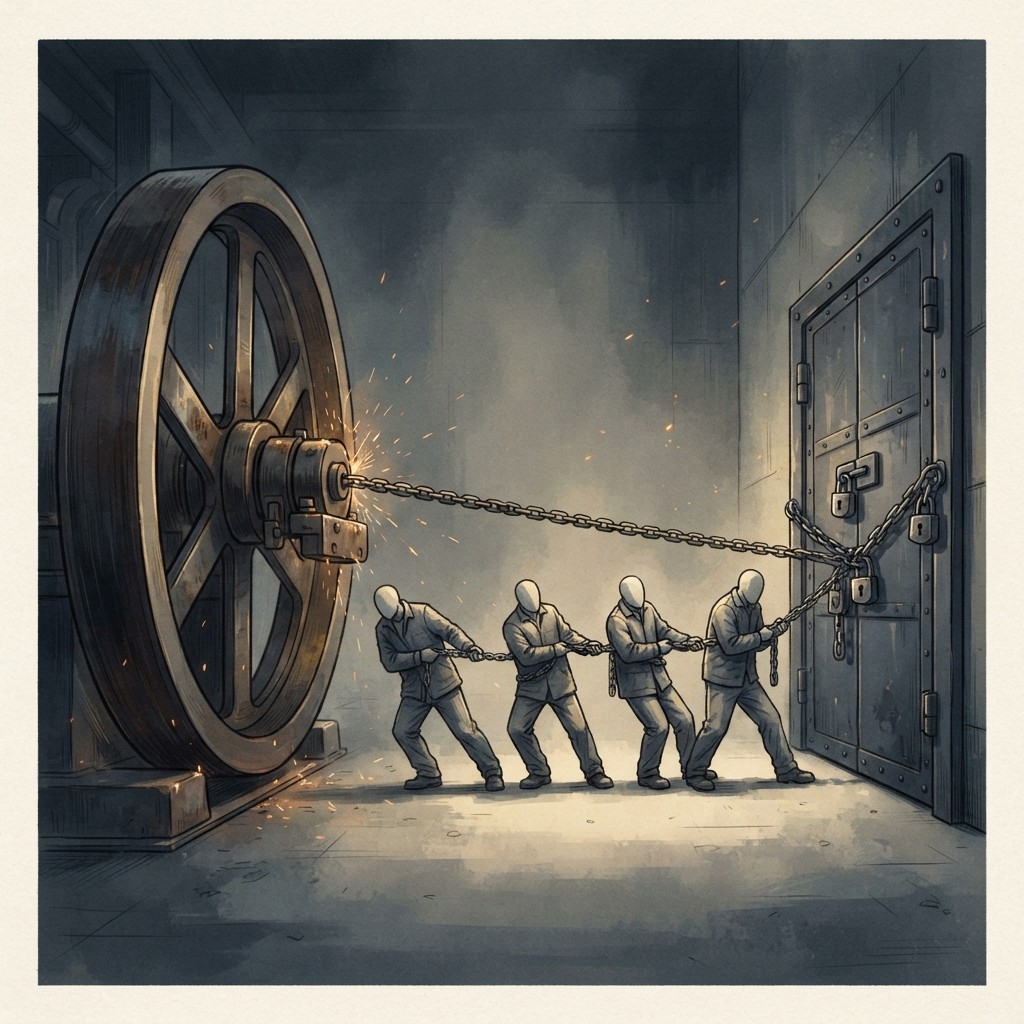
Domino's didn't win because it became a software company. It won because it sat at the one place every franchisee had to pass through - the loading dock - and made the app good enough to keep the trucks full. That arrangement compounds magnificently while orders rise and grinds when they stall. The flywheel was never powered by code. It was powered by a contract that says where the dough comes from - and a flywheel built on a chokehold spins exactly as long as the volume holding it up keeps coming.
When the real engine isn't the one you're shown
Flywheel Designer Canvas
A one-page canvas for mapping a business's flywheel: the reinforcing loop, how it was started, the second-order loops it spins off, the moat it creates, and how it could spin backward. Use it to diagnose whether you have a real flywheel or a funnel drawn in a circle — and to design one of your own.
Included, filled and blank, in the The Flywheel Casebook. See the set → · Preview the blank →
Sources
Where this comes from — the filings, records, and reporting behind it.
- 1Domino's Pizza is primarily a franchisor with approximately 99% of global stores owned by independent franchisees as of December 29, 2024; supply chain revenue was $2.845 billion in FY2024, the largest single revenue segment.
- 2In FY2025, supply chain revenue was $2.99 billion (60.5% of consolidated revenues); Domino's operated more than 22,100 locations in over 90 markets as of December 28, 2025, with ~99% franchised.
- 3Domino's generates more than 85% of sales via digital ordering channels; online ordering launched in 2007 and the Domino's Tracker launched in 2008 as the first such tool used by a national pizza chain.Domino's Pizza Inc., Innovations – biz.dominos.com ↗ · 2021-12-13
- 4Domino's Q4 and FY2024 financial results press release confirms supply chain revenues are directly impacted by franchise retail sales; global retail sales in 2024 were approximately $19.1 billion.
- 5The pizza recipe redesign process started under CEO David Brandon; Patrick Doyle was named CEO only in January 2010 after Brandon resigned, and then steered the launch. Domino's spent $75 million on a six-week marketing campaign and 200,000 hours retraining employees.
- 6DPZ all-time high closing price was $528.16 on December 31, 2021; the 15-year total return through early 2026 is approximately 1,940%, but the 5-year total return is approximately -6% and the TTM return is approximately -23%.
- 7DPZ shares have declined approximately 37% over the past year as of late June 2026, driven by slowing same-store sales and recent leadership changes; analysts project Q2 2026 EPS of $4.15.
- 8By 2018, Domino's tallied more than 60% of U.S. sales via digital orders and achieved its 30th straight quarter of same-store sales growth; Domino's loyalty program had more than 25 million active users and 85 million unique customer profiles as of circa 2022.
More like this — beyond Domino's
New Strategically analyses as they publish: the defining moves in business, checked against the record. No noise, and one click to leave.