Pairs with the Distribution Channel Map — a ready-to-use strategy tool. Included in the The Distribution Rebellion Casebook →
In October 2010, a young company in San Francisco got a letter telling it to stop. Two letters, actually — one from the California Public Utilities Commission, one from the city's own transit agency — warning of fines up to $5,000 per instance and, in the version that made the rounds, the threat of jail time for each day it kept running.3 The company complied with exactly one demand: it dropped the word 'Cab' from its name.2 Then UberCab became Uber, and kept going.
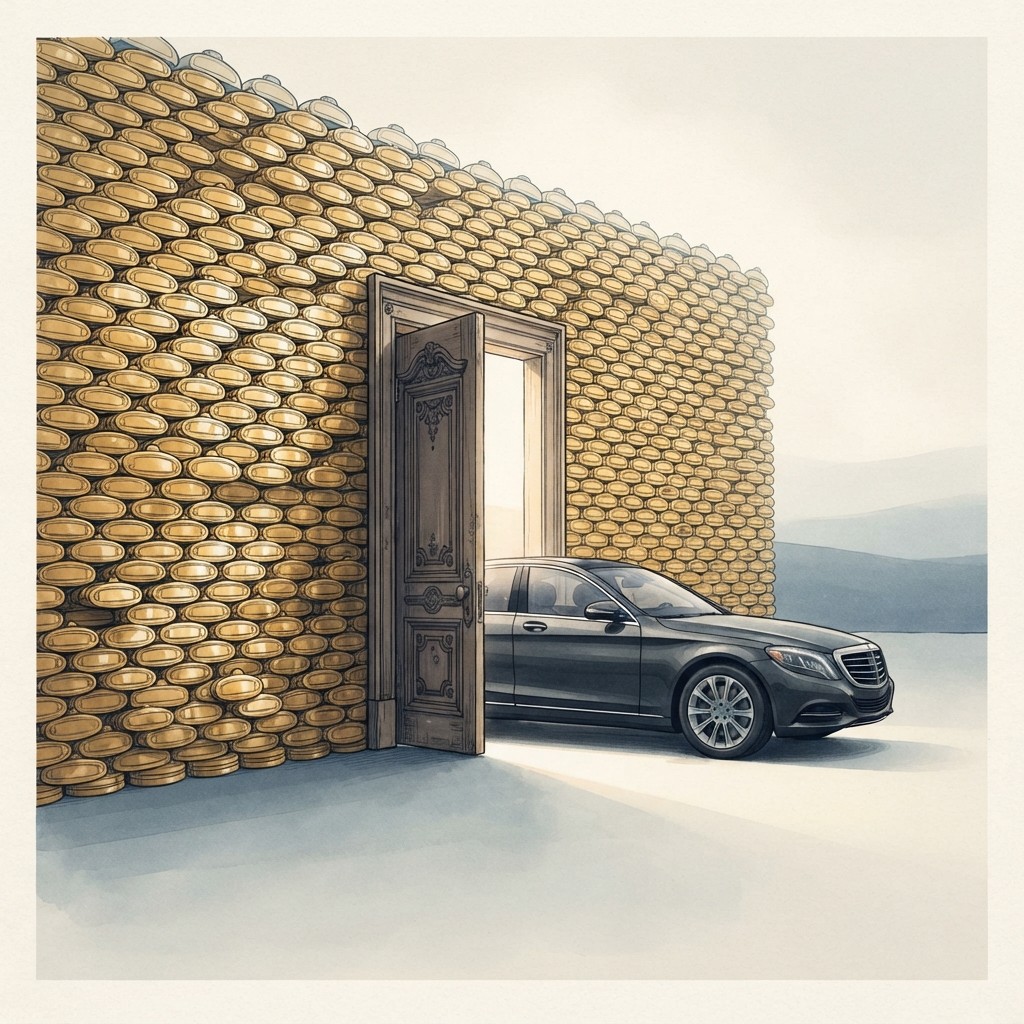
The legend that grew up around this is that Uber outsmarted a century-old taxi cartel — that it found a brilliant legal crack in the medallion fortress and slipped through. Almost none of that is right. Uber didn't crack the medallion system. It walked through a door that had been propped open for decades, by lawmakers, before anyone had a smartphone.
There were always two doors, and Uber used the unlocked one
Here is the part the disruption story skips. California never regulated all cars-for-hire the same way. Street-hail taxis — the ones you flag from a curb — fell under local jurisdiction, with supply choked to scarcity through medallions. But pre-arranged black cars fell under a different authority entirely: the state CPUC, with no medallion requirement and no cap on how many could exist.4 These were two separate legal lanes that happened to carry strangers from one place to another. UberCab simply connected riders to already-licensed black cars and digitized the one thing that lane required: the pre-arrangement.4 The early product wasn't an end run around the medallion. It was a category that the medallion rules had never claimed in the first place.
That is why the regulators' first objection was so oddly specific. The SFMTA wasn't enraged that Uber was moving people for money — black cars had done that legally for years. It was the word 'cab' that triggered the letter, because 'cab' implied taxi status, and taxi status is exactly the door Uber wasn't allowed through.4 Strip away the founding mythology and the original maneuver looks less like rebellion and more like reading the statute carefully and standing on the side of it that was already legal.
| Street-hail taxi | Pre-arranged black car | |
|---|---|---|
| Who regulates it | Local jurisdiction | State (CPUC) |
| Supply limit | Capped via medallions | No cap |
| Medallion required | Yes | No |
| What UberCab actually used | — | This one |
“The SFMTA's objection was to the word 'cab' in the name — implying taxi status — not to the underlying service.”4
The real rule-breaking came later — and someone else threw the first punch
The genuinely defiant move wasn't the black-car app. It was putting ordinary people in their own personal cars and paying them to drive strangers — a category for which no legal framework existed at all. And the company that did it first wasn't Uber. Sidecar and Lyft pioneered the peer-to-peer personal-vehicle model in 2012, the unambiguously illegal version, and they were the ones who forced the regulator's hand.12 In November 2012 the CPUC issued $20,000 citations to Lyft, Uber, and Sidecar for operating as charterparty carriers without authorization.5 Uber didn't lead the charge into the gray zone. It announced it would adopt the personal-vehicle model in April 2013 — after Lyft and Sidecar had already drawn the regulatory fire and the CPUC had opened a rulemaking that allowed the companies to continue operating in the interim.513
And the famous 'TNC' category — the legal box that finally legitimized the whole industry — wasn't Uber's invention either. The CPUC created the Transportation Network Company classification in Decision D.13-09-045 on September 19, 2013, written in response to the model Lyft and Sidecar had forced into the open.5 Uber's contribution to the rebellion was less the breakthrough and more the willingness to keep operating while the rules caught up. When you're not the one being made an example of, that's a cheaper kind of nerve.
The bubble that 'Uber killed' was already a fraud waiting to burst
The other half of the legend is that Uber detonated a trillion-dollar asset — the New York medallion, which had risen from $10 in 1937 to peaks around $1.05 million for an individual and $1.32 million for a corporate license in November 2013.6 That number is real. What it doesn't tell you is that the number was, in part, manufactured. The New York Attorney General later alleged the city's own Taxi & Limousine Commission published false and misleading medallion prices on at least ten occasions in 2013 and 2014, inflating reported values by excluding below-average sales — and the AG sought $810 million in restitution.7 Between 2002 and 2014, the reported price climbed past $1 million from around $200,000 even though driver incomes barely moved.7 A price detached from the income it supposedly represented isn't a healthy market. It's a speculative bubble — one the regulator had a hand in pumping.
Note too that Uber didn't even launch in a medallion-bubble city. San Francisco had long operated under Proposition K, which since 1978 had made medallions non-transferable city property issued free to working drivers — but SFMTA itself launched a paid sales pilot in 2010 and a permanent transfer program in 2012, meaning a nascent tradable market existed even as Uber was expanding.910 The speculative bubble that detonated in New York never fully inflated in San Francisco. Uber's home market never had the structure New York did. The image of Uber as the bomb under the medallion economy gets the timing exactly backwards: in the city where it began, the bomb was never there, and in the city where it detonated, the fuse had been lit by predatory lending, overleveraging, and the TLC's own inflated statistics.11
The most durable distribution rebellions rarely begin by smashing the incumbent's defenses head-on. They begin in the seam — the place where two regulatory regimes meet and neither one fully claims the new behavior. Uber's first product wasn't illegal; it lived in the black-car lane that medallion rules had never covered. The lesson for an operator isn't 'break the law and dare them to stop you.' It's: before you assault the wall, check whether the wall has a gap its builders never bothered to close. The defiance came later, and it was cheaper to attempt once someone else had been cited first. Two cautions: a seam exploited at scale eventually gets noticed, and the regulator you ignored today writes the rules you live under tomorrow — so the rebellion only pays if you can convert tolerance into a legal category before enforcement finds its budget.
Strip the founder myth, the snowstorm in Paris, the lone-genius framing, and what's left is more interesting than the legend. Uber's first act was compliance dressed as disruption: a digitized pre-arrangement inside a lane the medallion never owned. Its second act was real defiance — but defiance it followed others into, tolerated by agencies that chose rulemaking over enforcement once the citations went ignored. And the asset everyone says it destroyed was a price the regulator itself had allegedly faked. The genius wasn't beating the medallion. It was understanding, earlier than the people guarding it, that the medallion had only ever locked one of the two doors.
When a challenger walks around the rules instead of through them
Distribution Channel Map
A map of every hop between the company and the customer — each intermediary, who owns the relationship at each step, and where the company controls the channel versus where it's at the channel's mercy. Blank to chart your own route to market; filled as the worked example showing where the story's company went direct, fought its gatekeepers, or got disintermediated.
Included, filled and blank, in the The Distribution Rebellion Casebook. See the set → · Preview the blank →
Sources
Where this comes from — the filings, records, and reporting behind it.
- 1UberCab was officially incorporated in March 2009 by Garrett Camp and Travis Kalanick; its prototype was built by Camp, Oscar Salazar, and Conrad Whelan; Ryan Graves became first CEO in May 2010; Kalanick succeeded him in December 2010.
- 2In October 2010, the CPUC's Consumer Protection & Safety Division issued a cease-and-desist letter to UberCab for operating as a passenger carrier for hire without Commission authorization; the City of San Francisco also sent a cease-and-desist, which led Uber to drop 'Cab' from its name.San Francisco Taxi Workers Alliance, White Paper ↗ · 2015-01-06
- 3UberCab received cease-and-desist orders from both the SFMTA and the California PUC on or around October 20, 2010; penalties included up to $5,000 per instance and potentially 90 days in jail per day of continued operation; the company continued operating.TechCrunch, UberCab Ordered to Cease And Desist ↗ · 2010-10-24
- 4Uber's original black-car product was operating within existing legal rules: California black cars fell under state CPUC jurisdiction with no medallion requirement and no supply cap, while taxis fell under local jurisdiction with supply limits enforced via medallions. UberCab connected passengers with already-licensed black cars, making the early product technically legal. The SFMTA's objection was to the word 'cab' in the name — implying taxi status — not to the underlying service.
- 5The California CPUC formally created the Transportation Network Company (TNC) regulatory category via Decision D.13-09-045 on September 19, 2013. In April 2013, Uber announced it would adopt the personal-vehicle model after Lyft and Sidecar had obtained licenses. In November 2012, the CPUC issued $20,000 citations to Lyft, Uber, and Sidecar for operating as charterparty carriers without authorization.
- 6New York City's taxi medallion system was established in 1937 under the Haas Act, signed by Mayor Fiorello La Guardia, creating 16,900 licenses (later dwindling to 11,787 over six decades). Medallion prices rose from $10 in 1937 to $2,500 in 1947, $280,000 in 2004, and peaked around $1.05 million (individual) and $1.32 million (corporate) in November 2013.
- 7The NYC TLC published false and misleading medallion prices on at least 10 occasions in 2013 and 2014 by excluding below-average transactions, fraudulently inflating reported values. Between 2002 and 2014, the price of a medallion rose to more than $1 million from $200,000, even though driver incomes barely changed. The NY State Attorney General sought $810 million in restitution.
- 8Uber's S-1 was filed with the SEC on April 11, 2019 (Registration No. 333-230812), confirming the company's legal domicile as Delaware, headquarters at 1455 Market Street, San Francisco, and listing regulatory risk as a primary business risk factor.
- 9San Francisco's Proposition K, passed by voters in 1978, made taxi medallions non-transferable and banned their private sale; medallions were issued free to individual working drivers from a waitlist
- 10SFMTA authorized a temporary Medallion Sales Pilot program on February 26, 2010, and adopted a permanent Medallion Transfer Program on August 16, 2012 — meaning SF medallions became purchasable and transferable starting in 2010, before Uber's personal-vehicle expansion
- 11Predatory lending practices in the NYC taxi medallion market drove artificial inflation in medallion prices; in the early 2000s many medallion owners took out loans at inflated prices driven upward by predatory lenders
- 12Sidecar launched publicly in February 2012 with the peer-to-peer personal-vehicle model; Lyft launched publicly in summer 2012; the entry of Lyft, Sidecar, and UberX in San Francisco in 2012 raised serious questions about the legality of ridesourcing and sparked significant regulatory conflict
- 13In March 2013, Uber, Lyft, and Sidecar reached an agreement with the CPUC to suspend enforcement actions against them until the rulemaking process was complete, allowing all three companies to operate in the interim before Uber announced its personal-vehicle model in April 2013.
More like this — beyond Uber
New Strategically analyses as they publish: the defining moves in business, checked against the record. No noise, and one click to leave.