Pairs with the Distribution Channel Map — a ready-to-use strategy tool. Included in the Distribution Rebellion Casebook →
“How much of the channel's margin do you actually keep?”
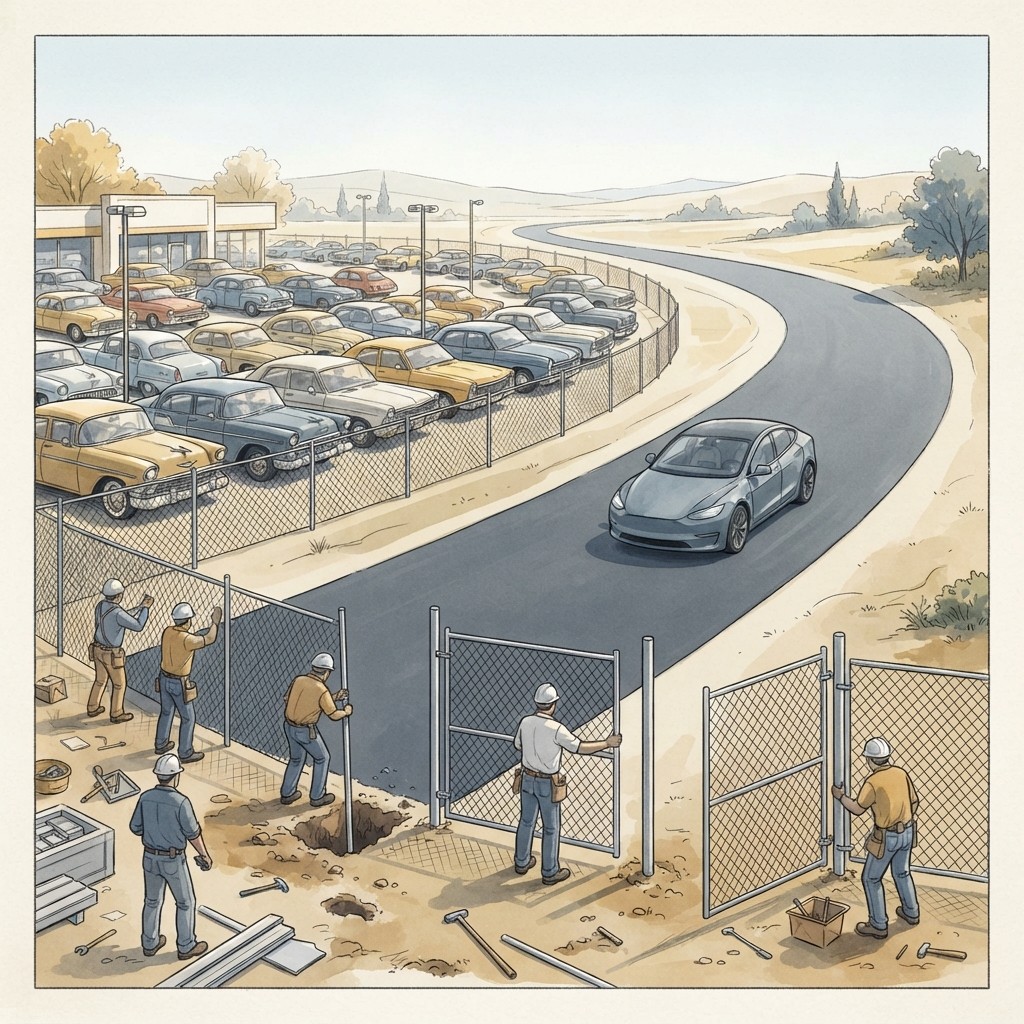
In a state that bars Tesla from selling you a car, you can still walk into a Tesla store, configure a Model whatever, and drive it home - if the store happens to sit on sovereign tribal land. That is roughly what Tesla did in Connecticut, opening on Mohegan territory to step outside the reach of a state franchise law it could not beat.7 It is a strange image for a company remembered as the great disruptor that stormed the dealer system and won. The reality is closer to a company finding the cracks in the floor and slipping through them, state by state, word by word.
The official story is that Tesla bravely chose to sell cars direct, defying a century-old dealer establishment and dragging the industry into the future. Almost every part of that framing flatters the wrong thing. Tesla didn't conquer the franchise laws. For most of its early life, those laws simply didn't apply to it - and the most consequential battle was not Tesla winning a new right, but incumbents trying to take away a freedom Tesla had by accident.
The freedom nobody chose: a manufacturer with no dealers to betray
Start with the thing the legend gets exactly backwards. State franchise laws exist to protect dealers from the manufacturers they're tied to - to stop a Ford from undercutting its own Ford dealers by selling straight to the public. The laws govern a relationship. They assume the manufacturer has franchisees in the first place. Tesla, incorporated in 2003 by Martin Eberhard and Marc Tarpenning - not, as the myth insists, founded by the man who later led its Series A and became CEO years later - was a clean-sheet startup.1 It had no dealer network. It had nothing to betray. So when it began selling through its own stores, it wasn't breaking the franchise laws; it was standing outside the door they were built to guard.
This is the part that turns the disruption narrative inside out. An incumbent that tried to copy Tesla's direct model would face open revolt from thousands of dealers holding binding contracts and statutory protection - the channel conflict that makes legacy distribution so sticky. Tesla faced zero. Not because it was braver, but because it was younger. Its own SEC filings document the owned-store, direct model from the start: by the end of 2012 it was clearing the last of the Roadster and ramping the Model S; a year later it operated 116 company-owned sales and service locations and planned to grow them by about three-quarters.2 Today the company describes itself plainly: sales and distribution 'primarily direct via website, company-owned stores, service centers and Mobile Service.'3 That isn't the language of a rebel. It's the language of a company that never had a channel to rebel against.
| Legacy automaker | Tesla | |
|---|---|---|
| Existing franchised dealers | Thousands, under binding contracts | None |
| Channel conflict from selling direct | Severe - dealer revolt, lawsuits | Zero |
| Did franchise law originally apply? | Yes - it governs the relationship | No - no relationship to govern |
| Cost of going direct | Tear up the entire network | Just open a store |
So here is the thesis, stated plainly: Tesla's direct-sales model wasn't a masterstroke executed against the dealer laws. It was an accident of having no franchise contracts - a structural freedom that worked until incumbents went to legislatures to make the laws apply to Tesla on purpose.
The single deleted word that nearly closed the door
If you want to see how fragile the freedom was, look at Michigan. The original statute prohibited a manufacturer from selling outside 'its' franchised dealers. That one possessive pronoun did all the work: it meant the ban only bit a manufacturer that had franchised dealers. Tesla had none, so the prohibition slid right past it. In October 2014, the state changed that with surgical precision - HB 5606 deleted the word 'its,' converting a targeted rule about a manufacturer's own dealers into a blanket prohibition covering any manufacturer at all.4 One word. That was the entire mechanism.
The way it passed matters as much as the substance. The amendment arrived with no debate, no committee process, and no public comment, in the final hours of the legislative session.5 General Motors formally applauded the signing; Ford supported it too.4 A University of Michigan law professor called the maneuver 'corrupt politics at its worst.'8 This is the tell that breaks the disruptor story open. If Tesla's model had genuinely been illegal, no edit would have been necessary. The incumbents didn't enforce an existing rule against a lawbreaker - they wrote a new one to reach a company the old one couldn't touch. Tesla sued Michigan in 2016 on due process, equal protection, and Commerce Clause grounds, the legal vocabulary of a company arguing it had been singled out.5
Loopholes win locally - which is why the map is still a patchwork
Where Tesla has prevailed, it has often won on the terms of the cracks rather than a clean knockout. In Massachusetts, the state dealers' association sued to stop Tesla and lost - but not on the merits of direct sales. The court dismissed the case because the dealers lacked standing: they held no franchise agreement with Tesla, so they could show no injury.6 Read that closely and it's the same structural fact again, now wielded as a shield. The thing that made the franchise laws inapplicable to Tesla also made the dealers unable to claim Tesla had harmed them. The absence of a relationship cut both ways, and Tesla rode it.
But loopholes are local, and so is the war. As of late 2024 Tesla still had no clean nationwide victory. In states where direct sales remain banned, it reaches customers through workarounds: leasing-only arrangements, booking purchases as out-of-state transactions, and opening stores on sovereign tribal territory beyond a state's franchise reach.7 Louisiana's ban was still being fought in federal appeals court, where Tesla won the right to keep suing the state.7 A decade after Michigan deleted a word, the map of where you can actually buy a Tesla off the lot is still a patchwork of exemptions and end-runs. The rebellion was never decided once. It is litigated, lobbied, and engineered around, jurisdiction by jurisdiction.
But doesn't the result prove it was strategy all along?
The fair objection: who cares how it started? Tesla ended up with a high-margin, brand-controlled, data-rich direct channel that the entire industry now envies. If the outcome is a textbook competitive advantage, calling it 'accidental' is just pedantry. There's truth in that - Tesla absolutely leaned into the freedom, built a real store network, and refused every chance to retreat into franchising. Conviction is part of the story.
But the distinction isn't pedantry; it's the whole strategic lesson. A deliberate strategy you can copy. A structural accident you cannot. Ford and GM watched Tesla's model work for a decade and still couldn't replicate it, because their advantage-blocker wasn't a lack of nerve - it was thousands of dealer contracts and the laws protecting them. The very thing that made Tesla's channel valuable was the thing no incumbent could acquire: not having one. And the fragility is real. Had a dozen more states moved like Michigan, surgically amending statutes before Tesla built scale and a customer base loud enough to fight back, the model could have been strangled in the cradle. The advantage held not because it was unbeatable, but because the incumbents were a few years too slow to delete the right words.
The most durable edges often aren't the ones a founder brilliantly engineered - they're the ones a company structurally cannot have if it's older, bigger, or already committed. Tesla's direct channel was powerful precisely because incumbents couldn't copy it without tearing up their own distribution. So when you find yourself winning, ask the uncomfortable question: am I winning because of a decision I made, or because of a constraint my rivals carry and I happen to lack? The first kind of advantage you defend with execution. The second you defend by moving fast before someone writes a rule to take it away - because an edge that depends on a loophole lives exactly as long as the loophole does.
Tesla didn't slay the dealer system. It was simply born outside it, in the gap where laws written for relationships couldn't grip a company that had none. Its genius wasn't choosing the rebellion - it was recognizing the freedom it had stumbled into and refusing to give it back, even as legislatures tried to legislate it away one possessive pronoun at a time. The most expensive advantage in modern retail turned out to be the absence of something everyone else had spent a century building. And the lesson is the one the legend hides: sometimes the strongest position on the board is the one you didn't choose - you just got there before the rules could follow.
When a company refuses to sell the normal way
Distribution Channel Map
A map of every hop between the company and the customer — each intermediary, who owns the relationship at each step, and where the company controls the channel versus where it's at the channel's mercy. Blank to chart your own route to market; filled as the worked example showing where the story's company went direct, fought its gatekeepers, or got disintermediated.
Included, filled and blank, in the Distribution Rebellion Casebook. See the set → · Preview the blank →
Sources
Where this comes from — the filings, records, and reporting behind it.
- 1Tesla Motors was incorporated on July 1, 2003, by Martin Eberhard and Marc Tarpenning. Elon Musk led the Series A funding round in February 2004, contributing $6.5M of the $7.5M raised, and became chairman — not CEO until October 2008. A 2009 lawsuit settlement allows all five early figures to call themselves co-founders.
- 2Tesla's 10-K for FY2012 (filed March 7, 2013) is the earliest SEC annual report documenting Tesla's owned-store and direct-sales model; as of Dec 31, 2012, Tesla had delivered almost all remaining Roadster inventory and was scaling Model S production targeting 10,000–15,000 cars/year. The 10-K for FY2013 reported 116 owned sales and service locations with plans to grow the network ~75% in 2014.
- 3Tesla's most recent 10-K filings describe its distribution as: 'Sales and distribution are primarily direct via website, company-owned stores, service centers and Mobile Service, supplemented by channel partners, global manufacturing sites and the Supercharger network.'
- 4Michigan's HB 5606, signed by Governor Rick Snyder on October 21, 2014, amended the state franchise dealer statute by deleting the word 'its' — converting a prohibition on a manufacturer selling outside 'its' franchised dealers into a blanket prohibition covering any manufacturer, including Tesla which had no franchisees. The amendment passed with no debate, no committee process, and no public comment, in the final hours of the legislative session. GM formally applauded the signing; Ford also supported it.
- 5The Cato Institute policy analysis documents that Michigan's 2014 amendment to MCL §445.1574(i) was introduced on the eve of legislative adjournment with no debate or legislative consideration, and that Tesla subsequently sued Michigan in September 2016 (Tesla Motors Inc. v. Johnson, 16-cv-01158, USDC W.D. Mich.) on due process, equal protection, and dormant Commerce Clause grounds.Cato Institute, Tesla Takes On Michigan ↗ · 2022-06-18
- 6In Massachusetts State Automobile Dealers Association, Inc. v. Tesla Motors MA, Inc., MASADA's case was dismissed because members lacked standing — the court found that as they held no franchise agreement with Tesla, they could not demonstrate injury from Tesla's direct sales.
- 7As of November 2024, Tesla has not achieved a clean nationwide direct-sales victory. It has resorted to workarounds including leasing-only models, processing purchases as out-of-state transactions, and opening stores on sovereign tribal territories (e.g., Mohegan tribal land in Connecticut) to circumvent state franchise laws. Direct sales remain prohibited in states such as Louisiana, where a U.S. appeals court upheld Tesla's right to sue the state over its ban.
- 8Green Car Reports contemporaneously reported on October 22, 2014 that HB 5606 was originally a bill to regulate fees automakers charge dealers; the anti-Tesla modification — deleting 'its' — was added in the Michigan Senate on October 2, 2014, passed the same day with no public comment, and caught Tesla by surprise. University of Michigan law professor Daniel Crane called it 'corrupt politics at its worst' in The Detroit News.
Weighing outside help with a decision like this? Hiring a digital strategy consultant
More like this — beyond Tesla
New Strategically analyses as they publish: the defining moves in business, checked against the record. No noise, and one click to leave.