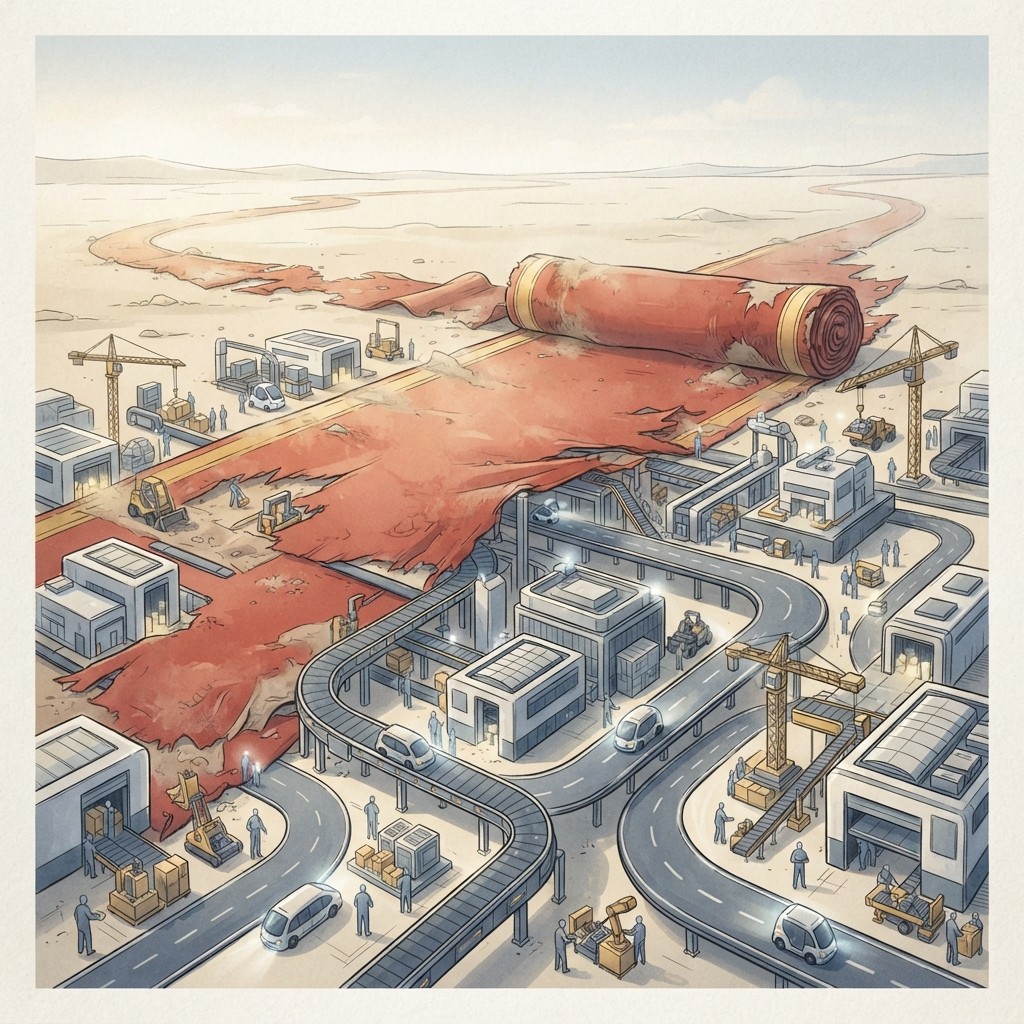
Pairs with the Distribution Channel Map — a ready-to-use strategy tool, filled for Macy's. Included in the The Distribution Rebellion Casebook →
On October 28, 1858, a former whaler named Rowland Hussey Macy opened a dry goods store at Sixth Avenue and 14th Street in Manhattan and took in $11.06 by the end of the day.1 He had already failed at retail several times across the preceding fifteen years.1 This time he did something the trade considered close to insane: he posted the exact price of every item, refused to haggle, took only cash, and bought newspaper space to print those prices for the whole city to see — backed by a money-back guarantee.2 He was not selling cheaper. He was selling the one thing the dry goods middleman had always controlled and never disclosed: the price.
The modern legend says Macy's bypassed the channel — that somewhere in the digital era it disintermediated its way around the old retail middlemen with omnichannel and e-commerce. Almost none of that is true. Macy's didn't bypass the channel. From day one, Macy's was the channel. The bypass is 166 years old.
The disintermediation happened in 1858, at the price tag
To understand why this matters, look at what the one-price tag actually killed. In the haggling model, the clerk was the channel — a human gatekeeper standing between manufacturer cost and customer price, extracting whatever margin the negotiation could bear. The price you paid depended on how you looked, how you bargained, what the clerk decided you'd tolerate. Macy's printed price did to that clerk what a published timetable did to the coach driver who used to quote you a fare on the spot. It removed the discretion, and with it the middleman's leverage.2 A posted price advertised in the newspaper is a direct line from the store to the customer's pocket, with no negotiation in between. That is disintermediation in its purest form, and it shipped in 1858 — not 2020.
| The popular story | What actually happened | |
|---|---|---|
| The bypass moment | A modern digital pivot | The 1858 one-price, cash-only founding |
| What got eliminated | Old-economy retail middlemen | The haggling clerk's pricing discretion |
| The direction of travel | Toward going direct | Recently, back toward the channel |
| The modern era's role | The breakthrough | A defensive retrenchment |
“First-day sales: $11.06.”1
The modern 'rebellion' is mostly a retreat
Read the modern history with the founding myth set aside, and the digital era looks less like a bold new disintermediation and more like a company spending decades trying to recover a footing. Macy's launched macys.com in 1998. The following year it paid $1.7 billion for Fingerhut — a direct-mail and credit catalog operation — and sold it roughly three years later for lack of strategic value.7 That is not the arc of a disruptor pulling ahead of the channel. It is the arc of a retailer that had already been through a debt-fueled buyout in 1986 and a 1992 bankruptcy before merging into Federated, which only took the Macy's name in 2007.8 By the time the internet arrived, the company bypassing the channel in 1858 was the one fighting to survive the channel of 2000.
Then came Polaris, introduced in February 2020 — not 2021, as it's often dated — as a push to accelerate digital and omnichannel sales.4 The pandemic obliged it immediately. With stores shut, digital sales rose 21% over the prior year and hit 44% of net sales in the fourth quarter of fiscal 2020, with a quarter of online orders fulfilled inside the stores themselves.4 That 44% number became the headline proof of the digital transformation. It was an artifact of locked doors, not a steady state. When the doors reopened, digital settled back toward roughly a third of revenue — real, important, but not the revolution the figure implied.
Closing 150 doors is not how you bypass a channel
The clearest tell came in 2024. Macy's announced 'A Bold New Chapter,' and the substance of the bold new chapter was subtraction: close or monetize roughly 150 underperforming stores, concentrate investment in about 350 go-forward locations, and rationalize the end-to-end supply chain.5 The fiscal 2024 closures, mostly Macy's-nameplate stores, pulled about $700 million of annual net sales out of the company's base.6 A company genuinely racing past the old channel toward direct customer relationships does not lead with shutting the doors and shedding three-quarters of a billion in sales. That is what retrenchment looks like — pruning the network back to the locations that still pay their way.
More telling still is where the merchandise now comes from. Macy's runs a Vendor Direct-to-Consumer program — internally, V2C — in which vendors ship straight to the shopper over EDI for goods Macy's doesn't stock in stores or online: odd sizes, unusual colors, secondary assortments.3 Strip the acronym and look at the shape of it. Macy's posts the listing, the customer pays Macy's, and the manufacturer fulfills the box. That is a marketplace — Macy's standing back in the middle of a transaction it doesn't physically touch, taking a cut for owning the storefront and the customer. The 1858 store eliminated the middleman. The 2023 storefront has quietly become one again.
A company's most radical move is often hiding in its origin story, not its press release. Macy's gets credit for a digital-era 'channel bypass' that it actually performed in 1858, at the price tag — and the modern moves marketed as bold disintermediation are, on the evidence, a defensive pruning of a network that overextended. Before you read a strategy as offense, ask one question: is the company adding direct reach, or shedding the channel it already built? Closing 150 stores and letting vendors drop-ship the long tail is the second thing wearing the language of the first. The founding tells you what the company has always been. The retrenchment tells you what it's afraid of becoming.
But isn't omnichannel a genuine reinvention?
The fair objection is that this is too tidy — that fulfilling a quarter of online orders from store shelves, integrating digital and physical inventory, and running a vendor marketplace really is a new operating model, not a retreat dressed up.4 That's true as far as it goes, and the mechanics are genuinely modern. But mechanics aren't the same as direction. The honest test of a 'distribution rebellion' is whether the company is winning more direct ownership of the customer relationship — and on Macy's own numbers, digital plateaued near a third of sales while the store count shrank and the marketplace reintroduced the very intermediary structure the brand was founded to remove.53 Omnichannel is a competent defense of a relationship Macy's already had. It is not a bypass of a channel it never controlled. The real rebellion happened once, in a Manhattan dry goods store, and everything since has been variations on holding the line.
Rowland Macy's revolution was never the building or the website. It was a number printed in a newspaper that no clerk was allowed to argue with — the moment a price stopped being a negotiation and became a promise.2 That was the bypass, and it's the one thing the modern story keeps getting backwards. Macy's didn't disrupt the channel a second time in the digital age. It spent the digital age slowly, quietly building one back.
When the origin story rewrites the strategy
Distribution Channel Map
A map of every hop between the company and the customer — each intermediary, who owns the relationship at each step, and where the company controls the channel versus where it's at the channel's mercy. Blank to chart your own route to market; filled as the worked example showing where the story's company went direct, fought its gatekeepers, or got disintermediated.
Included, filled and blank, in the The Distribution Rebellion Casebook. See the set → · Preview the blank →
Sources
Where this comes from — the filings, records, and reporting behind it.
- 1Macy's was founded October 28, 1858 by Rowland Hussey Macy as a dry goods store at Sixth Avenue and 14th Street in New York City, with first-day sales of $11.06, after several prior failed retail ventures between 1843 and 1855.
- 2Macy's introduced a strict one-price policy and cash-only transactions from its 1858 founding, departing from the prevailing haggling norm in dry goods trade, and supplemented these with newspaper advertisements listing exact prices alongside money-back guarantees.
- 3Macy's established a Vendor Direct-to-Consumer ('V2C') drop-ship program — using EDI technology — enabling vendors to ship directly to consumers for products not carried in brick-and-mortar or online stores, including odd sizes, unique colors, and secondary assortments.
- 4Macy's Polaris strategy was introduced in February 2020 (not 2021), focused on accelerating digital and omnichannel sales; by Q4 FY2020, digital sales rose 21% vs. 2019 and accounted for 44% of net sales, with 25% of online orders fulfilled in stores.
- 5Macy's launched 'A Bold New Chapter' strategy in 2024, targeting closure/monetization of approximately 150 underperforming stores, prioritized investment in approximately 350 go-forward stores, and simplification of end-to-end operations including supply chain rationalization.
- 6Fiscal 2024 store closures, primarily Macy's nameplate locations, contributed approximately $700 million of annual net sales that were removed from the company's base, per Macy's own 8-K filed December 2025.
- 7Macy's macys.com was launched in 1998 as a Silicon Valley subsidiary; the company acquired direct marketer Fingerhut in 1999 for $1.7 billion and sold it three years later due to lack of strategic value; a $230 million investment in macys.com followed in 2006–2007.
- 8After Macy's was purchased in a debt-ridden buyout in 1986, a combination of questionable purchases and an economic recession forced it into bankruptcy in 1992; in 1994 it agreed to a merger with Federated Department Stores, which changed its name to Macy's, Inc. in 2007.
More like this — beyond Macy's
New Strategically analyses as they publish: the defining moves in business, checked against the record. No noise, and one click to leave.