Pairs with the Disruption Vulnerability Assessment — a ready-to-use strategy tool, filled for Macy's. Included in the The Fall Casebook →
On its first day — October 28, 1858 — a dry-goods store on Sixth Avenue and 14th Street in Manhattan rang up $11.08 in sales.7 Its founder, Rowland Hussey Macy, had already failed at this four times across Massachusetts and California before this one finally took.7 A century and a half later the brand he built closed 64 stores in a single year4 and announced a plan to shut roughly 150 of them.1 The obituary writes itself: the internet came, the malls emptied, and another grand old department store met the inevitable. Almost none of that is the real story.
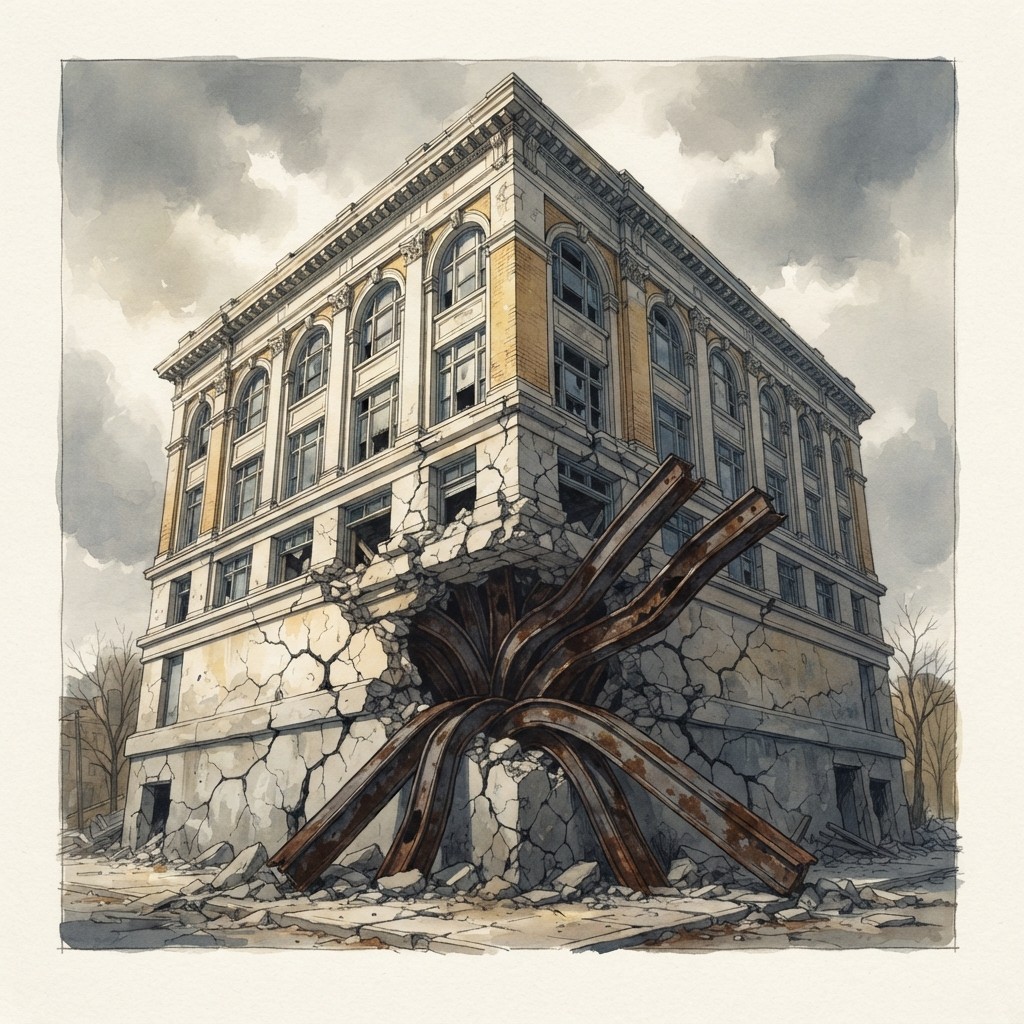
The official cause of death is the retail apocalypse — Amazon, the dying mall, the shopper who'd rather tap a phone than ride an escalator. The real cause of death is a loan. Macy's wound was self-inflicted decades before anyone bought a thing online, and the proof is sitting in a bankruptcy filing dated 1992.
The store went broke before the internet existed
On January 27, 1992, R. H. Macy & Co. filed for Chapter 11 protection, buried under $5.3 billion in liabilities and $3.7 billion in corporate debt.5 Mosaic Browser had not yet shipped. Jeff Bezos was a Wall Street quant. The thing that supposedly killed department stores would not arrive for years — and Macy's was already insolvent. The debt did not come from a bad season or a soft economy. It came from inside the building. In 1986, chairman Edward Finkelstein led a leveraged buyout that turned the company's own balance sheet into a weapon, borrowing against Macy's to buy Macy's, then borrowing more to acquire more.5 The recession of the early 1990s did not cause the collapse; it simply pulled the trigger on a gun the company had already loaded and pointed at itself.
“$5.3 billion in liabilities and $3.7 billion in corporate debt — the direct consequence of the 1986 leveraged buyout, compounded by subsequent acquisitions and an economic recession.”5
The brand outlived the company — and that's the tell
Here is the fact that quietly dismantles the whole 'continuous 166-year-old institution' framing: the company that runs Macy's today is not the one Rowland Macy built. In December 1994, Federated Department Stores absorbed the bankrupt R. H. Macy & Co.6 Then in 2005 Federated swallowed The May Department Stores Company for approximately $11 billion in combined cash and stock plus $6 billion in assumed debt, assembling a chain of more than 1,000 stores and roughly $30 billion in sales.9 Only in 2007 did Federated bother to rename itself 'Macy's, Inc.' — adopting the most valuable brand in its collection as its own corporate identity.10 The name is old. The company wearing it is an acquisition machine that put on a heritage costume. And that machine's defining move — buy the rival, convert its regional nameplate to Macy's, repeat — is exactly how you dilute a brand and over-store a country at the same time.
| The retail-apocalypse story | The record | |
|---|---|---|
| Cause of failure | Amazon and the dying mall | A 1986 leveraged buyout |
| When the trouble started | The 2010s | Bankruptcy filed January 1992 |
| What the company is | A 166-year-old institution | Federated in a heritage costume since 2007 |
| The 2024 store closures | Forced by an inevitable apocalypse | Belated triage of a fleet it over-built |
An over-stored fleet nobody pruned until it was too late
Acquisitions add stores fast; they almost never subtract them fast enough. Macy's-nameplate stores peaked at 737 locations in 2015 and have since fallen to roughly 450.3 The total company fleet — Macy's plus Bloomingdale's plus Bluemercury — sits around 685.3 That is not a chain trimming the edges; that is a chain that grew faster than demand and waited a decade to admit it. The mechanism is simple and brutal: every acquired store had to keep its lights on, its staff paid, and its rent current whether or not the surrounding market could support another full-line department store. When you buy your way to a thousand doors, you inherit a thousand fixed-cost obligations — and many of them sit in malls that were dying for reasons that had nothing to do with the internet. The over-store was the unpruned consequence of the buy-everything strategy. By the time anyone rationalized the fleet, the underproductive locations had already become a $950 million impairment charge waiting to be written off.1
Why 'A Bold New Chapter' concedes the thesis it claims to refute
On February 27, 2024, Macy's announced 'A Bold New Chapter': close approximately 150 underproductive locations through 2026, pour investment into roughly 350 go-forward stores, expand the healthier Bloomingdale's and Bluemercury banners by up to 45 locations, and monetize $600–$750 million of real estate.1 It is framed as a turnaround. Read it as a confession. You only need to close 150 stores and grow your two non-Macy's brands if the core Macy's fleet was over-built and under-loved for years. The same release booked roughly $950 million in non-cash impairment charges — the accounting language for value the company once paid for and is now admitting it will never recover.1 The plan does not refute the decline. It schedules it.
And the numbers underneath confirm the asymmetry. In fiscal 2024, total net sales fell 3.5% to $22.29 billion — but the split is the story.2 The Macy's brand itself shrank 4.2%, while Bloomingdale's grew 1% and Bluemercury 2.8%.2 The healthy parts of the portfolio are the ones that were never run through the acquisition-and-conversion machine. The part that was is the part that's bleeding.
The honest objection: wasn't the apocalypse real?
The fair counter is that the retail environment genuinely was brutal — and it was. U.S. retailers announced more than 7,100 store closures through November 2024, a 69% jump year-over-year, and 45 retailers filed for bankruptcy in 2024 against just 25 the year before.8 A wave that large is not a Macy's-specific problem; it is a structural shift in how Americans shop, and pretending Macy's faced no external pressure would be its own kind of dishonesty. But the apocalypse is a multiplier, not a first cause. Healthy retailers with low debt and a rationalized footprint weathered the same decade; Macy's met it carrying three decades of leveraged-buyout scar tissue and a fleet it had never pruned. The internet didn't loan Macy's $3.7 billion in 1986. The internet didn't force Federated to convert hundreds of beloved regional nameplates into a single homogenized banner. The apocalypse found Macy's already wounded — and a wounded company falls to a blow a healthy one would have absorbed.
The buy-the-rival-and-convert-it playbook has a hidden tax that doesn't show up until a downturn: every door you acquire becomes a fixed-cost obligation, and the political and emotional cost of closing an acquired store is always higher than the cost of opening one. So the fleet ratchets up in good times and refuses to ratchet down until the losses are undeniable — by which point the 'turnaround' is just triage, and the impairment charge is the bill for a decade of postponed decisions. If you grow by acquisition, the discipline that matters most is not what you buy. It's how ruthlessly and how early you're willing to close what no longer works.
Rowland Macy failed four times before the fifth store took, which means the brand's origin story is one of pruning hard and starting clean.7 The company that now bears his name spent thirty years doing the opposite — borrowing against itself, buying everything in sight, converting and bloating until the only honest move left was to dismantle. New Coke proved a company could be wrong while its data was right. Macy's proves something colder: a company can be killed not by the apocalypse it blames, but by the loans it took out against its own future. The retail apocalypse didn't write this obituary. It just delivered it.
When the cause of death isn't the one on the certificate
Disruption Vulnerability Assessment
An assessment that rates a company across the dimensions that predict disruption: how cheaply a challenger can serve the unsexy bottom of the market, how trapped you are by margins and a satisfied core. Blank to score your own position before the cliff; filled as the worked example showing where the story's incumbent was already exposed while the numbers still looked great.
Included, filled and blank, in the The Fall Casebook. See the set → · Preview the blank →
Sources
Where this comes from — the filings, records, and reporting behind it.
- 1On February 27, 2024, Macy's, Inc. announced 'A Bold New Chapter': closing approximately 150 underproductive locations through 2026, investing in ~350 go-forward locations, expanding Bloomingdale's and Bluemercury by up to 45 locations, and monetizing $600–$750 million of assets through 2026. The company simultaneously recorded ~$950 million in non-cash asset impairment charges and ~$50 million in employee termination charges.
- 2Macy's, Inc. reported net sales of $22.29 billion for fiscal year 2024 (52 weeks ended February 1, 2025), a 3.5% decline from $23.09 billion in FY2023. The Macy's brand saw a 4.2% reduction in net sales; Bloomingdale's rose 1%; Bluemercury rose 2.8%. Comparable sales fell 2.0% on an owned basis and 0.9% on an owned-plus-licensed-plus-marketplace basis for the full year.
- 3Macy's name-brand stores numbered approximately 450 locations as of late 2024, down from 737 in 2015. The total company fleet (including Bloomingdale's and Bluemercury) stood at 685 locations.
- 4Macy's, Inc. confirmed on January 9, 2025 the closure of 66 specific non-go-forward Macy's store locations as part of the Bold New Chapter strategy; by the end of FY2024 (February 1, 2025), 64 locations had been shut. The plan targets 150 total closures over three years through fiscal 2026.
- 5R. H. Macy & Co. filed for Chapter 11 bankruptcy protection on January 27, 1992, under the weight of $5.3 billion in liabilities and $3.7 billion in corporate debt — the direct consequence of the 1986 leveraged buyout led by chairman Edward Finkelstein, compounded by subsequent acquisitions and an economic recession.
- 6R. H. Macy & Co. merged with Federated Department Stores in December 1994; Federated then renamed itself Macy's, Inc. in 2007 after acquiring The May Department Stores Company in 2005 for $11 billion in stock (plus $6 billion in assumed debt), creating a chain with over 1,000 stores and ~$30 billion in annual sales.
- 7Rowland Hussey Macy founded R. H. Macy Dry Goods on Sixth Avenue at 14th Street, Manhattan, on October 28, 1858, after four prior dry-goods store failures between 1843 and 1855 in Massachusetts and California. First-day sales totaled $11.08. The store moved to Herald Square (34th Street and Broadway) in 1902 under Straus family ownership.
- 8U.S. retailers announced more than 7,100 store closures through the end of November 2024, a 69% jump year-over-year; 45 retailers filed for bankruptcy in 2024 vs. 25 in all of 2023, per CoreSight Research data.
- 9Federated acquired The May Department Stores Company in 2005 for approximately $11 billion in combined cash and stock (plus $6 billion in assumed debt), creating a chain with over 1,000 stores and ~$30 billion in annual sales
- 10On May 18, 2007, the shareholders of Federated Department Stores, Inc. approved a change in its corporate name to Macy's, Inc., effective June 1, 2007
- 11U.S. retailers announced more than 7,100 store closures through the end of November 2024, a 69% jump year-over-year; 45 retailers filed for bankruptcy in 2024 vs. 25 in all of 2023, per Coresight Research data
More like this — beyond Macy's
New Strategically analyses as they publish: the defining moves in business, checked against the record. No noise, and one click to leave.