Pairs with the Bet-Sizing Worksheet — a ready-to-use strategy tool, filled for Boeing. Included in the Bet-the-Company Move Casebook →
“How much does this bet commit before anybody outside the company acts on it?”
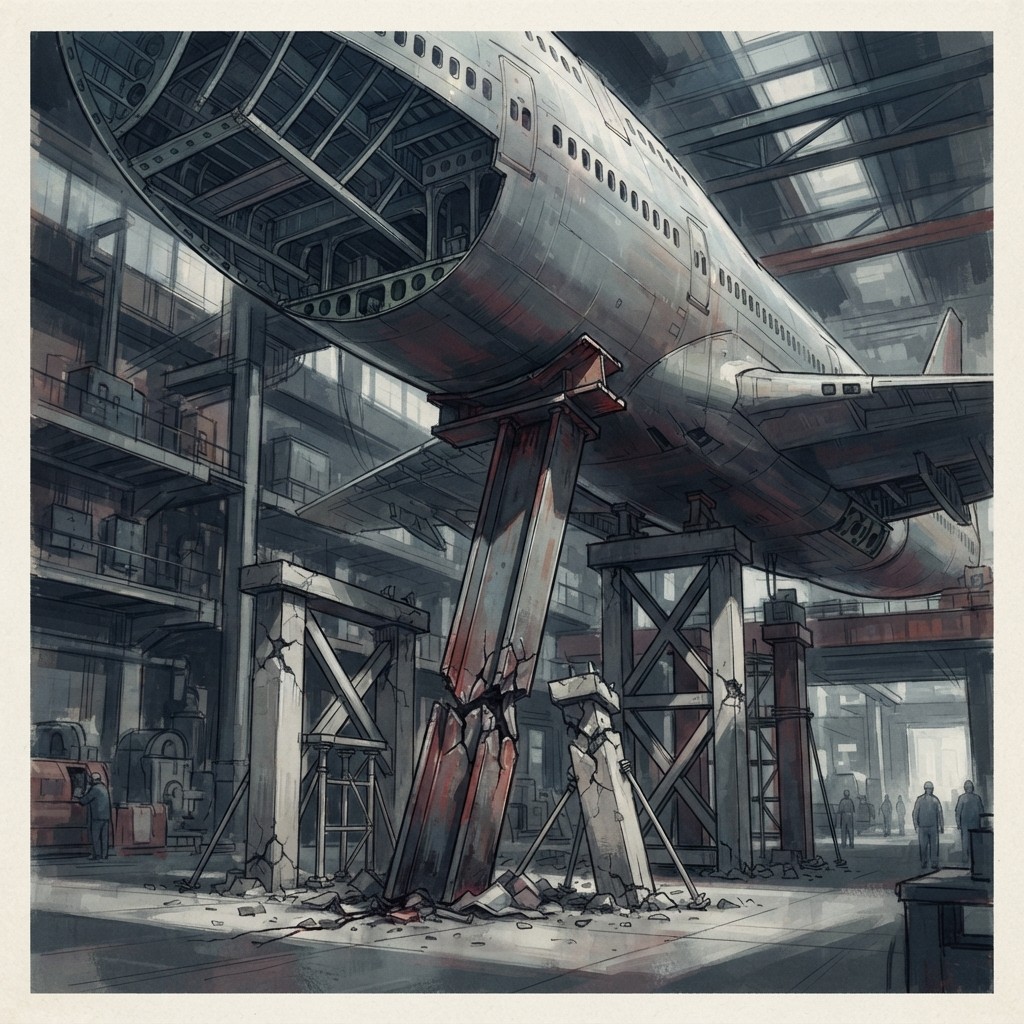
In 1965 Boeing was worth about $375 million. It then agreed to build an aircraft that would cost somewhere between $1.2 and $2 billion to develop—more than three times the entire value of the company spending it.3 There was no spare cash to do this with. There was only debt, which climbed past $2 billion, with $1.2 billion of it owed to banks: a borrowing record for any company on earth at the time.4 To build the 747, Boeing did not stake the company. It staked several companies' worth of money it did not have.
The story everyone tells is clean: Boeing bet the firm on the jumbo jet, the bet nearly failed, and the 747 almost bankrupted the most important planemaker in America. That story is true—and it is missing two of its three legs. The crisis that nearly took Boeing down had three co-equal causes, and the airplane was only one of them.
A plane two-and-a-half times too big to fund
Boeing had done this before, on a smaller scale. The 707 cost $186 million in 1952—already $36 million more than the company's entire net worth.3 Betting past your own balance sheet was, in other words, simply how Boeing built airliners. But the 747 was a different order of risk, because the aircraft itself was a different order of size: two-and-a-half times the 707, not twice. That multiple is the whole story. A plane that much bigger needed a new wing, new engines, and a factory in Everett large enough to assemble it—an entire industrial base spun up before a single jumbo was sold for cash.
The anchor customer was Pan Am. After a Letter of Intent in December 1965, Juan Trippe's airline placed the formal order on April 13, 1966: 25 aircraft for $525 million, then the biggest commercial jet order ever made.2 Production was approved that July, once Japan Airlines and Lufthansa had ordered too.1 That order is what made the bet thinkable. It is also what made it a trap, because a launch contract pays in installments tied to delivery—and delivery was exactly the thing about to go wrong.
The engines that wouldn't fly
Here is where a financed bet becomes an emergency. The 747's Pratt & Whitney JT9D engines failed repeatedly in flight testing—fan blades broke, casings distorted, compressors stalled. The problems were bad enough that up to 20 finished aircraft sat at Everett with no working engines to bolt on, delaying deliveries by months.7 Read that against the financing and it turns lethal: Boeing's debt was structured to be repaid by delivering airplanes, and the airplanes physically could not be delivered. Money was flowing out to build them and not flowing back in. In the final months before first delivery, Boeing had to keep going back to its banks for more, and a refusal would have threatened the firm's survival.4
Even the triumphant first flight carried the curse. Pan Am's inaugural 747 commercial service—New York to London, January 22, 1970—was delayed when the scheduled aircraft suffered an engine failure, and a substitute jet had to complete the flight.8 The plane that was supposed to inaugurate an era could not, on the night, get off the ground on its own engines.
“It was really too large a project for us.”4
Why the 747 gets all the blame, and shouldn't
Now the correction. If the 747 had been Boeing's only problem, it would have been a survivable problem—painful, embarrassing, but a single program working through a single bad patch. What actually happened, the 'Boeing Bust' of 1969 to 1971, was not one failure. It was three failures arriving at once. The 747 over-runs were the first. The second was a saturated airliner market so dead that Boeing went 17 months without a single U.S. airline sale, and received no new orders from any U.S. airline in 1970. The third was the federal cancellation of the supersonic transport program—the SST—whose funding was cut in 1971, erasing Boeing's other big future bet in a single stroke.5
| Cause | What it did | The popular story |
|---|---|---|
| 747 cost over-runs | Debt past $2B, deliveries stalled by engine failures | Gets nearly all the blame |
| A dead airliner market | 17 months with no U.S. airline sale; no 1970 U.S. orders | Mostly forgotten |
| SST cancellation (1971) | Erased Boeing's other future bet by federal funding cut | Rarely mentioned |
Put the three together and the scale of the human wreckage makes sense. Boeing's workforce fell from about 80,400 in early 1970 to roughly 37,200 by October 1971.5 Around 60,000 jobs vanished in under two years, and Seattle's unemployment hit 16 percent in June 1971—higher than any American city had seen since the Great Depression. The Economist called it 'the city of despair.'6 No single airplane program does that to a city. Three simultaneous shocks do.
We love a clean cause because it implies a clean lesson: don't make reckless bets. But the most dangerous failures are rarely one decision gone wrong—they are several reasonable decisions failing at the same time, in ways that compound. Boeing's 747 financing was survivable on its own. So was a soft sales year. So was losing the SST. What nearly killed the company was all three landing in the same eighteen months, each one removing the cushion that would have absorbed the others. When you stress-test a big bet, don't ask 'what if this fails?' Ask 'what else fails in the same year, and does this bet still survive it?'
But wasn't the 747 still a reckless bet?
The fair objection is that the 747 deserves more blame than this lets on. It was, after all, the program that took the firm past its own net worth several times over and forced the begging visits to the banks. Allen himself said it was too large a project for them.4 If you must rank the three causes, the 747 is the one Boeing chose, and the one it could have sized smaller. That is true, and it is why the legend persists: the 747 is the cause with an author, a villain you can name, while a saturated market and a Senate funding vote feel like weather. But notice what the recklessness actually bought. The plane survived the bust, paid the debt down across the following decade, and ran as the backbone of long-haul aviation for half a century. The bet that nearly broke Boeing is also the only one of the three causes that turned into a generational asset. The market recovered on its own. The SST stayed dead. The 747 flew for fifty years.
And the cruelest irony sits with the customer who made it all possible. Pan Am's enormous 747 order has itself been blamed for the airline's financial losses beginning in 1969, part of the slow slide toward its bankruptcy in January 1991.8 The same airplane that nearly broke its builder helped break its buyer. Boeing staked more than it was worth on a plane too big to fund, then watched engines fail, sales vanish, and its other future cancelled all at once—and it came out the far side carrying the most successful airliner in history. The lesson of the 747 was never 'don't make the big bet.' It was that a great bet and a near-fatal year are not opposites. They can be the same airplane, in the same hangar, in the same eighteen months—and the difference between legend and ruin is whether the banks pick up the phone one more time.
More companies that staked everything on a single move
Bet-Sizing Worksheet
Most bets fail on size, not on direction — right call, ruinous stake. This worksheet forces the three numbers that matter: how much of the bankroll is on the table, how strong the conviction really is, and whether the worst case is survivable. Blank, it stops you betting the company on a hunch; filled, it reverse-engineers the story's wager so you can judge whether it was bold or reckless.
Included, filled and blank, in the Bet-the-Company Move Casebook. See the set → · Preview the blank →
Sources
Where this comes from — the filings, records, and reporting behind it.
- 1Pan Am formally ordered 25 Boeing 747-100 aircraft in April 1966 for $525 million (equivalent to ~$3.9 billion in 2024 dollars); production approval followed in July 1966 after JAL and Lufthansa also ordered.
- 2Pan Am's formal order of 25 747s was placed on April 13, 1966, preceded by a Letter of Intent signed December 22, 1965; the $525 million order was confirmed by Juan Trippe at a press conference as the biggest commercial jet order and biggest jet engines to date.
- 3Boeing's 747 development cost was $1.2–$2 billion in late-1960s dollars; when development began in 1965 Boeing was valued at only ~$375 million—less than a third of what it ultimately spent on the program. The $186 million Boeing spent on the 707 in 1952 already exceeded the company's entire net worth by $36 million.
- 4Boeing's total debt exceeded $2 billion during the 747 program, with $1.2 billion owed to banks—a record for any company at the time. Boeing president William Allen later acknowledged, 'It was really too large a project for us.' During the final months before first delivery, Boeing repeatedly had to request additional bank funding; refusal would have threatened the firm's survival.
- 5The 'Boeing Bust' of 1969–1971 had multiple co-equal causes: 747 cost overruns, a saturated airliner market (Boeing went 17 months without a single U.S. airline sale and in 1970 received no new orders from any U.S. airline), and the 1971 cancellation of the SST program. Boeing's workforce fell from ~80,400 to ~37,200 between early 1970 and October 1971.HistoryLink.org, Boeing Bust (1969–1971) ↗ · 2019-12-16
- 6Boeing eliminated 60,000 jobs in less than two years (1969–1971), driving Seattle's unemployment to 16 percent in June 1971—higher than any U.S. urban area since the Great Depression. The Economist called Seattle 'the city of despair' in 1971.
- 7The Pratt & Whitney JT9D engines were plagued by fan blade failures, engine casing distortions, and compressor stalls during flight testing; problems were so severe that up to 20 aircraft at Everett were stranded awaiting engine installation, delaying deliveries by several months.
- 8Pan Am's inaugural 747 commercial service (January 22, 1970, New York JFK to London Heathrow) was delayed by engine failure on the scheduled aircraft; a substitute 747 (Clipper Victor) completed the flight. Pan Am's large 747 order has been attributed as a cause of its financial losses beginning in 1969, contributing to its eventual bankruptcy filing in January 1991.Wikipedia / Pan Am, Pan Am ↗ · 2024
Weighing outside help with a decision like this? Hiring a commercial due diligence provider
More like this — beyond Boeing
New Strategically analyses as they publish: the defining moves in business, checked against the record. No noise, and one click to leave.