Pairs with the Bet-Sizing Worksheet — a ready-to-use strategy tool. Included in the Bet-the-Company Move Casebook →
“How much does this bet commit before anybody outside the company acts on it?”
In July 2020, on a routine earnings call, Intel buried the most expensive sentence in its modern history inside the engineering euphemism of a 'defect mode.' Its 7nm process — the technology that was supposed to keep it ahead of the world — was running roughly twelve months behind the company's own internal target.4 Eight months later, a new CEO walked on stage and called the fix a bold new strategy. The fix was overdue, and it would soon reproduce the exact failure it was meant to cure.
The official story is that IDM 2.0 was Intel reinventing itself — a proactive pivot into foundry services and a manufacturing comeback. The real story is that Intel had already been quietly shipping work to other people's fabs and had already confessed, on the record, that its flagship process was broken before a turnaround plan ever existed. IDM 2.0 wasn't a leap forward. It was a company catching up to a hole it had spent six years digging.
The plan was right. The root cause was never touched.
On March 23, 2021, Pat Gelsinger announced IDM 2.0: an estimated $20 billion to build two new Arizona fabs and a new business, Intel Foundry Services, to make chips for outside customers.1 As a diagnosis it was sound — Intel had to keep its own fabs, lean on external foundries when needed, and turn manufacturing into a product. But notice what the strategy treated as solved. It assumed the manufacturing engine could be pointed in a new direction. It never addressed why the engine kept stalling in the first place.
Go back to 10nm. Intel didn't get unlucky; it got greedy. It set transistor-density goals so aggressive it gave them an internal name — 'Hyper Scaling' — and then discovered that packing that many features onto a wafer drove defect density up and yields down. Intel later acknowledged that this very ambition caused lower-than-expected yields and costs above its mature 14nm process.2 A node planned for volume in 2015 slipped to 2016, then 2017, then 2018, and didn't reach mass volume until 2019 — four years late.3 That is not a delay. That is a chosen design philosophy crashing into physics, repeatedly, on schedule.
| 10nm (from 2015) | 7nm (2020) | 18A (2024) | |
|---|---|---|---|
| What broke | Multi-patterning defect density | A 7nm 'defect mode' | Reported sub-10% yields |
| How far behind | ~4 years to volume | ~12 months behind internal target | Mass production not viable at that yield |
| Root diagnosis | 'Hyper Scaling' overreach | Yield degradation | 'Tried to do too much at once' |
| The pattern | Density ambition over yield | Same | Same |
“Intel's 18A troubles stemmed from trying to do too much at once.”8
How a rescue plan inherited the disease it was meant to cure
Here is the mechanism, worked all the way down. A leading-edge process node is a bet placed years in advance: you commit to a density target, then spend years discovering whether you can actually manufacture it at yield. Intel's institutional reflex was to bet the most aggressive density on the table — because for decades, density leadership was its entire identity. That reflex worked when Intel was the only one running the race. It became a trap the moment the density target outran the company's ability to control defects, because every additional patterning step is another chance for something to go wrong, and the chances compound across hundreds of millions of transistors.
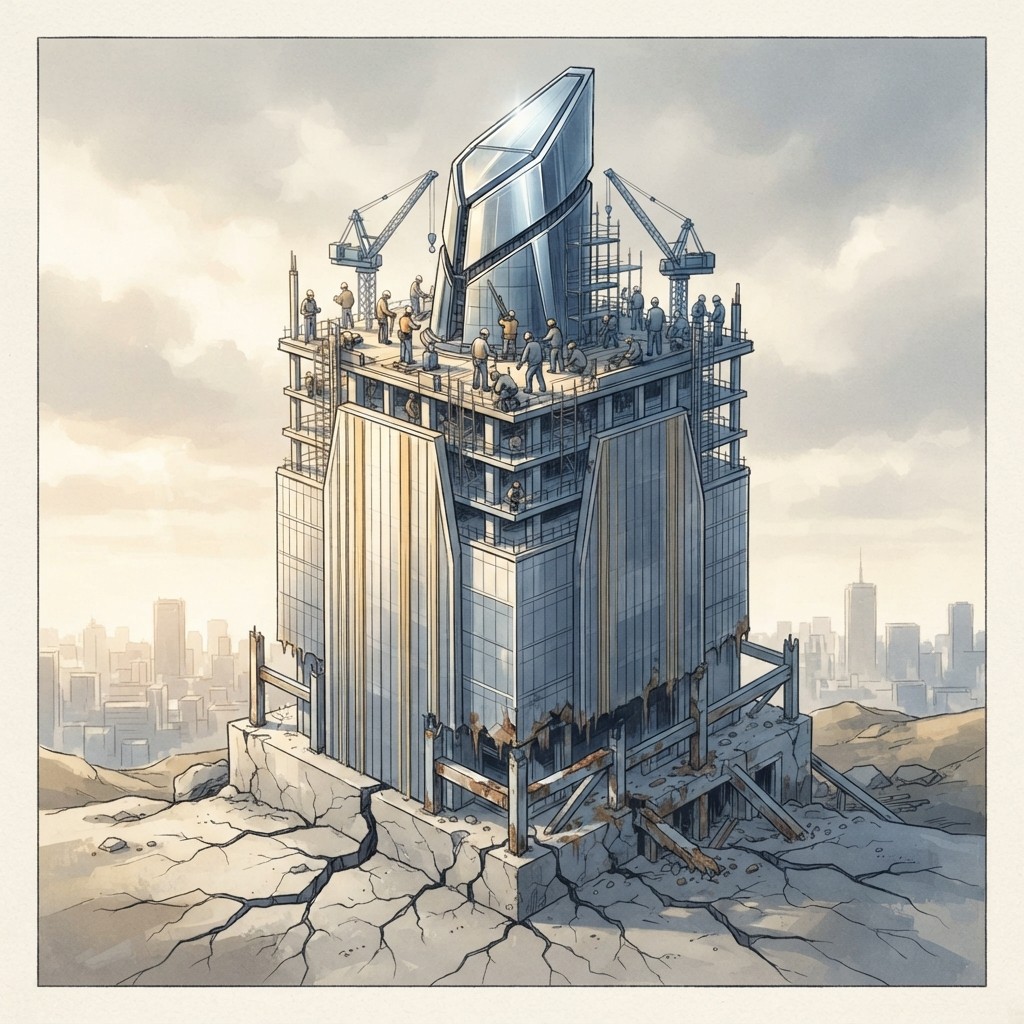
IDM 2.0 changed the org chart, the customers, and the capital plan. It did not change that reflex. So when 18A arrived — the node carrying RibbonFET transistors, PowerVia backside power, and the entire weight of the turnaround — it was reportedly stuck below 10% yields in late 2024, a level at which mass production simply isn't possible, with a named foundry trial customer said to have walked away.5 Intel's own CFO later described the failure in language that could have been lifted verbatim from the 10nm post-mortem: the company tried to do too much at once.9 Same overreach. Higher stakes. The cornerstone of the comeback cracked the same way the original problem did.
The fair objection: maybe the plan just needed more time
The honest counter is that turnarounds of this size take a decade, not a few years, and that judging IDM 2.0 by early 18A yields is like grading a marathon at mile six. Yields climb. RibbonFET and PowerVia are genuinely advanced bets that, if they mature, leapfrog rather than catch up. And the harshest 18A numbers trace to a single Korean media report, not a primary filing — so the sub-10% figure deserves a skeptic's asterisk.5 All of that is true, and it is why this is a real argument and not a verdict.
But the objection misses where the spine of the criticism actually sits. The problem was never that 18A was immature in 2024 — early nodes always are. The problem is that Intel's CFO named the cause as the identical overreach that had buried 10nm and 7nm.9 A company can survive a slow turnaround. What it cannot survive is repeating its founding mistake at the exact moment it has bet everything on not repeating it. The board appears to have reached the same conclusion: in December 2024 Intel said Gelsinger 'retired,' while multiple outlets citing people familiar with the matter reported he was given the choice to retire or be removed after the board lost confidence in his plan.67 The strategy didn't run out of time. It ran out of patience for the same bug, shipped a third time.
When a company falls behind, the visible damage — late nodes, lost customers, a slipping roadmap — is the symptom. The reflex that produced it is the disease. Intel reorganized everything around the symptom: new fabs, a new foundry business, a new CEO, a new $20 billion line item. It left untouched the institutional habit of choosing the most aggressive target over the achievable one, the very reflex that had broken 10nm and 7nm. So 18A broke the same way. The test of a turnaround isn't how much capital it deploys or how bold the announcement sounds. It's whether it names and removes the specific behavior that caused the fall. If the post-mortem on the rescue reads like the post-mortem on the crash, you didn't fix anything. You financed a rerun.
Intel spent six years, a new strategy, and a fortune in credibility learning a lesson it already had in writing. The 'Hyper Scaling' overreach that broke 10nm in 2015 was diagnosed, named, and confessed — and then it broke 7nm, and then it broke the node that was supposed to redeem all of it. IDM 2.0 was the right map drawn over the wrong terrain: it pointed the company toward a comeback while leaving the engine that kept stalling exactly as it was. The catch-up was never going to fail for lack of ambition. It failed because ambition was the bug, and nobody patched it.
Bet-Sizing Worksheet
Most bets fail on size, not on direction — right call, ruinous stake. This worksheet forces the three numbers that matter: how much of the bankroll is on the table, how strong the conviction really is, and whether the worst case is survivable. Blank, it stops you betting the company on a hunch; filled, it reverse-engineers the story's wager so you can judge whether it was bold or reckless.
Included, filled and blank, in the Bet-the-Company Move Casebook. See the set → · Preview the blank →
Sources
Where this comes from — the filings, records, and reporting behind it.
- 1On March 23, 2021, Intel CEO Pat Gelsinger announced IDM 2.0, including an estimated $20 billion investment to build two new fabs in Arizona and the launch of Intel Foundry Services.
- 2Intel first confirmed issues with its 10nm technology in July 2015, blaming multi-patterning for high defect density and low yields; Intel called its aggressive transistor-density targets 'Hyper Scaling' and later acknowledged this caused lower-than-expected yields and higher-than-14nm costs.
- 3Intel's 10nm was originally planned for volume production by end of 2015; it was pushed to 2016, then 2017, then H2 2018, then 2019, with mass 10nm volume not achieved until 2019.
- 4On Intel's Q2 2020 earnings call (July 23, 2020), CEO Bob Swan disclosed a 'defect mode' in the 7nm process causing yield degradation; 7nm yields were 'trending approximately twelve months behind the company's internal target,' and product timing was shifting approximately six months, with first 7nm client CPU shipments pushed to late 2022 or early 2023.
- 5Intel's 18A node, featuring Gate-All-Around (RibbonFET) transistors and PowerVia backside power delivery, faced reported yield rates below 10% as of late 2024, per South Korean outlet Chosun, making mass production impossible at that yield level; Broadcom reportedly found the process unready for high-volume production and canceled orders.
- 6Intel officially announced the retirement of CEO Pat Gelsinger effective December 1, 2024, with David Zinsner and Michelle Johnston Holthaus named interim co-CEOs and Frank Yeary as interim executive chair.
- 7Gelsinger was forced out, not voluntarily retiring: multiple sources cited by Bloomberg and Reuters (via Al Jazeera) report the board lost confidence in his turnaround plan and gave him the option to retire or be removed, and he chose to step down.
- 8Intel CFO David Zinsner stated at the Bank of America 2026 Global Technology Conference that Intel's 18A troubles stemmed from trying 'to do too much at once,' and acknowledged 18A as a node Intel had to settle before scaling — mirroring the same overreach diagnosis applied to 10nm.
- 9Intel CFO David Zinsner stated at the Bank of America 2026 Global Technology Conference that the challenge around 18A was two things: 'we tried to do too much at once' and that Intel was 'trying to play performance and yield and trying to improve both at the same time.'
Weighing outside help with a decision like this? Hiring a commercial due diligence provider
More like this — beyond Intel
New Strategically analyses as they publish: the defining moves in business, checked against the record. No noise, and one click to leave.