Pairs with the Crisis Response Playbook — a ready-to-use strategy tool. Included in the Crisis Response Casebook →
“What is one more quarter of not acting worth?”
In October 2024, Abercrombie & Fitch was having the best year of its modern life — sales marching toward a record, a turnaround held up in business schools as a textbook revival. Then a federal indictment was unsealed in Brooklyn, and overnight every headline about the company carried the same three words it had spent a decade burying: former CEO Mike Jeffries.7 The man had not run the company for nearly ten years. He didn't need to. His name was still load-bearing.
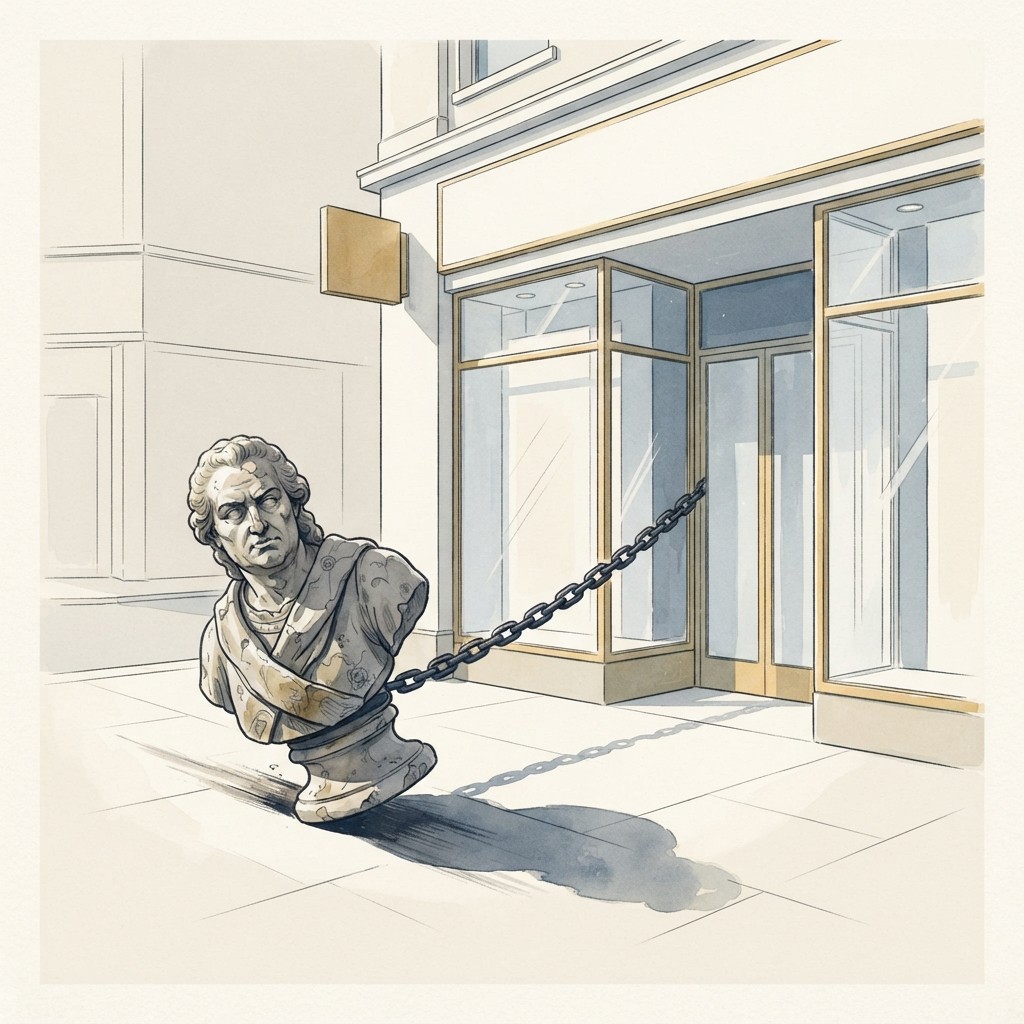
The official story is that Abercrombie lived down the Jeffries era. It hired a new CEO, scrubbed the shirtless-greeter aesthetic, broadened its sizes and its casting, and posted numbers Jeffries never touched. All true. But 'lived down' is the wrong tense, because the past it was distancing itself from was never inside the building's control. It was attached to a person — and a person can be indicted long after he's gone.
Here is the thesis a smart friend could repeat at dinner: Abercrombie's rehabilitation is real and it's in the financial statements — but it was built on distancing from a man rather than dismantling the culture that produced him, and a turnaround anchored to a person stays permanently exposed to whatever that person does next.
The decline came first, and it wasn't the tweet
The popular timeline is tidy and mostly false. People remember a 2013 firestorm over Jeffries declaring the brand was 'for the cool kids' — and assume he was hounded out for it. But those quotes were given to Salon in 2006 and went almost unnoticed; they only detonated in May 2013 when a separate piece dredged them back up.2 Jeffries did not leave in the heat of that backlash. He retired effective December 9, 2014, roughly eighteen months later, and the company's own SEC filing frames it as a senior-leadership change with a CEO search opening immediately — not a resignation under a quote.1
What actually pushed him out was duller and more durable than a viral quote: the money stopped working. Net sales slid from $3.744 billion in fiscal 2014 to $3.327 billion in fiscal 2016, a grinding multi-year decline.4 The exclusionary brand had aged out of its own moment. That matters for the strategy, because the company didn't fire a culture — it parted ways with an underperforming executive and then kept selling clothes for two years under an 'Office of the Chairman' while it figured out who would run the place. The culture question came later, and arguably never got asked the way the founding myth says it did.
| The popular narrative | The documented record | |
|---|---|---|
| Why the quote blew up | Jeffries said it in 2013 | Said to Salon in 2006; re-surfaced May 2013 |
| Why he left | Forced out by the backlash | Retired Dec 2014 amid multi-year sales decline |
| The handoff | Clean swap to a reformer | Two-plus years of interim leadership first |
| What was fixed | The culture | First the executive and the product; culture later |
What a real turnaround looks like in the statements
The recovery, once it took hold, was not a publicity stunt. Fran Horowitz had been inside the company since 2014 — running Hollister, then serving as president and chief merchant — before formally taking the CEO seat on February 1, 2017.5 That detail is the opposite of a clean break: the reformer was a multi-year succession, not a parachute drop. And the results compounded. In June 2022 the company published an 'Always Forward Plan' targeting $4.1–$4.3 billion in revenue and an 8%-plus operating margin by the end of fiscal 2025 — and beat those targets early.6 Sales reached $4.28 billion in fiscal 2023, $4.95 billion in fiscal 2024, and a record $5.27 billion for the year ending January 31, 2026.5 That is not spin. That is a near-$2 billion climb from the fiscal 2016 trough to the fiscal year ending January 2026 — the full arc of what the turnaround produced.
So the business healed. The product changed, the casting changed, the merch sold. By every operating metric, Abercrombie did the hard part of a crisis response: it stopped being the thing it was famous for being. The trouble is what it was famous for was never only a marketing posture. And here the company's own document is worth reading closely — because it complicates the most-repeated charge against it.
“18 to 22 year-old male and female college students… East Coast heritage and Ivy League traditions.”3
Notice what isn't there. The Netflix documentary White Hot: The Rise & Fall of Abercrombie & Fitch (2022) re-popularized the claim that Abercrombie's exclusion was deliberately racial, and the brand certainly behaved in ways that earned the accusation.10 But the primary corporate filing that defined the strategy contains no racial language at all — it speaks of college students and Ivy League heritage.3 The racial framing is a real and serious secondary-source interpretation; it is not the language the company put on paper. That gap is exactly where a distancing strategy gets dangerous: you can disavow the words in your filings while the meaning lives in the public's memory of the brand. Cleaning up the document doesn't clean up the association.
The indictment that proved the strategy was incomplete
On October 22, 2024, a 16-count federal indictment was unsealed in the Eastern District of New York, charging Jeffries, his partner, and a recruiter with one count of sex trafficking and fifteen counts of interstate prostitution, over a scheme prosecutors allege ran from December 2008 to March 2015.7 Read that span carefully: it stretches past his December 2014 departure. This was not framed as something a stranger did — it was framed as conduct by the man who built the brand, with the company's name in the headline by gravitational necessity.
And here the structural flaw in the turnaround surfaced in one sentence. Abercrombie's response was to say it was 'appalled and disgusted by the alleged behavior of Mr. Jeffries, whose employment… ended nearly ten years ago,' and that it had 'successfully transformed our brands and culture into the values-driven organization we are today.'8 That is a well-crafted statement. It is also a tell. A company that had truly dismantled the culture wouldn't need to keep reminding the public how far away the man is — distance is the only defense it has, because the rehabilitation was built on separation, not on a documented reckoning with how conduct of that nature could be alleged to have run for years on the watch of the man who built the brand. When the only shield is 'he left a long time ago,' every new revelation re-tests the shield.
Isn't this unfair to a company that genuinely changed?
The honest objection is strong, and worth stating at full strength: no current leader committed the alleged crimes, the conduct partly post-dates Jeffries's employment, he has pleaded not guilty and no conviction has been entered, and the business demonstrably reformed its product and its casting while posting record numbers.75 By that read, the company is a victim of one man's alleged conduct, not a participant in it, and holding the brand permanently liable for him is guilt by association. Fair. The point here is not that Abercrombie is morally on the hook for what a court has yet to decide. The point is strategic: a turnaround that succeeds at the business and outsources its reputational defense to the phrase 'he's been gone for years' has chosen a defense it cannot control. The trigger lives outside the company — in a courtroom, on a release date — and it can fire at any time. That is fragility, not vindication, regardless of who is morally right.
When a crisis is attached to a person, the instinct is to put space between the company and the name. It works on the income statement and fails on the timeline — because the person keeps living a life you don't control, and every chapter of it re-summons your brand. The durable version costs more: you don't just remove the executive, you publicly dismantle and name the system that let the conduct go unchecked, so that the next revelation lands on a culture you've already disowned rather than on a separation you have to keep re-asserting. Removing the man buys you the present. Reckoning with the culture is the only thing that buys you the future, because the man can always come back into the headlines — and on his schedule, not yours.
Abercrombie did the visible work and earned the record sales. But it solved a marketing problem and left a memory problem standing. The brand became a different company; it did not become a company the past couldn't reach. As long as the central defense is the number of years since a man walked out the door, that number is also the length of the fuse — and someone else gets to decide when it's lit. Abercrombie didn't live down the Jeffries era. It out-sold it. The bill for the difference comes due on October 26, 2026, when jury selection is scheduled to begin in a trial it has no control over, with its own name attached to a man it spent a decade insisting it had nothing to do with.9
When the past won't stay in the past
Crisis Response Playbook
A playbook for a crisis already in motion: who decides, which plays fire on which trigger, and what gets said to whom. It replaces panic and the all-hands meeting with a pre-agreed sequence each person can run alone. Blank to pre-load before a crisis hits; filled as the worked example reconstructing the plays the story's team ran — and the ones they should have.
Included, filled and blank, in the Crisis Response Casebook. See the set → · Preview the blank →
Sources
Where this comes from — the filings, records, and reporting behind it.
- 1Michael Jeffries retired as CEO and director of Abercrombie & Fitch effective December 9, 2014, with Arthur Martinez becoming Executive Chairman and a search for a new CEO commencing immediately.
- 2Jeffries's exclusionary 'cool kids' quotes — 'Candidly, we go after the cool kids… Are we exclusionary? Absolutely' — originate from a 2006 Salon interview, not from 2013; they went viral only in May 2013 when Business Insider re-surfaced them.
- 3A&F's own 10-K filed with the SEC in 2006 describes the 1992 repositioning as targeting '18 to 22 year-old male and female college students' with 'East Coast heritage and Ivy League traditions' — no racial language appears in the primary corporate document defining the brand strategy.
- 4Abercrombie & Fitch net sales fell from $3.744 billion in fiscal 2014 to $3.327 billion in fiscal 2016, a consecutive multi-year decline that preceded Fran Horowitz's formal appointment as CEO.
- 5Fran Horowitz became CEO on February 1, 2017, after serving as Brand President of Hollister (from October 2014) and President and CMO (from 2015). Under her tenure, net sales rose to $4.28 billion in fiscal 2023, $4.95 billion in fiscal 2024, and a record $5.27 billion for the year ending January 31, 2026.
- 6A&F's June 2022 'Always Forward Plan' investor day presentation (SEC-filed 8-K) projected revenues of $4.1–$4.3 billion and operating margin at or above 8% by end of fiscal 2025 — targets the company surpassed ahead of schedule.
- 7On October 22, 2024, a 16-count federal indictment was unsealed in the Eastern District of New York charging former CEO Michael Jeffries, his partner Matthew Smith, and recruiter James Jacobson with one count of sex trafficking and 15 counts of interstate prostitution, alleging a scheme from December 2008 to March 2015. Jeffries has pleaded not guilty.
- 8Abercrombie & Fitch stated in October 2024 that it was 'appalled and disgusted by the alleged behavior of Mr. Jeffries, whose employment with Abercrombie & Fitch Co. ended nearly ten years ago,' and separately noted it had 'successfully transformed our brands and culture into the values-driven organization we are today.'
- 9The judge set a trial date of October 26, 2026 for Jeffries and his co-defendants, with the caveat that Jeffries' case will proceed only if he is deemed fit to stand trial.
- 10White Hot: The Rise & Fall of Abercrombie & Fitch is a 2022 Netflix documentary that details the store's success and controversies, including its racist and exclusionary practices under CEO Mike Jeffries.
Weighing outside help with a decision like this? Hiring a supply chain strategy consultant
More like this — beyond Abercrombie & Fitch
New Strategically analyses as they publish: the defining moves in business, checked against the record. No noise, and one click to leave.