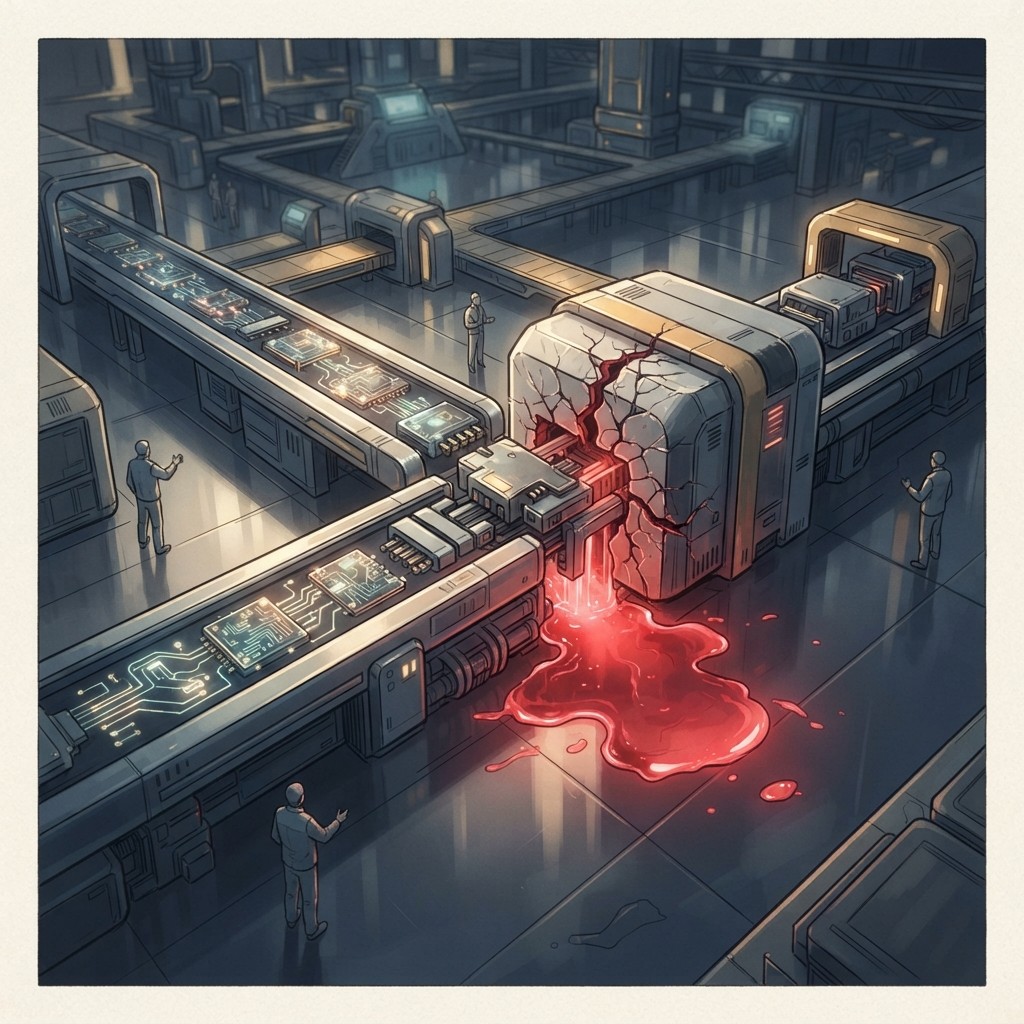
Pairs with the Cross-Subsidy Map — a ready-to-use strategy tool. Included in the Cross-Subsidy Casebook →
“Which unit pays for the others, and has anybody ever approved it?”
Build a Samsung phone and you are, in a sense, shopping inside one building. The application processor, the DRAM, the NAND flash, the display - four of the most expensive parts in the device, together roughly two-thirds of its bill of materials - can all be made by other arms of the same company.7 It looks like the ultimate household economy: the left hand makes the parts, the right hand assembles the product, and no margin escapes to a stranger. So the legend goes: Samsung quietly feeds itself at cost and undercuts everyone who has to buy on the open market.
The official story is that Samsung's components divisions subsidize its devices through preferential internal prices. It is a clean, intuitive story. It is also empirically false - and in 2023 the books said so out loud.
Samsung does not sell to Samsung at cost. Its semiconductor arm is a profit-driven global supplier that ships memory to Apple, Nvidia, AMD, and the cloud giants, and prices its internal transfers at arm's length, on short and flexible contracts pegged to the market.5 Which means the empire isn't a cross-subsidy machine at all. It is a portfolio of cyclically misaligned profit centers - and when the cycle turns, integration doesn't cushion the blow. It concentrates it.
When Samsung wouldn't sell to Samsung
The cleanest proof arrived not in a downturn but in a boom. Through 2024 and 2025, as AI demand sent memory prices climbing, Samsung's phone division found itself bidding against the hyperscalers for chips made by its own semiconductor sibling - and losing the family discount it was never actually getting.5 If the cross-subsidy story were true, this is exactly the moment it should have shown up: the chip arm protecting the phone arm from a spike. Instead the chip arm did what any profit-maximizing supplier does. It sold to whoever paid most, kept the contracts short, and treated its corporate sibling as one customer among many. Analysts who cover the company's structure describe the internal price as effectively the market price — the household economy, a market in disguise.
“Samsung's memory arm operates as a profit-driven global supplier - selling to Apple, Nvidia, AMD, cloud providers, and data-centre operators. Internal transfer pricing is arm's-length.”5
This isn't an accident of accounting; it's a deliberate stance baked into how the divisions are run. Analysts note that Samsung treats its component arms as profit centers, not cost centers.7 A cost center exists to feed the line at the lowest internal price. A profit center exists to earn the highest external price it can. Samsung chose the second, on purpose - which is precisely why the subsidy story collapses on contact.
Integration didn't diversify the risk. It pooled it.
If you run your chip business for profit rather than as an internal supplier, you inherit the chip business's most defining trait: violent cyclicality. And when you bolt that cyclical engine into the same legal entity as your stable device business, you don't get a smoother ride. You get one income statement breathing in and out with the memory cycle. 2023 is the autopsy. Samsung booked KRW 258.94 trillion in revenue - a vast, healthy top line - and squeezed out just KRW 6.57 trillion in operating profit.2 In a single down year, a near-trillion-dollar company earned the operating profit of a mid-cap. The memory crash didn't get absorbed by the rest of the portfolio. It walked straight through the consolidated P&L.
Notice where the money was buried that year. The Device Solutions arm - chips - was 25.7% of revenue; Samsung Display another 12.0%; the device businesses the remaining 65.7%.2 On paper, three legs propping each other up. In practice, when the memory leg buckled, the whole table tipped. And the capital commitment ran the same direction as the risk: of Samsung's KRW 53.1 trillion in 2023 capex, KRW 48.4 trillion went into Device Solutions.1 The company was pouring its investment into the most cyclical part of itself in the very year that part was bleeding.
| The cross-subsidy myth | What the books say | |
|---|---|---|
| Internal pricing | Components sold to devices at cost | Arm's-length market price5 |
| Role of chip arm | A captive supplier | A profit center selling to Apple, Nvidia, AMD5 |
| Effect of a downturn | Integration cushions the blow | 2023: profit collapsed to KRW 6.57T on KRW 258.94T revenue2 |
| Where the cash went | Spread across the empire | KRW 48.4T of KRW 53.1T capex into chips alone1 |
The chronology nobody tells correctly
Part of why the subsidy myth survives is a bedtime story about origins: that Samsung is a chip company that grew devices on top of its silicon, integration flowing naturally upward from the wafer. The dates say otherwise. Samsung Electronics was incorporated on January 13, 1969, and its first products were black-and-white televisions - a device company from day one.4 It took a 50% stake in Korea Semiconductor only in the mid-1970s, and didn't ship its first 64K DRAM until 1983 — technology licensed from Micron and Sharp — more than a decade after founding.4 Samsung didn't build devices on chips. It built chips beside devices, much later, and ran them as a separate business that happened to share a parent. The integration was always a federation of profit centers, not an organism with one bloodstream.
That federation can look invincible when every member is winning. Samsung briefly passed Intel to become the world's largest semiconductor company by revenue in 2017–2018, and it was the world's top smartphone vendor for more than a decade, leading every year from 2012 until Apple overtook it in 2023.811 But peak-cycle dominance is exactly when a structure's hidden fragility is least visible. The foundry tells the harder truth.
The foundry is the integration thesis failing in real time
Samsung Foundry was meant to be the crown of the integrated empire - in-house leading-edge manufacturing to rival TSMC, feeding Samsung's own chips and the world's. Instead it is the clearest evidence that integration guarantees nothing. Its market share fell from roughly 19% in Q1 2019 to 8.1% by Q4 2024 and 7.7% in Q1 2025, against TSMC's 67%.6 Samsung does not disclose foundry-only results, but analysts estimate its combined foundry and system-LSI operations lost roughly KRW 3 trillion in 202410 — with the foundry business alone reported to have shed more than KRW 2 trillion in the fourth quarter alone.13 Low yields on its 3nm process were so costly that Qualcomm, a Samsung customer of long standing, moved exclusively to TSMC.6 Owning the fab didn't keep customers; bad yields lost them. The lesson is brutal in its simplicity: a vertical you own but cannot run at the frontier is not an asset. It is a subsidized competitor you happen to be paying for.
But doesn't 2024 prove integration works after all?
The fair objection is the rebound. In 2024 Samsung came roaring back - KRW 300.9 trillion in revenue and KRW 32.7 trillion in operating profit, the second-highest revenue in its history.3 Doesn't a recovery that fast vindicate the structure? It does the opposite. The same lever that crushed 2023 lifted 2024: memory prices recovered, and because the cyclical engine sits inside the consolidated P&L, the swing back was just as violent as the swing down. Operating profit moving from KRW 6.57 trillion to KRW 32.7 trillion in twelve months is not the signature of a diversified, self-cushioning conglomerate.23 It is the signature of a company whose fortunes are levered to a single commodity cycle it has chosen to internalize. And notice the foundry losses persisted in the very year revenue hit a near-record - more than KRW 2 trillion of red ink in Q4 2024 while the top line set milestones.13 A real cross-subsidy machine would have used the memory windfall to quietly carry the foundry to health. This one couldn't, because the divisions don't feed each other. They each take the market's verdict, separately, at the same time.
Vertical integration is sold as a hedge: own the supply chain, smooth the shocks. But owning a supplier doesn't diversify your risk unless that supplier's cycle runs opposite to yours - and it almost never does. More often you've simply moved a volatile business inside your own walls, where its booms and busts now land directly on your consolidated income statement instead of someone else's. The test isn't 'do we control the input?' It's 'are these businesses correlated?' If your component arm and your device arm both swing with the same demand cycle - as Samsung's memory and phones do - integration concentrates risk it was supposed to spread. Run each captive unit at the market price, on the market's terms, and judge it as a standalone business. The moment you can only justify it as a subsidy, you've stopped owning an asset and started funding a hostage.
Samsung's empire is genuinely vast - 232 consolidated subsidiaries as of the end of 2023, displays and chips and phones under one roof, a balance sheet that carried a roughly trillion-dollar market cap.98 But scale is not the same as a cross-subsidy, and ownership is not the same as a moat. The chip arm sells to its own siblings at the same price it sells to Apple, because that is how you maximize a profit center - and the price of running it that way is that there is no hidden discount to pull from in a crisis. Integration didn't immunize Samsung from the memory cycle. It married Samsung to it. The left hand never fed the right hand at cost. It charged full freight, kept the receipt, and in 2023 the whole house paid the bill.
When the structure tells a different story than the legend
Cross-Subsidy Map
A map of the hidden plumbing inside a multi-line business: the cash-cow donor, the loss-making recipient it props up, and the strategic reason the subsidy exists. Use it to see who is really paying for what, and how exposed the whole structure is if the donor weakens. Blank to map your own portfolio's internal transfers; filled as the worked example of a business where one line secretly carries another.
Included, filled and blank, in the Cross-Subsidy Casebook. See the set → · Preview the blank →
Sources
Where this comes from — the filings, records, and reporting behind it.
- 1Samsung Electronics consolidates 232 subsidiaries including Samsung Display and Samsung Electronics America, and applies the equity method for 35 associates and joint ventures including Samsung Electro-Mechanics Co., Ltd. Capital expenditures in 2023 reached KRW 53.1 trillion, of which KRW 48.4 trillion was in the Device Solutions (DS) Division and KRW 2.4 trillion in Samsung Display Corporation (SDC).
- 2For full-year 2023, Samsung reported KRW 258.94 trillion in annual revenue and KRW 6.57 trillion in operating profit — a severe compression from prior years. In 2023, DS Division revenue was KRW 66,594.5 billion (25.7% of total), SDC was KRW 30,975.4 billion (12.0%), and DX Division was KRW 169,992.3 billion (65.7%). Major customers included Apple, Best Buy, Deutsche Telekom, Qualcomm, and Verizon.
- 3For full-year 2024, Samsung reported KRW 300.9 trillion in annual revenue and KRW 32.7 trillion in operating profit — the second-highest revenue on record, surpassed only in 2022. Q4 2024 revenue was KRW 75.8 trillion and operating profit KRW 6.5 trillion. SDC posted KRW 8.1 trillion in Q4 2024 revenue.
- 4Samsung Electronics Corporation was formally incorporated on January 13, 1969, in Suwon, South Korea. Its first products were black-and-white televisions. The Group had acquired a 50% stake in Korea Semiconductor by the mid-1970s, but Samsung did not produce its first 64K DRAM until 1983, obtaining technology from Micron (USA) and Sharp (Japan).
- 5Samsung's memory arm operates as a profit-driven global supplier — selling to Apple, Nvidia, AMD, cloud providers, and data-centre operators. Internal transfer pricing is arm's-length. In high-demand periods (2024–2025), Samsung's phone division effectively competed with AI hyperscalers for memory chips made by its own semiconductor sibling, with Samsung Semiconductor keeping contracts short, flexible, and at market prices.
- 6Samsung Foundry's global market share fell from ~19% in Q1 2019 to 8.1% in Q4 2024 (vs. TSMC's 67.1%), and further to 7.7% in Q1 2025. The foundry and System LSI operations posted combined operating losses widely estimated at roughly KRW 3 trillion for full-year 2024, including more than KRW 2 trillion in Q4 2024 alone. Low yields on the 3nm process caused Qualcomm to shift exclusively to TSMC.
- 7Samsung Electronics designs and manufactures four of the most valuable components in smartphones — application processors, DRAM, NAND flash, and displays — which together constitute roughly two-thirds of a phone's bill of materials. However, analysts note Samsung's vertical integration is not a simple cost-center strategy: Samsung 'started in the components business and then branched out into manufacturing end products,' treating component divisions as profit centers rather than cost centers.
- 8Samsung Electronics was the world's largest semiconductor memory manufacturer. From 2017 to 2018 it was briefly the largest semiconductor company in the world by revenue, dethroning Intel. As of 2023, Samsung's market capitalization stood at approximately US$1.025 trillion. Samsung has been the largest vendor of smartphones globally since 2012.
- 9As of December 31, 2023, Samsung Electronics had 232 consolidated subsidiaries.
- 10Samsung's foundry and System LSI businesses posted an estimated KRW 3.18 trillion (about US$2.4 billion) operating loss in 2024, based on the average of nine analyst estimates compiled by Reuters; Samsung does not disclose foundry-only results.
- 11Apple overtook Samsung as the world's largest smartphone vendor in 2023, ending Samsung's run at the top; the last time a company other than Samsung led was 2010.
- 12Samsung Electronics reported KRW 43.38 trillion in full-year 2022 operating profit on KRW 302.23 trillion in revenue — the prior peak before the 2023 collapse to KRW 6.57 trillion, representing a drop of roughly 85%.
- 13Samsung's foundry business posted more than 2 trillion won in operating losses in the fourth quarter of 2024.
Weighing outside help with a decision like this? Hiring a pricing strategy consultant
More like this — beyond Samsung
New Strategically analyses as they publish: the defining moves in business, checked against the record. No noise, and one click to leave.