Pairs with the Cross-Subsidy Map — a ready-to-use strategy tool, filled for Live Nation. Included in the Cross-Subsidy Casebook →
“Which unit pays for the others, and has anybody ever approved it?”
A fan walks into a Live Nation amphitheater on a summer night. She bought the ticket through Ticketmaster, where a fee she'll grumble about for years was tacked on. Inside, she pays for a beer at a counter whose food-and-beverage take climbed over 10% in a single year3, passes a beverage brand's logo on a stage skirt and a phone carrier's branded lounge, and watches a show inside a room the company owns. Three revenue streams just touched her in ninety minutes. The official story is that they are three businesses stapled together. They are not. They are one business, and the room she's standing in is the part that makes the other two worth having.
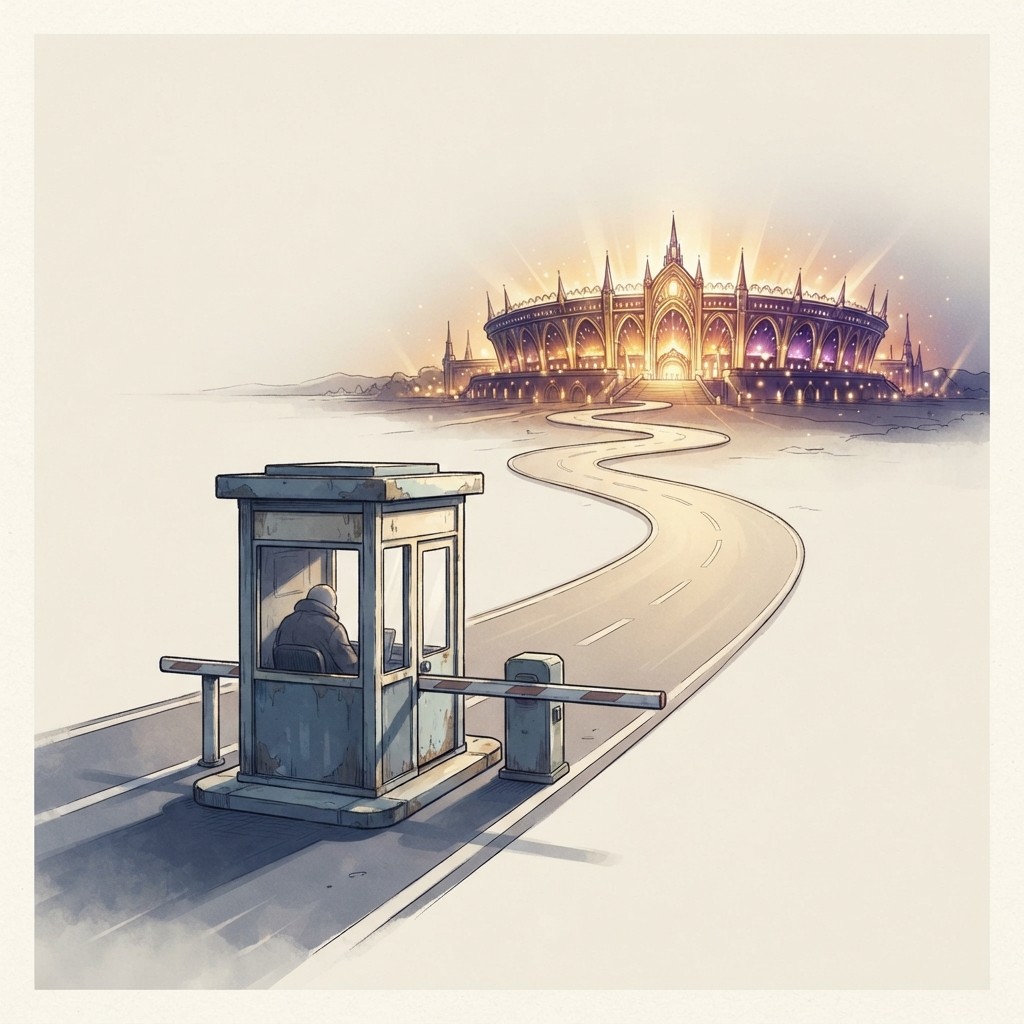
The popular framing names Ticketmaster as the crown jewel — the fee machine, the thing regulators chase, the brand everyone loves to hate. By revenue, that framing is upside down. Ticketing was about $3.0 billion in 2024, roughly 13% of Live Nation's $23.2 billion in total revenue, with concerts making up the bulk.1 Ticketmaster is not the empire. It's the tollbooth on the real asset — and the real asset is real estate with a stage in it.
Why the room is worth 2.5 of someone else's room
Start with the one number that reorders the whole company. Live Nation's owned and operated amphitheaters deliver over 2.5 times the per-fan profitability of similarly sized third-party venues.3 Same band, same crowd, same number of tickets — but in a room Live Nation controls, every fan is worth more than twice as much. The difference is not the music. It's everything else the room captures: the beer, the parking, the merch cut, the branded space on the concourse, and the ability to set the terms on who sells the ticket. When you own the room, you stop renting out the margin to a landlord and start keeping it. That is why three-quarters of the company's total capex in 2024 ran through its venue arm4, and why it announced a $1 billion program to build and upgrade U.S. venues over eighteen months.8 The cash is going where the multiplier is.
Here is the part that breaks the three-equal-legs picture. The venue doesn't just earn more on its own; it makes the other two legs possible. Ticketmaster's strength was never a clever website — it's the exclusive contracts that route a venue's ticketing through Ticketmaster and nobody else. Owning the venue is the cleanest way to guarantee that exclusivity, because you can't be undercut on a building you control. And sponsorship is not abstract advertising you could buy anywhere; it's the right to put a brand inside a room full of captive, emotionally primed fans. Onsite sponsorship — the kind tied directly to physical venues and festivals — was 'the primary driver of 2024 growth, leveraging the strength of our venue platform,' in the company's own words.4 No venues, no onsite. The legs don't stand side by side. One holds the other two up.
| Venues | Ticketing | Sponsorship | |
|---|---|---|---|
| Share of 2024 revenue | Majority (concerts) | ~13% ($3.0B) | ~$1.2B |
| Source of its edge | Owns the margin per fan | Exclusive contracts on venues | Captive in-venue audience |
| What it needs to work | Capital and locations | Control of the room | Control of the room |
| If you removed the venues | — | Loses exclusivity leverage | Loses the onsite franchise |
How the flywheel funds its own construction
A cross-subsidy is most powerful when the subsidized leg pays to build the subsidizing one. Watch how the cash actually moves. Sponsorship grew 9% to $1.2 billion in 2024, with its operating income up 13%1 — and rather than sitting in a separate ledger, that franchise reaches back to fund the venues it depends on. Live Nation pulled in $100 million of committed capital from sponsorship deals and joint-venture partners to reduce its own cash outflow on venue construction.4 The sponsors are, in effect, helping pay for the rooms whose captive audiences make the sponsorships valuable. Then the new rooms generate 2.5x per-fan economics, which deepen the ticketing exclusivity and create more premium space to sell to the next sponsor. The loop tightens with every venue opened — and Live Nation planned to open fourteen major venues globally across 2024 and 2025.4
A standalone third-party room earns the base per-fan profit and nothing else. A Live Nation-owned room earns 2.5x that3, plus it locks in Ticketmaster's contract and creates branded inventory for the ~760-person sponsorship sales force working with 1,500+ brands.2 And because sponsors and JV partners chip in committed capital toward construction4, the venue partly pays for itself before the first fan walks in. That is why three legs that look co-equal are really one leg carrying two.
“Onsite sponsorship was the primary driver of 2024 growth, leveraging the strength of our venue platform.”4
If venues are only 4% of the market, where's the monopoly?
The strongest objection is a fair one, and it comes straight from the numbers above. Live Nation owns or operates roughly 150 U.S. venues — about 4% of all U.S. music venues by count.8 Four percent doesn't sound like a chokehold. So how can a company that owns a sliver of the rooms be accused of monopolizing live music? The answer is that the 4% is the wrong denominator. The relevant rooms are the large amphitheaters and arenas where the high-grossing tours play, and in that tier the ownership concentrates exactly where the cross-subsidy compounds. The DOJ and thirty state and district attorneys general clearly didn't buy the 'small share' defense: they sued Live Nation and Ticketmaster in May 2024 for monopolization under the Sherman Act and sought to break Ticketmaster off entirely.5 And this was not a first contact. The government had cleared the 2010 merger with a consent decree, then amended and extended it in 2020 after finding Live Nation had 'repeatedly and over the course of several years' violated its anti-retaliation terms — adding an independent monitor and an automatic $1 million penalty per violation.6 The 2024 suit was the third escalation, not the awakening.
Notice what the eventual resolution targeted — and what it spared. The DOJ settled in March 2026 for $280 million plus behavioral remedies: a 15% cap on certain ticketing fees, access for rival sellers like SeatGeek and StubHub to venues Live Nation controls, and divestiture of exclusive booking at 13 amphitheaters. It did not require Live Nation to sell Ticketmaster.7 Read that as a confession of where the power actually lives. Regulators pried at the ticketing fees and at the exclusive booking rights — at the leverage the venues create — rather than amputating the ticketing brand. A separate jury did find a monopoly that April, with remedies still unsettled.7 But the settlement's shape is the tell: you don't cap the toll and force open the gates of the rooms if the rooms weren't the real source of the power.
When a company runs three businesses that look co-equal, ask which one fails first if you remove each. Often two of the three are not businesses at all — they are privileges that only exist because of the third. Live Nation's ticketing margin and sponsorship premium both depend on controlling the room; strip the venues and you don't have a smaller Live Nation, you have a ticket website and an ad-sales team with nothing exclusive to sell. The strategic move is to own the scarce physical asset others must route through, then let the high-margin legs ride on top of it — and let one of them quietly help fund the next room. One caution: an asset that lets you tax everyone who passes through attracts regulators precisely because it does, so defend it with genuine value to fans, not just leverage over rivals.
Live Nation is sold to the public as a ticketing villain and analyzed by the market as a concert promoter. Both miss the engine. The company's deepest bet is the least glamorous one: pour three-quarters of its capital into buildings, earn more than twice the profit per fan inside them, and let that ownership hand Ticketmaster its exclusivity and sponsors their captive crowd. The fee on your ticket and the logo on the stage are not separate empires. They are rent collected on the same square footage. The genius was never the website or the brand deal — it was deciding that whoever owns the room owns everything that happens in it, and building rooms until that was true.
When the obvious business isn't the real one
Cross-Subsidy Map
A map of the hidden plumbing inside a multi-line business: the cash-cow donor, the loss-making recipient it props up, and the strategic reason the subsidy exists. Use it to see who is really paying for what, and how exposed the whole structure is if the donor weakens. Blank to map your own portfolio's internal transfers; filled as the worked example of a business where one line secretly carries another.
Included, filled and blank, in the Cross-Subsidy Casebook. See the set → · Preview the blank →
Sources
Where this comes from — the filings, records, and reporting behind it.
- 1Live Nation's 2024 total revenue was $23,155.6 million; Ticketing segment generated $3.0B (13% of total); Sponsorship & Advertising revenue grew 9% to $1.2B with AOI up 13% to $763.8M; 331 million fee-bearing tickets sold; 637 million total tickets through its systems.
- 2Live Nation owns, operates, has exclusive booking rights for, or holds an equity interest in 394 venues globally as of December 31, 2024, including House of Blues, The Fillmore, Ziggo Dome, 3Arena, and Royal Arena; employs ~760 sponsorship salespeople working with 1,500+ sponsors.
- 3Live Nation's owned/operated amphitheaters deliver over 2.5x the per-fan profitability of similarly sized third-party venues; Q1 2024 food and beverage spending up over 10% at U.S. theaters and clubs; onsite sponsorship from operated venues and festivals up 28% year-to-date through Q2 2024.
- 4Onsite sponsorship was 'the primary driver of 2024 growth, leveraging the strength of our venue platform'; three-quarters of total capex was driven by Venue Nation; $100 million in committed capital from sponsorship agreements and joint venture partners reduced venue cash outflow; plans to open 14 major venues globally in 2024/25.
- 5The DOJ and 30 state/district attorneys general filed a civil antitrust lawsuit on May 23, 2024 in the Southern District of New York against Live Nation Entertainment and Ticketmaster LLC, alleging monopolization and other unlawful conduct under Section 2 of the Sherman Act; the complaint sought structural relief including Ticketmaster divestiture.
- 6The 2010 DOJ consent decree required Ticketmaster to divest Paciolan to Comcast-Spectacor, license the Ticketmaster Host platform to AEG, and include anti-retaliation provisions; the decree was amended in 2020 after the DOJ found Live Nation had 'repeatedly and over the course of several years' violated the anti-retaliation provisions; the 2020 modification added an independent monitor and a $1 million automatic penalty per violation.
- 7In March 2026, the DOJ settled its antitrust case against Live Nation for $280 million; the proposed consent decree required Live Nation to cap certain ticketing fees at 15%, allow rival ticket sellers (SeatGeek, StubHub) access to venues it controls, and divest exclusive booking agreements at 13 amphitheaters — but did not require a Ticketmaster sale. In April 2026, a federal jury separately found that Live Nation held a monopoly and violated federal and state antitrust laws.
- 8Live Nation owns approximately 150 venues in the U.S., representing about 4% of all U.S. music venues; the company announced a $1 billion venue investment program over 18 months in venues ranging from intimate clubs to large amphitheaters across large and small U.S. markets; in 2025 sponsorship AOI grew 11% to $845 million and ticketing fee-bearing GTV for concerts grew 9% to $26 billion.
Weighing outside help with a decision like this? Hiring a pricing strategy consultant
More like this — beyond Live Nation
New Strategically analyses as they publish: the defining moves in business, checked against the record. No noise, and one click to leave.