Pairs with the Cross-Subsidy Map — a ready-to-use strategy tool. Included in the The Cross-Subsidy Casebook →
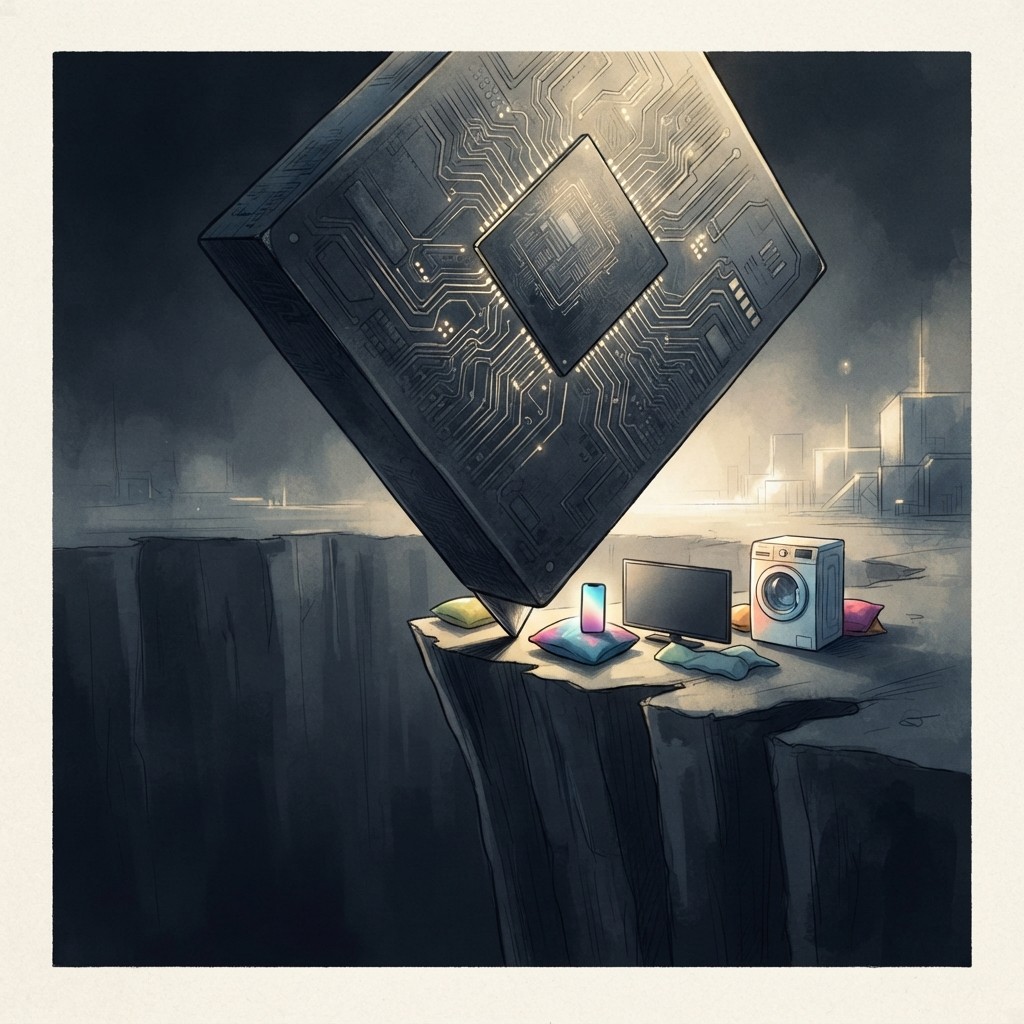
In 2023 Samsung Electronics earned KRW 6.57 trillion in operating profit - a number that, for a company selling phones, TVs, refrigerators, and the silicon inside half the world's gadgets, looks merely modest.1 It wasn't modest. It was a survival number. Strip out one division and the picture inverts: the semiconductor business alone lost roughly KRW 14.87 trillion that year.4 So the famous breadth - the appliances, the displays, the Galaxy line - didn't deliver a triumphant profit. It absorbed a chip-sized crater and left a thin layer of black ink on top. That is not diversification protecting a company. That is a cushion catching a falling anvil.
The official story is that Samsung is a diversified conglomerate whose many businesses smooth out any single shock. The truer story is that Samsung is a leveraged bet on the memory cycle, with a consumer-electronics shock absorber bolted underneath. When memory soars, the group looks like a genius. When memory craters, the rest of the company exists mainly to keep group profit from going negative.
The year the cushion did its real job
Run the arithmetic of 2023 and the conglomerate myth dissolves. The chip division posted a full-year operating loss near KRW 14.87 trillion.4 The group still came out at KRW 6.57 trillion in the black.1 That means every other business - smartphones, displays, home appliances, the whole sprawling rest of Samsung - had to generate something on the order of twenty trillion won of profit just to drag the total back above zero. They did it. But notice what they did: they didn't buffer the loss, they covered it. A buffer dampens a swing. A cover means the swing would otherwise have taken the entire company underwater. Samsung's breadth turned a catastrophic memory year into a merely disappointing group year - and that is a far more fragile thing than the diversification narrative implies.
Compare the swing to see how much one division drives the whole. In 2022, the chip business made roughly KRW 23.8 trillion in operating profit.4 In 2023 it lost about KRW 14.87 trillion.4 That is a year-over-year swing of nearly KRW 39 trillion in a single segment - larger than Samsung's entire group operating profit in good years. No phone cycle, no TV cycle, no appliance cycle moves like that. The memory cycle is the heartbeat; everything else is connective tissue.
| 2022 | 2023 | 2024 | |
|---|---|---|---|
| Group revenue (KRW) | 302.23T (then-record) | 258.94T | 300.9T |
| Group operating profit (KRW) | 43.38T | 6.57T | 32.7T |
| Chip division | ~+23.8T profit | ~-14.87T loss | Record Q4 memory revenue |
| What ran the result | Memory still strong | Memory crater, rest covers | HBM/DDR5 recovery |
Look across the row and the conglomerate's stability is an illusion of accounting. Group revenue barely moved between 2022 and 2024 - KRW 302T, then 259T, then 301T.213 But operating profit detonated from 43.38T to 6.57T and back up to 32.7T.213 Steady top line, violently unsteady bottom line. That signature - flat revenue, whipsawing profit - is the fingerprint of a commodity at the heart of the business, and the commodity is memory.
The capex that was supposed to be genius
Here is where the story gets sharper than 'a cyclical business had a bad year.' Samsung had a theory about downturns, and it was a good one on paper: when prices crash and weaker rivals retreat, the strong player keeps building, absorbs the share they abandon, and emerges from the trough larger. So as the 2022-2023 downcycle hit, Samsung refused to blink. It held capex near prior-year levels while SK Hynix cut more than half, and an executive flatly told the market the company was not considering an artificial production cut.5 One analyst read the intent plainly: Samsung looked like it would use the downcycle to push other flash makers out.5 Counter-cyclical aggression, by the textbook.
“We are not considering an artificial production cut.”5
The theory misfired in two ways at once, and the second was fatal. First, by holding supply into a collapsing market, Samsung helped flood it. Between 2021 and 2023 the company accounted for 51% of total industry DRAM capex while holding only 43% of global DRAM revenue - it was building disproportionately more capacity than its own market share justified, deepening the very glut that was crushing prices.6 The result of investing so much into a falling commodity: cash return on DRAM plunged to roughly 3% in 2023, from more than 30% before the pandemic, while NAND prices fell about 50% year over year.6 Counter-cyclical investing is supposed to buy cheap share. Samsung bought expensive overcapacity in exactly the products the market least wanted.
The strategy only works if the capacity you keep building is in something the recovery will want. Samsung kept building - 51% of industry DRAM capex on 43% of revenue6 - but poured it into conventional commodity DRAM and NAND just as the next cycle's value migrated to high-bandwidth memory for AI accelerators. You can win the volume war and still lose, if you stockpile the wrong product. Cash return on DRAM fell to ~3% in 2023.6
The pivot Samsung overbuilt its way past
The second failure is the one that rewrote the rivalry. While Samsung was pouring capital into commodity nodes, the value in memory was migrating to high-bandwidth memory - the stacked DRAM that AI accelerators devour. SK Hynix, the company cutting capex by half, had aimed its surviving investment at exactly that. When the AI demand wave broke, SK Hynix was the supplier ready to ride it. By Q1 2025 it had done something that had not happened in the entire history of the modern memory business: it overtook Samsung in global DRAM revenue share, 36% to 34% per Counterpoint, ending an unbroken Samsung lead that ran back to 1992.7 The decisive lever was HBM, where SK Hynix held roughly 70% share.7
Then came the symbol that no Samsung executive could spin. For full-year 2025, SK Hynix posted record operating profit of KRW 47.2 trillion, surpassing Samsung's KRW 43.6 trillion - the first time the smaller rival had out-earned Samsung over a full year, propelled by its position as Nvidia's primary HBM supplier.8 A company that had spent the downturn cutting capex now out-earned the one that spent the downturn flexing it. The counter-cyclical bet didn't push the rival out. It bankrolled the glut the rival declined to join, while the rival quietly cornered the product that mattered.
Wasn't 2024 the proof the strategy worked after all?
The fair objection is that this reads too much into one bad year. By 2024 Samsung had snapped back - KRW 300.9 trillion in revenue, the second-highest on record, KRW 32.7 trillion in operating profit, and a record Q4 in memory powered by HBM and DDR5.3 Doesn't the recovery vindicate the breadth and the capacity Samsung kept building? Partly, yes. The fixed plant Samsung financed through the trough is real, and when the cycle turned, it converted into a genuine rebound. A pure-play would have suffered the 2023 loss with nothing underneath it; Samsung's other divisions kept the group solvent enough to invest straight through. That cushion has value, and it is the honest case for the conglomerate.
But the rebound and the relegation arrived together, and that is the tell. Samsung recovered in 2024 - and still lost the DRAM revenue crown in early 2025 and the annual-profit crown by the close of 2025.78 A recovery that leaves you in second place where you were first for thirty years is not a vindication of the strategy; it is the bill for the part of it that misfired. Samsung proved it could survive the cycle. It has yet to prove the cushion makes it any wiser about which side of the cycle to build into.
A conglomerate's many businesses can make a company look stable when one segment quietly drives the entire bottom line. Samsung's flat revenue and whipsawing profit are the fingerprint: when one division can swing ~KRW 39 trillion year over year, the others aren't diversifying the risk - they're covering it. Two warnings follow. First, breadth lets you keep investing through a trough, but it doesn't tell you WHAT to invest in - and pouring counter-cyclical capital into a commodity node while the value migrates elsewhere can deepen the glut you're trying to outlast. Second, the most dangerous moment is a recovery that looks like vindication: Samsung bounced back in 2024 and still lost a leadership it had held since 1992. Survival is not the same as judgment.
Samsung's profit doesn't rise and fall with the cleverness of its phones or the elegance of its displays. It rises and falls with the price of a commodity stored in stacked silicon - and in 2023 that commodity reached up and nearly pulled the whole company under, while the appliances and screens dug in their heels and barely held the line.14 The conglomerate didn't insulate Samsung from the memory cycle. It just gave the cycle a softer place to land. And when the cycle finally turned back up, it carried the rival who'd bet on the right node past the giant who'd bet on the most - which is the most expensive way to learn that building the most is not the same as building the right thing.
Cross-Subsidy Map
A map of the hidden plumbing inside a multi-line business: the cash-cow donor, the loss-making recipient it props up, and the strategic reason the subsidy exists. Use it to see who is really paying for what, and how exposed the whole structure is if the donor weakens. Blank to map your own portfolio's internal transfers; filled as the worked example of a business where one line secretly carries another.
Included, filled and blank, in the The Cross-Subsidy Casebook. See the set → · Preview the blank →
Sources
Where this comes from — the filings, records, and reporting behind it.
- 1Samsung full-year 2023: KRW 258.94T revenue, KRW 6.57T operating profit; DS Division posted KRW 2.18T operating loss in Q4 2023 alone; capex KRW 53.1T of which KRW 48.4T in DS Division.
- 2Samsung full-year 2022: KRW 302.23T revenue (then-record high), KRW 43.38T operating profit; semiconductor capex KRW 47.9T; memory earnings declined sharply in Q4 2022 as prices fell and customers adjusted inventory.
- 3Samsung full-year 2024: KRW 300.9T revenue (second-highest on record), KRW 32.7T operating profit; DS Division KRW 46.3T capex; Memory Business achieved record Q4 revenue on HBM and DDR5 sales.
- 4Samsung's semiconductor DS division posted a full-year 2023 operating loss of KRW 14.87T (~$11.17B), versus a profit of ~KRW 23.8T in 2022; net profit collapsed 72.2% YoY to KRW 15.49T.
- 5Samsung maintained capex near prior-year levels entering 2023 downturn (~5% cut for memory vs. SK Hynix cutting >50%), with executive Han Jin-man stating 'We are not considering an artificial production cut' on the Q3 2022 earnings call; analyst Park Sung-soon attributed-to-source: 'Samsung seems to be saying it will use this downcycle to push out other NAND flash firms.'
- 6Samsung's DRAM capex between 2021-2023 accounted for 51% of total industry investment while its DRAM sales represented only 43% of global industry revenue; cash return on DRAM plummeted to ~3% in 2023 from >30% pre-COVID; NAND prices fell ~50% YoY in 2023.
- 7SK Hynix overtook Samsung in global DRAM revenue share for the first time ever in Q1 2025, taking 36% vs. Samsung's 34%, driven by HBM dominance (SK Hynix ~70% HBM share per Counterpoint); this ended Samsung's unbroken DRAM leadership since 1992.
- 8SK Hynix posted record full-year 2025 operating profit of KRW 47.2T, surpassing Samsung's KRW 43.6T — the first time SK Hynix beat Samsung in annual operating profit; SK Hynix's lead was driven by its dominant HBM position as primary Nvidia supplier.
- 9Samsung Electronics FY2025 full-year operating profit was KRW 43.6 trillion, on revenue of KRW 333.6 trillion
More like this — beyond Samsung
New Strategically analyses as they publish: the defining moves in business, checked against the record. No noise, and one click to leave.