Pairs with the Cannibalization Decision Tree — a ready-to-use strategy tool. Included in the The Cannibalization Choice Casebook →
In March 1973, in a low building in Palo Alto, a machine flickered to life that had a screen you could point at, a mouse you could roll, and a wire that let it talk to other machines like it. It was called the Alto, and it was, in every way that matters, the computer you are reading this on.4 Xerox built about 1,500 of them - and never sold a single one to the public.4 Three thousand miles away, in Rochester, the company that paid for it was busy counting the money from a photocopier.
The story everyone tells is that Xerox invented the future and was too blind to see it. That Steve Jobs walked in, saw the graphical interface, and walked out with it for free. Almost every beat of that story is wrong. Xerox saw exactly what it had. It commercialized more of it than the legend admits. And it still lost - which makes the real lesson far more uncomfortable than 'they were idiots.'
The copier was so good it became a prison
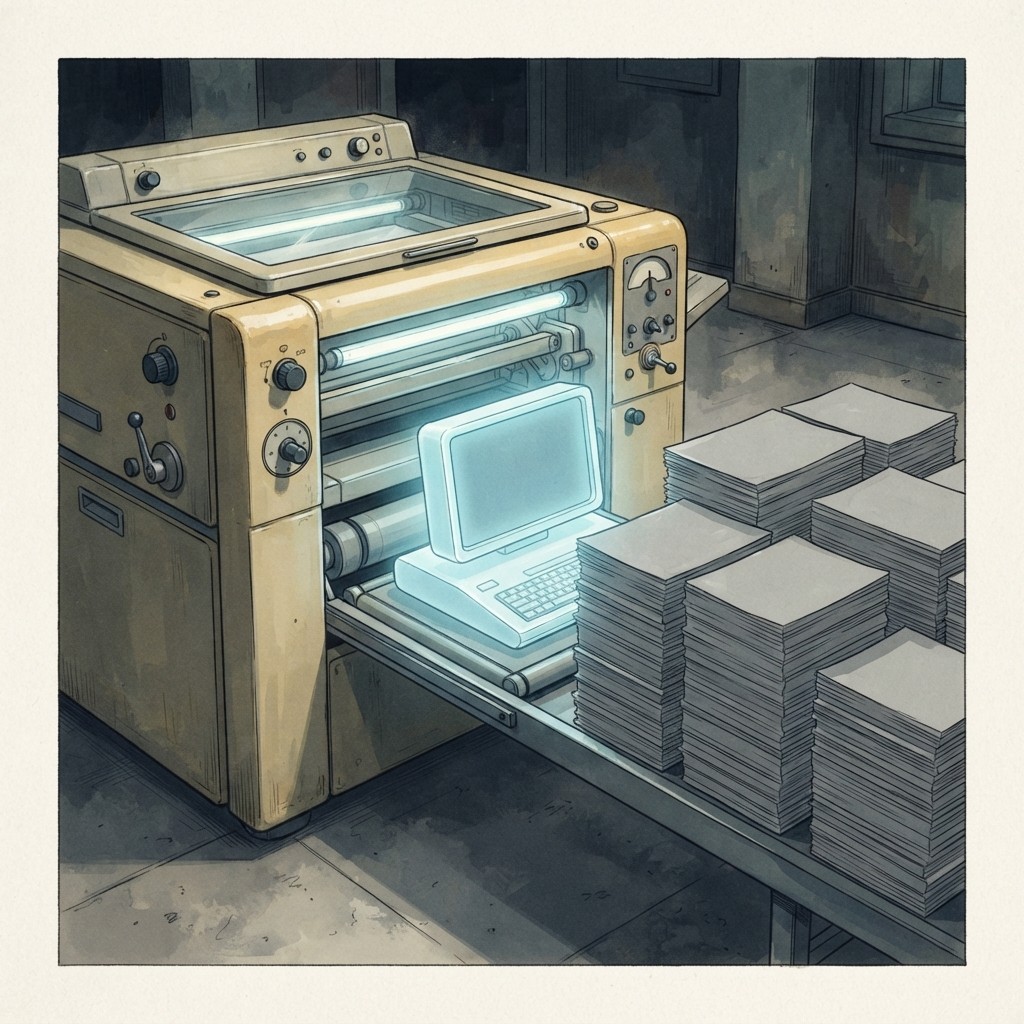
To understand why Xerox couldn't sell the future, start with how completely it owned the present. The 914 plain-paper copier was unveiled to the public on a live television demonstration in 1959, with commercial machines arriving in 1960.1 Fortune would later call it "the most successful product ever marketed in America" — a judgment the revenue numbers bear out.9 By one author's estimate the 914 accounted for roughly two-thirds of Xerox's revenue by 1965, generating something on the order of $243 million.2 That is not a successful product. That is a company that is a product. Every instinct, every salesperson, every pricing model, every customer relationship Xerox had was tuned to one thing: leasing big, expensive machines to large enterprises and charging by the page.
So when Jack Goldman, the chief scientist, founded the Palo Alto Research Center in 1970 to build computing beyond the copier, he did something both brilliant and fatal: he put it 3,000 miles from headquarters.3 The distance gave the researchers the freedom to invent the personal computer. It also guaranteed that whatever they invented would have to cross a continent and a culture before anyone in Rochester could figure out how to sell it. The lab got its independence. Xerox got a future it could not reach.
They didn't sit on it - they shipped it to the wrong customer
Here is the correction that breaks the myth. Xerox did not freeze. Ethernet was born at PARC around 1973, and in 1979 Robert Metcalfe persuaded Xerox, Intel, and DEC to promote it together as the DIX standard - the backbone of office networking for decades.8 Xerox brought the laser printer to market as a commercial product. And in 1981 it shipped the Star, a fully realized graphical workstation, years before Apple's Lisa reached anyone. The inventions left the lab. The problem was the price tag they wore when they arrived: a complete Star office system - workstations, storage, a laser printer - cost up to $100,000, roughly $350,000 in today's money.6
Read that number against the company that produced it. Xerox priced the personal computer the way it priced a copier: as a six-figure enterprise system leased to a corporation. It built the machine for individuals and then sold it only to the kind of customer it already knew how to sell to. The Star moved few units — most sources cite roughly 25,000, though some put the figure far lower — and by any count it was a commercial disappointment.611 It was not a flop because nobody wanted it. It was a flop because Xerox aimed the future at its own past.
| What PARC invented | How Xerox brought it to market | |
|---|---|---|
| The product | The personal computer, for one person | A $100,000 enterprise office system |
| The customer | Eventually, everyone | Large corporations it already leased copiers to |
| The price logic | Cheap enough to spread | Copier economics: high-margin, leased, enterprise |
| The timing | A decade ahead of the mass market | Sold to a mass market that didn't exist yet |
“Until 1976 there was no development organization at Xerox to take prototypes from PARC and turn them into products.”5
That quote is the whole mechanism in one line. The bottleneck was never that executives didn't understand the technology - PARC's own engineers say management was shown the Alto, Ethernet, and the laser printer as early as 1977.5 The bottleneck was that for years there was no organ inside Xerox whose job was to turn a prototype into something you could buy. A copier company is an engine for refining and leasing copiers. Drop a personal computer into it and the machine does what it knows how to do: it copier-izes it. Wraps it in enterprise pricing, enterprise sales, enterprise margins. The geography didn't suppress the inventions. It suppressed the translation - and a translation problem looks exactly like blindness from the outside.
Disruption isn't just having the technology - it's having the courage to sell it cheaply, to a new customer, before your old business is ready to let you. Xerox had the first variable and none of the others. It built the personal-computing future at PARC, then routed it through the only commercial machinery it owned: a copier company's instinct to lease expensive systems to big companies. Every product arrived late, over-priced, and aimed at the past.
But didn't Jobs just take it? And didn't Xerox give it away?
The most satisfying version of this story has a villain and a heist: Jobs visits PARC, sees the graphical interface, and Apple walks off with Xerox's crown jewels for nothing. It is a good story and it is mostly false. There were two Apple visits to PARC in 1979, and Jobs was only on the second.7 Both the Lisa and Macintosh projects were already underway before he arrived - Macintosh design documents dating from fall 1979 — months before the visit — already called for bitmapped screens and user-friendly interfaces.10 The visit confirmed and accelerated Apple's direction; it did not invent it. And Xerox was not robbed: its venture arm bought 100,000 private Apple shares at $10.50 each - just over a million dollars - with the PARC demo as a stipulated condition of the deal.7 Xerox sold a look at the future and took an equity stake in the company that would build it. That was a transaction, not a theft.
The honest counter to the whole thesis is harder. Maybe Xerox was simply right to protect the copier. The 914 was a once-in-a-generation business; cannibalizing it in the 1970s to chase a personal-computer market that wouldn't mature for another decade could have been corporate suicide on a faster timeline. There is truth in that. But notice what it concedes: it admits the failure was a choice about sequence and price, not ignorance. Xerox could have sold a cheaper Star to a new customer and let the copier ride beside it. Apple proved the market was real. Xerox had a ten-year head start and spent it building the future for an audience that wasn't in the room yet.
When a research arm hands you a genuinely new product, your existing business will try to sell it the only way it knows how - through its current customers, at its current margins, on its current timeline. That instinct is what kills the invention, not a lack of vision. Two disciplines protect against it. First, build the bridge before the prototype: someone whose only job is turning research into a shippable product for a NEW customer, not the one you already serve. Second, price for the market the technology fits, even when that market is smaller and poorer than the one funding you today. The danger isn't missing the future. It's commercializing it through the org chart of your past - and watching a leaner rival sell the same idea to the customer you refused to imagine.
Xerox is remembered as the company that fumbled the future. The truth is sharper and more useful: it caught the future, held it, and then handed it - priced and packaged - to the only customers its copier business had taught it to see. The Alto, the Star, the laser printer, Ethernet: all real, all shipped, all early. The thing Xerox couldn't invent was a version of itself willing to sell a $100,000 machine for a tenth of that, to someone it had never met. It out-engineered the entire industry and was beaten on the one question PARC could not answer for it: who is this for, and what will they pay? The future was in the building the whole time. It was just sitting at the wrong desk, with the wrong price on it.
When a company can't disrupt itself
Cannibalization Decision Tree
A decision tree for the moment the new thing threatens the cash cow: is the disruption real, will someone else do it if you don't, and can you afford to bleed your own margin to own the future? Blank to run on your own line; filled as the worked example tracing how the story's incumbent chose to cannibalize — or flinched and got cannibalized.
Included, filled and blank, in the The Cannibalization Choice Casebook. See the set → · Preview the blank →
Sources
Where this comes from — the filings, records, and reporting behind it.
- 1The Xerox 914 was introduced to the public on September 16, 1959, at the Sherry-Netherland Hotel in New York in a live television demonstration; commercial models were not available until March 1960.
- 2The 914 was a significant component of Xerox's revenues in the mid-1960s; one author estimates it accounted for roughly two-thirds of company revenue in 1965 with income generated of $243M.
- 3PARC was founded on July 1, 1970, by Jack Goldman, chief scientist of Xerox, as a division tasked with creating computer technology beyond Xerox's copier business; its 3,000-mile distance from Rochester headquarters gave researchers freedom but hindered technology transfer to management.Wikipedia, PARC (company) ↗ · 2026-06
- 4The Xerox Alto was operational at PARC in March 1973; approximately 1,500 units were built and deployed throughout Xerox and at universities, but the Alto was never sold as a commercial product.Computer History Museum, Xerox Alto Source Code ↗ · 2019-08-19
- 5Until 1976, there was no development organization at Xerox to take research prototypes from PARC and turn them into products — a key structural reason for commercialization failures, confirmed by PARC engineer Walter Teitelman.
- 6Xerox commercialized the Star (Xerox 8010 Information System) in 1981; a complete office system including workstations, storage, and a laser printer cost up to $100,000 (equivalent to ~$350,000 in 2025). Xerox sold about 25,000 units — though Britannica cites fewer than 2,000 — making it a commercial disappointment.
- 7There were two Apple visits to PARC in 1979; Steve Jobs was only on the second (early December 1979). Both Lisa and Macintosh projects were already underway beforehand. Xerox's venture arm (XDC) purchased 100,000 private Apple shares at $10.50 each ($1.05M) with the PARC demo as a stipulated condition.
- 8Ethernet was invented at PARC around 1973 by Robert Metcalfe and colleagues; in 1979 Metcalfe convinced Xerox, Intel, and DEC to promote 10Mb/s Ethernet through the 'DIX' standard — demonstrating that Xerox did actively commercialize at least one PARC invention.
- 9Fortune magazine called the Xerox 914 'the most successful product ever marketed in America.'
- 10Documents in The Book of Macintosh dating from fall 1979 — months before the PARC visit — show the Macintosh was going to feature user-friendly interfaces and a bitmapped screen.
- 11The Xerox Star was not considered a commercial success, as only around 25,000 devices were sold.
More like this — beyond Xerox
New Strategically analyses as they publish: the defining moves in business, checked against the record. No noise, and one click to leave.