Pairs with the Cannibalization Decision Tree — a ready-to-use strategy tool, filled for Shell. Included in the Cannibalization Choice Casebook →
“Should you launch the thing that takes revenue from your best business?”
In February 2021, Shell published the kind of strategy document that earns applause: net-zero by 2050, a customer-first energy transition, a brand pivot away from the barrel. Read to the bottom and you find a sentence the headlines skipped. As of that day, Shell wrote, 'Shell's operating plans and budgets do not reflect Shell's Net-Zero Emissions target.'4 The ambition was real. The money behind it was not. That single line is the whole story of a company praised for disrupting its own cash cow while never once cutting into it.
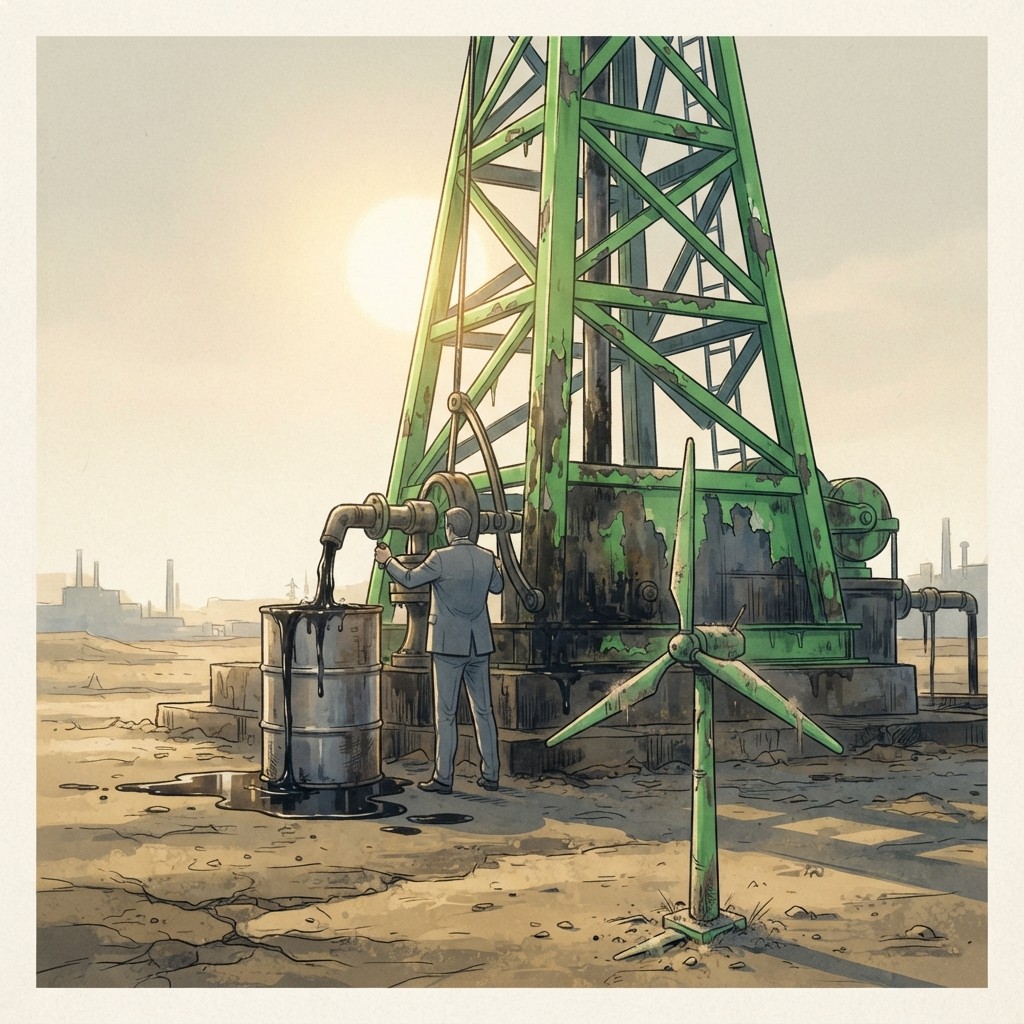
The official narrative is that Shell bravely cannibalized oil to bankroll renewables - sacrificing today's profit to build tomorrow's. The numbers tell a flatter, colder tale. Shell didn't disrupt its cash cow. It painted the cow green, kept milking it, and quietly walked away from the field where the grass was supposed to grow.
Follow the capital, not the press release
Strategy is not what a company says. It's where it points the money. In 2023 Shell's $24.4 billion of cash capex broke down like this: $12.5 billion into oil and oil products, $4.0 billion into LNG gas and power marketing and trading, $2.3 billion into non-energy products, and $5.6 billion into low-carbon energy solutions.1 That $5.6 billion sounds like a serious bet - until you open it up. Most of it is spread across EV charging, biofuels, hydrogen, and carbon capture; only $2.3 billion was the renewable-power line inside Shell's Renewables and Energy Solutions segment.36 Set that against oil and gas, and the cash cow got more than five times the feed. A company genuinely cannibalizing hydrocarbons starves them. Shell fed them first and labelled the leftovers a transition.
| Oil & oil products | LNG gas / power trading | Low-carbon (R&ES capex) | |
|---|---|---|---|
| 2023 capex | $12.5B | $4.0B | $2.3B |
| Role in the story | The cash cow | The cash cow's twin | The headline |
| Direction of travel | Protected | Protected | Retreating |
The cannibalization that never happened
Real cannibalization has a tell: the new business hurts because it's eating the old one's lunch on purpose, and you tolerate the pain because the future is worth it. Shell's renewables business hurt for the opposite reason - it simply lost money. In 2024 the Renewables and Energy Solutions segment posted a loss of more than $1 billion, while Integrated Gas earned roughly $9.6 billion, the most of any segment.8 And the 2023 internals are damning: the energy marketing and trading desk inside R&ES generated 216% of the segment's adjusted earnings, which is arithmetic for a trading book quietly subsidizing a loss-making renewable business sitting beside it.3 The 'pivot' wasn't a clever wager funded by a shrinking cash cow. It was a small, struggling unit propped up by a trading desk, while the actual cash cow kept paying the dividends. There was no sacrifice. There was nothing to disrupt because the disruption was never funded.
When the returns disappointed, the mask came off
The most honest moment in Shell's transition was the retreat. By December 2024, under CEO Wael Sawan's review, Shell formally stepped back from leading new offshore wind developments, pulled out of projects in South Korea and the United States, laid off its Netherlands-based offshore wind team, and split apart its power division - all while refocusing spend toward oil, gas, and biofuels.7 This is the part the cannibalization story can't survive. A company that had truly bet its future on renewables doesn't fold the team and walk the moment returns wobble. It only does that if renewables were always discretionary - a thing you do when capital is cheap and ESG pressure is loud, and a thing you drop the instant the spreadsheet says oil pays better. Shell now holds about 3.4 GW of renewable capacity globally.7 That is not the footprint of a disruptor. It's the footprint of a brand that rented the costume and returned it.
The targets moved the same direction. In March 2024 Shell softened its 2030 net carbon intensity target from a firm 20% to a hedged 15-20% range, and deleted its 45%-by-2035 interim target outright, citing a 'focus on value over volume.'5 When a company loosens its climate commitments in the same window it abandons offshore wind, the throughline isn't disruption. It's discipline - capital discipline, pointed exactly where it always was.
But wasn't Shell just being a responsible steward of capital?
The fair objection - and it's a strong one - is that Shell did the rational thing. Renewable power was returning poorly; oil and gas were returning richly; a public company owes shareholders the higher return. By that logic Shell isn't a hypocrite, just a clear-eyed allocator, and Sawan has been candid that the company lacks a competitive edge in renewable generation. Fine. But notice what that concedes: if capital discipline was always the real strategy, then the 2021 disruption narrative was never true. You cannot claim credit for bravely cannibalizing your cash cow and also claim you were prudently protecting it - those are opposite stories, and Shell told whichever one the room wanted. The defensible position isn't that Shell lied about its returns. It's that Shell let the world believe in a transformation its budget never funded, banked the reputational dividend, and dropped the act when the optics stopped paying.4 The honesty was always in the capex line, never the keynote.
The cannibalization test is brutally simple: does the new business get fed at the old one's expense, on purpose, before the returns arrive? If the incumbent product keeps the lion's share of capital while the 'disruptive' unit survives on cross-subsidy and brand goodwill, you are not watching a company eat its own lunch - you are watching it advertise a diet. The reliable signal is allocation under pressure. When margins tightened, Shell's renewable spend was the first thing cut and its hydrocarbon spend was the last - which tells you precisely which business was ever optional. Read the capex, not the keynote. Strategy is the number that survives a bad quarter.
Shell's profits remain hostage to the very commodity cycle it claimed to be transcending: Integrated Gas earnings fell from $22.2 billion in 2022 to $7.0 billion in 2023, a 68% collapse driven by softer LNG margins and gas prices.2 That is the tell. A company that had genuinely diversified into low-carbon revenue wouldn't swing two-thirds on the price of gas. The cash cow was never disrupted because the cash cow was always the plan. The renewables were the marketing budget. And the most expensive lesson in this story isn't about energy at all - it's that the cheapest way to look like you're disrupting yourself is to announce it loudly, fund it quietly, and quit before anyone audits the difference.
When the strategy and the spending disagree
Cannibalization Decision Tree
A decision tree for the moment the new thing threatens the cash cow: is the disruption real, will someone else do it if you don't, and can you afford to bleed your own margin to own the future? Blank to run on your own line; filled as the worked example tracing how the story's incumbent chose to cannibalize — or flinched and got cannibalized.
Included, filled and blank, in the Cannibalization Choice Casebook. See the set → · Preview the blank →
Sources
Where this comes from — the filings, records, and reporting behind it.
- 1Shell's 2023 cash capex consisted of $12.5 billion in oil/oil products, $5.6 billion in low-carbon energy solutions, $4.0 billion in LNG gas/power marketing and trading, and $2.3 billion in non-energy products; total $24.4 billion.
- 2Integrated Gas segment earnings in 2023 were $7,046 million, down from $22,212 million in 2022; Upstream earnings were $8,528 million in 2023 vs $16,222 million in 2022.
- 3In 2023, Adjusted Earnings from Energy Marketing and Trading and Optimisation accounted for 216% of Renewables and Energy Solutions Adjusted Earnings, and within R&ES capex, only $2.3 billion was in low-carbon energy solutions.
- 4Shell's Powering Progress strategy (Feb 11, 2021) stated explicitly that 'as of February 11, 2021, Shell's operating plans and budgets do not reflect Shell's Net-Zero Emissions target.' Original 2030 net carbon intensity target was 20%; 2035 target was 45%.
- 5In March 2024, Shell revised its 2030 net carbon intensity target down to 15–20% (from a firm 20%) and eliminated the 2035 interim target of 45%; it also introduced a new Scope 3 oil-products target of 15–20% reduction by 2030 vs 2021 baseline.
- 6Shell invested $5.6 billion in low-carbon solutions in 2023 (more than 23% of total capex), covering EV charging, biofuels, renewable power, hydrogen, and CCS; it is investing $10–15 billion in low-carbon between 2023 and end-2025.Shell plc, Shell Energy Transition Strategy 2024 ↗ · 2024-03-14
- 7By December 2024, Shell formally stepped back from new offshore wind developments, retreated from projects in South Korea and the United States, laid off its Netherlands-based offshore wind team, and split its power division; CEO Sawan's review since 2023 had refocused spend toward oil, gas, and biofuels. Shell currently has ~3.4 GW of renewable capacity globally.
- 8Shell's 2024 Integrated Gas segment had the highest earnings of any segment at ~$9.6 billion; the Renewables and Energy Solutions segment reported a loss of more than $1 billion in 2024.
Weighing outside help with a decision like this? Hiring a corporate strategy consultant
More like this — beyond Shell
New Strategically analyses as they publish: the defining moves in business, checked against the record. No noise, and one click to leave.