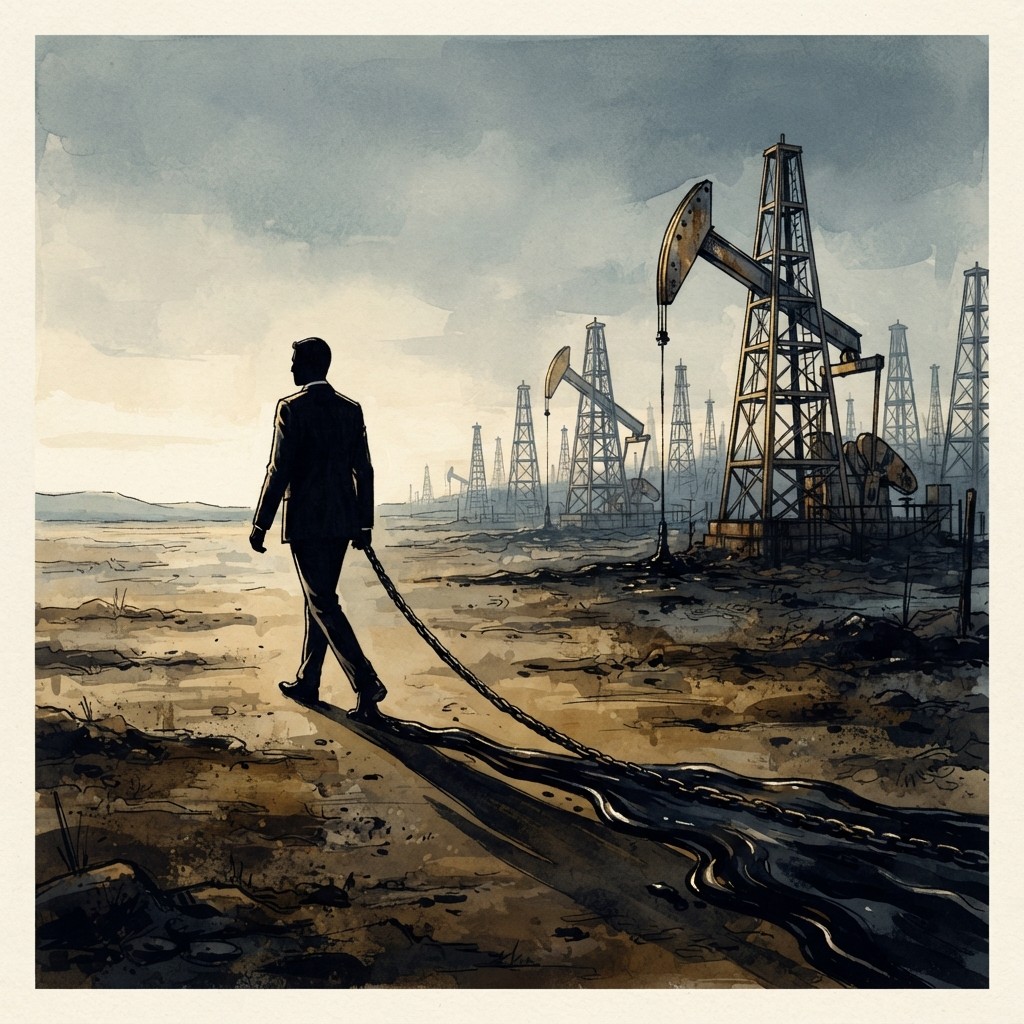
Pairs with the Crisis Response Playbook — a ready-to-use strategy tool, filled for Shell. Included in the Crisis Response Casebook →
“What is one more quarter of not acting worth?”
In March 2025, Shell finished selling the part of itself that produced oil in the onshore Niger Delta. The Shell Petroleum Development Company — SPDC, the entity with its name on the pipelines and the spill records — went to a Nigerian-led consortium called Renaissance.6 On paper it was a clean exit: a roughly $2.8 billion business with eighteen leases, gone from the books, no significant impairment expected.7 Three months later, a judge in London made the obvious move look a lot less clean. She ruled that Shell could still be sued for the pollution those pipelines left behind — even though Shell no longer owned them.1
The official story is that Shell divested SPDC to focus its Nigeria portfolio on deepwater and gas, and that the sale closed the book on a difficult onshore chapter. That is half true. The chapter that closed was operational. The chapter that stayed open was legal — and you cannot sell a contingent liability the way you sell an oil field.
Here is the thesis a smart friend could repeat at dinner: Shell bought its way out of operating in the Niger Delta, but it did not buy its way out of being answerable for it. The divestiture transferred the assets and the day-to-day risk. It left the legal exposure exactly where it was — sitting on the parent company, waiting for a 2027 trial. And in a separate courtroom in The Hague, a climate case Shell is widely thought to have lost, then won, is in fact still undecided. Two drags, both unresolved, both wearing the costume of a finished story.
You can sell the field. You can't sell the spill.
The mechanism here is the gap between an asset and an obligation. When you sell an asset, the buyer takes the upside and the going-forward risk. But a claim for pollution that already happened — before the sale, on infrastructure the parent oversaw for decades — does not automatically travel to the new owner. It can stay anchored to whoever had control when the harm occurred. That is precisely what the UK High Court signalled on 20 June 2025: Mrs Justice May ruled in Alame v Shell Plc that Shell plc and its former Nigerian subsidiary can be held liable for historic oil pollution, with the full trial set for March 2027.1 The buyer got the leases. The parent kept the lawsuit.
This was not a sudden ambush. The path was cleared eight months before the sale completed. In October 2024 the UK Court of Appeal granted the Bille and Ogale communities' appeal, overturning a lower ruling that had loaded claimants with an effectively impossible burden of proof and allowing the case to proceed to a real trial.2 So when Shell closed the SPDC sale in March 2025, it already knew the litigation door was open. The divestiture didn't shut that door. It just changed who was standing on the other side of it.
The Dutch case Shell didn't win and didn't lose
The second drag is cleaner to misread, because it has a famous headline number attached. In May 2021, the Hague District Court did something no court had done before: it ordered an individual private company to cut its group-wide CO2 emissions — across Scopes 1, 2 and 3 — by at least net 45% by the end of 2030, measured against 2019.4 That ruling travelled the world as the moment a court bound an oil major to the Paris Agreement. Most people stopped reading there.
They missed the reversal. On 12 November 2024 the Hague Court of Appeal overturned that order.3 But it did not let Shell off the hook either — and this is the part that matters. The appeals court affirmed that Shell has a duty of care on emissions. What it rejected was the 45% figure: it held that a global or national reduction pathway cannot be translated into a legally binding, company-specific percentage imposed by a civil court.3 A duty, yes. A precise number a judge can enforce, no. So the case ended neither in defeat nor victory — it ended in an unstable draw.
And an unstable draw is not a resting place. In February 2025, Milieudefensie filed a further appeal to the Dutch Supreme Court, arguing the appellate ruling failed to deliver effective protection against dangerous climate change and asking, once again, for a minimum specific reduction percentage.5 The headline says the climate case is over. The docket says it is alive at the highest court in the country.
| The tidy version | The actual status | |
|---|---|---|
| Nigeria oil spills | Sold SPDC, exited, done | Parent can still be liable; trial March 2027 |
| Dutch climate ruling | Court ordered a 45% cut | Order overturned; duty of care affirmed, no number |
| Climate case outcome | Shell lost / Shell won | At the Supreme Court on further appeal |
| Nigeria footprint | Fully exited | Deepwater and gas retained; JV continues |
Whose oil is on the ground, anyway?
The honest counter to all of this is that Shell may simply be right on the merits. Its consistent defence — taken seriously in the preliminary proceedings — is that a great deal of Niger Delta pollution comes not from operational failure but from third-party theft and illegal refining: people tapping the pipelines, the oil ending up in the creeks. The June 2025 ruling found that the former subsidiary could in principle be liable for failing to prevent third-party spills, but it pointedly left the causation merits unadjudicated until the 2027 trial.1 In other words, the question of who is actually responsible for which spill is exactly what hasn't been decided yet.
But the steelman cuts both ways. The 2011 UNEP assessment of Ogoniland found benzene in community drinking water far above WHO safe limits, found that Shell had failed to adhere to its own infrastructure maintenance standards, and estimated thirty years for the ecosystem to recover.8 Amnesty International and independent researchers have argued that corrosion and equipment failure — not only sabotage — were major historical causes, citing internal documents and that UNEP work.8 So 'it was mostly thieves' is a genuine defence with evidence behind it, and 'it was partly Shell's own neglected kit' is a genuine charge with evidence behind it. Which is the point: this is not a story with a known ending. It is a $2.8 billion business that left the balance sheet while its biggest question stayed on it.
“Shell completes sale of SPDC to focus its portfolio in Nigeria on Deepwater and Integrated Gas positions.”6
And Shell hasn't actually left Nigeria. The SPDC sale was an onshore oil exit, not a country exit; Shell retains its deepwater and integrated-gas positions, and the joint venture it sold into continues to operate with new and existing partners.6 So the company that divested the spill records still does business a few kilometres offshore from the communities suing it. The exit was real. It was also narrow.
The instinct under pressure is to sell the problem — shed the subsidiary, exit the region, change the headline. It works for operational risk: the buyer takes the wells, the workers, the going-forward spills. It does not work for legacy legal exposure, because courts can keep a claim anchored to whoever controlled the harm when it happened. The lesson for any company trying to litigate-proof an exit: a sale answers 'who operates this now?' It does not answer 'who is responsible for what already happened?' Those are two different ledgers, and the second one doesn't have a transfer button. The cleaner the press release looks, the more worth checking whether the liability actually went anywhere — or just changed seats.
Shell did the strategically sensible thing twice. It exited a chronic onshore liability and focused on higher-return offshore barrels. It fought a precedent-setting climate order to a reversal. By any operating measure, both were wins. But a win that leaves a 2027 trial date standing and a Supreme Court appeal pending is not closure — it's deferral wearing closure's clothes. Shell bought its way out of operating the Niger Delta and out of a 45% mandate. What it could not buy, in either case, was the verdict. The fields changed hands. The questions didn't.
Crisis Response Playbook
A playbook for a crisis already in motion: who decides, which plays fire on which trigger, and what gets said to whom. It replaces panic and the all-hands meeting with a pre-agreed sequence each person can run alone. Blank to pre-load before a crisis hits; filled as the worked example reconstructing the plays the story's team ran — and the ones they should have.
Included, filled and blank, in the Crisis Response Casebook. See the set → · Preview the blank →
Sources
Where this comes from — the filings, records, and reporting behind it.
- 1On 20 June 2025, Mrs Justice May ruled in Alame & ors v Shell Plc [2025] EWHC 1539 (KB) that Shell plc and its former Nigerian subsidiary can be held liable for historic oil pollution in the Niger Delta; full trial is set for March 2027.
- 2On 11 October 2024, the UK Court of Appeal granted a landmark appeal allowing the Bille and Ogale communities' oil-pollution claims against Shell to proceed, overturning the March 2024 High Court ruling that had imposed an impossibly high 'global claims' burden on claimants.
- 3On 12 November 2024, the Hague Court of Appeal (ECLI:NL:GHDHA:2024:2099) overturned the 2021 District Court ruling that had ordered Shell to reduce CO2 emissions by net 45% by 2030, finding that no specific reduction percentage can be imposed on a private company by a civil court, while affirming Shell has a duty of care on emissions.
- 4The original 26 May 2021 Hague District Court ruling (ECLI:NL:RBDHA:2021:5339) ordered Royal Dutch Shell to reduce group-wide CO2 emissions across Scopes 1, 2 and 3 by at least 45% net by end-2030 relative to 2019 — the first time any national court ordered an individual private company to meet specific emissions targets consistent with the Paris Agreement.
- 5Milieudefensie filed a further appeal to the Dutch Supreme Court on 11 February 2025 seeking a minimum specific CO2 reduction percentage for Shell, arguing the appeals court failed to ensure effective protection against dangerous climate change.
- 6Shell completed the sale of SPDC to Renaissance (a consortium of ND Western, Aradel Energy, First E&P, Waltersmith and Petrolin) in March 2025, as announced 16 January 2024, divesting its 30% stake in the SPDC JV and exiting onshore Niger Delta oil production.
- 7The book value of SPDC at announcement of its sale in January 2024 was approximately $2.8 billion; the SPDC JV held 15 oil mining leases onshore and 3 in shallow water in Nigeria; Shell stated no significant impairments were expected on completion.
- 8The 2011 UNEP Environmental Assessment of Ogoniland found benzene contamination in community drinking water at levels far exceeding WHO safe limits, and found Shell had failed to adhere to its own infrastructure maintenance standards; UNEP estimated 30 years for ecosystem recovery. Shell's post-sale liability exposure for pre-divestiture pollution is ongoing and contested.
Weighing outside help with a decision like this? Hiring a supply chain strategy consultant
More like this — beyond Shell
New Strategically analyses as they publish: the defining moves in business, checked against the record. No noise, and one click to leave.