Pairs with the Cannibalization Decision Tree — a ready-to-use strategy tool, filled for Atari. Included in the The Cannibalization Choice Casebook →
In 1982 Atari shipped a new console whose guts it had already built. The 5200 ran on the same CPU and chipset as Atari's own 400/800 home computers — meaning it could, with almost no effort, have played a vast existing software library and the 2600's games besides.8 Atari chose otherwise. Its engineers deliberately made the 5200 incompatible with both. The most powerful platform asset the company owned — a installed base of millions of 2600 cartridges — was locked out of its own successor on purpose. That single decision, more than any landfill, is the real story of how Atari fumbled the future.
The official story is that Atari was killed by a bad game about an alien. Almost none of that survives contact with the record. E.T. sold over 2.6 million copies and charted on Billboard's Top 15.5 It wasn't even the worst-reviewed 2600 game its launch month.6 The thing that actually broke Atari happened a year earlier, in a hardware lab — and it was a strategy failure dressed up as an engineering choice.
A complement is not a successor
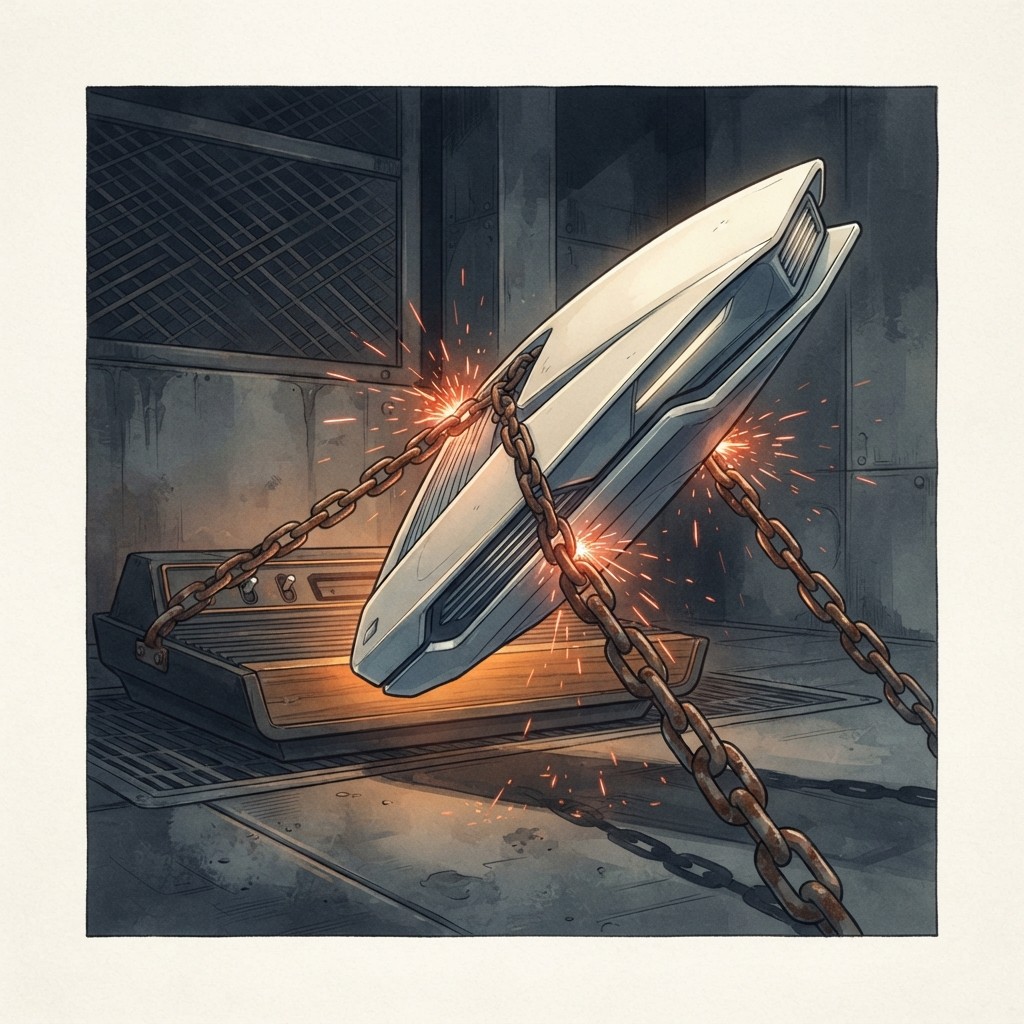
Here is the framing that doomed it. Atari did not build the 5200 to replace the 2600. It built it as a 'higher-end complement' — the consumer-electronics chief compared it to a carmaker offering different models, a premium line sitting alongside the economy one.3 That metaphor is the whole mistake. A carmaker can sell a sedan and an SUV because a buyer needs one car. A console maker is not selling a car; it is selling entry to a software library, and a household does not want two libraries that don't talk to each other. By keeping the 2600 in production and development while launching a $299.95 machine that played none of its games, Atari didn't widen its market.3 It split it down the middle and asked customers to pick a side.
| What Atari did | The two clean options it skipped | |
|---|---|---|
| The 2600 | Kept selling and developing for it | Either sunset it, or fold it into the new platform |
| The 5200 | Launched as a parallel 'premium' line at $299.95 | Make it the single, backward-compatible successor |
| The 2600 game library | Locked out of the 5200 by design | Carried forward as the new machine's launch catalog |
| The customer's choice | Pick one of two incompatible boxes | Upgrade without losing what they owned |
The cruelest detail is that backward compatibility was nearly free. The 5200 shared silicon with the 400/800; the path to playing that software — and, with an adapter, the 2600's — was short.8 Atari walked away from it. The incompatibility wasn't a limitation imposed by physics or cost. It was imposed by Atari on itself.
The org chart did the sabotaging
Why would a company cripple its own machine? Because the decision wasn't made by 'a company.' It was made by warring divisions. The 5200 was deliberately made incompatible with Atari's own 400/800 computer software partly because of rivalry between the groups that built consoles and the groups that built computers.8 Each division was protecting its turf — its products, its software revenue, its reason to exist — and the structurally rational move for each was to make sure the other's library couldn't run on its hardware. The result was rational for every department and catastrophic for the company. This is the deeper point: cannibalization is not really a product decision. It is an organizational one. A company that cannot decide internally which product is allowed to die will ship the indecision as a feature — and customers will feel it as friction. Atari's fragmentation wasn't a side effect of the 5200. It was designed into the circuit board.
Whether a new platform can run the old one's software looks like a question for the hardware team. It almost never is. It's a question about which of your products is allowed to win — and which department is allowed to lose. When that fight is unresolved, the org ships its internal standoff as 'incompatibility,' and the customer pays the tax. If two of your divisions each have a veto over the other's library, you don't have a platform strategy. You have a ceasefire, and the market will route around it.
No successor when the floor gave way
The bill arrived fast. On December 8, 1982, Warner Communications — which had bought Atari in 1976 for $28 million1 — reported only a 10% earnings increase against the 50% analysts had been promised, blaming weak Atari sales from unsold games and rising competition. The stock fell 33% in a single day, and another 7% the next.4 Then the industry itself caved in. By mid-1983 Atari had lost $356 million and cut 30% of its 10,000 employees, as U.S. video-game revenue began a slide from roughly $3.2 billion in 1982 toward under $100 million by 1985 — a 97% contraction.7 And here is where the cannibalization failure becomes fatal rather than merely wasteful. When the 2600's market collapsed, Atari had no lifeboat. The 5200 should have been the platform that absorbed the survivors of the old generation. Instead it was a separate, incompatible product with no library to inherit, launched into a market that was about to stop buying consoles at any price. Atari had built a successor and forbidden it from succeeding.
“It was created in the same spirit in which an automobile manufacturer builds different models.”3
Wasn't it really E.T. and a flooded market?
The fair objection is that the 1983 crash was an industry event, not an Atari blunder — too many publishers, too much shovelware, home computers eating the low end, and an aging platform reaching its natural end.7 That's true, and it matters: even a perfectly executed transition would have hit a brutal market. But it sharpens the indictment rather than softening it. A crash is exactly the moment a clean successor earns its keep. If the 5200 had been the single backward-compatible home for the 2600's enormous library, Atari would have entered the downturn with one strong platform and a reason for customers to stay loyal instead of two weak ones and a reason to leave. As for E.T. — it was a symptom of the glut, not its cause; it sold millions and reviewed acceptably at the time.56 The buried cartridges at Alamogordo were a mix of titles, not 'millions of E.T. carts,' and the legend grew in the retelling.5 Blaming one alien is comforting because it makes the failure a fluke. The incompatibility was not a fluke. It was a choice, made over and over, by an organization that couldn't agree on what to keep.
Atari's tragedy wasn't that it failed to disrupt itself. It built the very machine that could have done it — same chips, a short path to compatibility, a ready-made library waiting to migrate.8 It just couldn't decide internally to let that happen, so it shipped the indecision instead: two consoles that refused to speak to each other, sold side by side until the market that bought both disappeared. The lesson outlived the company. When you can't choose which of your products is allowed to die, the choice doesn't go away. It hardens into your architecture — and then it dies for you, on its own schedule, taking the rest with it.
When a company can't get out of its own way
Cannibalization Decision Tree
A decision tree for the moment the new thing threatens the cash cow: is the disruption real, will someone else do it if you don't, and can you afford to bleed your own margin to own the future? Blank to run on your own line; filled as the worked example tracing how the story's incumbent chose to cannibalize — or flinched and got cannibalized.
Included, filled and blank, in the The Cannibalization Choice Casebook. See the set → · Preview the blank →
Sources
Where this comes from — the filings, records, and reporting behind it.
- 1Warner Communications acquired Atari for $28 million in October/November 1976, with Bushnell personally receiving $15 million of that sum.
- 2Atari's official history page states Bushnell sold the company to Warner Communications for $28 million in 1976 to continue funding development of the VCS.
- 3The Atari 5200 was introduced in 1982 as a 'higher-end complement' to the Atari VCS (renamed 2600 at launch); contemporary Atari consumer electronics division president Michael Moone stated it was created 'in the same spirit in which an automobile manufacturer builds different models.' The 5200 was not backward-compatible with the 2600's game library and launched at $299.95.
- 4On December 8, 1982, Warner Communications' stock dropped 33% in a single day after it reported only a 10% earnings increase (vs. the 50% analysts had been promised), blaming lower Atari sales from unsold games and increased competition; stock fell a further 7% the next day.
- 5E.T. sold over 2.6 million copies by end of 1982 and appeared on Billboard's Top 15 Video Games list in December 1982 and January 1983; at least 669,000 copies were later returned in 1983. The landfill excavation in 2014 confirmed that E.T. cartridges were only a portion of the ~800,000 total games buried — not 'millions of E.T. carts.'
- 6E.T. was not a cause of the 1983 crash but a symptom; it was not considered the 'worst game ever' at time of release (Arcade Express scored it 6/10 in December 1982, and it was not even the worst-reviewed game that month on the 2600 — Gorf scored lower). The 'worst game ever' reputation is a retroactive construct.
- 7The 1983 crash had multiple causes: Atari's share of the cartridge-game market fell from 75% in 1981 to under 40% in 1982; by mid-1983 Atari had lost $356 million and laid off 30% of its 10,000 employees. U.S. video game revenues fell from ~$3.2 billion in 1982 to under $100 million by 1985 — a ~97% contraction.
- 8The Atari 5200's internal incompatibility with both the 2600 library and Atari's own 400/800 computer software was caused partly by inter-divisional rivalry within Atari; the 5200 used the same CPU and chipset as the 400/800 but was deliberately made incompatible. Atari eventually released a 2600 adapter for the 5200 but it arrived too late and only worked on certain hardware revisions.The Silicon Underground, Why the Atari 5200 failed ↗ · 2025-06-20
More like this — beyond Atari
New Strategically analyses as they publish: the defining moves in business, checked against the record. No noise, and one click to leave.