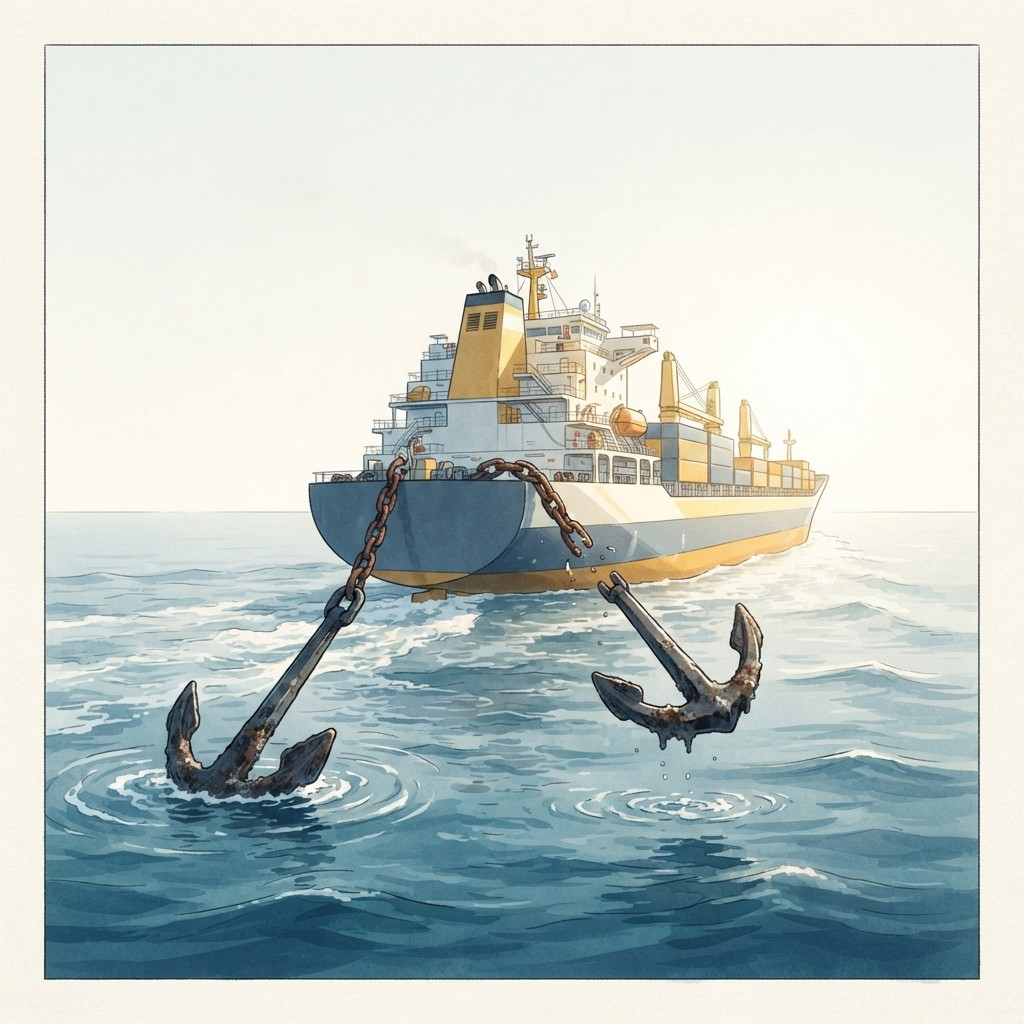
IBM sold the keyboard that made it famous — and then gave away a $19-billion business for free. The strangest part is that both moves were the exact same bet.
Pairs with the Cannibalization Decision Tree — a ready-to-use strategy tool. Included in the The Cannibalization Choice Casebook →
Sixteen years apart, IBM ran the same play and almost nobody noticed it was the same play. In May 2005 it handed the business that put the IBM logo on millions of desks — the ThinkPad, the Personal Computing Division — to a Chinese company called Lenovo.3 In November 2021 it cut loose a $19-billion services arm, christened it Kyndryl, and gave the shares away to its own stockholders.6 One was a sale to a buyer. One was a spinoff to nobody. They look like different decisions made by different IBMs. They were the same trade twice.
The official story is that IBM was pruning — trimming a tired commodity here, a low-growth service there, to keep the portfolio fresh. The real story is narrower and more deliberate: IBM was deliberately throwing revenue overboard. Both units were big. Both were shrinking or bleeding. And both dragged down the one number IBM had decided to be valued on — margin. The genius and the cost of these exits are the same fact: IBM chose to be smaller on purpose.
The trade hiding inside both deals: why throwing revenue overboard can lift everything that stays on the ship
Here is the move, stripped to its mechanism. A diversified company is priced as a blend. The market takes its high-margin, fast-growing parts and its low-margin, slow-or-shrinking parts and gives the whole thing one multiple — a weighted average that punishes the good businesses for sitting next to the bad ones. Cut out the worst-rated unit and two things happen at once: revenue falls, which looks like failure, and the average margin and growth rate of everything that remains rises, which is the entire point. You accept a smaller top line today to buy a higher multiple on a cleaner business tomorrow. That is a cannibalization trade — eating your own revenue to feed your own valuation.
The PC division was the textbook case, because it wasn't merely low-margin — it was losing money. IBM's own SEC-filed financials for the unit showed operating losses of $397M in 2001, $171M in 2002, and $258M in 2003, plus another $139M in the first half of 2004.2 That is roughly $965M of operating losses over four years, and it kept happening even after IBM outsourced most of the manufacturing in 2002.5 The popular telling that the PC unit was 'barely breaking even' is too kind by about a billion dollars. IBM wasn't trimming a flat business. It was stopping a hemorrhage — and getting paid to do it.
“The business has a history of recurring losses, negative working capital, and an accumulated deficit.”2
What the $1.25 billion headline left out: the parts of the deal that never made the press release
The deal announced in December 2004 is remembered as a $1.25 billion sale, and that number is real but partial — it covers only the cash and equity Lenovo paid.1 On top of it, Lenovo assumed roughly $500M of IBM liabilities, which is why contemporaneous reporting put the total transaction at about $1.75 billion.4 And IBM didn't fully walk away: it took an 18.9% equity stake in Lenovo at closing.1 So the structure wasn't 'sell the loser and leave.' It was 'hand off the operating burden, keep a slice of the upside, and book the rest as someone else's problem.' The combined PC business carried about $12B of annual revenue and 19,000 employees out the door — revenue IBM was, quite literally, happy to lose.1
Kyndryl rhymes with all of it. IBM didn't sell it; it distributed the shares tax-free to existing stockholders on November 3, 2021, which is just a different financial wrapper around the same intent — get the unit off IBM's books without triggering a tax bill.68 And the registration statement said the quiet part in plain corporate English: both companies would each have 'a more focused business better positioned to invest more in growth opportunities.'8 'More focused' is the polite word for what was happening to IBM's reported numbers. Strip out a roughly $19B unit and the rest of IBM instantly looks more like a software-and-cloud company, because it suddenly is one — by subtraction rather than by growth.
| PC division → Lenovo (2005) | Kyndryl spinoff (2021) | |
|---|---|---|
| Mechanism | Sale to a buyer | Tax-free distribution to shareholders |
| Revenue shed | ~$12B combined PC business | ~$19B managed-services unit |
| Why it dragged the multiple | Recurring operating losses | Years of declining revenue |
| Direction after leaving IBM | Commodity PC market, structural decline | Revenue kept falling |
| What IBM kept | 18.9% equity stake in Lenovo | A cleaner, higher-margin remainder |
Both businesses got worse the moment they left: IBM didn't free trapped growth engines — it uncoupled the slowest cars
Here is the detail that turns this from a tidy story into a real one. IBM did not spin off growing assets and then watch them flourish elsewhere. It cut loose units that were already in decline — and the decline continued on the other side of the door. Kyndryl is the cleanest example: its revenue had been falling inside IBM for years, from $21.8B in 2018 to $20.3B in 2019 to $19.4B in 2020, and after the spin it kept right on falling, to about $18.3B for the fiscal year ending March 2022 and roughly $17B the year after.7 IBM didn't free a trapped growth engine. It identified the slowest car in the train and uncoupled it.
Isn't this just dressing up failure as strategy?: the two tests that separate a real trade from a company slowly disappearing
The honest objection is sharp: if you keep cutting the parts that don't grow, you don't have a strategy, you have a company slowly disappearing — and re-rating the remainder is a magic trick, not a business. There's truth in that. A cleaner average is not the same as more profit, and a company that grows mainly by subtraction eventually runs out of things to subtract. But the objection misses what made these specific cuts defensible. The PC unit wasn't slow growth; it was a documented cash drain that even outsourced manufacturing couldn't fix.25 Kyndryl wasn't a misjudged keeper; it was a unit already shrinking three years running, whose decline simply continued in independent hands.7 Cutting a part that is destroying value frees real capital and management attention for software and cloud — and choosing which businesses to no longer be in is one of the few genuine strategic decisions a giant company has left. The trade is only a trick when you cut something that would have thrived. IBM, by the numbers it filed itself, mostly didn't.
When a diversified company sells or spins off a big, well-known unit, read past the press release's language of 'focus.' The real engine is almost always the blended multiple: the market prices the whole as a weighted average, so cutting the worst-rated part lifts the average of everything that remains — without anyone selling a single extra product. Two tests separate a real trade from a vanishing act. First: was the cut unit actually destroying value (losses, structural decline) or just unloved? IBM's PC division lost ~$965M over four years; Kyndryl's revenue fell for years before and after the spin — those are real. Second: does the remaining business have its own growth, or is subtraction the only growth left? Re-rating buys time and a cleaner story. It does not, by itself, build the thing the cleaner story is supposed to be about.
IBM is the company that taught the world to type on a keyboard with its name on it, and then decided that owning that keyboard made it worth less. That is the whole logic of both exits: in a portfolio priced as a blend, your biggest, most famous business can be the one quietly holding down your value, and the bravest financial move is to let it go to someone who wants it more — or to no one at all. IBM ran that calculation twice, in 2005 and in 2021, and twice it chose to be smaller, cleaner, and harder to copy. The PC and Kyndryl both kept shrinking after they left. That wasn't IBM's failure of foresight. It was the proof IBM had read the train correctly.
Cannibalization Decision Tree
A decision tree for the moment the new thing threatens the cash cow: is the disruption real, will someone else do it if you don't, and can you afford to bleed your own margin to own the future? Blank to run on your own line; filled as the worked example tracing how the story's incumbent chose to cannibalize — or flinched and got cannibalized.
Included, filled and blank, in the The Cannibalization Choice Casebook. See the set → · Preview the blank →
Sources
Where this comes from — the filings, records, and reporting behind it.
- 1IBM and Lenovo announced a definitive agreement on December 7–8, 2004; Lenovo would acquire IBM's Personal Computing Division for total consideration of approximately $1.75 billion ($1.25 billion in cash and equity plus IBM taking an 18.9% equity stake in Lenovo); the combined PC business would have ~$12B annual revenue and ~19,000 employees.
- 2IBM's PC division filed separate financials (via SEC 8-K) showing operating losses of $397M in 2001, $171M in 2002, $258M in 2003, and $139M in H1 2004; IBM itself stated 'the business has a history of recurring losses, negative working capital, and an accumulated deficit.'
- 3Lenovo completed the acquisition of IBM's Personal Computing Division on May 1, 2005, creating the world's third-largest PC company; IBM received an 18.9% equity stake in Lenovo at closing.
- 4The Washington Post's contemporaneous report (Dec 8, 2004) details the deal structure as: Lenovo paying $650M cash + up to $600M in common stock, plus assuming $500M in IBM liabilities; IBM to receive an 18.9% equity stake in Lenovo.
- 5IBM's PC division operating losses of $397M (2001), $171M (2002), and $258M (2003) were disclosed in an SEC regulatory filing; IBM had outsourced most PC manufacturing to Sanmina-SCI in 2002 yet losses continued.
- 6On November 3, 2021, IBM completed the legal and structural separation and tax-free distribution to its stockholders of all outstanding shares of Kyndryl Holdings, Inc., spinning off IBM's managed infrastructure services business.
- 7Kyndryl's pre-spinoff revenue was already in structural decline: $21.8B (2018), $20.3B (2019), $19.4B (2020); post-spin, revenue fell further to $18.3B (FY March 2022) and $17B (FY March 2023); the unit had ~90,000 employees and ~4,400 customers at separation.
- 8Kyndryl's Form DRS/A (SEC registration statement) states that following the spinoff, both IBM and Kyndryl would each have 'a more focused business better positioned to invest more in growth opportunities'; IBM structured the spin as a tax-free distribution under U.S. federal income tax law.
More like this — beyond IBM
New Strategically analyses as they publish: the defining moves in business, checked against the record. No noise, and one click to leave.