Pairs with the Profit-Engine Map — a ready-to-use strategy tool. Included in the Money Machine Casebook →
“Where does the money actually come from, and who sets the rate it comes in at?”
Picture the moment everyone now recognizes: the email arrives, your streaming service is going up by a few dollars, and you feel something between a sigh and a grudge. You are not alone. By late 2025, 75% of streaming viewers said price increases frustrate them, and 61% said they would cancel their favorite service over a five-dollar bump.5 That feeling has a name now — subscription fatigue — and a tidy obituary attached to it: the recurring-revenue model has finally outrun what people will tolerate. It is a clean story. It is also two different stories wearing the same coat.
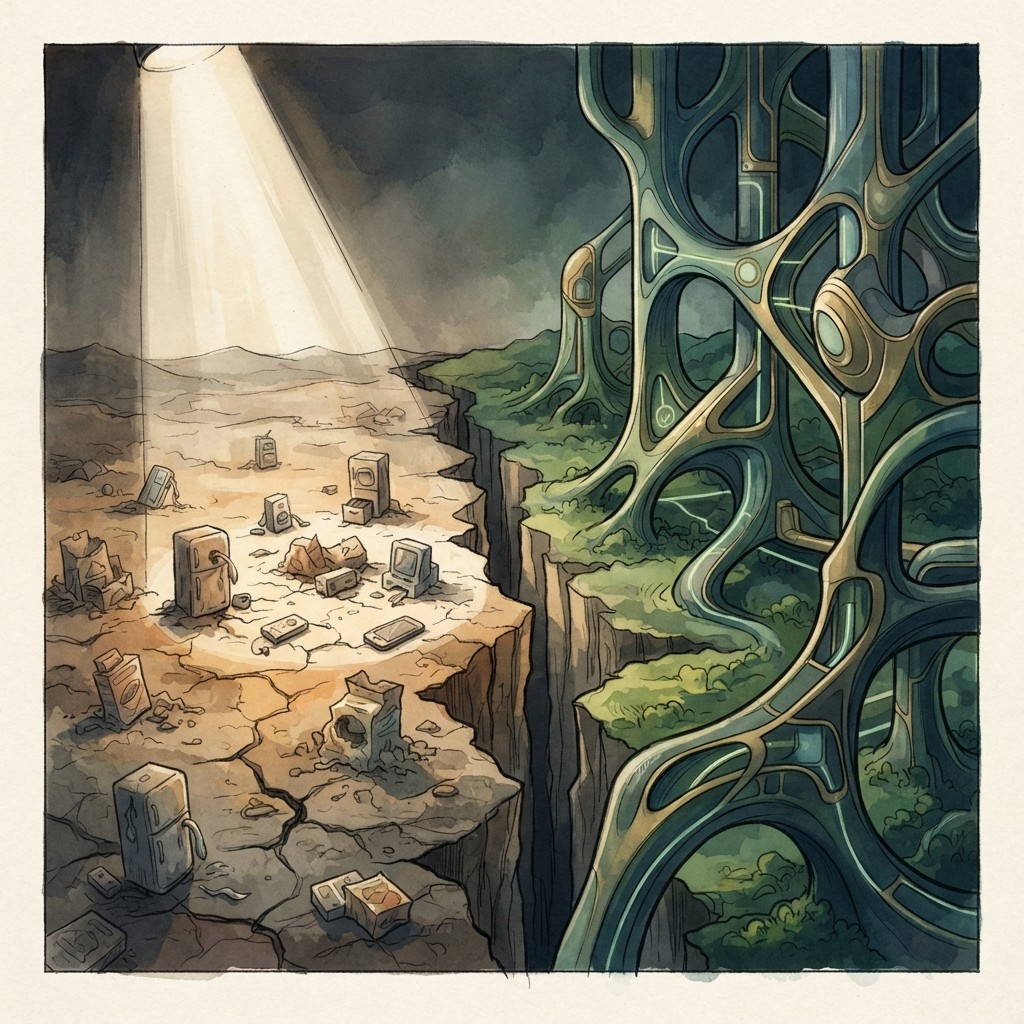
The official version says the subscription economy is buckling under its own weight — too many bills, too much friction, a model that overreached. The truer version is narrower and stranger: one consumer category is in genuine pain while the larger machine keeps compounding. The fatigue is real. It just isn't where the headline points.
Two economies are being mistaken for one
Here is the thesis a smart friend could repeat at dinner: subscription fatigue is a value-delivery problem in media and a pricing-trust problem at the cash register — not a structural collapse of the subscription model. The reason the two get fused is that the painful part is the visible part. You feel your Netflix bill; you do not feel your employer's Salesforce contract. But that invisible part is where the money actually lives. Grand View Research pegs the global subscription economy at roughly $492 billion in 2024, and B2B subscriptions hold about 55% of that revenue — with the SaaS and tech segment forecast to be the fastest-growing slice through 2033.8 The angry consumer is real, loud, and a minority shareholder in the thing being eulogized.
| Consumer streaming | The broader subscription economy | |
|---|---|---|
| Who feels the bill | Households, monthly, visibly | Mostly businesses, contractually |
| Dominant mood | Frustration over price | Continued growth |
| Share of the market | A loud minority | B2B alone is ~55% of revenue |
| The real problem | Content no longer worth the price | Trust in how prices change |
| Direction of travel | Churning toward ad-supported tiers | Outgrowing the S&P 500, by a shrinking margin |
Why the streaming pain is a value problem, not a model problem
Watch what people actually do, not just what they grumble about. In Deloitte's 2026 survey, 41% of consumers churned a streaming service in the last six months, with millennials leading at 52%.5 That sounds like an exodus. But look at where they go: 68% of streaming households now keep at least one ad-supported service, up more than twenty points from 2024.5 They are not abandoning subscriptions. They are renegotiating the price by accepting ads. The fatigue is specific — 41% say the content simply isn't worth what it costs4 — and the response is a downgrade, not a divorce. That is the signature of a value-delivery failure, not a rejection of recurring billing itself.
The causal mechanism is subtler than 'too many subscriptions.' A peer-reviewed study of streaming multi-homers found that what actually drives people to cancel isn't the number of services — it's the search cost of finding something worth watching across them, compounded by the fee.10 When the recommendations are good and the catalog feels deep, fatigue eases; when you pay to scroll, it spikes. The problem was never that the bill recurs. It's that the value stopped showing up at the same cadence the charge did.
The numbers everyone repeats are quietly out of date
The fatigue narrative leans on two pillars, and both have eroded. The first is the famous boast that subscription companies grew 4.6 times faster than the S&P 500 — a figure that lives forever in slide decks. It was true, in February 2022, over a ten-year window.3 By Zuora's April 2024 report the multiple had fallen to 3.4x.2 By April 2025, over a two-year window, the gap had narrowed to 11% faster.1 The outperformance is real and it persists — but it is shrinking, and it measures Zuora's own roughly 600 billing customers, not the whole economy. Cite the peak number without the date and you are quoting a high-water mark as if it were the tide.
“SEI companies grew revenue 11% faster than the S&P 500 over the past two years.”1
The second pillar is regulation. For most of 2024 and 2025, articles framed the FTC's 'click-to-cancel' rule as the hammer about to fall on dark-pattern subscriptions — cancellation made as hard as a hostage negotiation. The rule was indeed finalized on October 16, 2024.6 But the Eighth Circuit vacated it on July 8, 2025, finding the FTC's rulemaking procedurally insufficient, and it is now unenforceable.7 So the regulatory pressure the narrative invokes is, for the moment, gone — even as the underlying grievance it was meant to address remains. The FTC was fielding nearly 70 subscription complaints a day in 2024, up from 42 in 2021.9 The anger is documented. The enforcement tool isn't there.
The honest counter: isn't the friction the whole point?
The fair objection cuts deep: maybe the recurring model only ever worked because it was hard to leave. If 47% of cancellations are driven by price increases1 and complaints to the FTC keep climbing,9 perhaps the entire category is a quiet tax that survives on inertia — and the fatigue is the sound of inertia finally breaking. There is truth in this. A business that grows because customers forget to cancel is not a healthy business; it is a leak with a logo. The Zuora figure that 70% of subscription revenue comes from existing customers3 reads as loyalty until you ask how much of it is just friction.
But the data refuses to support a collapse. Even amid the fatigue, 68% of U.S. consumers signed up for a new subscription for the first time in 2024.1 Households kept spending the same $69 a month on streaming while complaining about it.5 People aren't fleeing the model; they are demanding it earn its place — switching to ad tiers, cancelling and re-subscribing, treating each charge as a renewed vote. The friction defense gets the diagnosis backwards. The companies in trouble are the ones whose only retention strategy was making the exit narrow. The ones thriving made the exit easy and the value obvious, and let the customer choose to stay.
The instinct when churn rises is to defend the perimeter — harder cancellation, longer commitments, the dark-pattern toolkit. That treats fatigue as a leak to plug. It's better read as a signal that the value and the charge have fallen out of sync. The businesses still outgrowing the market — B2B SaaS, hybrid-monetization players using four or more revenue models — win on delivered value, not trapped customers. The diagnostic question isn't 'how do we make leaving harder?' It's 'would they re-buy this today at this price, with the label on and the door open?' Where the answer is yes, the recurring model is a money machine. Where it's no, no amount of friction saves it — it only postpones the verdict and earns you a regulator's attention.
Subscription fatigue is best understood as a single coat thrown over two very different bodies. One is a streaming customer who feels overcharged for a catalog that stopped surprising them — a real problem, and a fixable one, because it's about value, not about the calendar of the charge. The other is a half-trillion-dollar economy, led by businesses paying for tools they'd repurchase tomorrow, still growing faster than the market that supposedly killed it. The mistake the headline makes is to hear one of them sigh and pronounce both of them dead. The model isn't tired. The customer is just done paying for things that stopped being worth it — which is not fatigue at all. It's the market doing its job.
Other businesses that get paid the same way every month
Profit-Engine Map
A one-page map that pulls a business apart into the hook that gets the customer in the door and the engine that quietly earns the margin. Use it to see where the real profit lives, how the two halves are wired together, and what breaks if the link is cut. Blank to dissect your own P&L; filled as the worked example of a business whose advertised product is not where it makes its money.
Included, filled and blank, in the Money Machine Casebook. See the set → · Preview the blank →
Sources
Where this comes from — the filings, records, and reporting behind it.
- 1Zuora's 2025 SEI (covering 600+ companies, April 2025 release): SEI companies grew revenue 11% faster than the S&P 500 over the past two years; 68% of U.S. consumers subscribed to a new service for the first time in 2024; 47% of 2024 cancellations were driven by price increases; companies using four or more revenue models saw 4.5% faster ARPA growth.
- 2Zuora's April 2024 SEI (12-year window): SEI companies grew 3.4x faster than the S&P 500; in 2023 SEI revenue grew 10.4% vs. 6% for the S&P 500.
- 3Zuora's February 2022 SEI (10-year window): SEI companies grew 4.6x faster than the S&P 500 (CAGR 17.5% vs. 3.8%); SaaS grew 19.4% CAGR 2018–2021; 70% of subscription revenue comes from existing customers on average.
- 4Deloitte 2025 Digital Media Trends (19th edition, n=3,595, fielded October 2024): 47% of consumers say they pay too much for streaming; 41% say content isn't worth the price (up 5% from 2024); ad-free SVOD average price reached ~$16/month; younger generations increasingly canceling or switching to cheaper/ad-supported tiers.
- 5Deloitte 2026 Digital Media Trends (20th edition, n=3,575, fielded October–November 2025): 75% of consumers frustrated by streaming price increases; 61% would cancel favorite SVOD service for a $5 price hike; average subscribing household spends $69/month on SVOD (flat YoY); 41% of consumers overall churned an SVOD service in the last six months; millennials lead at 52% churn; 68% of SVOD households now have at least one ad-supported (AVOD) service, up 20+ percentage points from 2024.
- 6FTC finalized the 'Click-to-Cancel' Negative Option Rule on October 16, 2024 (3–2 vote), requiring cancellation to be as easy as sign-up; civil penalties up to $51,744 per violation; the Eighth Circuit (Custom Communications, Inc. v. FTC) vacated the rule on July 8, 2025, finding procedural insufficiency in the FTC's rulemaking (failure to prepare a required preliminary economic analysis); the rule is unenforceable as of July 14, 2025.
- 7Eighth Circuit vacatur of FTC Click-to-Cancel rule: On July 8, 2025, the U.S. Court of Appeals for the Eighth Circuit vacated the rule, ruling FTC's rulemaking process was 'procedurally insufficient'; the court did not reach the rule's substantive merits; businesses are no longer obligated to comply.
- 8Grand View Research estimates global subscription economy at $492.34 billion in 2024, growing to $1,512.14 billion by 2033 at a 13.3% CAGR; B2B subscriptions hold 55.2% revenue share; North America leads at 38.2%; SaaS/tech segment forecast to grow fastest at 15.8% CAGR through 2033.
- 9FTC received nearly 70 consumer complaints per day about negative option/subscription practices in 2024, up from 42 per day in 2021—a 67% increase over three years. The total number of complaints has risen steadily for five years.
- 10Peer-reviewed study (SAGE/Socius, published November 2025): Subscription fatigue in OTT multi-homing is empirically measured via survey (n=quota-sampled South Korean multi-homers, June 2024); high search costs and subscription fees drive discontinuation; content diversity and efficient recommendations mitigate it; American OTT users subscribe to 2.9–4 platforms on average (citing Deloitte 2021 and Forbes 2024).
Weighing outside help with a decision like this? Hiring a pricing strategy consultant
More like this — beyond The Subscription Economy
New Strategically analyses as they publish: the defining moves in business, checked against the record. No noise, and one click to leave.