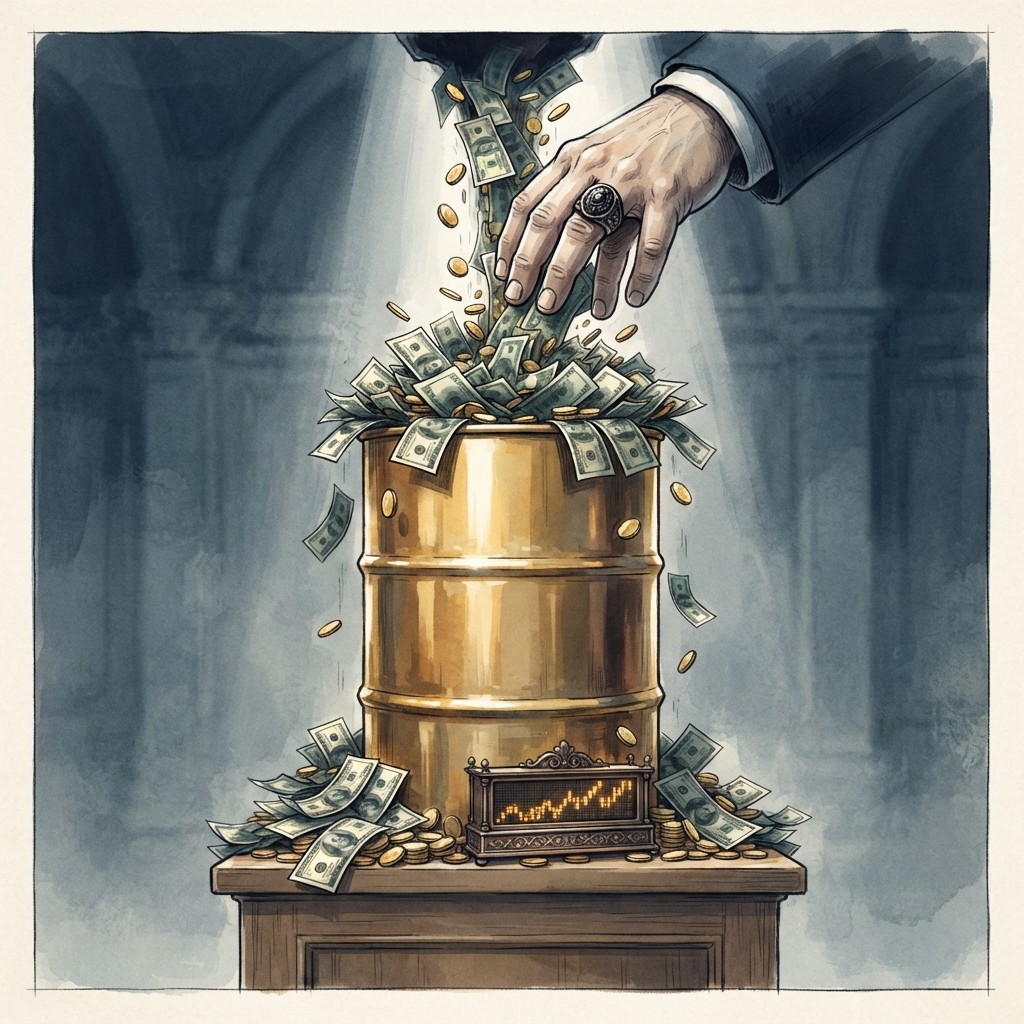
Pairs with the Profit-Engine Map — a ready-to-use strategy tool, filled for Saudi Aramco. Included in the Money Machine Casebook →
“Where does the money actually come from, and who sets the rate it comes in at?”
In 2022, a single company earned $161.1 billion in net income — very possibly the largest annual profit any business has ever recorded.2 The company pumped a barrel of oil for roughly two dollars and sold it into a market that averaged around one hundred dollars a barrel for the year.97 That spread is the most spectacular margin in the history of commerce. And almost none of it belongs to the people who own the stock.
The official story is that Saudi Aramco is the world's most profitable company — a corporate titan that went public in 2019 and sits on a mountain of cheap crude. Every word is technically true and the conclusion is wrong. Aramco is not really a company in the sense the league table implies. It is a sovereign fiscal instrument that has been issued shares, and the difference is the entire point.
The cheapest oil on Earth, and the most expensive landlord
Start with what is genuinely extraordinary, because it is real. CEO Amin Nasser puts Aramco's crude extraction cost at about $2 a barrel, with gas around $1, and says the company can hold 12 million barrels per day of capacity for a year without spending more.7 Filings put production-and-exploration costs a touch higher, but the order of magnitude is the same: this is the lowest-cost conventional oil on the planet, by a wide margin. A shale producer in Texas typically needs oil somewhere in the sixties to break even on a new well. Aramco is in profit before the price clears a coffee. On that base it produced 12.8 million barrels of oil equivalent per day in 2023.1 The geology did the hard part a hundred million years ago.
Now watch the money leave before anyone calls it profit. The Saudi state is not a shareholder waiting at the end of the line for dividends — it stands at the front of every barrel with a royalty meter and a tax stamp. The royalty is steeply progressive against the oil price: 15% of revenue when Brent is below $70, jumping to 45% between $70 and $100, and a punishing 80% on anything above $100.6 Only after royalties does Aramco compute income — and then the state takes 50% of upstream income in tax.6 The mechanism is deliberate: when oil spikes and the windfall is largest, the state's share climbs fastest. Aramco keeps a thinner slice of a fatter barrel exactly when the barrel is fattest. The cheap oil is the company's; the upside is the kingdom's.
| Brent price | Royalty rate on crude | Then, upstream income tax | Who gets the windfall |
|---|---|---|---|
| Below $70/bbl | 15% | 50% | Mostly the state |
| $70–$100/bbl | 45% | 50% | Overwhelmingly the state |
| Above $100/bbl | 80% | 50% | Almost entirely the state |
The state collects in three stacked layers. First the royalty comes off the top of revenue, scaling up to 80% at high prices.6 Then a 50% income tax falls on what remains.6 Then, as owner of 81.5% of the shares, the state captures the lion's share of whatever dividend Aramco declares — $97.8 billion in total dividends in 2023.8 Each layer is a separate claim on the same barrel, and by the time a free-float investor's share emerges, it has passed through all three.
Aramco doesn't even decide how much to pump
A real free-market producer responds to price: when oil is high and margins are fat, it pumps more. Aramco does the opposite, on command. As the swing producer at the center of OPEC+, it routinely cuts output precisely when prices are strong — withholding barrels to defend the price for everyone, including its competitors. That is not a corporate decision; it is foreign and fiscal policy made in Riyadh, and the company executes it. The clearest tell is the dividend itself. In 2023, Aramco paid out $97.8 billion in dividends while generating only $101.2 billion in free cash flow — and free cash flow had actually fallen that year.8 A profit-maximizing board does not raise the payout 30% into a cash-flow decline. A state that needs to fund its budget does exactly that, because Aramco's dividend is, functionally, a line in the kingdom's accounts.
“Probably the highest net income ever recorded in the corporate world.”2
The 2019 prospectus told on the legend
For nearly forty years, Aramco disclosed almost nothing, and the void filled with flattering folklore. Two myths were load-bearing. The first: Ghawar, the largest conventional oil field ever found, supposedly pumped over five million barrels a day — the IEA had cited 5.3 million, the EIA 5.8 million. The 2019 bond prospectus, the first primary disclosure in decades, put Ghawar's maximum sustainable capacity at 3.8 million bpd.4 The backbone was a third smaller than the world had assumed. The second myth: the headline reserve figure of around 260 billion barrels. The independent DeGolyer & MacNaughton audit verified roughly 162 billion; the remaining ~98 billion was never independently evaluated — about 45 billion in fields too small or remote to assess, and about 53 billion simply excluded because it is expected to be produced after the concession expires in 2077.5 The number everyone quoted was bigger than the number anyone had checked.
A national oil company's headline figures — reserves, profit, valuation — are political artifacts as much as financial ones, because the entity that owns the asset also writes the disclosure and sets the tax. The discipline is to find the audited number underneath the announced one: 162 billion verified barrels under the 260 billion claimed; a $1.7 trillion IPO valuation — well below the $2 trillion figure the Crown Prince had publicly targeted; 3.8 million bpd from Ghawar under the 5.8 the agencies repeated for years. The gap between the two isn't fraud — it's the difference between what a sovereign wants to be true and what an auditor would sign. In any business where the scorekeeper also plays, the second number is the real one.
Isn't a state cash machine still the best business on Earth?
The fair objection is that this whole frame is a sneer dressed as analysis. So the state takes most of it — so what? The barrels are still the cheapest in the world, the reserves still vast, the margins still real, and an 81.5%-owner state that funds itself from Aramco has every incentive to keep the company healthy and pumping. All true. The point is not that Aramco is a bad business; it is that calling it 'the most profitable company in the world' imports assumptions that don't hold. That title implies a firm that controls its own output, prices, and capital allocation, competing on the open market — and Aramco controls none of those. It pumps what OPEC+ dictates, pays what the royalty schedule extracts, and distributes what the budget requires. The honest read is that Aramco is the most profitable extraction of a sovereign resource ever organized — which is a genuinely different thing, and a more fragile one. Its profit rises and falls with a single commodity it is often instructed not to sell more of, and its fortunes are bolted to one state's fiscal needs and one field's quieter-than-advertised flow.
Strip the ticker away and what remains is not a corporation that happens to be sovereign. It is a sovereign that happens to be listed — a treasury with the world's cheapest oil under it, wearing just enough of the costume of a public company to sell 1.5% of itself for $29.4 billion and let the rest of the world admire the profit from outside the toll gate.3 The record net income is real. It just was never the shareholders' to keep. The genius of Aramco was never the margin. It was building a machine where the lowest costs on Earth meet the highest claims on Earth, and arranging for both to belong to the same hand.
Profit-Engine Map
A one-page map that pulls a business apart into the hook that gets the customer in the door and the engine that quietly earns the margin. Use it to see where the real profit lives, how the two halves are wired together, and what breaks if the link is cut. Blank to dissect your own P&L; filled as the worked example of a business whose advertised product is not where it makes its money.
Included, filled and blank, in the Money Machine Casebook. See the set → · Preview the blank →
Sources
Where this comes from — the filings, records, and reporting behind it.
- 1Saudi Aramco reported a net income of $121.3 billion for full-year 2023, its second-highest ever, on total revenue of $440.8 billion. Average hydrocarbon production was 12.8 million barrels of oil equivalent per day, including 10.7 million bpd of total liquids.
- 2Aramco reported a record net income of $161.1 billion for full-year 2022, up 46.5% from $110.0 billion in 2021, with free cash flow reaching a record $148.5 billion. CEO Amin Nasser said on the earnings call it was 'probably the highest net income ever recorded in the corporate world.'
- 3The 2019 IPO priced at SAR 32 ($8.53) per share, selling 1.5% of the company and raising $25.6 billion at a $1.7 trillion valuation; the greenshoe option was exercised, bringing total proceeds to $29.4 billion, surpassing Alibaba's 2014 record $25 billion IPO.
- 4Saudi Aramco's bond prospectus (April 2019) revealed Ghawar's maximum sustainable capacity is 3.8 million barrels per day — well below the 5+ million bpd that had been conventional market wisdom, including a 2005 IEA figure of 5.3 million bpd and a 2017 EIA estimate of 5.8 million bpd.
- 5The DeGolyer & MacNaughton audit cited in Aramco's bond prospectus independently verified approximately 162 billion barrels of reserves; the remaining ~98 billion barrels of the headline 260 billion figure were not independently evaluated — ~45 billion in fields too small/remote to analyze and ~53 billion not assessed because they are expected to be produced after the 2077 concession expiry.
- 6Aramco's upstream income tax rate is 50% (with a 20% rate on certain natural gas activities and a 20% rate on qualifying downstream activities). Marginal royalty rates on crude oil production are: 15% for Brent up to $70/bbl, 45% for $70–$100/bbl, and 80% above $100/bbl — as disclosed in Aramco's 2023 Annual Report.
- 7Saudi Aramco's CEO Amin Nasser stated at the October 2025 Energy Intelligence Forum that extraction costs stand at $2/boe for crude oil and $1/boe for gas, and that Aramco can sustain 12 million bpd capacity for a year without additional costs.
- 8Saudi Aramco paid total dividends of $97.8 billion in 2023 (up 30% from 2022), despite free cash flow falling to $101.2 billion; the government's stake in Aramco has declined to 81.5% (from 100% pre-IPO) following transfer of 16% to the Public Investment Fund and sale of 2.5% via public share offerings.
- 9Brent crude oil spot price averaged $100 per barrel in 2022
Weighing outside help with a decision like this? Hiring a pricing strategy consultant
More like this — beyond Saudi Aramco
New Strategically analyses as they publish: the defining moves in business, checked against the record. No noise, and one click to leave.