Pairs with the Profit-Engine Map — a ready-to-use strategy tool. Included in the The Money Machine Casebook →
Open the New York Times app to read about an election and you are three taps from a five-letter word puzzle, a braised-chicken recipe, a review of the best air fryer, and last night's box score. None of that is journalism in the way the masthead means it. All of it is the strategy. The Times spent more than $30 million on Wirecutter6, a low-seven-figure sum on a word game it then gave away free5, and $550 million on a sports site that was losing money3 — and the point of all three was never to make you a better-informed reader. It was to make you a harder one to cancel.
The official story is that the bundle drives revenue per subscriber higher — more products, more value, more dollars. The filings tell a stranger story. Bundle and multiproduct ARPU actually fell 6.7% in 2024 even as those subscribers grew 44.2%.2 The Times is deliberately making less money per person. It is doing so to drain the one tier it is most afraid of.
The bundle is a migration machine, not an ARPU machine
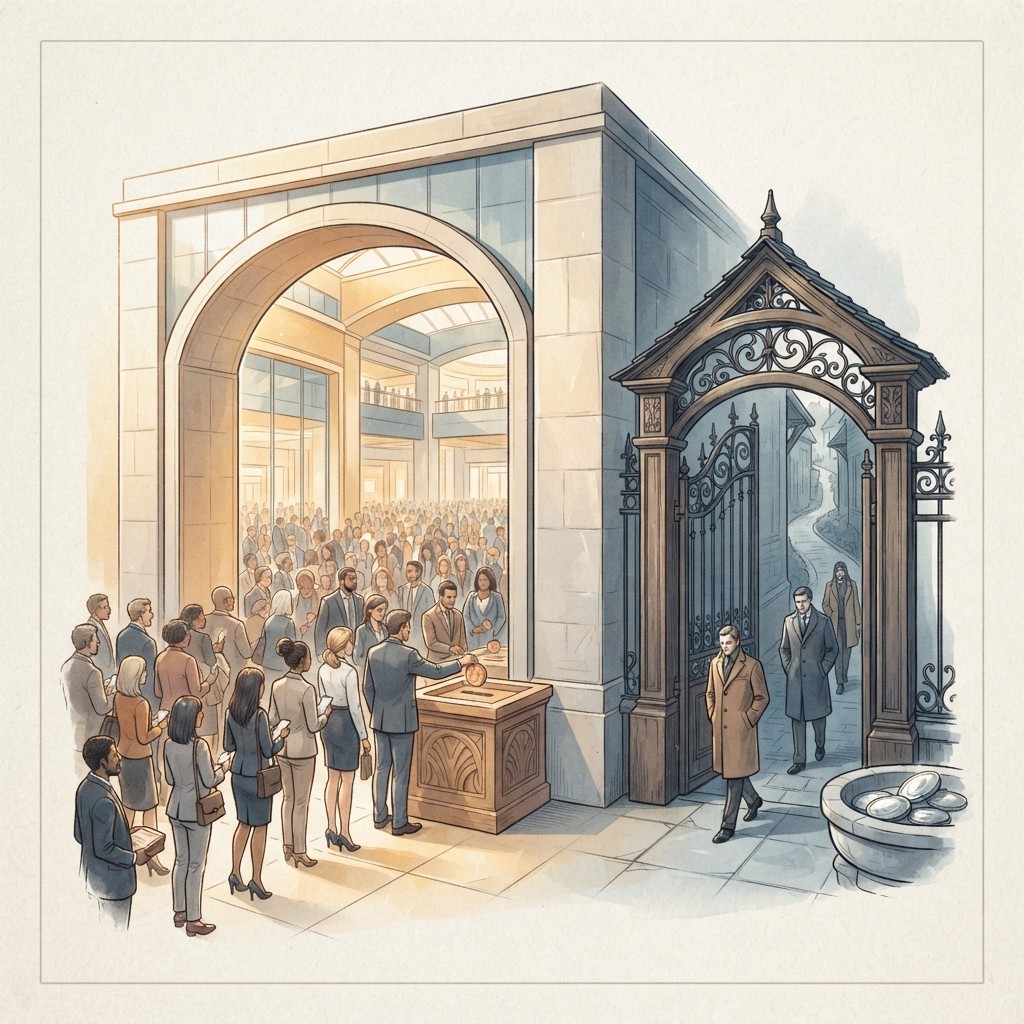
Look at the two halves of the subscriber base moving in opposite directions in 2024. Bundle and multiproduct subscribers grew 44.2%, but the average revenue they each pay slipped 6.7% as cheaper introductory pricing pulled new people in. Meanwhile the news-only tier — people paying for the journalism and nothing else — shrank 30.6%, while the price each remaining news-only subscriber pays jumped 19.1%.2 Read those four numbers together and the design is unmistakable. The Times is not trying to wring more out of every reader. It is herding readers off a tier it considers fragile and onto one it considers sticky, and pricing the leftover news-only base like a rump premium product to squeeze the stragglers while it can.
| Bundle / multiproduct | News-only | |
|---|---|---|
| Subscriber count | Up 44.2% | Down 30.6% |
| Revenue per subscriber | Down 6.7% | Up 19.1% |
| What the company is doing | Pulling people in cheap | Squeezing the stragglers |
| The strategic role | The future, locked in | The tier being drained |
Why fear a news-only subscriber? Because news is the most cancelable product the Times sells. It is seasonal, election-driven, mood-driven; people subscribe in a crisis and lapse in the calm. A reader who pays only for the news report has exactly one reason to stay, and that reason fluctuates with the headlines. The bundle attacks that fragility by changing what the subscription is — from a thing you consult during a crisis to a thing you open every single day.
Why a free word game was worth more than the journalism it sat beside
This is where Games and Cooking do the real work. The Times bought Wordle in January 2022 for an undisclosed price in the low seven figures, kept it free, and slotted it next to the Crossword, the Mini, and Spelling Bee.5 On its face that is bizarre: pay for an asset and then refuse to charge for it. But the puzzle was never the product. The habit was. A crossword is a daily appointment; so is figuring out what to cook tonight. These are products you return to whether or not there is news worth reading, and that frequency is the entire mechanism. A subscriber who opens the app for the puzzle every morning is a subscriber who happens to be standing inside the news report — and who has, without thinking about it, made the Times part of the texture of an ordinary day. You don't cancel an appointment you keep without noticing.
The Athletic fits the same logic, just at a far heavier price. The Times announced the deal in January 2022 at an all-cash $550 million, closing it that February.3 At acquisition The Athletic had 1.2 million subscribers and was not profitable4 — the close alone carried $34.7 million in acquisition-related pre-tax costs in the first quarter.3 No one buys an unprofitable property at that price for its standalone economics. They buy it because sports is another daily habit, another reason to keep the app, another set of subscribers to fold into the bundle and another lock on the door.
The bundle trades away near-term ARPU — bundle ARPU fell 6.7% in 2024 even as that base grew 44.2%2 — to buy frequency. Total digital ARPU grew 2.6% to $9.42, per the 10-K, driven by promotional-to-full-price graduation and price increases on tenured non-bundled subscribers9 — a tailwind that included the 19.1% pricing surge on the shrinking news-only base. The volume is the strategy; the per-unit dilution is the cost the company has chosen to pay for a stickier subscriber.
The number the company refuses to show you
Here is the honest hole in the entire thesis. The whole case for the bundle rests on the claim that bundled subscribers churn less than news-only ones — and no primary filing discloses a churn rate at all. Executives describe it only as 'healthy.'8 The CEO has confirmed that at least half of subscribers are on a bundle or multi-product plan, which tells you the migration is happening, but not that it is working as advertised.8 Every 'the bundle cuts churn in half' figure in circulation is an attributed claim from a company source or an unverifiable third-party benchmark, not a documented one. A company genuinely confident in its retention math would publish it. The Times publishes everything except that.
Isn't this just a bigger product winning the obvious way?
The fair objection is that none of this is clever — it's just bundling, the oldest trick in subscriptions, and it's plainly working because the subscriber count keeps climbing. The Times crossed 10.82 million digital-only subscribers by the end of 20241 and roughly 12.78 million total by the end of 2025, with a stated target of 15 million by the end of 2027.7 Growth like that doesn't need a subtle reading. But notice what the simple story can't explain: why a profitable, growing company would let its per-subscriber revenue fall on its fastest-growing tier on purpose, and why it would pay $550 million for a loss-making sports site and give away a hit game for free. The growth is real. The interesting part is the price the Times is willing to pay for it — diluted ARPU now, in exchange for a base that opens the app out of habit rather than headlines. Whether that trade pays off depends entirely on the churn number it won't share.
The most defensible subscription isn't the one with the most content — it's the one with the most reasons to open the app on a slow day. News is a crisis product; people pay during the storm and lapse in the calm. Games and recipes are appointment products; they get opened whether or not anything happened. So the strategic move is to buy frequency, even at the cost of revenue per user, because frequency is what survives a quiet news cycle. Two cautions: a bundle that dilutes ARPU is a bet that retention will earn the discount back — so you'd better be measuring churn obsessively. And if a company makes that bet loudly while declining to publish the very number that would prove it worked, treat the claim as a hypothesis, not a result.
The New York Times still sells the news the way it always has — but it no longer needs you to want the news to keep you paying. It needs you to want the crossword on Tuesday, the recipe on Thursday, the box score on Sunday, and to find, when an election finally arrives, that you were already a subscriber and had been for a year without thinking about it. The bundle's genius was never breadth. It was the decision to be worth less per subscriber and harder to leave — to turn a product people consult into a product people simply have. The only thing missing is the proof, and that's the one figure the company keeps in the vault.
Companies that profit where you'd never look
Profit-Engine Map
A one-page map that pulls a business apart into the hook that gets the customer in the door and the engine that quietly earns the margin. Use it to see where the real profit lives, how the two halves are wired together, and what breaks if the link is cut. Blank to dissect your own P&L; filled as the worked example of a business whose advertised product is not where it makes its money.
Included, filled and blank, in the The Money Machine Casebook. See the set → · Preview the blank →
Sources
Where this comes from — the filings, records, and reporting behind it.
- 1Paid digital-only subscribers totaled approximately 10.82 million as of December 31, 2024; total subscribers were approximately 11.43 million across 229 countries and territories.
- 2Total subscription revenue was $1,788,207 thousand in 2024 vs. $1,656,153 thousand in 2023; bundle and multiproduct subscribers grew 44.2% while bundle ARPU fell 6.7%; news-only subscribers fell 30.6% while news-only ARPU rose 19.1%; total digital-only ARPU was $9.42 in 2024.
- 3The Athletic acquisition closed February 1, 2022 for an all-cash purchase price of $550 million, funded from cash on hand; The Athletic operated at a loss in Q1 2022, with $34.7 million in acquisition-related pre-tax costs.
- 4The Athletic acquisition was announced January 6, 2022 at an all-cash price of $550 million; at the time The Athletic had 1.2 million subscribers and was not profitable.
- 5NYT acquired Wordle in January 2022 for 'an undisclosed price in the low-seven figures'; the game remained free and was added to the Games portfolio alongside the Crossword, Mini, and Spelling Bee.
- 6The New York Times purchased Wirecutter (and sibling site The Sweethome) for more than $30 million in 2016.
- 7As of December 31, 2025, NYT had approximately 12.78 million total subscribers (12.21 million digital-only) across 234 countries; target is 15 million subscribers by end-2027. Digital advertising comprised ~73% of 2025 ad revenue.
- 8CEO Meredith Kopit Levien confirmed at least 50% of subscribers are on a bundle or multi-product subscription; the Times' churn rate was described only as 'healthy' by executives and has never been disclosed in primary filings.
- 9Total digital-only ARPU grew 2.6% year-over-year to $9.42 in 2024, driven primarily by subscribers graduating from promotional to higher prices and price increases on tenured non-bundled subscribers.
More like this — beyond New York Times
New Strategically analyses as they publish: the defining moves in business, checked against the record. No noise, and one click to leave.