Pairs with the Profit-Engine Map — a ready-to-use strategy tool, filled for Booking Holdings. Included in the The Money Machine Casebook →
Type the name of a small boutique hotel into Google and watch what happens. Before the hotel's own website appears - the one whose name you just typed, the one whose photos you saw, the one you'd already half-decided to book - a sponsored result sits on top of it. It usually isn't the hotel. It's Booking.com, having paid Google for the privilege of standing in the doorway of a customer the hotel thought was already theirs. In one analysis of 22 hotels, Booking's ad showed up 80% of the time at an average position of 1.4, while the hotels' own ads appeared only 52.5% of the time, further down at position 2.4.7 Booking didn't build the hotel. It bought the spot in line in front of it.
The story people tell is that Booking 'bids on its own brand' - a clever trick where a company buys ads for itself. That isn't the trick, and it inverts the real one. The scale machine is Booking bidding on everyone else's brand: intercepting demand that a hotel's marketing already created, then renting it back to that hotel at a commission. And the entire intercept is financed by writing one of the largest advertising checks on earth - mostly to a single company.
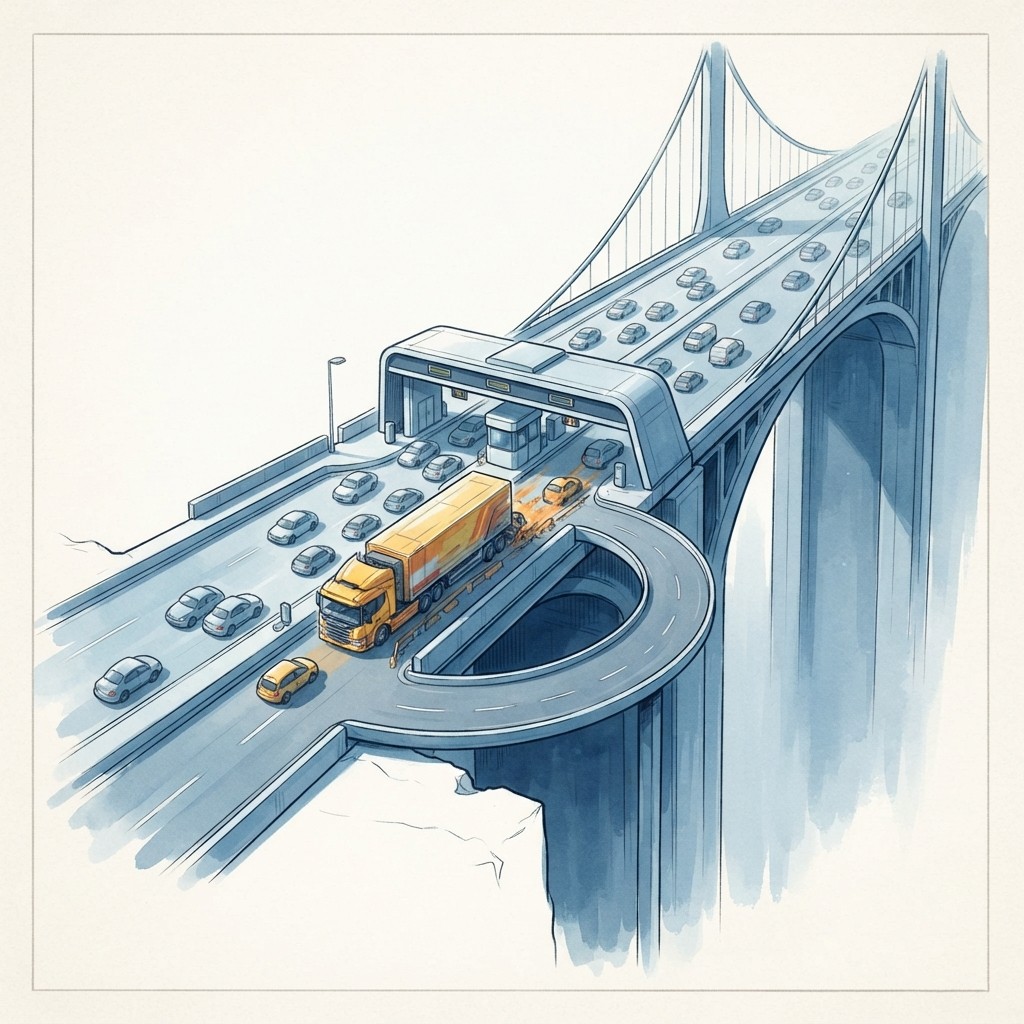
The toll Booking pays to stand in everyone's doorway
Booking Holdings spent $7.278 billion on marketing in 2024, climbing to $8.186 billion in 2025.1 That is not a brand-awareness budget. Booking's own filings are blunt about where it goes: performance marketing, 'which represent[s] a substantial majority' of the total, is 'primarily related to the use of online search engines (primarily Google), affiliate marketing, meta-search, and social media channels to generate traffic.'2 Strip away the corporate phrasing and it reads: most of those billions buy clicks, and most of those clicks are bought from Google. Against $23.739 billion of revenue and $5.900 billion of net income3, Booking spends close to a third of its top line just to be the result you see first.
Here is the thesis, plain: Booking isn't a hotel company and it isn't really a search-ads company either. It is an interception machine that pays Google a toll to capture demand other people created, resells that demand at commission, and is now structurally desperate to stop paying the toll. The clever part of the model is also its prison. The same billions that built the flywheel are the bill it most wants to escape.
Why the meter runs before the money arrives
The cruelty in the model lives in the timing. When you reserve a room, Booking recognizes the marketing expense right then - in the quarter the booking is made - but it doesn't recognize the revenue until you actually check in, often weeks or months later.4 So every time bookings accelerate, the ad bill arrives first and the cash arrives second, compressing near-term margins exactly when the business is winning. Worse, the company concedes in its own risk disclosures that rising cancellations 'can negatively impact our marketing efficiency as a result of incurring performance marketing expenses at the time a booking is made even though that booking could be canceled in the future.'8 Booking pays Google to acquire a customer who can simply walk away - and Google keeps the fee regardless. The toll is non-refundable even when the trip is.
| The cost | The revenue | |
|---|---|---|
| When it lands | At booking - immediately | At check-in - weeks or months later |
| Who controls it | Google sets the auction price | The traveler controls the trip |
| If the booking cancels | Already paid, non-refundable | Never recognized |
| Effect on margins | Compresses them as growth speeds up | Lags the spending that created it |
The escape plan: buy a customer once, keep them forever
A company that spends $8 billion a year renting traffic has every incentive to stop renting and start owning. That is precisely the move underway. In Q1 2024, CEO Glenn Fogel told investors that the company sees 'paid marketing channels becoming a gradually smaller proportion of our business over time,' with direct-channel room nights already in the 'mid-50% range' over the prior four quarters - and growing faster than paid-channel nights.5 Marketing Week corroborated it: Booking is deliberately reducing paid-media investment as bookings through its Genius loyalty program climb.6 The logic is simple. A customer Booking pays Google to win the first time is a customer it can re-acquire for free on the second trip - if it can convert that paid click into an app open, a loyalty tier, a habit. The first booking is rented. Every booking after that is owned. Across 1,144 million room nights reserved in 20243, even a small shift from paid to direct compounds into real money saved from Google's auction.
“We see paid marketing channels becoming a gradually smaller proportion of our business over time.”5
Isn't Booking just trapped in Google's auction forever?
The honest objection is that this 'escape' is a slide everyone shows and nobody finishes. Booking has run the interception game for two decades; the spend went up to $8.2 billion in 2025, not down1 - which looks less like an addict quitting than an addict insisting they could quit anytime. There is force in that. But the direct-channel mix isn't a talking point; it's a number in the mid-50s and disclosed as growing faster than the paid side.5 The more honest framing is that Booking is doing two opposing things at once - pouring money into Google's auction to win first-time travelers, while quietly converting the winners into a loyalty base it no longer has to pay for. Total spend can rise even as the share bought from Google falls, if the business grows faster than the toll. The question isn't whether Booking is hooked. It's whether it can grow its owned audience faster than Google can raise the price of standing in the doorway. So far, by its own numbers, it's running just ahead.
The most dangerous position in any marketplace is renting your customers from a gatekeeper who can raise the rent at will - and Booking sits squarely in it, paying Google billions to intercept demand it didn't create. The escape is always the same: convert a paid acquisition into an owned relationship before the gatekeeper figures out what you'd pay to keep it. Loyalty programs, apps, and habit are not soft 'brand' fluff here; they are the only mechanism that turns a recurring toll into a one-time cost. The trap to watch for: total spend can keep rising while the strategy is genuinely working, because the metric that matters isn't the size of the check to the gatekeeper - it's the share of customers you no longer have to pay them for.
Booking built an empire on a single, almost rude insight: the customer a hotel works hardest to attract is the easiest one to intercept, one Google ad earlier in the journey. That insight printed $5.9 billion of net income in a year.3 But the machine that prints the money also pays the toll, and the toll has a name and a price that only Google controls. So Booking is now trying to do the hardest thing a middleman can attempt - to need the gatekeeper a little less each year without ever quite leaving the gate. It learned to stand in everyone else's doorway. The next two decades are about whether it can finally afford its own.
Companies that pay a toll - or charge one
Profit-Engine Map
A one-page map that pulls a business apart into the hook that gets the customer in the door and the engine that quietly earns the margin. Use it to see where the real profit lives, how the two halves are wired together, and what breaks if the link is cut. Blank to dissect your own P&L; filled as the worked example of a business whose advertised product is not where it makes its money.
Included, filled and blank, in the The Money Machine Casebook. See the set → · Preview the blank →
Sources
Where this comes from — the filings, records, and reporting behind it.
- 1Booking Holdings FY2024 marketing expenses were $7.278 billion; FY2025 marketing expenses were $8.186 billion. Q4 2024 marketing spend alone was $1.578 billion.
- 2Performance marketing expenses, 'which represent a substantial majority' of total marketing expenses, are 'primarily related to the use of online search engines (primarily Google), affiliate marketing, meta-search, and social media channels to generate traffic to our platforms.'
- 3Booking Holdings FY2024 total revenues were $23.739 billion; net income was $5.900 billion. Room nights reserved totaled 1,144 million in 2024, up from 1,049 million in 2023.
- 4Marketing expense is recognized as incurred, typically in the quarter when gross bookings are recognized—before revenue is recognized at check-in—creating a structural timing mismatch that compresses near-term margins when bookings growth accelerates.
- 5CEO Glenn Fogel stated in Q1 2024 earnings: 'We see paid marketing channels becoming a gradually smaller proportion of our business over time.' Direct-channel room nights were in the 'mid-50% range' over the prior four quarters and growing faster than paid-channel room nights.
- 6Fogel's Q1 2024 direct-channel comments were independently corroborated: Marketing Week reported Booking Holdings is 'gradually reducing the amount of investment it makes in paid media channels' as direct bookings through Genius loyalty grow, with 'mid-50%' direct room-night mix confirmed by Fogel on the Q1 2024 investor call (May 3, 2024).
- 7Booking.com bids on hotel brand-name keywords in Google Ads, appearing above those hotels' own ads—documented as an industry-wide OTA practice. A set of 22 hotels showed Booking.com sponsored results appearing 80% of the time at average position 1.4, versus hotels' own ads appearing only 52.5% of the time at average position 2.4. (Source is an industry marketing blog citing unnamed proprietary research—confidence: attributed-to-source only.)
- 8Increases in cancellation rates 'can negatively impact our marketing efficiency as a result of incurring performance marketing expenses at the time a booking is made even though that booking could be canceled in the future'—a primary-source disclosure of the structural risk in Booking's paid-at-booking, revenue-at-check-in model.
More like this — beyond Booking Holdings
New Strategically analyses as they publish: the defining moves in business, checked against the record. No noise, and one click to leave.