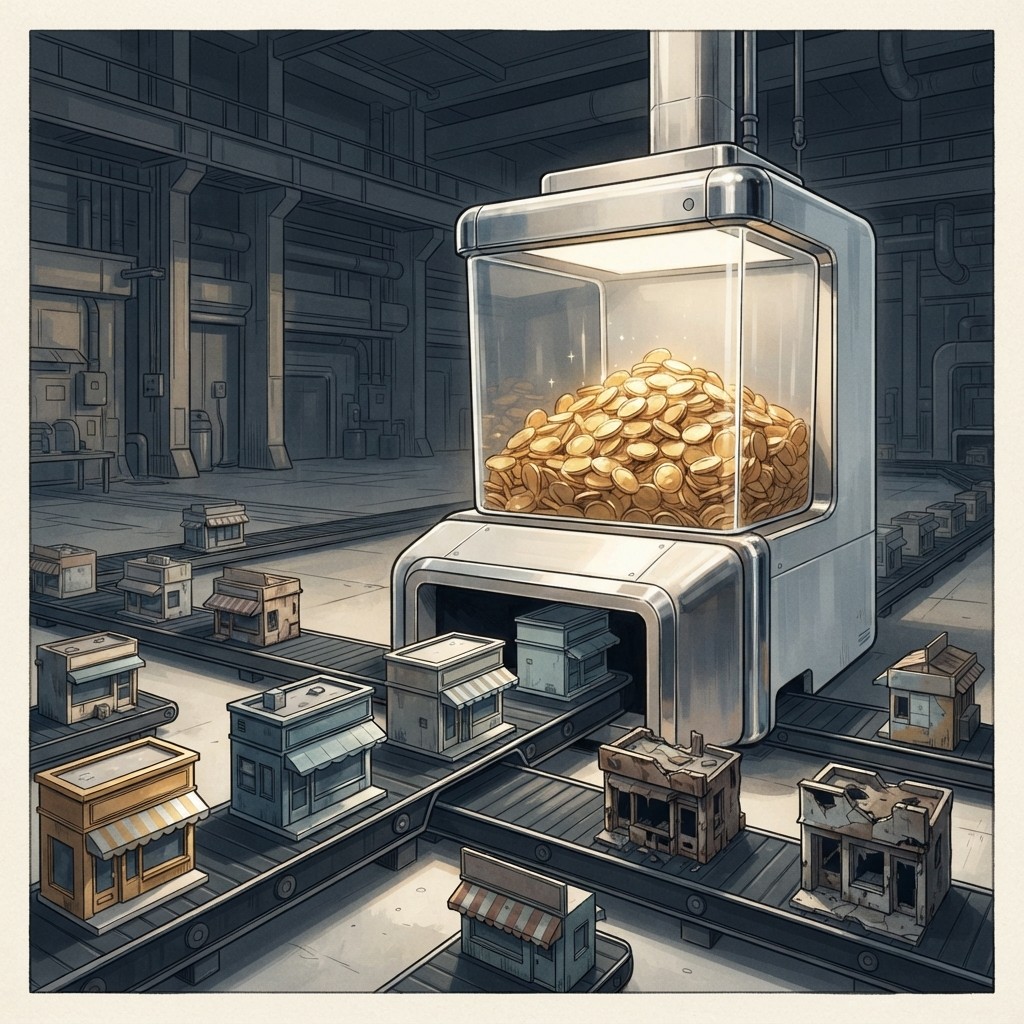
Pairs with the Asset-Light vs Asset-Heavy Comparator — a ready-to-use strategy tool, filled for Subway. Included in the The Asset-Light Model Casebook →
Imagine paying for the right to open a sandwich shop, building a customer base over a decade — and then watching corporate license another Subway across the street, with nothing in your contract to stop it. That isn't a loophole. It's the design. Subway's franchise agreement says it in plain language: franchisees 'will not receive any territorial rights and there are no radius restrictions or minimum or maximum population requirements' limiting where the company can open the next store.3 For most of the 2000s and 2010s, that next store kept arriving, until the United States had more than 27,000 of them.1
The official story is that Subway is a franchising success — the chain that out-built McDonald's on store count and made small-business ownership accessible for a $15,000 fee.2 The real story is that the model was built to extract revenue from franchisees, not to build wealth for them. And in 2016 the two stopped pointing the same direction. Since then, every single year has been a net loss of stores.
The math that only works for one party
Start with what every Subway operator owes before they sell a single sandwich. The royalty is 8% of gross sales. The advertising contribution is another 4.5%.2 That is 12.5 cents of every revenue dollar gone off the top — not off profit, off the top line — before rent, before labor, before the bread and the cold cuts. It is among the steepest combined takes in fast food. Now set it against the revenue that take is applied to: Subway's average unit volume reached roughly $490,000 in 2023, which sounds like progress until you read the rest of the sentence — it was the highest in company history and still 25% below where it would sit had it merely kept pace with inflation since 2012.5 A franchisee is paying a premium fee on a shrinking real top line. The percentage stays fixed; the dollars it eats grow heavier every year.
The franchisor's economics scale with system-wide gross sales, not with any single store's profit. Open a second store that splits the first one's customers, and total system sales barely move — but the franchisor still collects 8% royalty plus 4.5% ad fund on both.2 The operator who built the first store eats the cannibalization; the franchisor is indifferent to which of its own stores rings the sale. The fee is on the cargo. The risk is on the driver.
This is the engine of an asset-light model worked to its logical extreme. Subway owns no real estate, signs no leases, hires no sandwich makers. The capital — the $238,625 to $536,745 it costs to open a store — comes entirely from the franchisee.2 What Subway sells is the brand and the right to be taxed on your own sales for the next twenty years.3 When density helps the brand and hurts the operator, the contract has already chosen a side.
The man inspecting your store wanted your store
The territorial design alone would have been corrosive. What made it predatory was the layer Subway built on top of it. For years the chain relied on development agents — business development agents who were themselves franchisees, paid to sign up and oversee other operators in their region. They held an extraordinary conflict of interest: they had access to the financial books of the very competitors they oversaw, and a financial incentive to acquire stores. Lawsuits and a New York Times investigation alleged the result was exactly what the structure invited — field consultants manufacturing or exaggerating inspection violations, the cucumbers sliced wrong, handprints on the windows, to push targeted franchisees toward forced exit so their stores could be picked up.6 The watchdog and the buyer were the same person.
The friction this generated is visible in the paper. Restaurant Dive, citing the New York Post, reported Subway initiated 702 arbitration actions against franchisees in 2017 — against one by McDonald's and two by Dunkin' that year.6 When Franchise Times reviewed Subway's 2022 disclosure document, it counted 125 disclosed litigation cases against the company, versus 29 for McDonald's and zero for Chick-fil-A among the top-ten chains — with the list of franchisee and third-party actions running 25 pages, and a section on enforcing 'system standards' buried on page 732 of a 795-page filing.9 A healthy franchise system does not generate that much legal weather.
| What the franchisor gets | What the franchisee gets | |
|---|---|---|
| A new store opens nearby | More system sales, more fees | Split customers, lower volume |
| Royalty + ad fund | 12.5% of gross, off the top | Paid before rent, labor, food |
| The 20-year term | Two decades of locked-in fees | A long exit with penalties |
| Disputes per year (2017) | 702 arbitrations initiated | Defending against the franchisor |
How the trap closes at renewal
The 20-year term is where the asymmetry becomes a vise. A franchisee cannot simply leave a failing store; the agreement allows the franchisor to impose materially different royalty rates and terms at renewal.3 In 2021, Subway showed what that power looks like in practice. Its newest agreement offered operators a choice: accept a royalty raised by 25% to a 10% rate, or keep 8% but swallow a non-disparagement clause, a requirement that early-closers pay three years of royalties — roughly $136,875 — and a termination trigger for closing as little as two days in a 12-month window.4 The contract was rewritten to make leaving expensive and staying compliant. And it landed at the exact moment franchisees were asking for the opposite: a royalty cut from 8% to 4.5%.4 One side was negotiating for survival. The other was tightening the screw.
“Mandatory discounting and the remodels are going to drastically cut into what's left of their profits to the point that they will not be able to stay in business.”7
The receipt: corporate profit, divorced from franchisee health
Here is the cleanest proof that the model works for one party and not the other. In 2025, Subway's net income rose to $688 million — up from $397 million the year before and a mere $15 million in 2023 — even as total franchise revenue fell more than 6% to $767 million.10 Read that twice. The franchise revenue, the money the operators feed up the chain, was shrinking. Corporate profit nearly doubled anyway, on falling operating expenses. The franchisor learned to make more while its franchisees made less. When the people generating the sales are bleeding stores for a tenth straight year and the brand's own bottom line is at a record, the two have come fully unhooked. Same system. Opposite math.
The honest counter: wasn't this just a bad sandwich era?
The fair objection is that Subway's collapse is a product story, not a contract story. The food got tired, fast-casual rivals ate the lunch occasion, and any chain that over-expanded into 27,000 doorways was going to retrench regardless of how the agreement was written. There is real truth in that — AUV did stagnate in absolute terms, and a brand can't fee its way out of stale relevance.5 But the structure is what turned a product problem into a wealth-destruction machine. A franchise with protected territories would have throttled over-expansion before it metastasized. A lower fee load would have left operators the margin to remodel and discount without going under. A shorter or more flexible term would have let weak stores close cleanly instead of dragging owners through penalties and arbitration. Subway had a demand problem like everyone else. What it added was a contract that made the demand problem fatal to the people least able to absorb it. The product weakened the patient; the model removed the ability to recover.
In any franchise — or any 'partnership' dressed as one — the question that matters isn't 'how big is the brand?' It's 'when our interests diverge, whose does the contract protect?' Subway's answer was written in advance: no protected territory, the highest combined take in the category, a 20-year lock-in, and renewal terms the franchisor can rewrite. Each clause is rational for the franchisor and ruinous for the operator the moment the brand stops growing. Asset-light means someone else carries the asset — and the risk. Before you become that someone, find the clause that decides who loses when growth stops. It already exists. It just isn't in the brochure.
Roark Capital closed its acquisition of Subway in April 2024 at a price the Wall Street Journal put near $9.6 billion — terms neither party ever officially confirmed.8 The buyer wasn't paying for sandwiches. It was paying for a fee stream — 12.5% of whatever the surviving operators ring up, plus a global push toward nearly 37,000 restaurants and more than 10,000 future commitments overseas, where the same model can run again on fresh capital.11 That is the genius and the indictment in one sentence. Subway built a machine that extracts value from franchisees with industrial efficiency. It worked exactly as designed. The only thing it never reliably produced was a franchisee who got rich — and for a decade now, it has been quietly producing the opposite.
When the model and the operator stop sharing a side
Asset-Light vs Asset-Heavy Comparator
A side-by-side matrix that pits owning the assets against renting or orchestrating them, dimension by dimension. Blank to weigh your own model choice; filled as the worked example showing why the story's company went capital-light — or planted its money in concrete and steel.
Included, filled and blank, in the The Asset-Light Model Casebook. See the set → · Preview the blank →
Sources
Where this comes from — the filings, records, and reporting behind it.
- 1Subway's U.S. store count peaked at more than 27,000 in 2015; net closures began in 2016 and have persisted for 10 consecutive years through 2025, totaling a net loss of 8,345 units between 2016 and 2025, leaving 18,773 U.S. locations.
- 2Subway's 2025 FDD (Item 7) discloses an initial investment range of $238,625 to $536,745 including a $15,000 franchise fee; the royalty fee is 8% of gross sales and the advertising contribution is 4.5% of gross sales, confirmed on Subway's own franchise FAQ page.
- 3Subway's franchise agreement grants franchisees no territorial rights whatsoever: 'Franchisees will not receive any territorial rights and there are no radius restrictions or minimum or maximum population requirements which limit where the franchisor can license or open another Subway restaurant.' The franchise term is 20 years. At renewal, the franchisor may impose materially different royalty rates and terms.
- 4In 2021, Subway's newest franchise agreement raised the royalty by 25% (to a 10% option) or kept 8% but added a non-disparagement clause, required franchisees who close early to pay three years of royalties (~$136,875), allowed termination for closing two days in a 12-month period, and gave Subway pricing/promotional compliance power — all at a moment when franchisees were requesting a royalty cut from 8% to 4.5%.
- 5According to Restaurant Business (citing Technomic), Subway's average unit volume was approximately $490,000 in 2023 — up 4.3% year-over-year and the highest in company history — yet still 25% below where it would be had AUV merely kept pace with inflation since 2012. Subway does not report AUV in its FDD.
- 6Multiple lawsuits and a New York Times investigation reported that Subway's development agents (BDAs) — who were themselves franchisees with access to competing operators' financial books — allegedly used field consultants to manufacture or exaggerate inspection violations (e.g., incorrectly sliced cucumbers, handprints on windows) to force targeted franchisees out and acquire their stores. According to Restaurant Dive citing the New York Post, Subway initiated 702 arbitration actions against franchisees in 2017, compared to one by McDonald's and two by Dunkin' that year.
- 7The North American Association of Subway Franchisees hired attorney Robert Zarco in March 2024 to address 'systematic issues' with Subway franchises; Zarco stated that 'mandatory discounting and the remodels are going to drastically cut into what's left of their profits to the point that they will not be able to stay in business.'
- 8Roark Capital completed its acquisition of Subway on April 30, 2024. The Wall Street Journal reported the deal at approximately $9.6 billion, making it the largest restaurant transaction since Inspire Brands' $11.3 billion purchase of Dunkin' in 2020. The exact purchase price was never officially disclosed by either party; the sale was delayed by an FTC review.Subway IP LLC, Subway® Sale to Roark is Complete ↗ · 2024-04-30
- 9Franchise Times, reviewing the 2022 Subway FDD Item 3, counted 125 disclosed litigation cases against Subway — compared to 29 for McDonald's and zero for Chick-fil-A among top-10 chains by systemwide sales — with a list of franchisee/third-party actions running 25 pages and a 'enforcement of system standards 2021' section buried on page 732 of the 795-page FDD.
- 10Subway's net income rose to $688 million in 2025 (up from $397 million in 2024 and just $15 million in 2023) even as total franchise revenue fell over 6% to $767 million, with the income increase attributable to falling operating expenses — meaning Subway's corporate profitability divorced from franchisee royalty revenue.
- 11Subway confirmed it operates nearly 37,000 restaurants across more than 100 countries, with over 10,000 future restaurant commitments from more than 20 master franchise agreements signed in three years — representing Subway's international push as a counterweight to domestic contraction.
More like this — beyond Subway
New Strategically analyses as they publish: the defining moves in business, checked against the record. No noise, and one click to leave.