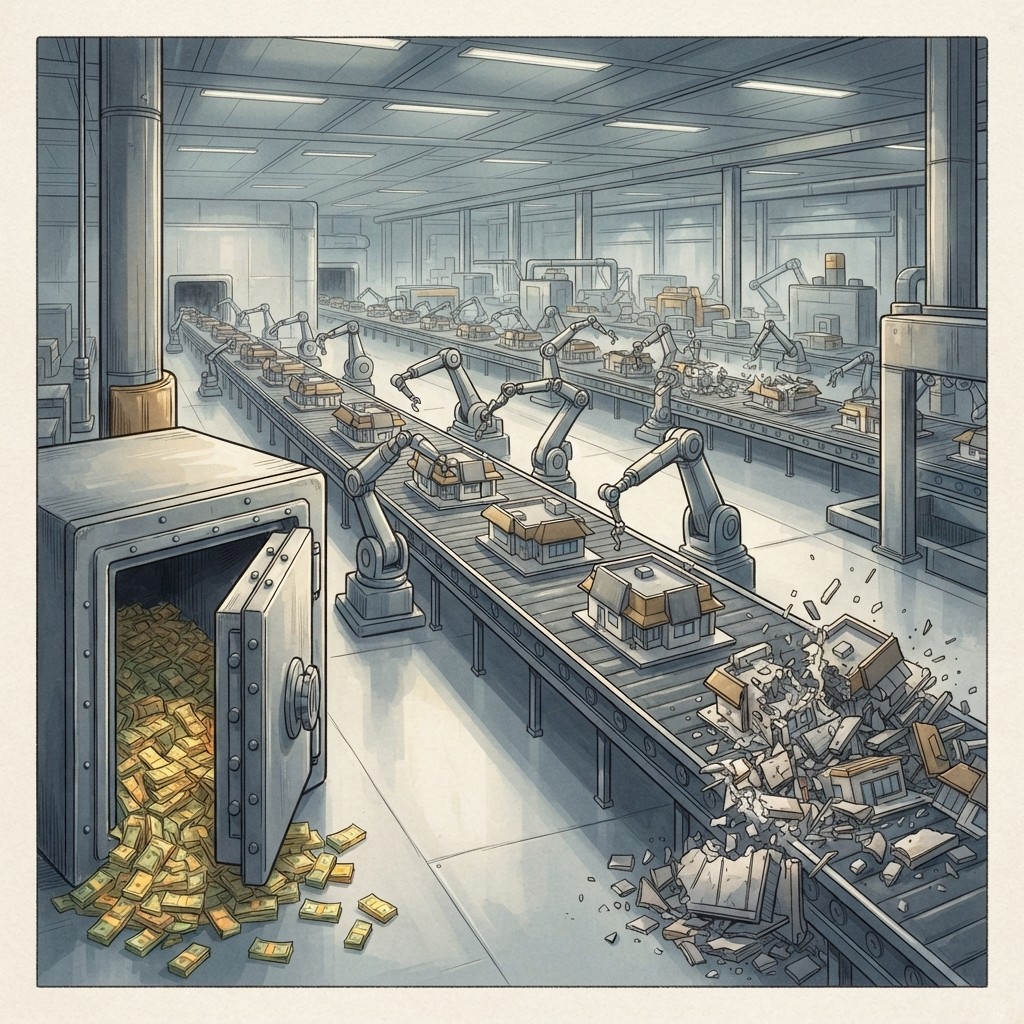
Pairs with the Asset-Light vs Asset-Heavy Comparator — a ready-to-use strategy tool. Included in the Asset-Light Trap Casebook →
“Which parts of the business should you stop owning?”
In 2015, you could stand on a city corner and see two Subways from one spot. That wasn't a glitch — it was the strategy. The chain had crossed 27,000 U.S. stores, more locations than McDonald's, and every one of them was sold to someone who paid for the privilege of opening it.210 Then the line bent. In 2016 the U.S. count started falling, and it has fallen every single year since. By the end of 2025 Subway was down to 18,773 stores — a net loss of 8,345 since the peak, a tenth straight year of decline.2 That's not a slump. That's a chain that built more restaurants than its own customers could feed.
The popular story is that Subway fell apart after the Jared Fogle scandal in 2015. That's the wrong cause and the wrong year. The decline began in 2016 — the year after founder Fred DeLuca died — and its real engine was structural, not reputational.9 The stores were doomed before the spokesman was.
The model was built to sell franchises, not to feed them
Subway started in 1965 as a single sub shop in Bridgeport, Connecticut: a 17-year-old Fred DeLuca, a nuclear physicist named Peter Buck, and $1,000.7 When the chain began franchising in 1974, it discovered something intoxicating. A new Subway needs no fryer, no grill, no drive-thru — just a counter, a bread oven, and a few feet of retail. That made each store cheap to open, which made each store easy to sell. And selling stores, not running them, was where the money was. Every franchise sold meant a new royalty stream for headquarters with almost none of the operating risk landing on headquarters' books.
So the incentive ran one way and one way only: open more. The cost of a store sitting too close to another store was paid by the franchisee whose sales got split — not by the corporate parent collecting royalties on both. That is the trap at the center of an asset-light franchise model. The parent grows by adding units; the franchisee survives only if each unit has enough territory to feed it. Subway optimized hard for the first and ignored the second, and the result is a chain whose Circana-estimated average unit volume sits around $500,000 — roughly half the $1 million-plus median of the 100 largest restaurant franchises.6
Onto that thin AUV sits one of the heaviest tolls in franchising. Subway's royalty was 8% of sales long before Roark arrived, plus a 4.5% advertising contribution — 12.5% of a store's gross sales handed over before rent, labor, food, or the franchisee's own paycheck — and since 2021 renewing franchisees have been offered a 10% royalty option.6 Restaurant Business found that's the second-highest combined burden among the country's 100 largest restaurant franchises, against a typical royalty of 5%.6 Run the arithmetic on a $500,000 store and the parent's cut is the difference between a hard living and no living at all.
| Typical large franchise | Subway | |
|---|---|---|
| Median average unit volume | Just over $1 million | ~$500,000 |
| Typical royalty rate | 5% | 8% (was 4.5% for decades) |
| Combined royalty + ad fund | Lower | 12.5% — 2nd-highest of top 100 |
| Where the squeeze lands | Absorbed by a bigger store | Half the volume, double the toll |
An asset-light franchise model pays the parent to add units and pays the franchisee to defend territory. Those two incentives point in opposite directions, and when the cheaper a store is to open, the harder the conflict bites — because nothing physical stops the parent from packing them tighter. The number that matters isn't how many locations you have; it's how much demand each one is allowed to keep. Subway maximized the first and quietly cannibalized the second, and a fee hike on a halved sales base finished what saturation started.
How corporate profit can soar while the stores die
Here is the part that confuses people. In August 2023, private-equity firm Roark Capital agreed to buy Subway; the deal closed on April 30, 2024 after an FTC review delayed it.83 The Wall Street Journal reported a price around $9.6 billion — though neither Subway nor Roark ever officially disclosed it, so it should be read as reported, not confirmed.3 And since the close, Subway's corporate profit has exploded: net income climbed from $15 million in 2023 to $397 million in 2024 to roughly $688 million in 2025.4 A casual reader sees that and assumes the patient is recovering.
The patient is not recovering. Over the same stretch, total franchise revenue fell more than 6% to $767 million, and royalty revenue — the truest gauge of franchisee health — dropped 10% over two years.4 The profit surge came from somewhere else entirely: cost cuts and vendor rebates. Those rebates, the fees suppliers pay for the right to sell into Subway's system, ballooned from $44.7 million in 2021 to $136.5 million in 2025.4 In plain terms, the parent learned to make more money off the supply chain even as it collected less from the stores. The royalty stream is shrinking; the profit on it is rising. Same chain. Opposite math.
“Three years of sales growth and positive global net restaurant growth for the first time since 2016.”8
And there's a clock running underneath all of it. Roark funded the acquisition partly through whole-business securitization, loading $5.7 billion of new debt onto Subway's books as of end-2025.4 That debt is serviced, ultimately, by the royalty stream the franchisees generate — the same stream that has been falling for two years. Vendor rebates and expense cuts can flatter a single year's income statement. They cannot manufacture more $500,000 stores. The reckoning isn't cancelled; it's financed.
Isn't this just smart rightsizing?
The fair objection is that Subway is doing exactly what a wounded chain should do: shedding weak stores so the survivors get stronger. Close the cannibals, thin the herd, and the remaining locations capture the demand the closures release. There's truth in it — QSR itself frames the cuts as a 'rightsizing effort,' and a system that over-built genuinely needs to shrink.2 If the net number stabilized and AUVs climbed, that would be the model self-correcting.
But the honest counter is that ten straight years of decline is not a tidy prune; it's an entrenched bleed, and the headline net numbers hide how deep it runs. In 2025 the chain opened 499 stores while posting a net loss of 72911 — meaning gross closures topped 1,200, by implication.11 More than a thousand franchisees walked away or went under in a single year, and the shorthand of '729 closed' undercounts the failures by more than half. Real rightsizing would relieve the surviving stores' economics. Instead Subway raised the royalty on them. You don't strengthen the herd by feeding it less and charging it more — you cull it faster.
Subway spent fifty years discovering that the easiest thing to sell — a store with no fryer and a low entry price — is also the easiest thing to oversell. The genius of the franchise model was that headquarters could grow without operating; the curse was that headquarters grew by selling its franchisees a slice of a pie that kept getting cut thinner. Now Roark has found a way to keep the parent fat while the system contracts: more rebates, fewer costs, more debt. It works on the income statement. It does not put a customer in a store that has too few of them. The toll road only pays as long as cars keep driving it — and Subway built so many lanes that the traffic finally ran out.
When the model that built a company turns on it
Asset-Light vs Asset-Heavy Comparator
A side-by-side matrix that pits owning the assets against renting or orchestrating them, dimension by dimension. Blank to weigh your own model choice; filled as the worked example showing why the story's company went capital-light — or planted its money in concrete and steel.
Included, filled and blank, in the Asset-Light Trap Casebook. See the set → · Preview the blank →
Sources
Where this comes from — the filings, records, and reporting behind it.
- 1Subway's 2026 Franchise Disclosure Document (released April 30, 2026) shows a net loss of 729 U.S. units in 2025, bringing the total to 18,773 — the steepest annual decline since 2021 when over 1,000 net units were lost. Since the start of 2021, the chain has shed 3,417 U.S. restaurants.
- 2Subway reached a peak of more than 27,000 U.S. stores in 2015. Between 2016 and 2025, the chain closed a net of 8,345 restaurants. The U.S. unit count declined for a 10th straight year in 2025.
- 3Subway completed its sale to Roark Capital on April 30, 2024. The Wall Street Journal reported the deal at ~$9.6 billion (Subway and Roark did not officially disclose the price). Roark funded the acquisition partly via whole-business securitization, placing $5.7 billion in new debt on Subway's books as of end-2025.
- 4Per the 2026 FDD, Subway generated ~$688-689 million in net income in 2025 (up from $397M in 2024 and $15M in 2023), while total franchise revenue fell more than 6% to $767 million and royalty revenue declined 10% over two years. The net income improvement is attributed to falling operating expenses and rising vendor rebates, not franchisee royalty health.
- 5Subway charges franchisees an 8% royalty on gross sales plus a 4.5% advertising fund contribution, totaling 12.5% of top-line revenue — among the highest combined rates in QSR. The 8% royalty represents a significant increase from the legacy 4.5% rate that defined the brand for decades.
- 6Restaurant Business analysis found Subway's combined royalty and ad fund charges are the second-highest among the 100 largest restaurant franchises. The typical franchise royalty across those 100 chains is 5%, with a median AUV just over $1 million — versus Subway's ~$500,000 Circana-estimated AUV.
- 7Subway was founded in 1965 when 17-year-old Fred DeLuca and family friend Dr. Peter Buck (a nuclear physicist) opened 'Pete's Super Submarines' in Bridgeport, Connecticut, with a $1,000 investment. The chain began franchising in 1974 to accelerate growth.Subway, Subway History ↗ · 2024
- 8The Roark Capital acquisition agreement was announced August 24, 2023 at a reported price over $9 billion per Reuters. The deal closed April 30, 2024 after an FTC investigation into Roark's restaurant-sector concentration delayed completion. Subway described itself as coming off 'three years of sales growth and positive global net restaurant growth for the first time since 2016.'
- 9Fred DeLuca died on September 14, 2015, making 2016 the year after his death
- 10Subway had more locations than McDonald's globally, beating McDonald's for the title of world's largest restaurant chain in 2011, and holding that lead through its 2015 U.S. peak
- 11Subway opened 499 U.S. locations in 2025 while posting a net loss of 729 units, per its 2026 FDD — implying gross closures of roughly 1,228.
Weighing outside help with a decision like this? Hiring a supply chain strategy consultant
More like this — beyond Subway
New Strategically analyses as they publish: the defining moves in business, checked against the record. No noise, and one click to leave.