Pairs with the Turnaround Diagnosis Worksheet — a ready-to-use strategy tool, filled for Marvel. Included in the The Turnaround Casebook →
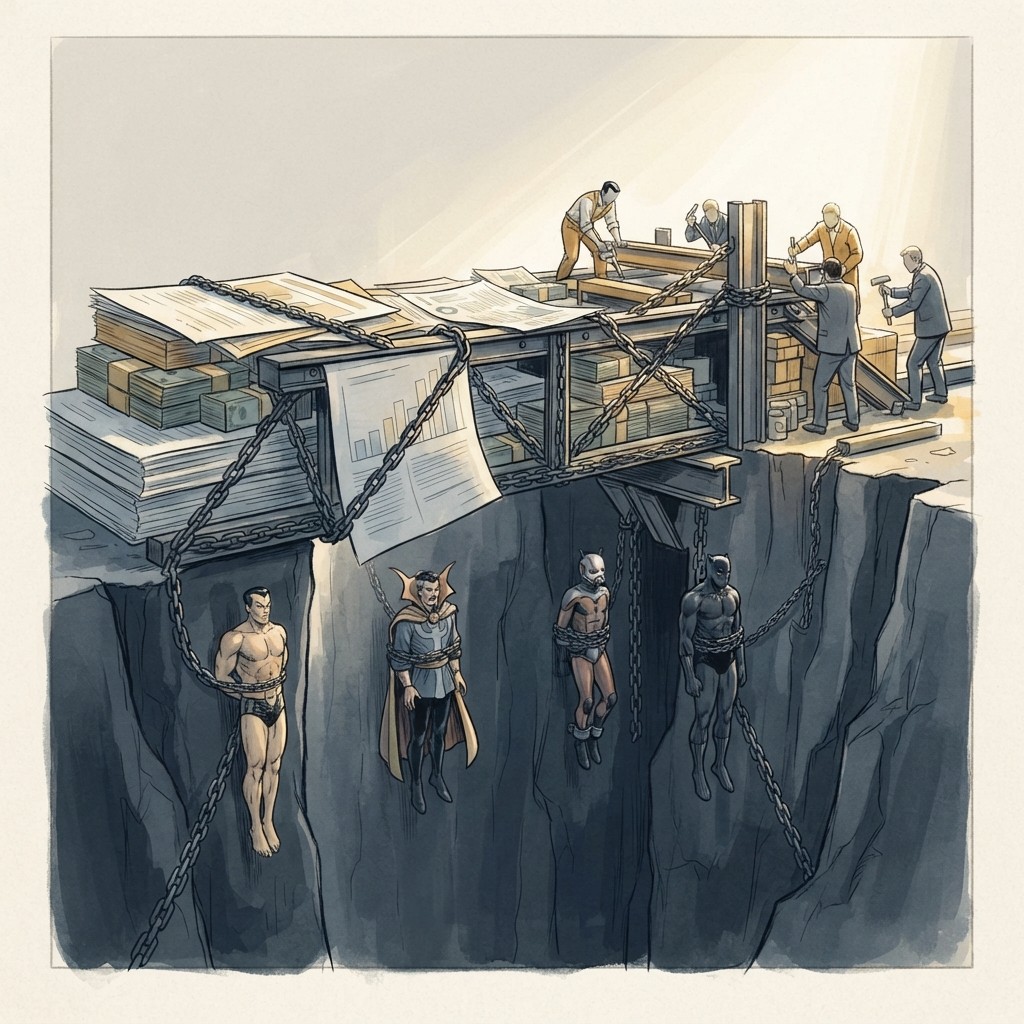
On September 1, 2005, Marvel did something that should be famous and isn't: it walked into Merrill Lynch and pledged ten of its superheroes as collateral on a $525 million loan.3 Not the comics. Not the toys. The characters themselves — Captain America, Black Panther, Doctor Strange, the Avengers — signed over to a structured-finance facility the way a homeowner signs over a deed. If the films flopped, the bank could take the heroes. This is the moment the cinematic universe actually began. It was not a creative breakthrough. It was a non-recourse credit agreement.
The story everyone tells goes like this: Marvel went broke, then dreamed up a connected movie universe, and Iron Man saved it. Almost every beat of that is wrong. Marvel's bankruptcy was self-inflicted, not industry-driven. The turnaround was run by a cost-cutting CEO nobody remembers. And the loan that bankrolled the bet didn't even include Iron Man on its list of pledged characters.
The bankruptcy wasn't an industry collapse. It was a buyout that bit.
Marvel Entertainment Group filed Chapter 11 on December 27, 1996, listing $229.6 million in assets against $693.2 million in liabilities.1 Read those two numbers again. This was not a company nicked by a soft market — it was insolvent by nearly half a billion dollars. The convenient myth blames the comic-book bubble bursting. The truth is closer to home: Ronald Perelman, who controlled Marvel through his holding company, had spent the early 1990s turning a character library into a leveraged conglomerate, and the debt he stacked on the balance sheet is what the bubble eventually crushed.2 The industry was the weather. The leverage was the leak in the roof.
Then the fight everyone misremembers. Carl Icahn is cast as the activist shareholder squaring off against Perelman. He wasn't a shareholder at all in the way that mattered. Icahn came in as a bondholder — he controlled roughly a quarter of Marvel's public debt2 — buying distressed paper cheap and using it to seize control through the restructuring, the classic vulture play. The two raiders spent the bankruptcy locked in a control war over the carcass. Neither was building anything. They were dividing it.
The CEO the myth deletes
Marvel emerged from bankruptcy on June 2, 1998, when ToyBiz and the old Marvel were merged into a new entity, Marvel Enterprises.8 But emerging from Chapter 11 is not the same as being healthy — it's being alive. The company still had to be made to throw off cash. That job fell to F. Peter Cuneo, hired in July 1999, and it is here that the popular narrative simply skips a chapter. Cuneo didn't pitch a universe. He ran a balance sheet. He drove SG&A down from $124.6 million in 1999 to $107.5 million in 2000, and slashed warehousing and merchandising costs by 71% between 2000 and 2001.7 Unglamorous, line-item discipline — and without it, there was no creditworthy company for any bank to lend a half-billion dollars to in 2005.
“SG&A fell from $124.6 million to $107.5 million, and warehousing and merchandising costs dropped 71% in a single year.”7
Why pledging your superheroes was the genius move
By 2005, Marvel had licensed its biggest names to other studios for one-time fees and the structural insult of a small cut. To make real money, it had to produce its own films — and a company freshly out of bankruptcy cannot bet its survival on box office. So it built a firewall. The $525 million facility Merrill Lynch arranged was non-recourse: $465 million in senior bank debt and $60 million in mezzanine debt, secured against ten specific characters and the films built from them, not against the company itself.3 If the movies bombed, the lenders could seize the pledged characters — and that was the worst case. Marvel's other assets, its survival, were ring-fenced. The structure, not the story, is what made the gamble survivable.
| Recourse loan (the alternative) | The non-recourse film facility | |
|---|---|---|
| What's pledged | The whole company | Ten specific characters + their films |
| If the films flop | Marvel goes under again | Lenders take the pledged characters |
| Downside on the bet | Existential | Contained, walled off |
| Why it mattered | Too risky to attempt | Made a post-bankruptcy studio bet survivable |
Here is the detail that detonates the legend. The ten characters Marvel collateralized were Ant-Man, the Avengers, Black Panther, Captain America, Cloak & Dagger, Doctor Strange, Hawkeye, Nick Fury, Power Pack, and Shang-Chi.3 Iron Man — the film that supposedly launched everything — is not on the list. His rights had been reacquired on a separate track. The first MCU movie was financed under a facility that didn't even name him as one of its bets. Marvel's later annual report does confirm the facility was the primary funding for its film segment, including Iron Man and The Incredible Hulk, distributed by Paramount and Universal respectively.4 But the foundational collateral list and the foundational film were two different decisions. The myth fused them into one act of vision. They were two acts of finance.
Doesn't the $4 billion exit prove the vision was real?
The honest counter is hard to dismiss: Disney agreed to buy Marvel on August 31, 2009 for roughly $4 billion — $30 cash plus about 0.745 Disney shares per Marvel share — and the deal closed at a reported $4.24 billion that December 31.56 Surely that price validates a creative master plan, not a clever loan. And it's true that the films were genuinely good, and that the connected-universe idea had real audience pull. But notice what Disney was actually buying. It bought a clean, de-levered, cash-generating company with a proven film-financing structure and a library whose film rights had been methodically reassembled — exactly the company Cuneo's discipline and the non-recourse facility had made possible. Ike Perlmutter, who owned 37% of the stock, blessed the sale.6 The vision is what made the films watchable. The financial engineering is what made there be films to watch — and a company solvent enough to sell.
The cinematic universe is celebrated as a creative idea. It was first a risk-containment structure. A company that nearly died of leverage could not afford to bet its life on box office — so it built a non-recourse wall around the wager, pledging specific assets rather than the firm. The lesson for any operator eyeing a transformational gamble: you don't need the courage to risk everything; you need the structure that lets you risk only what you can lose. Marvel's heroes were the collateral, not the inspiration. The genius wasn't believing in the bet — it was engineering a way to make the bet survivable. And remember the unglamorous prerequisite: none of it is possible without the boring cost discipline that makes you creditworthy in the first place.
Strip away the capes and the box-office records, and Marvel's turnaround is a finance story with a costume on. Two raiders bled the company nearly to death over its debt. A turnaround CEO made it solvent again, one line item at a time. And a structured-finance desk drew a wall around the studio bet so a near-bankrupt company could place it without dying if it lost. The pledged characters were ledger entries before they were legends. The most expensive proof in modern entertainment isn't that vision conquers all — it's that vision only gets to play once someone has engineered a way for it to fail safely.
When the real story is hiding in the financials
Turnaround Diagnosis Worksheet
A worksheet that forces a turnaround down to first principles: is this a cash problem, a cost problem, or a strategy problem — and which one will kill you first. It separates the bleeding you must stop this week from the rebuild that takes years. Blank to triage your own situation; filled as the worked example tracing how the story's leader sequenced survival before revival.
Included, filled and blank, in the The Turnaround Casebook. See the set → · Preview the blank →
Sources
Where this comes from — the filings, records, and reporting behind it.
- 1Marvel Entertainment Group filed Chapter 11 bankruptcy on December 27, 1996, listing assets of $229.6 million and liabilities of $693.2 millionVariety, Perelman Takes Marvel to Bankruptcy Court ↗ · 1996-12-30
- 2Marvel Entertainment Group filed Chapter 11 bankruptcy on December 27, 1996; Carl Icahn controlled ~25% of Marvel's public debt; Ronald Perelman controlled Marvel through MacAndrews & Forbes
- 3Marvel Enterprises closed a $525 million non-recourse credit facility on September 1, 2005, arranged by Merrill Lynch Commercial Finance Corp., consisting of $465M in revolving senior bank debt and $60M in mezzanine debt, to produce up to ten films; the ten collateralized characters were Ant-Man, The Avengers, Black Panther, Captain America, Cloak & Dagger, Doctor Strange, Hawkeye, Nick Fury, Power Pack, and Shang-Chi — not Iron Man
- 4Marvel's 10-K confirmed that its film production segment (including Iron Man and The Incredible Hulk) was financed primarily by the $525 million film facility; Paramount distributed Iron Man and Universal distributed The Incredible Hulk
- 5Disney agreed to acquire Marvel Entertainment on August 31, 2009 for approximately $4 billion ($50 per Marvel share), with shareholders receiving $30 cash plus ~0.745 Disney shares per Marvel share; deal closed December 31, 2009
- 6Disney completed the $4.24 billion acquisition of Marvel Entertainment on December 31, 2009; Isaac 'Ike' Perlmutter, who owned 37% of Marvel stock, supported the deal and would oversee Marvel reporting to Disney CEO Robert Iger
- 7Post-bankruptcy CEO F. Peter Cuneo (hired July 1999) imposed cash-flow discipline; SG&A fell from $124.6M (1999) to $107.5M (2000) per Marvel's 2001 SEC filing; warehousing and merchandising costs dropped 71% from 2000 to 2001
- 8ToyBiz and Marvel Entertainment Group were merged into Marvel Enterprises to bring it out of bankruptcy on June 2, 1998; in April 1998 the NYSE had delisted Marvel stock; in August 2008 Perelman paid $80M to settle a lawsuit over diverting $553.5M in notes
More like this — beyond Marvel
New Strategically analyses as they publish: the defining moves in business, checked against the record. No noise, and one click to leave.