Pairs with the Turnaround Diagnosis Worksheet — a ready-to-use strategy tool. Included in the The Turnaround Casebook →
The Wii U sold 13.56 million units in its entire life. The Switch sold 155.92 million.1 Same company, same franchises, same Mario and the same Zelda - and a gap of more than ten to one. The easy story is that Nintendo got its mojo back: a flash of creative genius turned a flop into a phenomenon. That story is half true and entirely misleading. The Switch's most important difference from the Wii U was not on the screen. It was on the balance sheet.
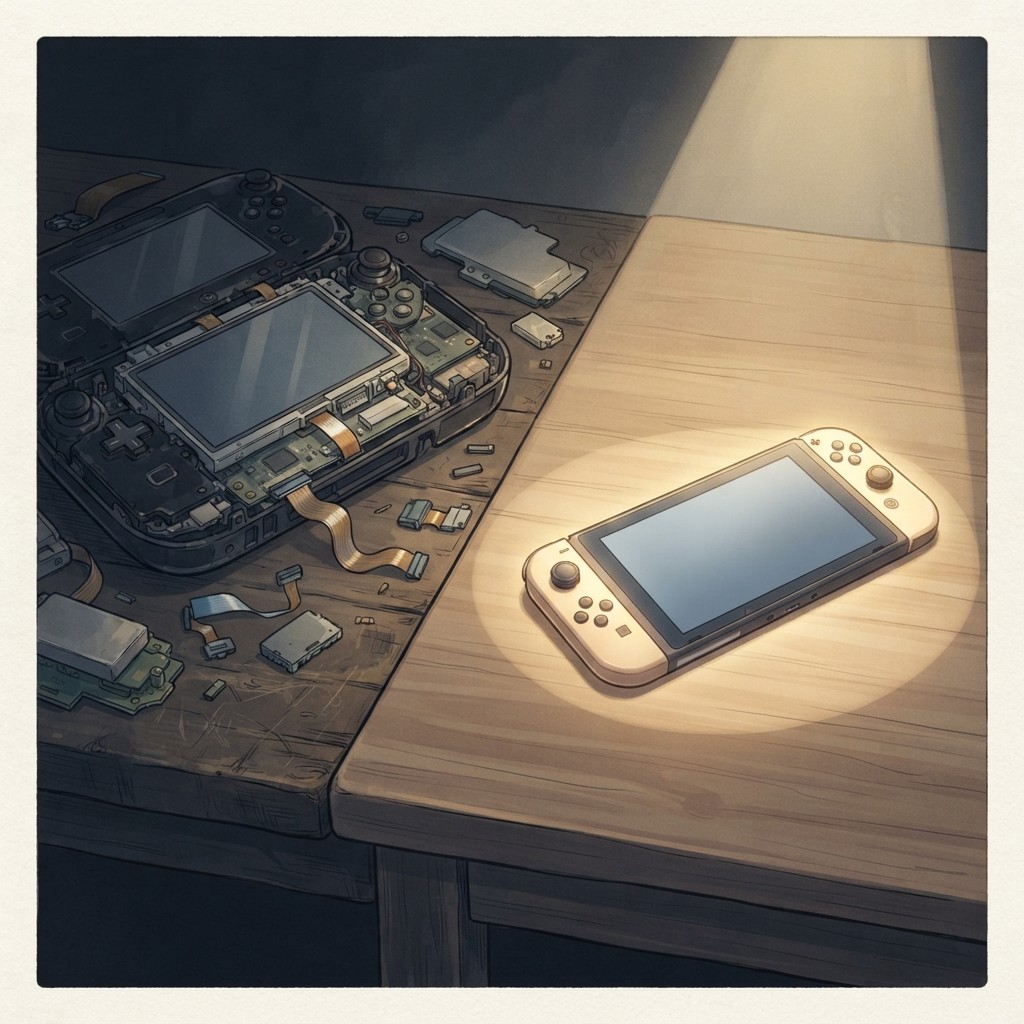
The legend says Nintendo reinvented itself. The truth is closer to the opposite: it subtracted. It looked at the Wii U, found the one part bleeding money and confusing customers, and cut it out - then wrapped the same IP in a device engineered to make money on the very first unit sold.
The Wii U lost on the sticker, not just the shelf
The Wii U's headline feature was a chunky tablet controller with a second screen built in - expensive to manufacture, and worse, nearly impossible to explain. Many shoppers thought it was an accessory for the original Wii. Iwata himself owned the failure plainly: 'We are to blame,' he told CNBC in 2013, conceding that consumers 'still cannot understand what's so good and unique about the Wii U,' and that the console had no 'Wii Sports'-equivalent hit to make its case for it.8 But the marketing miss was only the visible half of the wound. Like the 3DS before it, the Wii U was sold below its manufacturing cost.6 That meant every confused shopper who didn't buy wasn't just a lost sale - and every shopper who did buy handed Nintendo a unit it had already lost money on. The hardware needed software attach to ever break even, and the software never came in volume.
“We are to blame. We relaxed our [marketing] efforts, so consumers still cannot understand what's so good and unique about the Wii U.”8
The bleeding showed up exactly where you'd expect. For the fiscal year ending March 2014, Nintendo posted an operating loss of ¥46.4 billion - roughly $457 million - with Wii U hardware moving just 2.72 million units.2 By the platform's final full year, hardware sales had collapsed to 760,000 units, a 77% drop.3 And the damage was bigger than one console: net sales had fallen from a 2009 peak of about ¥1.8 trillion to ¥549 billion by 2015 - a two-thirds collapse, and the company's first operating losses in three decades.7 This was not a brand needing a fresh idea. It was a business model quietly hemorrhaging on every box it shipped.
| Wii U | Nintendo Switch | |
|---|---|---|
| The signature gimmick | Costly second-screen tablet | Detachable, portable play |
| Sold at launch | Below manufacturing cost | Profitable from unit one |
| Lifetime hardware | 13.56 million | 155.92 million |
| The IP behind it | Mario, Zelda | Mario, Zelda |
The fix wasn't a new idea. It was a new income statement.
Here is the move that mattered. Nintendo confirmed in its 2016 fiscal-year earnings report that the Switch would be profitable from launch - an explicit break from both the 3DS and the Wii U, which were sold below cost.6 A teardown estimated the Switch cost about $257 to build against a $299 retail price.6 Read that again: the same company that lost money on every Wii U now made a margin on every Switch before a single game was attached. That is not a design story. That is financial engineering wearing a Mario costume. The second screen - the part that was both expensive and inexplicable - was gone, replaced by portability, a feature that explains itself the instant you pick the thing up off the dock and keep playing on the train.
Then the IP did its job. The Switch shipped 2.74 million units in its launch month of March 2017, beating Nintendo's own target of 2 million.5 More telling was the software: Zelda: Breath of the Wild sold 2.76 million copies - more games than consoles, an attach rate above 100%.5 People weren't buying a console and waiting for a reason; they were buying it because there was already a reason in the box. The Wii U's fatal lack of a defining launch title was answered on day one. Same Zelda. Opposite math.
When a product is failing, the loud diagnosis is always 'people don't get it' - a marketing problem. Nintendo's Wii U had that problem, but the deeper one was structural: it lost money on every box, so even success would have been expensive. The turnaround treated the income statement first. It cut the single feature that was both costly and confusing, then made the device profitable at unit one - so that volume created margin instead of multiplying losses. The lesson isn't 'be more creative.' It's: find the part of your product that is simultaneously expensive and unloved, and have the nerve to delete it. A flop sold below cost doesn't need a better ad. It needs a better cost.
Wasn't it just better games? The honest counter.
The fair objection: this is too tidy. Plenty of consoles sold at a profit and still flopped, and plenty of beloved IP has failed to save bad hardware. The Switch worked, a skeptic would say, because the games were genuinely great and portability genuinely delighted people - the financial trick is a footnote. There's real truth there, and the attach rate proves it: a 100%-plus software attach is a creative achievement, not an accounting one. But notice what the profitability decision actually bought Nintendo. It bought patience. A console that earns a margin per unit doesn't have to win a price war or pray for a system-seller to bail out the hardware - it can sell at whatever pace the market gives it without bleeding the company white. The Wii U's below-cost model meant slow sales compounded losses; the Switch's at-launch profit meant slow sales would simply have been slow. Creativity got the credit. Cost discipline removed the trapdoor under it.
And a final myth worth retiring: that Nintendo expected the Wii U to sell 100 million units. That figure came from an unnamed projection at an internal sales meeting, not an official target - and Kimishima, who later disclosed it, said he had warned at the time that explaining the Wii U's appeal 'would be no easy task.'4 He was right. The Wii U was never killed by a missed forecast. It was killed by a feature nobody understood, sold at a price below what it cost to make. The Switch's genius was to recognize both halves of that sentence and remove them. Nintendo didn't out-create the Wii U. It out-subtracted it - and discovered that the cheapest fix was taking something away.
Turnaround Diagnosis Worksheet
A worksheet that forces a turnaround down to first principles: is this a cash problem, a cost problem, or a strategy problem — and which one will kill you first. It separates the bleeding you must stop this week from the rebuild that takes years. Blank to triage your own situation; filled as the worked example tracing how the story's leader sequenced survival before revival.
Included, filled and blank, in the The Turnaround Casebook. See the set → · Preview the blank →
Sources
Where this comes from — the filings, records, and reporting behind it.
- 1Wii U lifetime hardware sales = 13.56 million units; Nintendo Switch lifetime hardware sales = 155.92 million units (Nintendo IR, as of most recent update).
- 2Nintendo reported an operating loss of 46.4 billion yen (~$457 million) for the fiscal year ending March 2014, with Wii U hardware and software sales of only 2.72 million and 18.86 million units respectively cited as a contributing factor.
- 3Nintendo's FY2017 consolidated financial statements confirm Wii U hardware sales of 760,000 units (77% YoY decrease) and software of 14.8 million units (46% YoY decrease) in the final year of the platform's commercial life.
- 4At a 2016 shareholder meeting, Nintendo CEO Tatsumi Kimishima disclosed that 'someone' at an internal sales meeting had projected close to 100 million Wii U sales, reasoning that Wii's success would carry over—but Kimishima had personally cautioned at the time that clearly explaining the Wii U's appeal 'would be no easy task.'
- 5The Nintendo Switch shipped 2.74 million units in March 2017 (its launch month), exceeding Nintendo's own pre-launch target of 2 million units. Zelda: Breath of the Wild accounted for 2.76 million software units—an attach rate exceeding 100%.
- 6Nintendo confirmed in its 2016 fiscal year earnings report that the Switch would be profitable from launch, unlike the 3DS and Wii U which were both sold below manufacturing cost. A hardware teardown estimated the Switch cost ~$257 to make against a $299 MSRP.
- 7Nintendo's net sales declined from a peak of ¥1.8 trillion ($18.7B) in 2009 to ¥549 billion ($4.6B) in 2015—a two-thirds collapse—driven by the back-to-back underperformance of the 3DS and Wii U. Nintendo saw its first operating losses in 30 years during this period.
- 8Nintendo CEO Satoru Iwata admitted in a 2013 CNBC interview: 'We are to blame. We relaxed our [marketing] efforts, so consumers still cannot understand what's so good and unique about the Wii U.' He also acknowledged the lack of a 'Wii Sports'-equivalent title as a core failure.
More like this — beyond Nintendo
New Strategically analyses as they publish: the defining moves in business, checked against the record. No noise, and one click to leave.