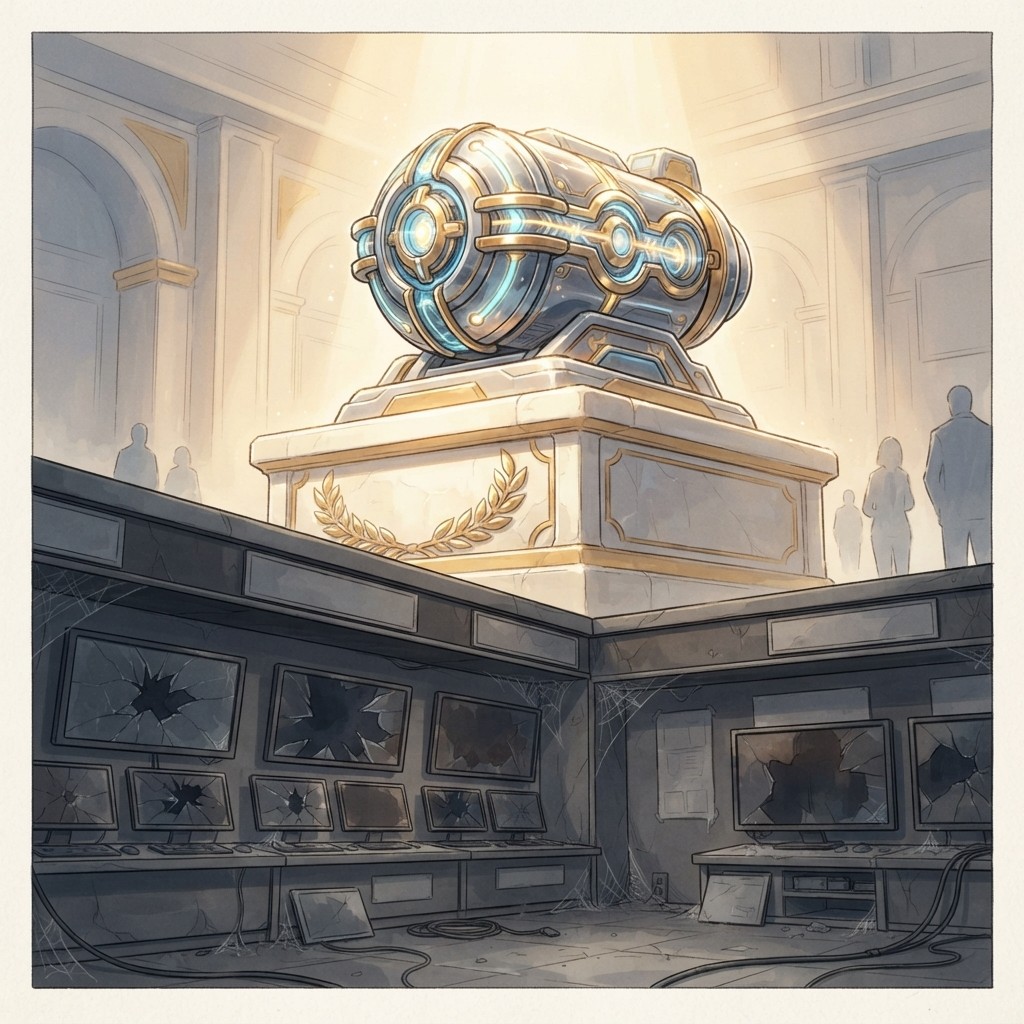
Pairs with the Standards-War Battle Map — a ready-to-use strategy tool. Included in the Standards War Casebook →
“What can you charge for your standard without losing the war to win it?”
In December 2018, Epic Games went to war with the most entrenched standard in PC gaming. Steam took 30 cents of every dollar spent on a game; Epic launched a rival store and offered developers 88 cents of that dollar instead of 70.8 It was a clean, aggressive bet: undercut the toll, buy exclusivity, and pry open a market Valve had owned for fifteen years. Six years later that store reached 295 million PC users — and was still losing money, with more than three-quarters of its revenue coming from Epic's own games.8 Meanwhile, almost as a footnote, Epic was quietly winning a different standards war it barely talked about. That second war is the one that paid the bills.
The official story is that Epic is the scrappy challenger taking on the gatekeepers — Steam, Apple, Google — and winning. The real story is stranger and more useful. Epic won the standards war it wasn't fighting, and is steadily losing the one it loudly started. The engine became a standard while the store stayed a subsidy.
The war Epic actually won is the one it rarely fights about
Unreal Engine doesn't run loud exclusivity campaigns or sue Apple. It just sits underneath other people's games, taking a small royalty when they succeed. And by 2024, that quiet position had become a standard: Unreal powered 28% of all games released on Steam and captured 31% of total Steam game-sales revenue.2 Here's the part that matters. Unity still leads by raw game count — roughly 51% of Steam releases to Unreal's 28%.2 So Unreal is not the most-used engine. It's the most-earning engine, because it concentrates in the high-budget AAA titles where the money is. That is what winning a standards war actually looks like: not the biggest install base, but ownership of the segment that pays. Unreal Engine revenue climbed from $150M in 2021 to $275M in 2023 — small against Epic's billions, but pure, defensible royalty that compounds with every blockbuster shipped on the engine.1
| Unity | Unreal | |
|---|---|---|
| Share of games released | ~51% | ~28% |
| Share of game-sales revenue | 26% | 31% |
| Concentrated in | Indie and mid-tier volume | High-budget AAA titles |
| The standard it owns | The long tail | The money |
The store was never a mistake — it was a land-grab that didn't land
The easy read on the Epic Games Store is that Epic stumbled into a money pit. That's wrong, and the correction matters. The losses were deliberate, funded, and disclosed in internal projections shown at the Apple trial — Epic expected the store to stay unprofitable until at least 2025 and to accumulate a combined loss of $965M by 2027.5 This was a chosen war, paid for out of Fortnite's profits, to pry developers off Steam's 70/30 split with a far more generous 88/12.8 The bet wasn't crazy. The problem is what the spending bought. By 2024 the store reached 295 million users and $1.09B in total spend — but only $255M came from third-party games, meaning over 74% of revenue still came from Epic's own titles like Fortnite. Worse, third-party revenue actually fell 18% year over year.8 A store that spent years buying exclusives to attract outside developers was, six years in, mostly a way for Epic to sell Fortnite to itself. In 2023 the store's general manager admitted under oath that it still wasn't profitable.5
“The downturn in Fortnite engagement that started in 2025 means we're spending significantly more than we're making.”6
That sentence is the whole strategic problem in one breath. The engine war Epic won throws off thin, durable royalties. The store war Epic started was financed by Fortnite — and Fortnite is the one asset cooling off. When the funding source softens, the subsidized war can't be subsidized anymore. In September 2023 Epic cut roughly 830 employees, about 16% of its workforce; in March 2026 it cut over 1,000 more.610 Two rounds, not one — a detail the single-restructuring narrative quietly drops, and the one that tells you the distress is structural, not a blip.
Didn't Epic just beat Apple and Google in court?
This is where the popular scoreboard is most wrong, and it's worth being precise. Against Apple, Epic lost. The judge ruled for Apple on 9 of 10 counts in 2021 — every federal antitrust claim — and Epic prevailed only on a single California anti-steering claim; the Ninth Circuit affirmed the split in 2023, and the Supreme Court declined to hear further appeals in 2024.3 Against Google, Epic won: a jury found Google's conduct anticompetitive in 2023, the Ninth Circuit affirmed, and Google settled in March 2026 agreeing to charge 20% or less on Epic's transactions.4 Opposite outcomes, different mechanisms — one a bench trial decided by a judge, one a jury verdict. Conflating them into 'Epic beat the gatekeepers' flatters a record that is genuinely split. And note the deeper point: even the win against Google lowers a toll. It doesn't make Epic's own store profitable. Litigation can pry open a market; it cannot manufacture demand for the platform you built to fill the opening.
Epic ran two standards wars at once, and the difference between them is the lesson. Unreal Engine wins by sitting underneath other people's success and taking a thin, automatic royalty — Epic profits when its customers win, and it costs almost nothing to extend. The Epic Games Store fights from the front: it pays to acquire users, pays for exclusives, and only profits if it can pull demand away from an entrenched standard. The first model compounds quietly; the second bleeds until you achieve the market share you projected — and Epic's store has not reached the 25–30% of third-party sales its own GM identified as the necessary threshold.11 When you choose a standards war, check which side of the toll you're standing on. A royalty you collect scales for free; a subsidy you pay scales your losses.
The fair objection is that this is too neat — that a store with 295 million users and a court win over Google is hardly losing.48 True, and the optionality is real: Disney put $1.5B into Epic in 2024.7 But notice the price. That round valued Epic at $22.5B, down from $31.5B in 2022 — a third of the company's paper worth gone while it was supposedly winning.7 The market is reading the same split the financials show: the engine is an asset, the store is a bet still being funded by a hit game that is no longer growing. Optionality you keep paying for is not the same as victory.
Epic Games is two companies wearing one logo. One quietly became a standard by taking a sliver of everyone else's blockbuster; the other spent years and a billion dollars trying to become a standard by giving money away, and is still waiting. The engine war was won by being unavoidable. The store war is being lost by being optional — a generous alternative to Steam that most developers simply don't need, financed by a game whose players are drifting off. Sweeney was right that it was a real plan. The trouble is the cheapest standard to own is the one you collect on. Epic built one of those. It just spent the proceeds fighting for the other kind.
Standards-War Battle Map
A one-page canvas for a winner-take-most format war: who's fighting, which platforms and partners back each side, where the installed base sits today, and which forces will tip the market before it locks. Blank to map a standards fight you're entering; filled as the worked example charting the battle the story describes. Use it to spot which side has already won and which is still spending to lose.
Included, filled and blank, in the Standards War Casebook. See the set → · Preview the blank →
Sources
Where this comes from — the filings, records, and reporting behind it.
- 1Sacra estimates Epic Games generated $5.7B in revenue in 2024, up ~10% from $5.2B in 2023; Unreal Engine revenue reached $275M in 2023, up from $225M in 2022 and $150M in 2021.
- 2In 2024, Unreal Engine powered 28% of all Steam games released and accounted for 31% of total Steam game sales revenue, while Unity led by game count at ~51%; Video Game Insights forecasts Unreal will reach 40% of annual Steam sales by 2030.
- 3Epic Games v. Apple: Judge Gonzalez Rogers ruled in Apple's favour on 9 of 10 counts in September 2021; the Ninth Circuit largely affirmed in April 2023; the Supreme Court denied appeals in January 2024. A separate April 2025 contempt ruling found Apple willfully violated the anti-steering injunction.
- 4Epic v. Google: A San Francisco jury found Google had engaged in anticompetitive conduct in December 2023; the Ninth Circuit affirmed; in March 2026 Epic and Google reached a settlement in which Google agreed to charge 20% or less on Epic app transactions.
- 5Court documents disclosed during the Epic v. Apple trial showed Epic projected the Epic Games Store would remain unprofitable until at least 2025 and accumulate a combined loss of $965M by 2027. EGS general manager Steve Allison admitted in the Epic v. Google trial (November 2023) that the store was still not profitable.
- 6In March 2026, Epic laid off over 1,000 employees — its second major layoff after cutting ~830 in September 2023. CEO Tim Sweeney's public memo stated: 'The downturn in Fortnite engagement that started in 2025 means we're spending significantly more than we're making.'
- 7Disney invested $1.5B in Epic Games in February 2024 at a $22.5B post-money valuation, down from the $31.5B valuation set in the April 2022 Sony-KIRKBI funding round. Epic has raised $8.127B across 15 rounds total.
- 8Epic launched the EGS in December 2018 with an 88/12 revenue split vs. Steam's 70/30. In 2024, the EGS reached 295 million PC users; total spend on the platform was $1.09B, but only $255M came from third-party games (74%+ of revenue was first-party titles like Fortnite), and third-party revenue fell 18% vs. 2023.
- 9Video Game Insights data: games on Unreal Engine earned 31% of Steam revenue, while games on Unity earned 26%.
- 10In September 2023, Epic cut about 830 jobs, or roughly 16% of its workforce.
- 11Epic Games Store GM Steve Allison stated the store's target is 'a predictable average market share of 25 or 30% of your sales or more'; current third-party revenue share is roughly 3%.
More like this — beyond Epic Games
New Strategically analyses as they publish: the defining moves in business, checked against the record. No noise, and one click to leave.