Pairs with the Moat Anatomy Canvas — a ready-to-use strategy tool, filled for Airbnb. Included in the Moat Anatomy Casebook →
“What would it actually cost a challenger to take your customer?”
A host in a mountain town fires up a piece of software and, with a few clicks, the same cabin appears on Airbnb, Vrbo, and Booking.com at once. The calendars sync. A booking on one platform blocks the dates on the others. There is no penalty, no exclusivity, no friction — an entire industry of channel-management tools exists precisely to make this painless.5 In resort areas, 40% of rentals do exactly this.5 So before we talk about Airbnb's famous moat, sit with the uncomfortable fact underneath it: the hosts are not locked in. They never were.
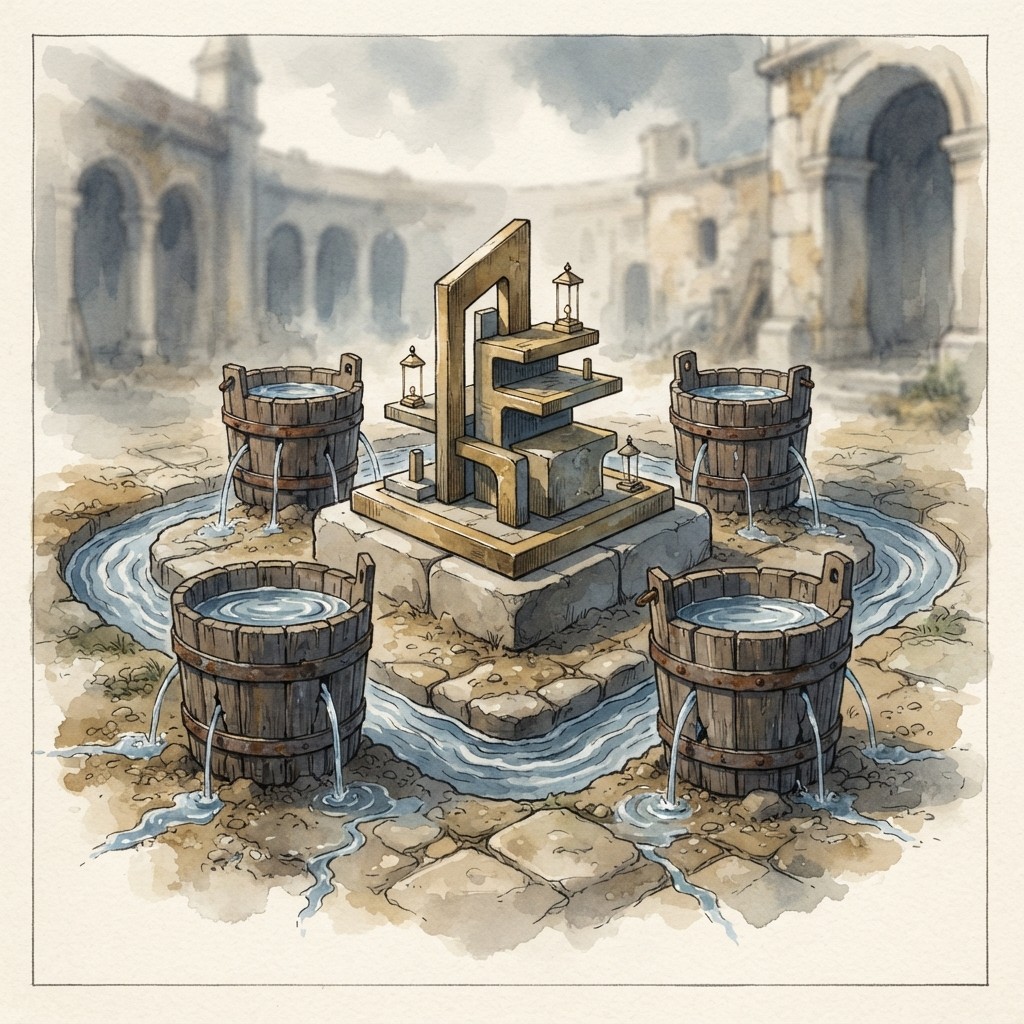
The official story is that Airbnb is protected by an unbreakable network effect — that, like Facebook or Google, it simply got too big to challenge. That story is half true and badly told. Airbnb's network is two-sided, not winner-take-all, and both sides multi-home constantly. The real protection is something less cinematic and far more durable: not one wall, but four leaky buckets that never all drain at the same time.
Here is the thesis a smart friend could repeat at dinner. Airbnb's moat is not a single fortress. It's a compounding stack of four imperfect advantages — brand-led organic traffic, a non-replicable long-tail of individual hosts, a trust-and-review data asset, and enormous prepaid float — each one individually leaky, and collectively very hard to take apart. Attack any one and you can win. Attack all four at once and you have to become Airbnb.
Bucket one: the brand that brings the traffic for free
The cheapest customer is the one who types your name into the search bar instead of clicking your ad. "Airbnb" became a verb, and a verb doesn't need to bid against Google for its own demand. In 2024 the company's marketing spend rose 22% to $2.1 billion — so the lazy claim that Airbnb "spends nothing on marketing" is wrong.4 The precise claim is sharper and more interesting: that spend held roughly flat at about 19% of revenue, and the majority of it goes to brand, not performance.4 Compare the alternative. Booking Holdings poured $7.3 billion into marketing in 2024 — 31% of its revenue — much of it feeding the search engines for clicks it has to re-buy every quarter.4 That gap is the moat made visible. Airbnb is paying to be remembered; Booking is paying to be found, again and again, forever.
| Airbnb (2024) | Booking Holdings (2024) | |
|---|---|---|
| Marketing spend | $2.1B | $7.3B |
| As share of revenue | ~19% | 31% |
| Weighted toward | Brand (remembered) | Performance (re-bought) |
| Cost of the next booking | Falls as brand compounds | Re-paid every quarter |
Bucket two: the supply nobody else can buy
Airbnb crossed 8 million active listings in 2024.2 Numbers like that invite the assumption that the future belongs to professional property managers — slick, branded, consistent. Airbnb's own CFO says the data refuses to cooperate. At a Bernstein conference in June 2024, Ellie Mertz noted the common "presumption that professional hosts provide better quality" is "not entirely proven out by the data," and that individual hosts on Airbnb actually carry higher ratings on average.7 Airbnb names those individual hosts — the spare room, the family cabin, the apartment while the owner travels — as its biggest edge over Vrbo and Booking.com.7 This is the part rivals can't simply outspend. You can recruit professional managers with a sales team. You cannot acquire a long tail of millions of one-off, idiosyncratic homes that exist nowhere else; it has to accrete, host by host, over years.
Buckets three and four: the data that costs to leave, and the cash that arrives early
The third bucket is trust, stored as data. A host's years of reviews, Superhost status, and ranking history don't travel. List the same cabin on Vrbo and you start at zero — no reviews, no rank, no proof. That doesn't lock a host in; multi-homing is everywhere. But it does mean Airbnb usually stays the host's primary channel even when they list elsewhere, because the reputation that converts bookings lives on Airbnb. The company actively curates this asset, removing over 300,000 listings that failed guest expectations since Q3 2023 — pruning the supply to protect the trust.2 The fourth bucket is the quietest and the most underrated: float. Guests pay when they book, often months before they stay, on $81.8 billion of gross bookings in 2024.3 That timing gap turns into real cash — $4.5 billion of free cash flow at a 40% margin.3 A business that collects before it pays is financing itself with other people's money, and that's a structural advantage no clever app replicates.
The instinct in strategy is to find the single durable moat — the network effect, the patent, the switching cost — and bet the company on it. Airbnb is a lesson in the opposite. Not one of its four advantages is airtight: hosts multi-home freely, the brand still costs $2.1 billion a year to maintain, reviews don't actually trap anyone, and float is just timing. But a competitor that beats the brand still faces the supply; one that buys the supply still faces the trust data; one that matches the data still can't conjure the float. The protection isn't depth in any one bucket — it's that an attacker has to drain all four at once, and they never drain together. When you can't build a fortress, build redundancy.
The honest counter: isn't a leaky moat just a weak one?
The fair objection is brutal and worth stating plainly: a moat you have to describe as "four imperfect things" might just be a polite way of saying Airbnb has no real moat at all. The evidence for the skeptic is strong. Airbnb's own 10-K names "intense competition from OTAs, hotels, search engines, and super-apps" as a material risk — not a footnote, a headline risk.8 And the company is actively weakening one of its historic host advantages: starting October 27, 2025, PMS-connected hosts were moved, with no opt-out, to a mandatory 15.5% host-only fee — converging with Booking.com's roughly 15% and well above Vrbo's roughly 8%.6 When you raise the cost of staying and your supply can leave in a click, the leak gets faster. The honest answer is that the skeptic is right about each bucket and wrong about the system. A free-multi-homing host still defaults to the channel that brings the most bookings — and the brand, the trust data, and the demand all point back to Airbnb. The fee hike is a calculated bet that the demand advantage is now strong enough to charge for. That bet could fail. But the reason Airbnb can even make it is the stack: no single advantage justifies it, and all four together just might.
“There is a presumption that professional hosts provide better quality than individual hosts... it's not entirely proven out by the data.”7
Airbnb spent a decade letting the world believe it was protected by a single, Facebook-style network nobody could touch. The truer story is humbler and more durable. Its hosts can walk out the door any day, and many already keep one foot outside it. What holds the business together is not a wall but a weave — brand, supply, trust, and float — where every thread is fraying and the cloth still holds. The genius was never one unbreakable advantage. It was building four breakable ones that never break on the same day.
More anatomies of what actually protects a business
Moat Anatomy Canvas
A one-page canvas that dissects a moat instead of asserting it: where the advantage comes from, how much of the market it covers, how long it would take to copy, and what keeps it from eroding. Blank to dissect your own claimed edge; filled as the worked example tracing the structure of the story's defensible advantage. Use it to tell a real moat from a head start.
Included, filled and blank, in the Moat Anatomy Casebook. See the set → · Preview the blank →
Sources
Where this comes from — the filings, records, and reporting behind it.
- 1Airbnb FY2024 revenue was $11,102 million; FY2023 revenue was $9,917 million; FY2022 revenue was $8,399 million. Net income in FY2024 was $2.6 billion (24% margin). Trailing twelve-month FCF was $4.5 billion (40% FCF margin). Total assets were $20,959 million at 12/31/2024.
- 2Airbnb had over 8 million active listings as of Q3 2024, with growth across all regions and market types. Q3 2024 revenue grew 10% YoY to $3.7 billion. Full-year 2024 Nights and Experiences Booked reached over 491 million. App bookings accounted for 58% of total nights booked in Q3 2024, up from 53% a year prior. Since Q3 2023, Airbnb removed over 300,000 listings that failed to meet guest expectations.
- 3FY2024 Airbnb Q4 and full-year results: Revenue surpassed $11 billion in 2024; Adjusted EBITDA of $4.0 billion (36% margin); FCF of $4.5 billion (40% margin); GBV of $81.8 billion. Since the 2020 IPO, Airbnb's revenue and GBV have tripled. The Co-Host Network, launched in 2024, grew to support almost 100,000 listings in its first four months, with those listings earning approximately twice as much as comparable Airbnb listings.
- 4Airbnb's sales and marketing spend increased 22% to $2.1 billion in 2024, but held roughly flat as a 19% share of revenue. The CFO stated the majority of spend is brand marketing, which she described as not scaling one-for-one with revenue unlike performance marketing. Booking Holdings' marketing investment in 2024 was $7.3 billion, representing 31% of revenue.
- 5As of 2024, 28% of U.S. short-term rental listings are cross-listed on multiple platforms. In resort areas (mountain/lakefront), 40% of rentals are cross-listed. Among larger properties (4+ bedrooms), 39% are cross-listed. Even in urban areas, 17% of studios and single-bedroom units are cross-listed. Many hosts list simultaneously on Airbnb and Vrbo using property management software to sync calendars and avoid double bookings.Baselane, VRBO Host Requirements & Rules 2026 ↗ · 2025-07-10
- 6Starting October 27, 2025, all PMS-connected Airbnb hosts were automatically transitioned to a 15.5% host-only fee structure (16% in Brazil), making it mandatory with no opt-out. The prior split-fee model charged hosts ~3% and guests 14–16%. To maintain the same net payout under the new structure, hosts must apply a markup of approximately 18.34% to their prices, not merely 15.5%. Airbnb's host fee now converges with Booking.com (~15%), while Vrbo remains cheaper for hosts (~8%).
- 7Airbnb CFO Ellie Mertz stated at a Bernstein conference (June 2024) that there is 'a presumption that professional hosts provide better quality than individual hosts' but that this is 'not entirely proven out by the data,' and that individual hosts on Airbnb have higher ratings on average than professional hosts. Airbnb explicitly frames individual hosts—not professional property managers—as one of its biggest competitive advantages over Vrbo and Booking.com.
- 8Airbnb's own 10-K (FY2025 risk summary) explicitly discloses 'intense competition from OTAs, hotels, search engines, and super-apps' as a material risk. The filing states brand and reputation are critical, that negative safety or security incidents could materially harm the business, and that regulatory expansion is an increasing risk as the company enters new markets. The company collects and remits lodging taxes in approximately 33,000 jurisdictions worldwide.
Weighing outside help with a decision like this? Hiring a commercial due diligence provider
More like this — beyond Airbnb
New Strategically analyses as they publish: the defining moves in business, checked against the record. No noise, and one click to leave.