Pairs with the Moat Anatomy Canvas — a ready-to-use strategy tool. Included in the Moat Anatomy Casebook →
“What would it actually cost a challenger to take your customer?”
Walk into a Costco looking for your usual brand of detergent, and you may find it sitting right next to a blue-and-black bottle that does the same job for less. That bottle is Kirkland Signature, and it is doing something far more aggressive than competing for your dollar. It is a message to the company that makes your usual brand: lower your price, or we will hand your sales to the label we own. Most retailers' store brands are the cheap shelf you skim past. Kirkland is something else entirely — a private label that, by Costco's own disclosure, runs in the high-20s percent of net sales.4 On FY2024 net sales of $249.6 billion, that is a brand earning somewhere in the rough neighborhood of $67 to $75 billion a year — bigger than most companies on the stock exchange.14
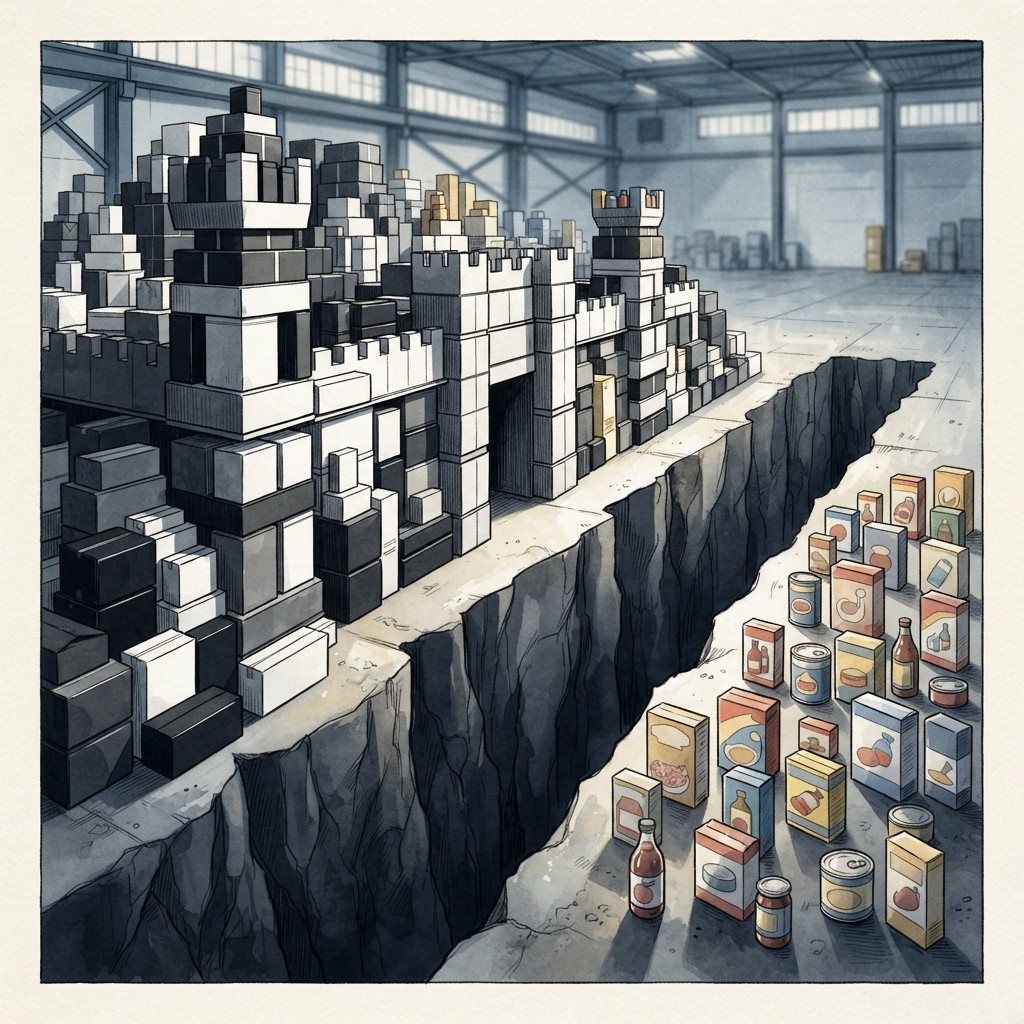
The official story is that Kirkland is a quality private label that happens to sell well. The real story is that the brand is the visible tip of an enforcement mechanism. Costco's leverage isn't the logo; it's the credible threat to wreck its own margin on a national brand until the supplier capitulates — and the brand is simply where the threat gets paid out.
How one brand replaced thirty
Kirkland Signature launched in 1995, but it wasn't born from nothing. Costco already sold private-label goods under a scatter of names — Simply Soda, Clout detergent, Chelsea toilet paper, Ballantrae wine — roughly thirty of them, none building any equity for the others.5 The decision was to collapse all of them into a single label named for the company's then-headquarters town of Kirkland, Washington.5 That consolidation is the under-appreciated move. Thirty brands mean thirty trust-building exercises that never compound. One brand means every good experience with Kirkland coffee makes you trust Kirkland olive oil. Jim Sinegal, who ran Costco, had been circulating a 1991 Forbes article about how national consumer-goods brands were fattening their margins while private label quietly grew, and he pointed his merchants at UK grocers as proof that a store brand could be the thing customers actually wanted, not the thing they settled for.6
“As good or better than the leading national brand — and save members at least 15 to 20%.”6
That standard is the cleverest part of the design, because it's a trap for suppliers as much as a promise to members. Match or beat the leading brand on quality, then undercut it by a fifth. A shopper standing in the aisle has no reason to pay the premium — the quality argument has been neutralized and only the price gap remains. The national brand isn't being beaten in a fair fight. It's being beaten in a fight Costco gets to referee, on a shelf Costco owns, next to a product Costco prices.
The threat that does the work
Here is the mechanism most analysis misses. Costco runs a notoriously thin retail business — operating income of $9.3 billion on net sales of $249.6 billion, an operating margin under 4%, with merchandise gross margin around 11%.1 A retailer that thin cannot win a price war by absorbing losses indefinitely. But it doesn't need to win one. It needs to threaten one credibly. Costco can put a Kirkland product beside a national brand, price the Kirkland version to deliver that 15-to-20% saving, and let the comparison do the persuading. If the national supplier wants to keep its volume on Costco's shelf, it can lower its wholesale price. If it won't, Costco's own label takes the sale — and Kirkland products, by Costco's own words, 'generally carry higher margins than national brand products.'2 Either outcome is fine for Costco. The supplier faces a choice where both branches lead to Costco winning.
| Supplier cuts its wholesale price | Supplier refuses | |
|---|---|---|
| Who keeps the shelf | The national brand | Kirkland Signature |
| Costco's margin on the sale | Improves (cheaper input) | Higher than the national brand |
| What the member sees | A better deal | A cheaper equal |
| Who controls the outcome | Costco | Costco |
A private label is easy to copy — anyone can stick their name on a bottle. What's hard to copy is the structural willingness to make a national brand's life worse until it relents, and to mean it because your own label earns more anyway. Costco can do this because Kirkland's quality bar makes the threat believable and its higher margin makes the threat painless. A competitor that launches a store brand but still depends on national-brand co-op marketing dollars cannot pull the trigger without flinching. The label is the gun. The credibility is the moat.
Why the threat is even believable: the membership underneath
None of this works if Costco needs the supplier more than the supplier needs Costco. The reason the leverage holds is that Costco's profit doesn't actually come from the markup on the merchandise — it comes from the membership fee. Costco raised its Gold Star fee to $65 and its Executive fee to $130 in September 2024, across roughly 52 million memberships.3 Those members renew at 92.3% in the U.S. and Canada.7 A retailer whose real income is a near-guaranteed annual subscription can afford to run the store itself at a sliver, which means it can afford to treat every shelf as a tool for keeping members happy rather than a profit center to defend. Kirkland exists to make members feel they're getting the best possible deal — which keeps them renewing — and that renewal income is precisely what frees Costco from having to please any individual supplier. The membership funds the indifference that makes the threat real.
Isn't this just a good store brand that anyone could build?
The fair objection is that private label is the oldest trick in retail and everyone has one. Sam's Club consolidated roughly twenty of its own brands under 'Member's Mark' in 2017 — a real, scaled program, not a half-measure. So why hasn't the discipline been replicated at Costco's scale? The honest answer is partly that the precise size of Kirkland's lead is murkier than the headlines suggest: Costco discloses no Kirkland dollar figure at all, and the popular $86 billion number appears to lean on total revenue rather than net merchandise sales, inflating the picture.8 But strip the contested number away and the structural point survives. The moat isn't a revenue figure; it's the combination a rival has to assemble all at once — a tight, curated assortment so a single label can carry the whole quality reputation, a profit model that lives on membership rather than markup, and a renewal rate high enough that no supplier's threat to walk actually frightens anyone. Member's Mark is a brand. What Costco built is a system where the brand is allowed to be a weapon. Copying the bottle is easy. Copying the willingness to lose the war you started is the part nobody has matched.
So Kirkland Signature is not really Costco's store brand. It is the visible expression of a stance: that on any given shelf, Costco is prepared to be its own supplier's most dangerous competitor, and is structured so that doing so costs it nothing. Members read a blue-and-black bottle as a bargain. National brands read it as a deadline. And every time a member trusts Kirkland a little more, the deadline moves a little closer for everyone whose name is printed in a louder font next door.
More on companies that win where you'd never look
Moat Anatomy Canvas
A one-page canvas that dissects a moat instead of asserting it: where the advantage comes from, how much of the market it covers, how long it would take to copy, and what keeps it from eroding. Blank to dissect your own claimed edge; filled as the worked example tracing the structure of the story's defensible advantage. Use it to tell a real moat from a head start.
Included, filled and blank, in the Moat Anatomy Casebook. See the set → · Preview the blank →
Sources
Where this comes from — the filings, records, and reporting behind it.
- 1Costco FY2024 net sales were $249,625 million; gross margin was $27,267 million (10.92%); operating income was $9,285 million — the primary financial figures against which all Kirkland Signature penetration estimates must be indexed.
- 2Kirkland Signature products 'generally carry higher margins than national brand products carried in our warehouses and represent a growing portion of our overall sales' — direct language from Costco's own risk-factor disclosures across multiple 10-K filings.
- 3Effective September 1, 2024, Costco raised Gold Star annual membership fees to $65 (from $60) and Executive annual fees to $130 (from $120), affecting approximately 52 million memberships.
- 4CEO Ron Vachris disclosed Kirkland Signature penetration in the 'high 20s' percent of net sales. Applied to FY2024 net sales of $249.6B, analyst estimates place Kirkland revenue in the range of $67.4B–$74.6B — NOT the $86B figure widely repeated in secondary coverage.
- 5Kirkland Signature launched in 1995, consolidating approximately 30 predecessor private-label brand names (including Simply Soda, Clout detergent, Chelsea toilet paper, Ballantrae wine) under a single label named for Costco's then-headquarters city of Kirkland, Washington.
- 6Jim Sinegal was inspired by a 1991 Forbes article on rising margins for national consumer-goods brands and the emerging growth of private-label, and circulated it to Costco's top merchants. He also cited UK retailers (Sainsbury's) as models for successful private-label execution. His quality standard: Kirkland products must be 'as good or better than the leading national brand' and save members 'at least 15–20%.'
- 7U.S. and Canada membership renewal rate at end of Q4 FY2024 was 92.3%; worldwide rate was 89.8% — per CFO Gary Millerchip's direct earnings-call disclosure. The commonly cited '90%' round number understates the U.S./Canada figure.
- 8Kirkland Signature's FY2023-24 revenue was reported at approximately $86 billion by the Wall Street Journal, representing roughly one-third of Costco's total haul — a figure also cited by Grocery Dive and Tasting Table. However, this figure is derived from total revenues (~$254B including membership fees), not net merchandise sales ($249.6B), and Costco discloses no precise Kirkland dollar figure in its SEC filings.
Weighing outside help with a decision like this? Hiring a commercial due diligence provider
More like this — beyond Costco
New Strategically analyses as they publish: the defining moves in business, checked against the record. No noise, and one click to leave.