Pairs with the Moat Anatomy Canvas — a ready-to-use strategy tool, filled for Costco. Included in the The Moat Anatomy Casebook →
Stand at a Costco checkout and watch the math run backwards. The store is selling a rotisserie chicken, a vat of olive oil, a coffin-sized pack of paper towels — much of it at prices a normal retailer couldn't survive on. The merchandise is barely making money. And yet this is one of the most durable businesses in retail, because the customer already paid before they walked in. Costco renews more than nine in ten of its members every year and collected $5,323 million in membership fees in fiscal 2025 alone.1 The chicken is bait. The membership is the business.
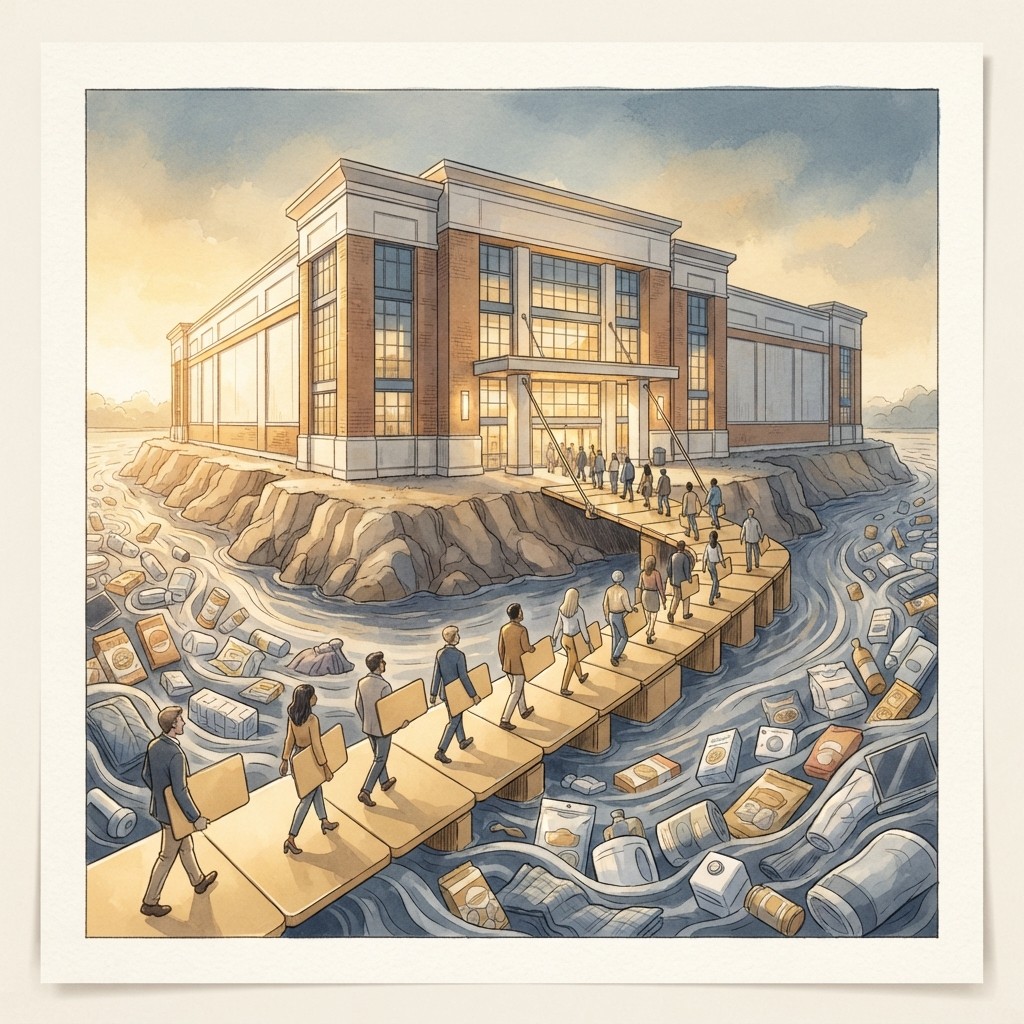
The official story is that Costco is a warehouse retailer that wins on low prices. That's the part everyone can see and the part nobody can copy. The real engine is underneath: Costco is a membership club that runs a near-break-even store, and the two halves feed each other in a loop that gets harder to break the longer you're inside it.
The fee pays for the discount that earns the fee
Here is the mechanism, worked all the way down. A normal retailer marks merchandise up to cover its costs and produce a profit. Costco deliberately does not. It keeps markups thin and lets the savings show up in the price you see on the shelf — which is exactly the price a competitor can't match while also paying the bills. Costco can match it because it isn't trying to profit on the box of detergent. The profit is in the card, not the cart. In fiscal 2025 the company turned almost $270 billion of net sales into a slim merchandise margin, while $5.3 billion in pre-paid membership fees did the heavy lifting.1 The fee buys you a year of irrationally low prices; the irrationally low prices make you renew the fee. Round and round.
“Membership fee revenue increased 14% in the first quarter of fiscal 2026.”2
The renewal rate is where you can see the loop holding. At the end of fiscal 2025, 92.3% of US and Canada members renewed; worldwide, 89.8% did.1 By the close of the first quarter of fiscal 2026, those numbers had barely moved — 92.2% and 89.7%.2 Costco even raised the annual fee in September 2024 — Gold from $60 to $65, Executive from $120 to $130, its first increase since 2017 — and the members didn't flinch.2 That's the tell. When you can raise the price of admission after seven years and lose almost no one, you don't have customers. You have subscribers who would feel foolish cancelling, because the moment they cancel, the year's worth of savings they were promised evaporates.
Kirkland is the part of the basket you can't price-check
If the membership is the moat, Kirkland Signature is the part that fills it in. Costco launched the label in 1995, folding roughly thirty scattered store-brand names into a single house brand — a move reportedly prompted by founder Jim Sinegal reading a Forbes article on branding.56 What that consolidation quietly accomplished is strategic, not cosmetic. A shopper can walk into Walmart with a Costco receipt and compare prices on national brands line by line. They cannot do that with Kirkland, because Kirkland exists nowhere else. The estimated near-third of purchases that carry the label are, by design, impossible to price-check against a rival — and impossible to buy if you let the card lapse.
One caution worth nailing down, because nearly every write-up gets it wrong: Costco does not disclose Kirkland's revenue anywhere in its SEC filings. The headline figures that circulate — most recently around $86 billion for fiscal 2023-24 — are outside estimates, that one attributed to the Wall Street Journal, not audited company numbers.5 The scale is plainly enormous; the precise figure is a guess wearing a suit. The strategic point survives either way: a brand you can only buy from one retailer is a brand that quietly raises the cost of ever shopping anywhere else.
| A normal retailer | Costco | |
|---|---|---|
| Where profit comes from | Markup on merchandise | Pre-paid membership fees |
| Reason for low prices | Promotional, must end | Structural, funded by the fee |
| The flagship products | National brands, comparable everywhere | Kirkland, available nowhere else |
| Cost of customer leaving | Lose one sale | Lose a year of fees and the loop's pull |
The loop has no obvious entry point for a competitor. To match Costco's shelf price you need its membership base subsidizing the loss; to win the membership base you need the shelf price. Costco had a decades-long head start — the first warehouse opened in Seattle in 1983, and the 1993 Price Club merger built early scale47 — and used it to lock both halves in place. Layer Kirkland on top, and roughly a third of the basket can't even be compared, let alone undercut.
Isn't this just a discount store with a cover charge?
The fair objection is that none of this is magic — it's a discount store charging a cover at the door, and plenty of clubs have done that and failed. True. Sam's Club exists; BJ's exists; the model is not secret. So why does Costco's loop hold when copies sputter? Because the loop only works at scale, and scale is the one thing you can't shortcut. The fee subsidy is only cheap per member when there are tens of millions of members — Costco counts more than 80 million paid households and nearly 146 million cardholders — and that base took forty years to build.8 A challenger trying to match the price without the base is simply selling at a loss. And the most committed members make the math better still: Executive members, the ones who pay double, drove 73.6% of worldwide net sales in fiscal 2025.1 The honest counter is that the moat is not invincible — it depends on Costco never breaking faith on price, the one promise that holds the whole loop together. The day the discount stops being real, the renewals stop being automatic. So far, it hasn't.
A low price is a feature; anyone can copy it for a quarter. A self-funding loop is a moat, because the copy can't afford it. The pattern to look for: a recurring fee that pays for a benefit so good it guarantees the next fee — and then a product the member can only get by staying inside. Costco's version is membership funding the discount, with Kirkland making a third of the basket un-shoppable elsewhere. Two cautions. First, the loop only holds if the benefit is genuinely worth the fee every single cycle — the moment you start clawing it back, the renewal becomes a real decision again. Second, scale isn't optional; the subsidy only pencils out across millions of members, so a small version of this is just a discount store losing money politely.
The thing competitors keep trying to copy is the price tag. It's the wrong target. The price tag is an output of a machine they don't have: tens of millions of pre-paid members funding a discount that earns the next year's membership, wrapped around a house brand you can buy in exactly one place. Costco didn't win by being cheap. It won by making cancelling feel like leaving money on the table — and then putting a third of the table behind a door that only opens for members.
Other moats built on something you can't see
Moat Anatomy Canvas
A one-page canvas that dissects a moat instead of asserting it: where the advantage comes from, how much of the market it covers, how long it would take to copy, and what keeps it from eroding. Blank to dissect your own claimed edge; filled as the worked example tracing the structure of the story's defensible advantage. Use it to tell a real moat from a head start.
Included, filled and blank, in the The Moat Anatomy Casebook. See the set → · Preview the blank →
Sources
Where this comes from — the filings, records, and reporting behind it.
- 1Costco FY2025 membership fee revenue was $5,323 million (up 10% YoY); end-of-year renewal rates were 92.3% US/Canada and 89.8% worldwide; Executive members represented 73.6% of worldwide net sales; net sales were $269,912 million.
- 2At end of Q1 FY2026, Costco's US/Canada renewal rate was 92.2% and worldwide rate was 89.7%; membership fee revenue increased 14% in Q1 FY2026; the September 2024 fee increase (Gold: $60→$65, Executive: $120→$130) was confirmed effective September 1, 2024.
- 3Costco FY2023 membership fee revenue was $4.6 billion; membership base grew to nearly 128 million cardholders with a 90% renewal rate; 23 net new locations opened in FY2023.
- 4Jim Sinegal and Jeffrey H. Brotman opened the first Costco warehouse in Seattle on September 15, 1983; Costco headquarters moved to Kirkland in 1987; Kirkland Signature label is named after that former HQ location, not the current one (Issaquah, WA).
- 5Costco launched Kirkland Signature in 1995 to consolidate approximately 30 legacy private-label brands; the brand is estimated to have generated ~$86 billion in FY2023-24 sales per the Wall Street Journal — this figure is a media estimate, not a line item in any Costco SEC filing.
- 6Kirkland Signature was inspired by Jim Sinegal reading a Forbes article on branding in 1995, leading him to consolidate ~30 store-brand names into one; Starbucks, Duracell, and Kimberly-Clark are among reported (but not officially confirmed) Kirkland manufacturing partners.
- 7Costco and Price Club merged in 1993, forming PriceCostco with 206 locations and ~$16 billion in annual sales; Costco became the first company to grow from $0 to $3 billion in sales in under six years.
- 8Total paid Costco households reached 81.4 million (up 5.2% YoY) and total cardholders 145.9 million as of Q1 FY2026; Executive memberships grew 9.1% YoY to 39.7 million and represent 74.3% of total sales at that snapshot.
More like this — beyond Costco
New Strategically analyses as they publish: the defining moves in business, checked against the record. No noise, and one click to leave.