Pairs with the Market-Entry Gambit Canvas — a ready-to-use strategy tool, filled for Shake Shack. Included in the Market-Entry Gambit Casebook →
“How fast can this actually be done?”
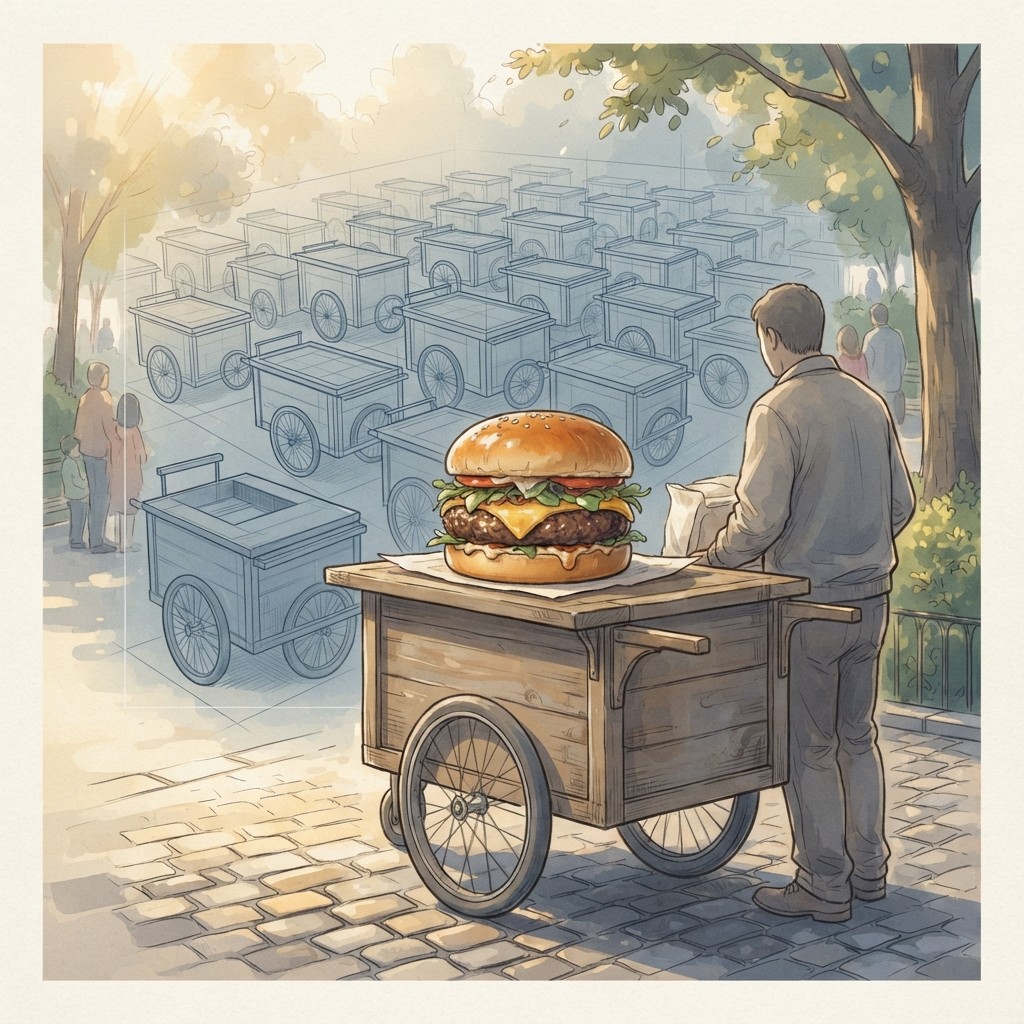
In 2001, a hot dog cart appeared inside Madison Square Park, run out of the kitchen of an upscale restaurant a few blocks away.1 It was not a business plan. It was a favor — a way to feed visitors to an art installation in a park that needed a reason to draw a crowd. The cart ran for nearly three years before anyone bothered to build a permanent kiosk, and when the kiosk opened in July 2004, it was designed as one shop, full stop. Not a flagship. Not a prototype. Not a beachhead. A single burger stand in a park.3 That stand became Shake Shack, and Shake Shack became the textbook case of a deliberate, density-first market entry. The textbook is wrong about almost everything except the outcome.
The story the business press tells is clean: a visionary restaurateur withheld supply on purpose, let lines stretch around the block, manufactured scarcity, and only expanded once the brand was white-hot. A masterclass in patience. Almost every word of that is a back-formation. The patience was real. The intent was not.
The founder says the strategy never occurred to him
You do not have to take a critic's word for this. You can take Danny Meyer's, on the record, in a federal filing. Years later, explaining a leadership transition to investors, he wrote that the idea of expanding beyond the one location 'had not dawned' on him — and that a second Shake Shack only happened because his CEO, Randy Garutti, pushed for it nearly five years on.1 Read that again. The most celebrated slow-growth strategy in modern restaurants was, by the founder's own admission, an absence of strategy. He wasn't holding the brand back to build mystique. He simply wasn't thinking about a second store at all. The line stretched around the block because there was exactly one place to stand in it, and there was one place because nobody had decided there should be two.
“Expansion had not dawned on me... until Randy urged a second location nearly five years later.”1
The second location finally opened on the Upper West Side in October 2008, roughly four years after the first.6 That four-year gap is the entire factual basis for the 'density-first' legend — and the gap exists because, for most of it, there was no plan to grow. Strip the romance away and the early Shake Shack looks less like a coiled spring and more like a happy accident nobody was in a hurry to repeat.
| The slow-growth legend | What the record shows | |
|---|---|---|
| The single shop | A deliberate scarcity play | A one-off kiosk, not meant to be a chain |
| The four-year gap | Patience, holding back supply | Expansion 'had not dawned' on the founder |
| The second store | Phase two of a master plan | Happened only because the CEO pushed |
| Early economics | Profitable by year three | Lost money all three years |
Even the profit was a story it told to feel better
The myth runs deeper than timing. A frequently repeated detail holds that the original kiosk turned profitable in its third year — proof that restraint paid off early. Meyer himself has corrected this. In his own book, he admitted the kiosk lost money for all three of its first years, and that an oft-quoted $7,500 third-year profit was simply fabricated, out of embarrassment over the losses.4 So the foundational artifact of the discipline narrative — early profitability validating a patient model — was a number invented to hide the opposite truth. The brand that the world later credited with iron strategic patience spent its first three years quietly bleeding and slightly lying about it.
How an accident became an asset
Here is the part that makes this more than trivia. The accidental restraint produced something genuinely valuable — a brand with the texture of scarcity and the standards of a fine-dining operator — and then Shake Shack did the smart thing: it repackaged the accident as a doctrine. By the time it filed to go public, the company had coined its own category. Not fast food. Not even fast casual, a label Meyer rejects. 'Fine casual,' the S-1 declared, coupling 'the ease, value and convenience of fast casual concepts with the high standards of excellence... grounded in fine dining.'5 That is the move. The years of stumbling, the single park kiosk, the lines, the losses — all of it got laundered into a coherent origin myth that justified premium prices and signaled discipline to investors. The accident became the pitch. And the pitch worked: the February 2015 IPO brought in $112.3 million in net proceeds.2
The 'density-first' story is not true as history — but it became true as strategy the moment the company started believing it. A retrofitted origin myth does real work: it tells customers the scarcity was earned, tells investors the founder is disciplined, and tells the operators who join later exactly what the brand is supposed to feel like. The danger is the same as the value. Believe your own myth too literally and you confuse 'we got lucky and stayed small' with 'we should always stay small' — which is exactly the trap Shake Shack is now sprinting away from.
The brand built on patience is now in a hurry
Watch what the company does, not what its founding story says. By the end of FY2024, Shake Shack ran 579 system-wide locations and pulled in more than $1.25 billion in revenue.7 That is not a scarcity play anymore. And the trajectory is steepening, not flattening: by Q1 2026 the company posted its largest first quarter of company-operated openings ever and raised full-year guidance to 60–65 new company-operated units — opening more locations in one year than it once opened in a decade — while pointing at a long-term U.S. target of roughly 1,500 restaurants.8 The 'density-first, slow-growth' brand now plans to multiply its current footprint several times over. The slow phase is a historical chapter, kept alive in the founding deck because it still sells. The actual company is doing the precise opposite of the thing it is famous for.
But didn't the slowness actually work?
The fair objection is that none of this matters. The restraint, however accidental, produced exactly the right outcome — a brand dense with meaning, lines that became free advertising, prices the market accepted. Who cares whether the discipline was intentional if it was effective? That objection is half right, and the half it gets right is important: the early slowness genuinely built the equity that the IPO later sold. But intent is not a footnote — it changes what you can learn. If you read Shake Shack as a deliberate density-first playbook, you draw the lesson 'withhold supply on purpose.' That is the wrong lesson, because the company never did that and is now racing to 1,500 stores.8 The right lesson is harder and truer: a brand can accumulate enormous value before it has a strategy at all, and the strategic act that mattered came later — recognizing what the accident had built, naming it 'fine casual,' and protecting it.5 The skill wasn't the patience. It was the editing.
Shake Shack's real gambit was never the four-year gap between its first two stores. It was deciding, after the fact, what that gap had meant — and then selling that meaning to customers, to investors, and eventually to itself. The slow-growth, density-first brand was built by a founder who admits he wasn't thinking about growth or density at all. He out-grew his own origin story, kept it on the wall because it still works, and quietly went the other way. The most valuable thing the company ever made wasn't the burger or the line. It was the explanation.
Market-Entry Gambit Canvas
A one-page canvas for staging an entry into a market you don't own yet: the beachhead you take first, the wedge that gets you in cheaply, the sequence that turns a foothold into a position, and the incumbent's likely counter-move. Blank to plan your own entry; filled as the worked example showing how the story's challenger picked its landing spot and walked the rest in.
Included, filled and blank, in the Market-Entry Gambit Casebook. See the set → · Preview the blank →
Sources
Where this comes from — the filings, records, and reporting behind it.
- 1Danny Meyer launched a hot dog cart inside Madison Square Park in 2001 out of Eleven Madison Park's kitchen, which ran for nearly three years before the permanent Shake Shack kiosk opened in July 2004. Meyer personally stated in an SEC filing that expansion beyond the original location 'had not dawned on me' until Randy Garutti pushed for a second location 'nearly five years later.'
- 2On February 4, 2015, Shake Shack completed its IPO of 5,750,000 shares of Class A common stock at $21.00 per share, receiving $112.3 million in net proceeds.
- 3The first permanent Shake Shack kiosk opened in Madison Square Park in July 2004 after the city solicited bids to operate a kiosk in the park; the original location was designed as a single shop and not intended to be a chain.
- 4Danny Meyer self-corrected the myth that Shake Shack turned profitable in year three: he admitted in 'Shake Shack: Recipes & Stories' that the kiosk lost money for all three of its first years, and that an oft-cited $7,500 profit figure was fabricated out of embarrassment.
- 5Shake Shack's S-1 filing coined the term 'fine casual,' defined as coupling 'the ease, value and convenience of fast casual concepts with the high standards of excellence in thoughtful ingredient sourcing, preparation, hospitality and quality grounded in fine dining.'
- 6The second Shake Shack location opened on the Upper West Side (366 Columbus Avenue, across from the American Museum of Natural History) in October 2008, approximately four years after the original Madison Square Park kiosk.
- 7As of FY2024 (Dec. 25, 2024), Shake Shack operated 579 total system-wide locations (329 company-operated, 250 licensed), with FY2024 total revenue of $1,252.6 million and net income of $10.8 million.
- 8By Q1 2026, Shake Shack opened 17 company-operated locations (its largest Q1 ever) and raised full-year 2026 guidance to 60–65 new company-operated units, with the company targeting a long-term U.S. footprint of approximately 1,500 locations.
Weighing outside help with a decision like this? Hiring a commercial due diligence provider
More like this — beyond Shake Shack
New Strategically analyses as they publish: the defining moves in business, checked against the record. No noise, and one click to leave.