Pairs with the Moat Anatomy Canvas — a ready-to-use strategy tool. Included in the Moat Anatomy Casebook →
“What would it actually cost a challenger to take your customer?”
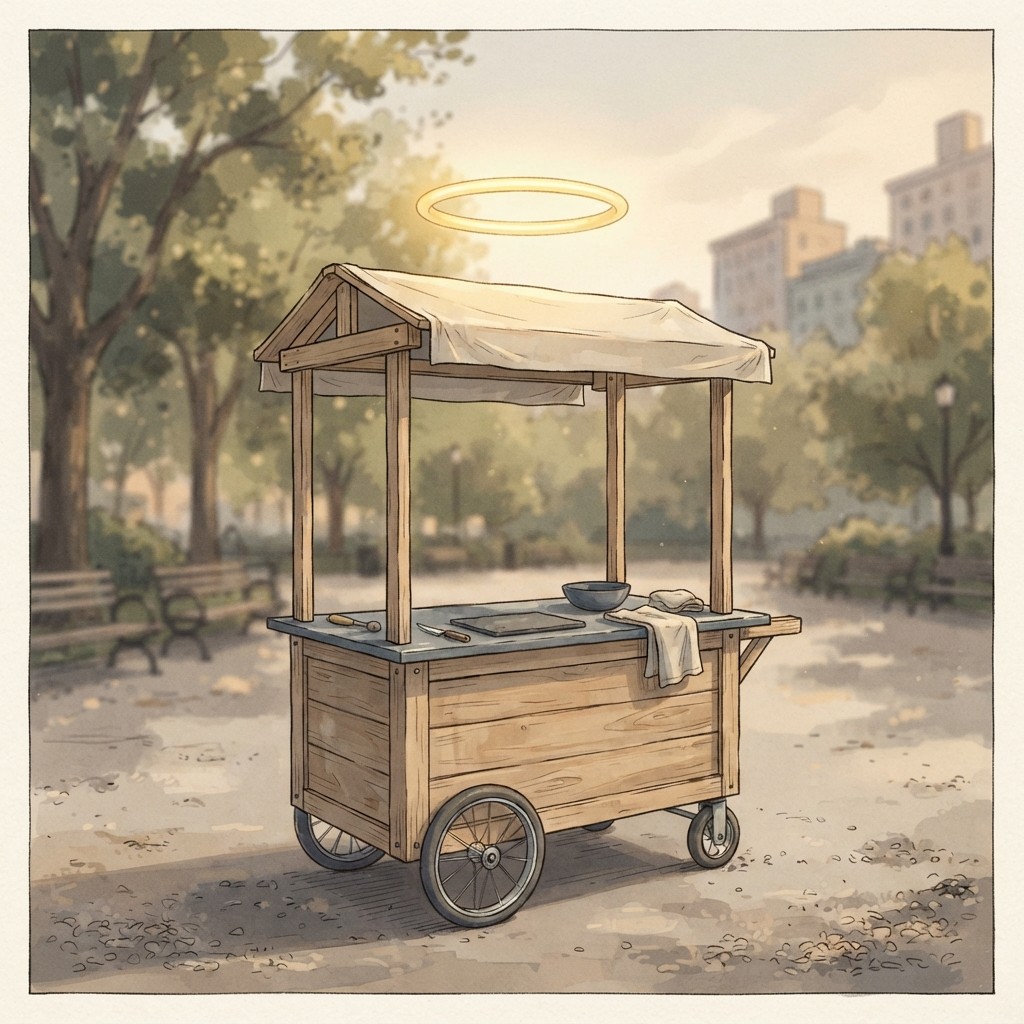
In the early 2000s, a fine-dining restaurateur set up a hot dog cart in a New York City park that most New Yorkers avoided — Madison Square Park, then a patchy, half-neglected square that a small conservancy was trying to bring back to life. The cart was there to draw foot traffic to an art installation and help rescue the park, run out of the kitchen of one of his nearby restaurants.7 It would become Shake Shack. And here is the part nobody mentions on the way to the IPO: that cart lost money for all three years it ran.5
The official story is a scrappy underdog tale — a humble cart that earned its way to a $1.6 billion debut on pure burger merit. Almost every load-bearing beam of that story is either softer than it sounds or quietly false. The cart wasn't profitable. What actually happened is more interesting, and harder to copy: the moat was dug before the first burger was ever sold.
The famous early profit was invented
For years the origin story carried a tidy proof point: the cart turned a small profit in year three. Danny Meyer himself later took it back. In the book 'Shake Shack: Recipes & Stories,' he admitted the stand lost money every one of its three cart years, and that the $7,500 profit he'd publicly claimed was a fabrication — Meyer's own account attributes the invention to his embarrassment at three straight years of losses.9 That admission matters far beyond a bruised ego. It tells you the early Shake Shack was not a business that worked. It was a gift to a park that happened to sell food.
“The stand lost money in each of its first three years — and the $7,500 profit I'd claimed in year three was a number I made up.”5
If the unit economics were underwater, why did the eventual brand detonate? Because while the cart was bleeding cash, it was accumulating something that doesn't show up on a P&L: institutional goodwill. A restaurateur with a serious fine-dining reputation lent his name to a civic rescue. A struggling park got saved, and the food stand got to be the hero of that story. None of it was monetized at the time. All of it was banked.
The moat was social capital, paid in before the burger
Think of the assets a normal restaurant chain has to buy with marketing dollars: credibility, a beloved location, a design that signals taste rather than fast food. Shake Shack got all three for free, as a byproduct of being a park-rescue project. The location wasn't rented from a landlord — it was won as a contract from New York's Department of Parks & Recreation and the Madison Square Park Conservancy, which makes the address itself a civic endorsement, not just real estate.1 And the look — the clean green-and-white identity that telegraphs 'this is nice' — came from Pentagram, one of the most respected design firms in the world, which by its own account did the work for free, precisely because everyone assumed this was a one-kiosk park extension rather than a future chain.6
| A typical fast-casual launch | Shake Shack at the park | |
|---|---|---|
| Location | Leased, generic, paid for | A civic contract in a beloved park |
| Credibility | Built with ad spend over years | Borrowed from a fine-dining reputation |
| Brand identity | Agency fees | Pentagram, for free |
| The narrative | Manufactured in marketing | A genuine park-rescue story |
A competitor with deep pockets can match a burger, a logo, even a flagship address. What it cannot buy is the chain of events that pre-loaded Shake Shack's brand: a respected operator choosing to help save a public park, a famous design firm donating work because nobody saw a fortune coming, and a city handing over a piece of treasured ground. Social capital like that only forms when no one is trying to capture it — which is exactly why it can't be replicated by spending money later. The moat isn't the halo. It's that the halo was earned for free, in a window that has since closed.
By the time the cart became a permanent kiosk in July 2004, the project had already converted years of underwater operations into a reservoir of affection.1 That reservoir is the asset. When Shake Shack later expanded, every new location carried a whisper of the original: not 'a chain burger,' but 'the park burger that good people built.' That whisper is the halo — and it had been paid for in losses and donated labor long before a single franchise-grade unit existed.
The IPO that priced the halo
The market's verdict arrived in 2015. For the fiscal year before the offering, Shake Shack reported $118.5 million in total revenue, up nearly 44%, on net income of just $2.1 million — a real but modest business that had opened ten Shacks that year.4 On those numbers, the IPO priced at $21 per share, above its marketed range, raising $105 million.23 Then the first day happened: shares more than doubled to about $45.90 at the close, lifting the market value to roughly $1.6 billion.310 A company earning a couple of million in profit was suddenly worth more than a billion and a half. That gap between the earnings and the valuation is the price tag on everything that never showed up on the income statement.
Isn't this just survivorship and good timing?
The honest objection is that this reads too neatly — that for every cart blessed by a famous design firm and a beloved park, there are a hundred that simply died, and we only call this one a strategy because it worked. Fair. Some of the moat was luck: Pentagram donated the work because nobody, including Meyer, foresaw a chain.6 And several beats of the founding myth are genuinely shakier than the retelling suggests — the origin spans two dates — a 2001 cart and a 2004 kiosk — and the celebrated early profit turned out to be fiction.9 But the argument survives the discount. Even granting the luck, the goodwill was real, it was accumulated, and it was structurally unavailable to a competitor — because you cannot retroactively decide to rescue a park you didn't rescue, or be handed donated design by people who only gave it away because they thought you'd stay small. The luck explains why the window opened. It doesn't explain away the asset that got built inside it.
Shake Shack's halo is taught as proof that a great product wins. Look closer and the lesson inverts. The product came later; the cart that started it lost money for three straight years.5 What came first was a pile of goodwill that no marketing budget could have purchased — donated by a design firm, a city, and a park, to a project nobody expected to monetize. The most durable moat Shake Shack ever dug was the one it dug while losing money and trying to save a park. By the time anyone thought to copy the burger, the window for copying the story had already closed.
When the moat isn't the obvious thing
Moat Anatomy Canvas
A one-page canvas that dissects a moat instead of asserting it: where the advantage comes from, how much of the market it covers, how long it would take to copy, and what keeps it from eroding. Blank to dissect your own claimed edge; filled as the worked example tracing the structure of the story's defensible advantage. Use it to tell a real moat from a head start.
Included, filled and blank, in the Moat Anatomy Casebook. See the set → · Preview the blank →
Sources
Where this comes from — the filings, records, and reporting behind it.
- 1The permanent Shake Shack kiosk at Madison Square Park officially opened in July 2004, after Meyer won a contract from New York City's Department of Parks & Recreation and the Madison Square Park Conservancy.
- 2Shake Shack's IPO priced at $21 per share on January 29, 2015; the company raised $105 million selling 5 million shares; shares closed at ~$45.90 on the first trading day (January 30, 2015), giving a market cap of approximately $1.6 billion.
- 3Shake Shack's IPO first-day closing price of ~$45.90 gave it a market value of $1.6 billion; the pricing was above the marketed range of $17–$19.
- 4Shake Shack's total revenue for fiscal year 2014 was $118.5 million (up 43.7% year-over-year); Shack sales were $112.0 million; net income was $2.1 million; and the company had opened 10 system-wide Shacks that year.
- 5Danny Meyer admitted in the book 'Shake Shack: Recipes & Stories' that the cart lost money in each of its first three years — correcting his prior public claim of a $7,500 profit in year three.Clarkson Potter / Danny Meyer, Shake Shack: Recipes & Stories (book) · 2017
- 6Pentagram designed Shake Shack's original brand identity and logo for free because the restaurant was conceived as a one-location park extension, not a commercial chain.
- 7The hot dog cart was operated out of the kitchen of Eleven Madison Park (an USHG restaurant) and was set up to support the Madison Square Park Conservancy's first art installation.
- 8At the IPO (January 2015), Shake Shack operated 63 stores domestically and internationally and targeted 10 new U.S. locations per year; at IPO it had 31 company-owned stores and set a long-term target of 450 company-owned units.
- 9In the book 'Shake Shack: Recipes & Stories,' Meyer admitted they lost money in year three and said: 'I was just so embarrassed that we'd lost money for three years, we chose to make a bigger contribution.'Mashed, The Untold Truth Of Shake Shack ↗ · 2021-10-18
- 10Shake Shack shares closed at just under $46 on their first trading day, giving the company a market value of $1.63 billion.
Weighing outside help with a decision like this? Hiring a commercial due diligence provider
More like this — beyond Shake Shack
New Strategically analyses as they publish: the defining moves in business, checked against the record. No noise, and one click to leave.