Pairs with the Market-Entry Gambit Canvas — a ready-to-use strategy tool, filled for Nestle. Included in the The Market-Entry Gambit Casebook →
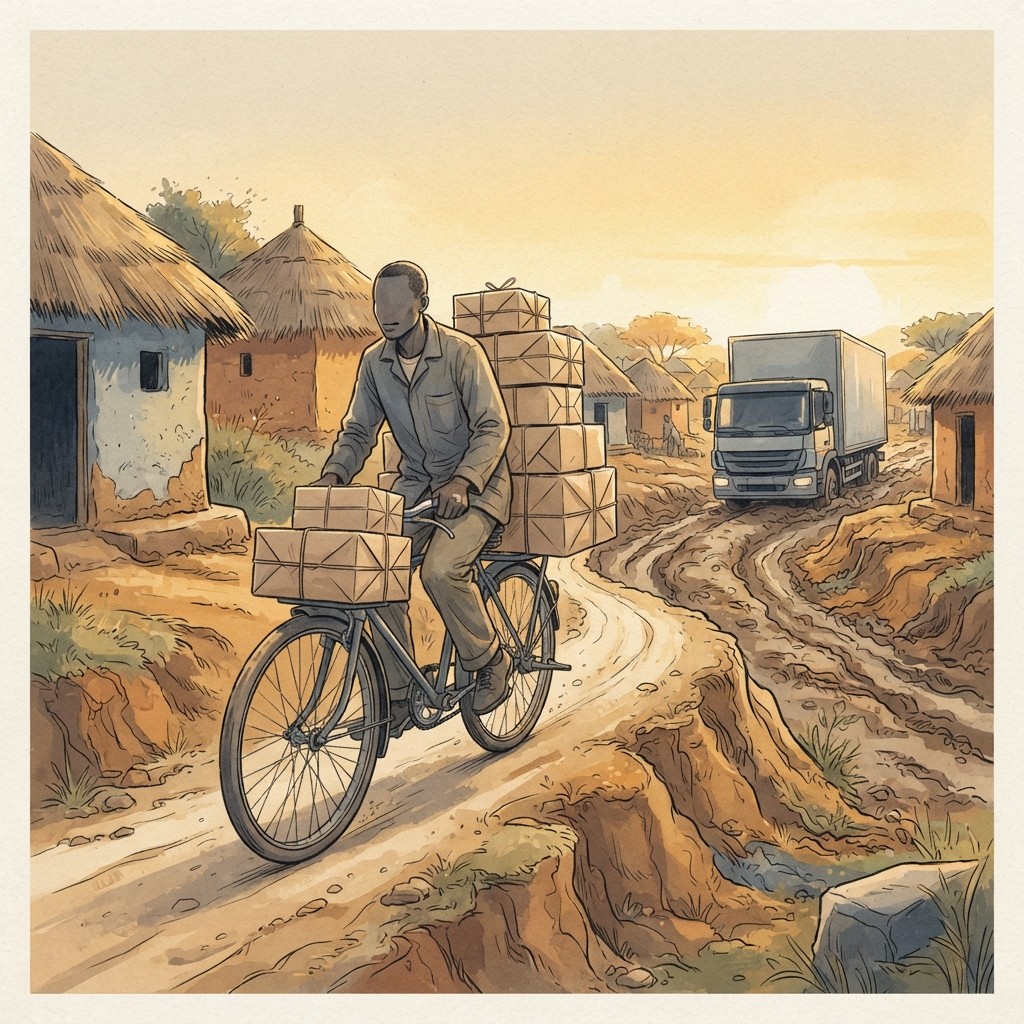
In a town with no supermarket, no cold chain, and no paved road to the next village, the most valuable logistics asset Nestlé owns is a person with a bicycle and a basket of single-serve sachets. According to a former senior Nestlé executive, between 30% and 40% of the company's distribution in Africa happens through small-scale delivery, often by bike.4 No fleet, no warehouse robotics, no algorithm. Just someone who knows which kiosk reorders on a Tuesday and which one took your last shipment on credit. That intimacy is the moat — and it is also where the company once nearly set itself on fire.
The popular story is that Nestlé is one of the world's largest food companies because it owns famous brands. That's the surface. The brand gets you noticed in São Paulo and Lagos; it does not get a sachet of bouillon onto a shelf two hours past the end of the road. What does that is a distribution machine assembled village by village over decades — and that machine, not the logo, is the thing a rival cannot simply buy.
The shelf is the easy part. The last mile is the moat.
Nestlé's emerging-market engine has a name inside the company: Popularly Positioned Products, or PPP. The product side is the part everyone copies — shrink the pack, drop the price point, sell a meal's worth of coffee or stock instead of a jar. The hard part is the road it travels. The PPP playbook leans on street markets, mobile street vendors, and door-to-door micro-distributors, many of them financed by Nestlé micro-loans and outfitted with their own vending carts.2 That last detail is the quiet genius. By lending a vendor the cart, Nestlé doesn't just reach the customer — it converts the last mile into a network of small entrepreneurs whose livelihood depends on moving Nestlé product. The distributor is the moat, and Nestlé built the distributor.
Then there's the other half: you can't run a hyper-local last mile on imported product. Over 85% of what Nestlé sells in Central and West Africa is manufactured locally, across nine factories in a region spanning 25 countries.3 On the continent as a whole, Nestlé reported 26 factories and 14,300 direct employees as of 2010, with products sold in all 53 countries.5 This is not opportunism. Nestlé began trading in Ghana in 19573 — the manufacturing footprint is the product of more than half a century of patient capital, including a reported $850 million invested in African manufacturing and distribution over a five-year stretch.4 Local factories shorten the supply line, dodge import friction, and feed bulky, low-margin volume into a network that only works if the product is already nearby.
| What a rival can buy quickly | What took Nestlé decades | |
|---|---|---|
| The product | Shrink the pack, cut the price | — |
| The factory | Build one with capital | 85%+ local manufacturing, since 1957 in Ghana |
| The last mile | — | Thousands of micro-distributors on financed carts |
| The relationship | — | Knowing which kiosk reorders, and when |
The result shows up where it matters. In 2023, Nestlé's emerging markets grew organically at 8.4%, against 6.4% in developed markets, out of CHF 93.0 billion in group sales.1 The PPP range itself, by a secondary analyst's reckoning, earned roughly CHF 12.2 billion in 2017 — about 14% of total revenue, up from a much smaller share in 2009.8 Treat that figure as an estimate, not an audited line item. But the direction is unmistakable: the low-margin, hard-to-reach, sachet-by-sachet business is where the growth lives, and the machine that serves it is the thing competitors quote in their nightmares.
Isn't a bicycle network just a sign of weak infrastructure?
The fair objection is that none of this is a moat — it's a workaround. Bicycle couriers and door-to-door vendors exist because roads, cold chains, and modern retail don't. The moment a country gets supermarkets, e-commerce, and paved highways, the argument goes, Nestlé's hand-built network becomes a quaint liability and the field levels for anyone with a truck. There's truth in it. But it underrates how long the head start lasts and how local it is. A relationship with the kiosk owner who has bought from your vendor for fifteen years does not transfer to a new entrant when the road gets paved — it transfers to whoever already holds it. The infrastructure modernizes around an incumbent who got there first, one bicycle at a time. The workaround quietly becomes the relationship, and the relationship is the asset.
The same intimacy that sells also burns
Here is the part the distribution story usually leaves out — and the reason this is a cautionary tale, not a victory lap. The closer you get to the customer, the more power you hold over what they buy, and that power has a dark mirror. On July 4, 1977, INFACT launched a boycott of Nestlé over aggressive infant-formula marketing in underdeveloped countries.6 The same machine that could put a sachet in front of a mother who could barely afford it could also put formula in front of one who would have been better served by breastfeeding. Reach without restraint is not a feature; it is a loaded weapon pointed at the brand.
Note the timing carefully, because the company's own record corrects a flattering myth. Nestlé is sometimes credited as the first to embrace the WHO Code in 1981. It wasn't simultaneous: the Code was adopted in 1981, and Nestlé introduced its own derived policy in 1982 — first among manufacturers, but a year after the standard already existed.7 And the boycott did not cleanly 'end.' The US campaign was suspended in 1984 after Nestlé pledged compliance,6 but the broader effort has never been fully called off worldwide. A reputational liability built on distribution reach behaves differently from a supply-chain shock: a rival can take years to copy your bicycle network, but a campaign against it can move in weeks.
“Small-scale delivery, often on bicycle, accounts for between 30% and 40% of our distribution in Africa.”4
The deepest competitive advantage in emerging markets is rarely the product or the brand — it's the last mile no rival can rebuild quickly: the financed vendor, the local factory, the kiosk relationship measured in years. But the same proximity that makes you impossible to dislodge also makes you accountable for what travels down that pipe. A network that can reach the most vulnerable customer can also exploit them, and when it does, the backlash routes around your supply chain entirely and hits the brand directly. Build the reach. Then build the guardrails first — because a reputational fire spreads faster than any competitor can, and unlike a logistics shock, it doesn't stay suspended just because you said sorry.
Nestlé's emerging-market machine is the strongest case in consumer goods that distribution, not branding, is the real moat — a network of bicycles and carts and half-century-old factory towns that no balance sheet can replicate on demand. But the 1977 boycott is the permanent footnote stapled to that strength. The very intimacy that lets Nestlé reach a customer no truck can serve is the intimacy that makes the company answerable for every sachet it places. The man on the bicycle is the moat. He is also the witness. Get the reach right and the wrong thing into his basket, and the thing competitors couldn't disrupt in twenty years can become a liability in twenty days.
How companies win — and lose — at the edge of the map
Market-Entry Gambit Canvas
A one-page canvas for staging an entry into a market you don't own yet: the beachhead you take first, the wedge that gets you in cheaply, the sequence that turns a foothold into a position, and the incumbent's likely counter-move. Blank to plan your own entry; filled as the worked example showing how the story's challenger picked its landing spot and walked the rest in.
Included, filled and blank, in the The Market-Entry Gambit Casebook. See the set → · Preview the blank →
Sources
Where this comes from — the filings, records, and reporting behind it.
- 1In FY-2023, Nestlé's emerging-market organic growth was 8.4% (vs. 6.4% in developed markets); total reported group sales were CHF 93.0 billion.
- 2Nestlé's PPP strategy uses locally adapted distribution including street markets, mobile street vendors, and door-to-door distributors; emerging-market sales were USD 33 billion in 2009; PPP micro-distributors are often financed by Nestlé micro-loans with vending carts.
- 3Over 85% of Nestlé products sold in Central & West Africa are manufactured locally across nine factories; Nestlé began trading in Ghana in 1957 and the CWAR region covers 25 countries with 5,400 employees.
- 4Small-scale delivery, often on bicycle, accounts for between 30% and 40% of Nestlé's distribution in Africa (attributed to former EVP Frits van Dijk); Nestlé invested $850 million in Africa over the prior five years in local manufacturing and distribution.
- 5Nestlé EAR (Equatorial African Region, 20 countries) was set up in September 2008; Nestlé products are sold in all 53 countries of the African continent; the continent had 26 factories and 14,300 direct employees as of 2010.
- 6The 1977 Nestlé boycott was launched by INFACT on July 4, 1977 over aggressive infant formula marketing in underdeveloped countries; it expanded to Europe in the early 1980s; the US INFACT boycott was suspended in 1984 after Nestlé pledged compliance with WHO Code.
- 7In 1982, Nestlé became the first manufacturer to introduce its own internal marketing policy derived from the WHO Code for breast-milk substitutes in developing countries; the WHO Code itself was adopted in 1981.
- 8In 2017, Nestlé's 4,746 PPP products earned approximately CHF 12.2 billion gross revenue (~14% of total), up from ~8% of total revenue in 2009 — approximately 55% growth; this figure is reported by a secondary analyst, not directly broken out in Nestlé's annual report as a line item.
More like this — beyond Nestle
New Strategically analyses as they publish: the defining moves in business, checked against the record. No noise, and one click to leave.