Pairs with the Market-Entry Gambit Canvas — a ready-to-use strategy tool. Included in the Market-Entry Gambit Casebook →
“How fast can this actually be done?”
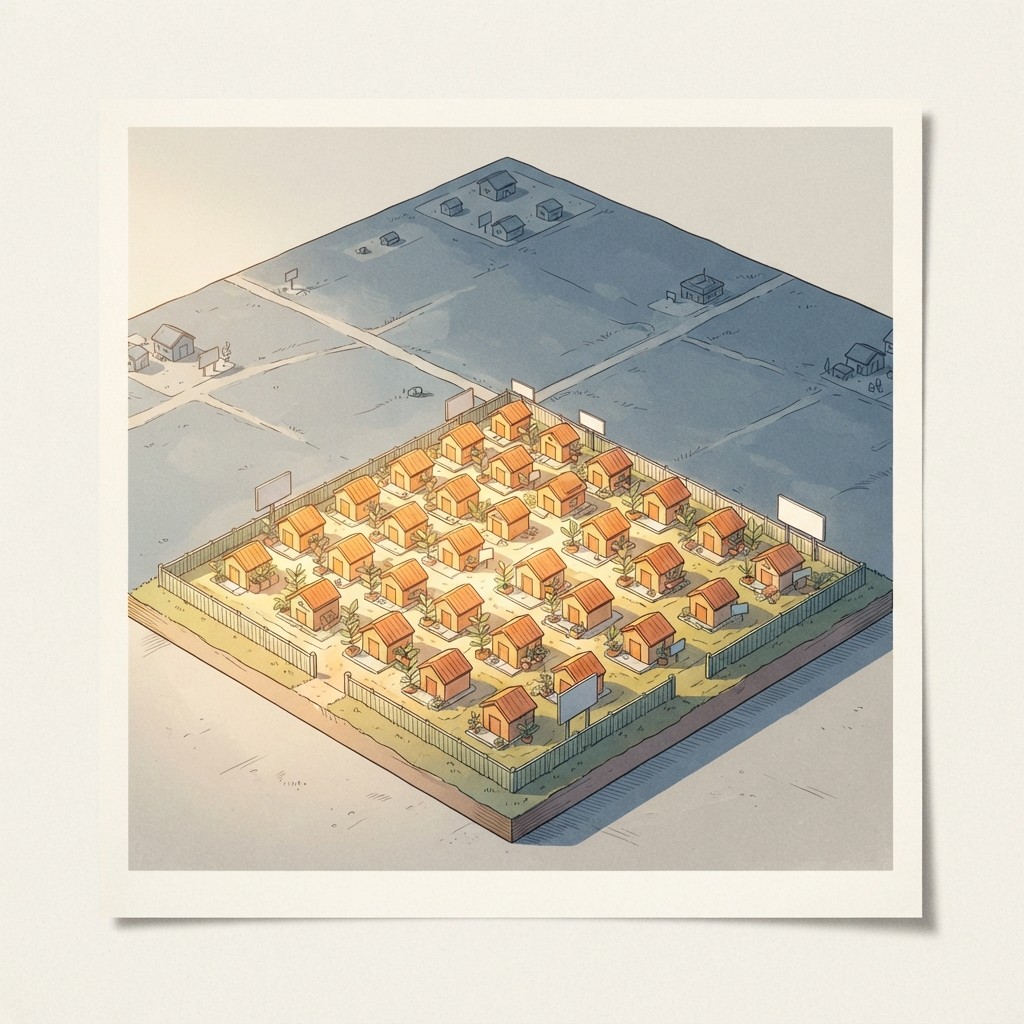
Drive through Atlanta, Dallas, or Orlando and you will pass three orange warehouses before you've finished a coffee. They sit a few exits apart, each the size of two football fields under one roof — roughly 104,000 square feet of enclosed space and another 24,000 of garden yard out back.1 It looks like a campaign. It looks like a company that drew a circle on a map and decided to own everything inside it. That story is everywhere, and it is wrong in a way that matters.
The official legend is that Home Depot pioneered market saturation — that it clustered stores on purpose to choke the air out of every local rival. Strip that away and read the filings, and a duller, smarter truth appears: Home Depot never set out to saturate anything. It set out to grow fast and sell cheap, capped its own growth so it wouldn't blow up, and poured the openings into markets it already knew. The density was the exhaust, not the engine.
A company that put a speed limit on its own ambition
Here is the detail that demolishes the saturation myth. In the years it was growing fastest — adding stores by the hundreds across the early 1990s — Home Depot wrote into its own 10-K a self-imposed ceiling: a stated policy not to exceed a maximum new-store growth rate of about 22% per year.3 Even with that brake on, the count roughly tripled from 174 stores to 512 over five years, an average pace near 24% annually.3 A company executing a deliberate competitor-denial doctrine does not put a speed limit on itself. It floors it. The cap exists for the opposite reason: to keep a hyper-growth retailer from outrunning its own logistics and management.
So where did the dense map come from? From the path of least resistance. By the end of fiscal 1995 the company had 423 stores, half of its U.S. locations packed into just four states — California, Georgia, Texas, and Florida — and the filing flatly notes that new openings happened 'primarily in existing markets.'4 That phrase is doing quiet, enormous work. When you already have the distribution centers, the brand recognition, the vendor relationships, and the trade-pro customers in a region, the cheapest, safest next store is the one near your last store. You don't open in a fresh city to fight a war; you open down the road because you already won the supply chain there. Density is what happens when 'primarily in existing markets' compounds for two decades.
| The saturation legend | What the 10-Ks show | |
|---|---|---|
| The goal | Deny markets to rivals | Grow volume safely |
| The growth rate | Floor it | Capped at ~22% a year |
| Where stores went | Strategic enemy territory | 'Primarily in existing markets' |
| The dense map | The plan | The residue of the plan |
The moat the density built without anyone naming it
Whatever the intent, the result was a barrier that is brutally hard to copy: switching-cost geography. Once Home Depot blankets a region, a rival can't peel off customers one store at a time. To matter, a challenger has to match the whole grid at once — the same number of locations, the same proximity, the same nearby distribution — against an incumbent that built that grid back when land was cheaper and it had no equal. This is why the question 'why not just open a competing warehouse?' misses the point. The asset was never one store. It was the lattice of them, and the lattice only pays off as a lattice.
The proof that this was emergent rather than engineered is what happens to a company when it overlaps its own stores. The academic literature on retail expansion defines sales cannibalization plainly — 'a decrease in the sales of one or several existing stores as a result of nearby store openings' — and treats it as a cost to be managed, varying by geography and category.8 A firm running deliberate density warfare against rivals would tolerate cannibalizing itself as the price of denial. The evidence is that Home Depot, like every disciplined operator, treated self-cannibalization as a tax to minimize. You don't manage down the side effect of a strategy you're running on purpose.
The companies people most want to copy often have moats that nobody set out to build. Home Depot's geographic lock wasn't drawn on a map in 1979 — it accreted from a simpler rule (grow fast, but not recklessly, in markets you already know). The lesson for an operator is uncomfortable: you can't shortcut to the lattice by 'saturating' a market on day one, because you don't yet have the distribution, brand, or pro relationships that make each next store cheap. The density is earned by the boring stuff first. Try to manufacture the side effect without the engine and you just burn capital opening stores that cannibalize each other with nothing underneath them.
But surely the founders meant to do this?
The honest objection is that hindsight makes everything look accidental, and that Bernie Marcus and Arthur Blank — fired from Handy Dan in April 1978 and incorporating Home Depot in Delaware that June, with the first two Atlanta stores opening in June 1979 — clearly knew what they were doing.56 They did. But what they stated they were doing was one-stop shopping for the do-it-yourselfer: a giant store with everything, at low prices. Market denial through clustering is the read analysts applied later, to a map that had already filled in. The founders optimized for the customer in front of them; the geography optimized itself behind their backs. That isn't a knock on them — it's the more interesting fact. The most durable moat in big-box retail was a byproduct nobody at the company had to be smart enough to design.
The real saturation is the one nobody talks about
There is a sense in which Home Depot is saturated — just not the one the legend means. Between the end of fiscal 2023 and the end of fiscal 2024, the store count moved from 2,335 to 2,347.21 That's net growth of twelve stores across all of the U.S., Canada, and Mexico. The big-box land grab is effectively over; on $159.5 billion in net sales, the company is the world's largest home improvement retailer and has run out of obvious new ground for orange warehouses.1 So where does it grow now? Not in new locations. In FY2024 it spent its energy buying SRS Distribution, a residential trade-distribution business that operated more than 780 branch locations — a bet on serving the professional contractor and the supply chain, not on opening store 2,348.7
That pivot is the tell. A company that believed its power came from clustering would keep clustering. Home Depot stopped, because the power never came from the act of opening stores — it came from a geographic position that, once built, didn't need to be rebuilt. The orange grid you drive past is a finished structure, not an advancing front. The saturation everyone sees was never the strategy. It was the fossil the strategy left behind — and the smartest thing a competitor could learn from it is that you cannot quarry that fossil into existence on purpose.
Market-Entry Gambit Canvas
A one-page canvas for staging an entry into a market you don't own yet: the beachhead you take first, the wedge that gets you in cheaply, the sequence that turns a foothold into a position, and the incumbent's likely counter-move. Blank to plan your own entry; filled as the worked example showing how the story's challenger picked its landing spot and walked the rest in.
Included, filled and blank, in the Market-Entry Gambit Casebook. See the set → · Preview the blank →
Sources
Where this comes from — the filings, records, and reporting behind it.
- 1As of the end of fiscal 2024, Home Depot operated 2,347 stores throughout the U.S., Canada, and Mexico; stores average approximately 104,000 sq ft of enclosed space plus ~24,000 sq ft of outside garden area; net sales were $159.5 billion; the company is the world's largest home improvement retailer by net sales.
- 2As of the end of fiscal 2023, Home Depot operated 2,335 stores in the U.S., Canada, and Mexico, with stores averaging approximately 104,000 square feet of enclosed space.
- 3From the end of fiscal 1991 to the end of fiscal 1996, Home Depot increased its store count by an average of approximately 24% per year (from 174 to 512 stores); the company's stated policy was not to exceed a maximum growth rate of new stores of approximately 22% per year.
- 4At fiscal year end 1995, Home Depot had 423 total stores (404 U.S., 19 Canadian), with 50% of U.S. stores concentrated in California, Georgia, Texas, and Florida; new store openings occurred 'primarily in existing markets.'
- 5Home Depot was incorporated in Delaware on June 29, 1978 (not 1979); the first two stores opened June 22, 1979, on Memorial Drive and Buford Highway in Atlanta, GA. Bernie Marcus and Arthur Blank were fired from Handy Dan on April 14, 1978.
- 6Home Depot's founders Bernie Marcus and Arthur Blank were fired from Handy Dan Home Improvement Centers in April 1978 and co-founded Home Depot that same year; Marcus was the company's first CEO; the first stores opened in Atlanta in June 1979.
- 7In FY2024, Home Depot acquired SRS Distribution, a residential specialty trade distribution company; at the end of fiscal 2024, SRS operated over 780 branch locations throughout the U.S. This represents Home Depot's current growth vector — services and trade distribution, not new big-box stores.
- 8Peer-reviewed academic literature defines sales cannibalization as 'a decrease in the sales of one or several existing stores as a result of nearby store openings,' and finds that cannibalization severity varies by geography and product category — framing it as a cost to manage, not a strategic weapon.
Weighing outside help with a decision like this? Hiring a commercial due diligence provider
More like this — beyond Home Depot
New Strategically analyses as they publish: the defining moves in business, checked against the record. No noise, and one click to leave.