Pairs with the Flywheel Designer Canvas — a ready-to-use strategy tool. Included in the The Flywheel Casebook →
A creator posts a fifteen-second clip. Within hours it has a million views, and the platform mails them a check for roughly twenty dollars. That is not a typo and it is not an outlier — TikTok's Creator Fund paid somewhere between two and four cents per thousand views, which means a million views earned $20 to $40.2 Now do the thing every flywheel diagram tells you to do: imagine that creator looks at the check, looks at the effort, and decides the loop is worth running again. The strange part isn't that some did. It's that the wheel kept accelerating anyway — to an estimated $23 billion in revenue in 20245 — almost regardless of whether they did.
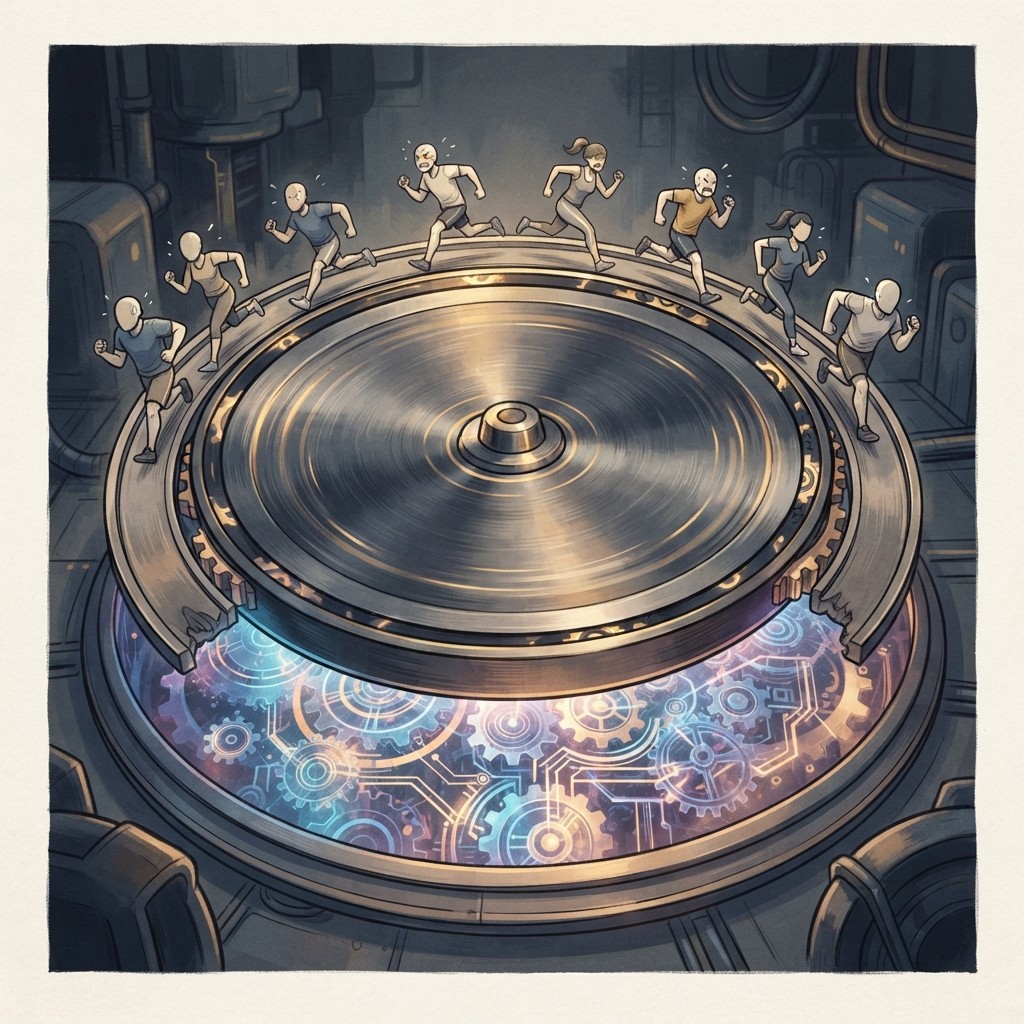
The official story is that TikTok built a classic content flywheel: pay creators, creators make content, content draws viewers, viewers draw advertisers, ad money funds bigger creator payouts, repeat. It is a tidy loop and it is mostly wrong about where the power lives. The creator-payment spoke was underpowered from the day it launched, and the wheel spun fast anyway. Which tells you the engine was somewhere else.
The fund that got thinner the better it worked
TikTok announced its US Creator Fund in July 2020 with a starting pool of $200 million and a stated expectation — not a commitment — that it would grow past $1 billion over three years.1 Read the structure carefully and the problem is built into the math: a fixed pool, divided among everyone eligible. The more creators a flywheel attracts, the more mouths feed at the same trough. So the very success the loop was supposed to produce — more creators, more content — mechanically cut each creator's slice. Pay fell as the platform grew. By the time TikTok shut the fund down in late 2023 and swapped in the Creator Rewards Program, the new program paid far more per thousand views — up to $0.40 to $1.00 — but only on videos longer than a minute, a deliberate nudge toward content that holds attention rather than content that simply exists.2 That repair was real. It was also a quiet admission that the original spoke had been bent from the start.
| Creator Fund (2020–2023) | Creator Rewards Program (2023–24) | |
|---|---|---|
| Pool design | Fixed pool, split among all | Performance-weighted |
| Pay per 1,000 views | ~$0.02–$0.04 | Up to $0.40–$1.00 |
| Effect of more creators | Each slice shrinks | Rewards held to longer content |
| Length requirement | None | Videos over one minute |
The real engine doesn't care who's holding the camera
If the creator-pay spoke was weak, what kept the wheel turning? The recommendation system. TikTok's own newsroom documentation confirms the For You feed runs on an interest graph, not a social graph: follower count is not a direct ranking signal, and watch-time completion is.7 That one design choice rewires the whole loop. On a social-graph platform, distribution is hoarded by whoever already has the audience — the big creators are load-bearing, and you must pay to keep them. On an interest-graph platform, the system can hand a brand-new account a million views because the content matched a viewer's interest, no following required. The flywheel's job of matching supply to demand is done by the algorithm, not by the creator's accumulated clout. Which is exactly why TikTok could afford to pay creators so little: it never needed to bribe a small priesthood of stars to stay. It needed a firehose of cheap content and a sorting machine good enough to find the good stuff. The sorting machine was the asset. The creators were the raw input — and raw input is the one thing you don't have to pay a premium for when you have 1.6 billion monthly users supplying it for free.5
Every flywheel diagram makes its spokes look equal. They never are. In most content platforms, the expensive, visible spoke — creator payouts, talent deals, exclusive shows — gets the credit, because that's where the press and the negotiations happen. But the load-bearing spoke is usually the boring one: distribution. TikTok's lesson is that if your matching engine is good enough, supply becomes a commodity you can underpay for, because the engine — not the creator's reputation — decides what gets seen. Before you spend to strengthen the spoke everyone is watching, find out which one is actually carrying the wheel.
“We expect this Fund will grow to over $1 billion.”1
The numbers downstream of the algorithm tell the same story. TikTok's estimated $23 billion in 2024 revenue was up nearly 43% year on year, with 77% of it coming from advertising — not from any creator-economy product.5 Advertisers pay for attention, attention is manufactured by the For You feed, and the feed keeps working whether a given creator is thrilled with their check or not. At the parent level, ByteDance's international revenues — driven substantially by TikTok — rose nearly 60% in the first half of 2024.6 The demand side compounded. The creator-incentive side limped and was patched. Those two facts only fit together if the demand side was never really powered by paying creators in the first place.
But didn't creators build the culture that made it work?
The honest objection is that this reads the loop too coldly. An algorithm with nothing to recommend recommends nothing — without millions of people making clips, the For You feed is an empty room with very good acoustics. That's fair, and it matters: TikTok inherited a creator culture when ByteDance absorbed Musical.ly in 2018, an acquisition the contemporaneous record prices somewhere between roughly $800 million and as much as $1 billion.3 So creators are necessary. The point is narrower and harder: they were necessary but cheap to keep. The interest graph meant TikTok needed creators in aggregate but depended on no creator in particular — and a platform that depends on no individual supplier has almost no pricing pressure to pay any of them well. That is the difference between a flywheel powered by creator incentives and one merely fed by creator labor. TikTok ran the second kind and let the world call it the first. A second caution: ByteDance's headline financials are unaudited estimates from unnamed sources48 — so treat the parent-level figures as direction, not gospel. The structural argument doesn't need them; it rests on the design of the fund and the design of the feed, both of which are on the record.
TikTok built the most-copied content engine of the decade and got credited for a generosity it never quite practiced. The flywheel everyone admired wasn't spinning on creator paychecks worth two cents a thousand views. It was spinning on a sorting machine that made any creator interchangeable and every viewer findable — and then quietly underpaid the people it had made replaceable. The genius wasn't paying creators to show up. It was building a system where it didn't have to.
How the best loops actually compound
Flywheel Designer Canvas
A one-page canvas for mapping a business's flywheel: the reinforcing loop, how it was started, the second-order loops it spins off, the moat it creates, and how it could spin backward. Use it to diagnose whether you have a real flywheel or a funnel drawn in a circle — and to design one of your own.
Included, filled and blank, in the The Flywheel Casebook. See the set → · Preview the blank →
Sources
Where this comes from — the filings, records, and reporting behind it.
- 1TikTok's Creator Fund launched in the US in July 2020 with a starting pool of $200 million, with a stated expectation to grow to over $1 billion in the US within three years.
- 2TikTok's Creator Fund paid approximately $0.02–$0.04 per 1,000 views; per-creator earnings declined as more creators joined and split the fixed pool. TikTok ended the Creator Fund and replaced it with the Creator Rewards Program, which pays up to $0.40–$1.00 per 1,000 views but requires videos over one minute.
- 3ByteDance acquired Musical.ly on November 9–10, 2017 for 'as much as US$1 billion' (WSJ) or approximately $800 million (Recode); the acquisition price is a confirmed range, not a single verified figure. ByteDance merged Musical.ly into TikTok on August 2, 2018.
- 4ByteDance revenue grew to approximately $120 billion in 2023 (from ~$80 billion in 2022); EBITDA exceeded $40 billion in 2023, a ~60% jump over 2022's ~$25 billion. These figures are unaudited internal figures from anonymous sources.
- 5TikTok generated an estimated $23 billion in revenue in 2024 (a 42.8% year-on-year increase), with 77% from advertising. TikTok reached approximately 1.6 billion monthly active users in 2024.
- 6ByteDance's international (non-China) revenues rose nearly 60% in H1 2024 to approximately $17 billion, driven substantially by TikTok; international revenues represented 23% of ByteDance's total, up from 19% in H1 2023.
- 7TikTok's recommendation system uses an interest graph (not a social graph), officially confirmed by TikTok's own Newsroom documentation. Follower count is not a direct ranking factor; content relevance and watch-time completion rate are the primary signals. The algorithm's mechanics are drawn from TikTok's published 'How TikTok Recommends Videos #ForYou' newsroom post.
- 8ByteDance achieved record revenue of approximately $170.5 billion in 2024 (29% increase YoY); TikTok's international revenues reached approximately $42.9 billion (+63% YoY), accounting for ~25% of ByteDance total. Net profit approximately $36.3 billion. All figures are unaudited estimates from unnamed sources.
More like this — beyond ByteDance / TikTok
New Strategically analyses as they publish: the defining moves in business, checked against the record. No noise, and one click to leave.