Pairs with the Distribution Channel Map — a ready-to-use strategy tool. Included in the The Distribution Rebellion Casebook →
In October 2023, Nike sneakers reappeared on the shelves of DSW — a discount shoe chain Nike had walked away from on the way to a grander idea.6 Two years later, in 2025, Nike products returned to Amazon, ending a six-year absence from the very marketplace it had once decided it was too good to need.99 These were not new partnerships. They were old ones, repaired. The most direct-to-consumer brand in sports was quietly knocking on doors it had slammed shut, asking to be let back in.
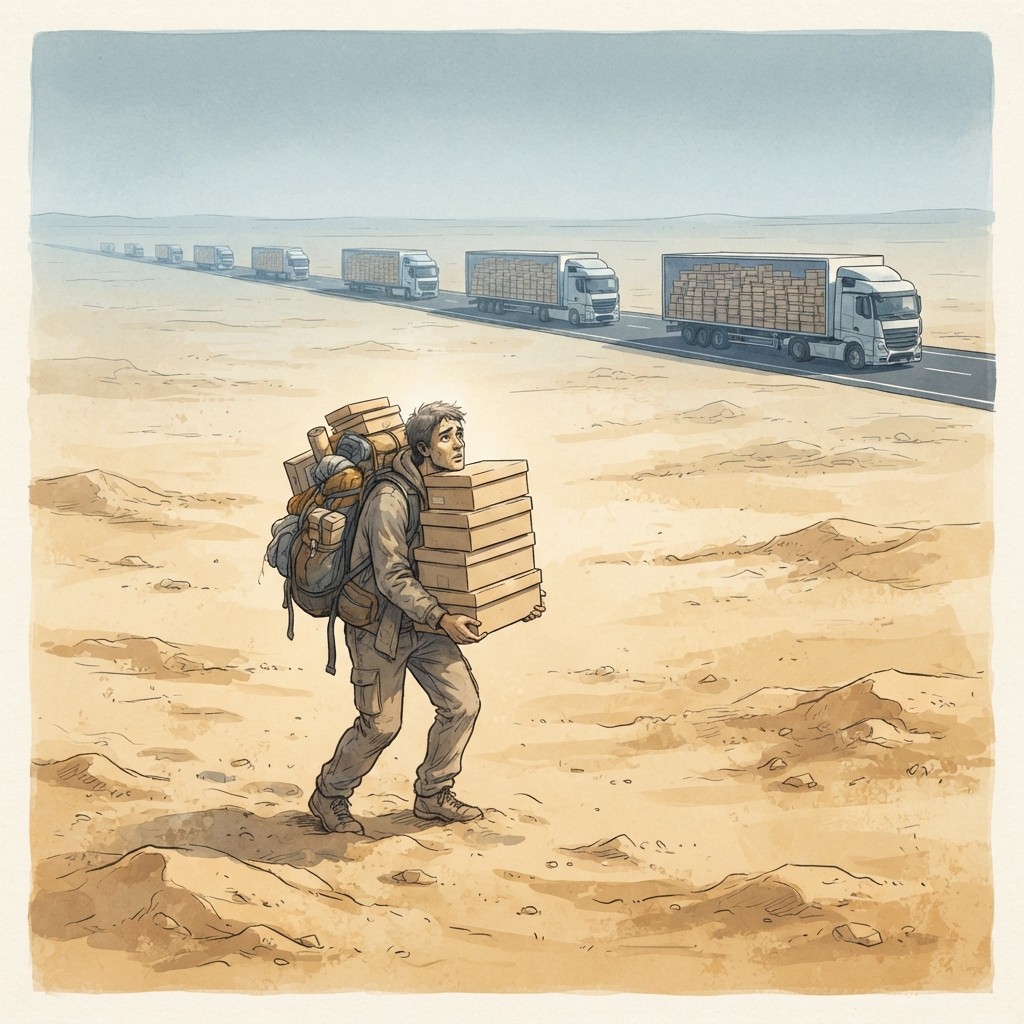
The official story is that Nike pulled off a bold channel rebellion: cut out the middlemen, own the customer, capture the margin. The real story is that Nike spent six years dismantling the leverage it held over retailers, never built an owned channel big enough to replace them, and ended up weaker in both lanes at the same time. The bypass didn't disrupt the channel. It disrupted Nike.
The plan was to own the consumer. The cost was the road to reach them.
Nike announced the Consumer Direct Offense on June 15, 2017 — a realignment built, in its own words, 'to better serve the consumer personally, at scale.'1 The logic was clean and seductive. Sell to a shopper directly and you keep the wholesale discount, you own the data, you control the story. At its October 2017 Investor Day, Nike promised investors high-single-digit revenue growth and expanding margins on the back of the shift.2 When the pandemic emptied stores in 2020, Nike doubled down with the Consumer Direct Acceleration: in the first quarter of fiscal 2021, Nike Direct sales hit $3.7 billion, up 12%, while brand digital sales surged 82%.3 The thesis looked vindicated. Direct-to-consumer revenue had already climbed to 35% of brand revenue, up from 16% a decade earlier.4
Then Nike did the thing that made it a rebellion rather than an expansion: it started firing its distributors. By September 2021, CFO Matthew Friend told the market Nike had 'exited about 50%' of its retail partners — Big 5, Dunham's, Urban Outfitters, Dillard's, Zappos — keeping the marquee names like Foot Locker and Dick's.5 On paper this was a power move: prune the messy, undifferentiated doors, concentrate the brand. In practice, every account Nike cut was a shelf it now had to refill from its own website and stores. It was tearing up the road while assuming it had already built a better one.
“...exited about 50% [of retail partners].”5
Why cutting the channel cut Nike too
Here is the mechanism the bypass story skips. A wholesale partner is not just a margin leak — it is a shock absorber. Foot Locker carried inventory, financed it, marked it down in lean seasons, and gave Nike a place to push product without flooding its own brand. Strip that away and the demand swings land directly on Nike's balance sheet. They did. By September 2022 Nike's inventory had ballooned 44%, and the company missed its revenue projection for the first time in two years.7 To clear the glut, Nike leaned on markdowns and promotions — the exact discounting that the direct model was supposed to abolish. The theoretical margin advantage of selling direct evaporated into clearance pricing the moment the wholesale buffer was gone.
| With wholesale | After the bypass | |
|---|---|---|
| Who holds excess inventory | The retailer | Nike's own balance sheet |
| Who runs the markdowns | The retailer, off-brand | Nike, on its own storefront |
| Demand-swing risk | Shared down the chain | Concentrated on Nike |
| Margin per unit | Lower (wholesale discount) | Higher in theory — until promotions |
The damage ran in both directions. When Foot Locker announced reduced Nike volumes in early 2022, its shares fell nearly 35%, erasing roughly $950 million in market value.7 That looked, briefly, like proof of Nike's dominance. But a wounded distributor is a less useful distributor, and the rupture proved temporary anyway. Foot Locker's Nike inventory share slid from 75% toward a projected 55% — then its CEO Mary Dillon stood up at the March 2023 Investor Day and announced a 'revitalizing' of the Nike partnership.6 The supposed conquest had become a negotiation between two parties who had each discovered they needed the other more than they'd admitted.
The bill comes due
By March 2024 the architect was conceding the design flaw. CFO Matt Friend said plainly that the consumer-direct strategy had added 'complexity and inefficiency' to operations, as Nike paired a return to wholesale with a $2 billion cost-savings plan.8 The 60% direct goal was never reached; fiscal 2023 came in at roughly 42%.8 And the months that followed told the rest. Elliott Hill took over as CEO in October 2024 against a 10% full-year revenue decline to $46.3 billion. Under him the lines crossed back over: wholesale grew 8% year-over-year, and in the second quarter of fiscal 2025, North America wholesale grew 24% while direct fell 10%.9 The channel Nike had spent six years bypassing was now the channel pulling it forward.
Wasn't this still the right long-term bet?
The honest objection is that owning the customer was always correct, and Nike simply executed the timing badly — the pandemic inflated digital, then collapsed it, and any plan would have looked clumsy through that whiplash. There's real truth there. Direct-to-consumer did grow durably: brand DTC went from 16% of revenue in fiscal 2011 to 35% by fiscal 2020, and that data and relationship are genuine assets no retailer hands over.4 But the steelman has a ceiling. The flaw wasn't building a direct business — it was destroying the wholesale leverage before the direct business could carry the weight. Nike treated the channel as a tax to be eliminated rather than infrastructure to be balanced. The proof is in the return itself: a company that had truly outgrown its distributors would not be back on DSW shelves and Amazon listings within two to four years. You don't re-hire the people you successfully replaced.
Before you bypass a distributor, count what it actually does for you beyond taking a cut. It holds your inventory, finances it, runs your markdowns off-brand, and absorbs the swings in demand that would otherwise hit your own balance sheet. The wholesale discount is visible; those functions are invisible until they're gone. The trap is treating distribution as pure friction — eliminate it and the margin you 'recover' can vanish into the clearance pricing and operating complexity you now own outright. Trim the doors that dilute the brand, by all means. But cut the leverage faster than you can replace the function, and you end up weaker in both channels at once — paying full freight to run a store you used to outsource.
Nike set out to fire the middleman and keep the margin. What it learned, at the cost of a 44% inventory pile, a missed quarter, a leadership change, and a public return to the partners it had scorned, is that the middleman was never only a cost. It was the part of the system that bent so Nike didn't break. The rebellion wasn't wrong to want the customer. It was wrong to assume the road to the customer was disposable — and it spent six years discovering that you cannot bypass a channel you still need.
Distribution Channel Map
A map of every hop between the company and the customer — each intermediary, who owns the relationship at each step, and where the company controls the channel versus where it's at the channel's mercy. Blank to chart your own route to market; filled as the worked example showing where the story's company went direct, fought its gatekeepers, or got disintermediated.
Included, filled and blank, in the The Distribution Rebellion Casebook. See the set → · Preview the blank →
Sources
Where this comes from — the filings, records, and reporting behind it.
- 1Nike formally announced the Consumer Direct Offense on June 15, 2017, as 'a new Company alignment designed to allow NIKE to better serve the consumer personally, at scale,' and simultaneously reorganized from six geographic segments to four.
- 2At Nike's October 2017 Investor Day, the company stated it expects 'high-single digit revenue growth, expanding margins and mid-teens earnings per share growth on average over the next five years,' fueled by the Consumer Direct Offense.
- 3The Consumer Direct Acceleration (CDA) was announced in June 2020 as a new, digitally-empowered phase of Nike's strategy. In Q1 FY2021 (ended August 31, 2020), Nike Direct sales were $3.7 billion, up 12%, and Nike Brand digital sales increased 82%.
- 4In fiscal year 2020 (ended May 31, 2020), Nike digital sales increased 75% in Q4 and were approximately 30% of total Q4 revenue; full-year Nike brand DTC revenue reached $12.4 billion, or 35% of Nike brand revenue, up from 16% in FY2011.
- 5As of September 2021, Nike CFO Matthew Friend stated Nike had 'exited about 50%' of its retail partners, including Big 5 Sporting Goods, Dunham's Sports, Urban Outfitters, Dillard's, and Zappos, while retaining Foot Locker and Dick's Sporting Goods.
- 6Foot Locker's Nike share of inventory declined from 75% in Q4 2020 to a projected 55% by Q4 2022; Foot Locker CEO Mary Dillon announced a 'revitalizing' of the Nike partnership at the March 2023 Investor Day. Nike returned to DSW floors in October 2023.
- 7Foot Locker's shares fell nearly 35%—erasing roughly $950 million in market value—when it announced reduced Nike product volumes in February 2022 (year prior referenced); Nike's inventory ballooned 44% in September 2022 and Nike missed revenue projections for the first time in two years that quarter.
- 8Nike CFO Matt Friend stated in March 2024 that the consumer direct strategy had added 'complexity and inefficiency' to operations; Nike returned to wholesale partners and announced a $2 billion cost-savings plan. In fiscal 2023, Nike Direct contributed $21.3 billion of $51.2 billion in total revenue (~42%), well short of the projected 60% DTC target.
- 9Elliott Hill became CEO in October 2024 amid a full-year revenue decline of 10% to $46.3 billion; under Hill, wholesale revenues grew 8% year-over-year and in Q2 FY2025, North America wholesale grew 24% while DTC declined 10%. Nike also returned to Amazon in 2025 after a six-year absence.
- 10In Q4 fiscal 2024, NIKE Direct revenues were down 8 percent and wholesale revenues were up 5 percent on a reported basis.
- 11Nike and Adidas set goals for direct sales to represent 60 and 50 percent of their respective sales by 2025 — goals that have since been abandoned.Statista, Has Nike's DTC Push Reached Its Limit? ↗ · 2024-10-14
More like this — beyond Nike
New Strategically analyses as they publish: the defining moves in business, checked against the record. No noise, and one click to leave.