Pairs with the Reversal Readiness Checklist — a ready-to-use strategy tool. Included in the The Reversal Casebook →
On October 16, 2020, Atlassian told the millions of teams running Jira and Confluence on their own servers that the ground beneath them had an expiration date.1 First new license sales would stop, then support, then security patches, then bug fixes. The framing was warm and forward-looking: the future is cloud, and we're all going there together. Co-CEO Scott Farquhar pointed out that more than 90% of customers start with cloud and that more server customers were switching every day.8 It sounded like a company reading the room. It was a company emptying it.
The story you'll hear is that Atlassian led a cloud migration its customers wanted. Almost every word of that is doing quiet work it shouldn't. The 90% figure describes new customers — not the installed base being asked to leave. And the migration wasn't pulled by demand; it was pushed by a series of end-of-life mandates, each one closing a door the customer had paid to stand in.
Read the deadlines, not the press release
Strip away the language and look at the sequence of actions, because the sequence is the strategy. New Server licenses stopped selling on February 2, 2021. Server support — security updates, bug fixes, all of it — ceased entirely on February 15, 2024.1 Customers who had bought into a self-managed product — one sold as an annual-maintenance license tied to a one-time deployment — were left with software that still ran but would no longer be defended against the next exploit. That is not a migration. It is a deadline with a friendly face.
The mechanism is plainest in the revenue. Server maintenance revenue fell year over year in widening steps — 29%, then 27%, 31%, 35%, 69% — and finally hit a clean 100% decline in the fourth quarter of fiscal 2024.4 A whole product line walked to exactly zero, on schedule. Meanwhile, the period since the October 2020 Server EOS announcement saw enterprise seats migrating to Cloud rise nearly sevenfold, on Atlassian's own disclosed count.33 One line goes to zero by design; the other goes up by gravity. The gravity is the deadline.
The promise Atlassian made — and then took back
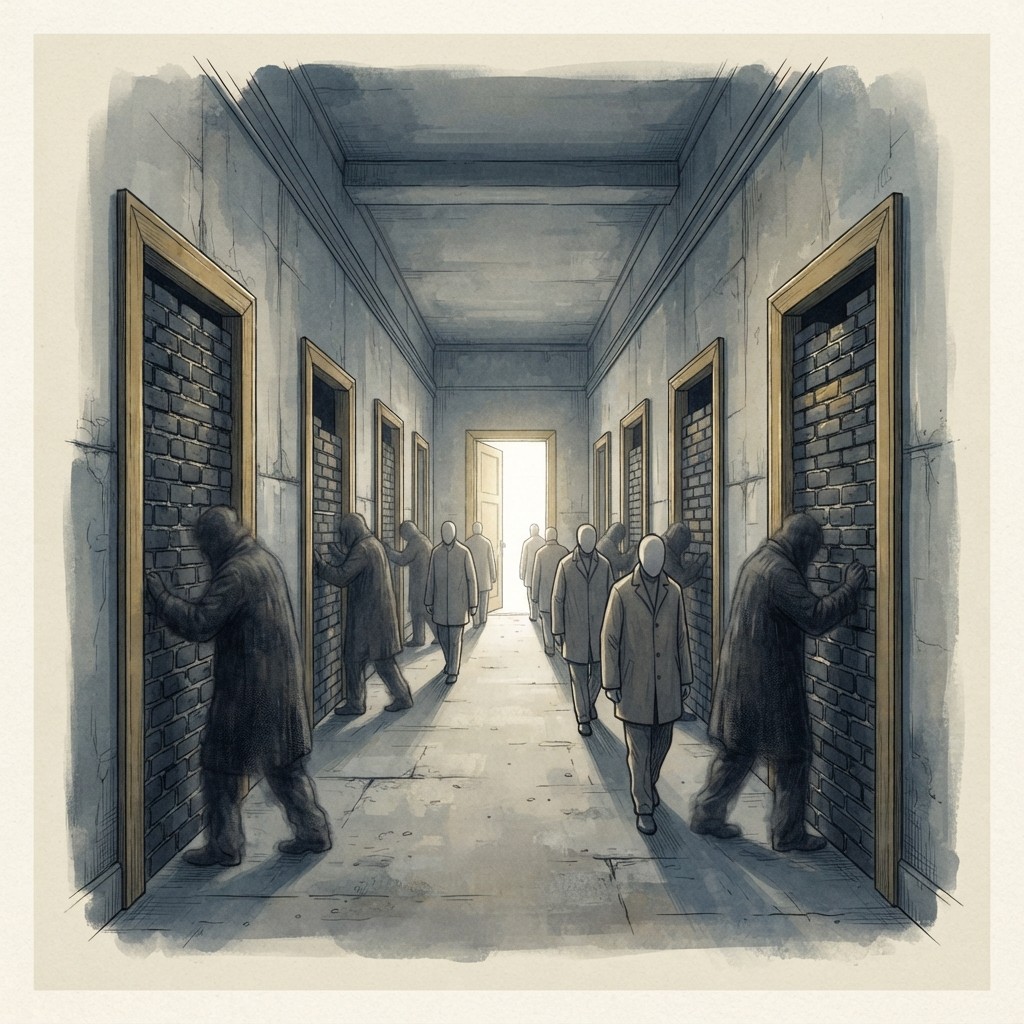
Here is the move that turns this from a migration into a thesis. When Server was killed, Data Center was the safe harbor — the self-managed product that big enterprises could keep. Atlassian even said publicly it had no plans to end-of-life Data Center — in a June 2022 official post, it stated explicitly: "To be clear, we have no plans to end of life or end of support for our Data Center offering."9 Then, in September 2025, it did exactly that, setting a hard Data Center EOL of March 28, 2029, with new sales ending in 2026 and the last purchase date in 2028.67 The harbor was never a harbor. It was the next room in a hallway with one exit, and the exit is Cloud.
“Data Center will no longer be able to deliver on our core promise.”6
Notice what the second kill reveals about the first. A genuine cloud transition wouldn't need to keep removing self-managed options after the original deadline passed — customers who wanted cloud would already be there. The only reason to also eliminate Data Center is that a large, profitable cohort had chosen to stay self-managed, and staying was no longer permitted. Atlassian's own filings concede the friction in plain language: it offered discounts to certain enterprise Server customers to incentivize migration, and warned that if remaining Server or Data Center customers don't transition, revenue and profitability could suffer.5 That is not the language of pull. It's the language of a company that has to push, because the demand was never as universal as the slide deck said.
| The official story | What the actions show | |
|---|---|---|
| Driver | Customers wanted cloud | Company-set end-of-life mandates |
| The 90% figure | Everyone is going to cloud | Describes new customers, not the installed base |
| Data Center | A long-term self-managed option | Killed too, hard EOL March 28, 2029 |
| Customer's timeline | Migrate when ready | Migrate before the patches stop |
Isn't this just a vendor doing the obvious thing?
The honest counter is strong, so let's make it. Maintaining three deployment models — Server, Data Center, and Cloud — is genuinely expensive, and a smaller cloud-native codebase ships features faster and is more secure for most customers. Atlassian's own framing, that Data Center 'will no longer be able to deliver on our core promise,'6 is not pure spin; a self-managed product really does fall behind a continuously deployed cloud one. And the cloud penetration is real at some level — 99% of its 300,000-plus customers, the company says, already benefit from Cloud.6 So why call it a monetization reset rather than good engineering housekeeping?
Because of how that 99% is built and how the deadlines are timed. 'Benefit from Cloud' is undefined in Atlassian's disclosure; on any reasonable reading it likely counts any customer with any cloud product — free tiers, hybrid setups — not customers who have fully exited self-managed deployment.6 The figure flatters the very transition it's used to justify. And the tell is the broken promise: a company simplifying for the customer's sake doesn't reverse a public assurance about Data Center the moment the holdouts prove they'd rather stay. Engineering efficiency and forced monetization aren't mutually exclusive — but when the efficiency story requires removing every exit on a calendar the vendor controls, the customer is no longer the one being served. They're the one being scheduled.
The clearest read on a platform's intentions is rarely the feature it launches — it's the option it deletes. Lock-in is seldom announced as lock-in; it arrives as a roadmap, a 'core promise,' a sunset framed as progress. The signal to watch is sequence: when a vendor kills one self-managed path, then assures you the next one is safe, then kills that too, the through-line isn't innovation — it's the methodical closing of every door but theirs. Two cautions. First, a kill can be genuinely justified by real engineering cost, so judge the deadline against the promise, not the press release. Second, the deepest lock-in is the one you helped build — data, workflows, integrations — so price your exit before the vendor prices it for you. The time to value an off-ramp is while it's still open.
Atlassian didn't move its customers to the cloud. It removed every place they could stand that wasn't the cloud, one product at a time, on a clock it wound itself — Server to zero by February 2024, Data Center to zero by March 2029.47 The genius isn't the migration; anyone can ship a cloud product. The genius is converting an entire installed base from owners into subscribers without ever asking them to choose, by making every other choice expire. The future may well be cloud. But the customer never got to decide when their present ran out.
Reversal Readiness Checklist
Reversing a public commitment is the hardest decision a leader makes — and the easiest to botch by doing it too late or too messily. This checklist gates the U-turn: is the evidence in, is the old logic genuinely dead, can you absorb the credibility hit, and is the new path actually ready. Blank, it keeps you from flip-flopping on a whim; filled, it scores the story's reversal against what a clean one demands.
Included, filled and blank, in the The Reversal Casebook. See the set → · Preview the blank →
Sources
Where this comes from — the filings, records, and reporting behind it.
- 1Atlassian announced Server EOL on October 16, 2020; stopped selling new Server licenses on February 2, 2021; and fully ended Server support on February 15, 2024.
- 2Atlassian's official blog confirmed the Server retirement announcement was made 'in late 2020' and that the company was 'retiring our self-managed server offerings' in 2024.
- 3In Atlassian's Q2 FY24 SEC 8-K shareholder letter, the company disclosed that since the October 2020 Server EOS announcement, enterprise seats migrating to Cloud increased nearly 7x, and that Data Center migrations were driving more than 60% of cloud migrations.
- 4Atlassian's Q4 FY24 SEC 8-K shareholder letter showed Server revenue declined (29%), (27%), (31%), (35%), (69%), and hit (100%) year-over-year in Q4 FY24, confirming Server maintenance revenue reached zero after the February 2024 EOL. Full-year FY24 revenue was $4.4 billion. Server migration from Data Center customers is more complex than the original Server cohort because DC customers are large enterprises.
- 5Atlassian's FY2024 10-K (Annual Report on Form 10-K for the fiscal year ended June 30, 2024) discloses that the company offered discounts to certain enterprise-level Server customers to incentivize migration, impacting near-term revenue growth, and warned that if remaining Server or Data Center customers do not transition to Cloud, revenue growth rates and profitability may be negatively impacted.
- 6Atlassian's official Ascend announcement (September 2025) confirmed Data Center EOL on March 28, 2029, with end of new customer sales March 30, 2026 and last existing-customer purchase date March 30, 2028; stated 99% of 300,000+ customers already benefit from Cloud; and acknowledged Data Center 'will no longer be able to deliver on our core promise.'
- 7Atlassian's official licensing page for Data Center EOL confirms the hard deadline of March 28, 2029, with FAQ items explicitly addressing what happens if customers do not act by that date.
- 8Co-CEO Scott Farquhar said at the October 2020 Server EOL announcement that 'more than 90 per cent' of customers start with cloud products and 'more server customers [are] making the switch every day,' framing the EOL as following existing customer behavior rather than forcing it.
- 9Atlassian publicly stated in 2022 that it had no plans to end of life or end of support for its Data Center offering.
More like this — beyond Atlassian
New Strategically analyses as they publish: the defining moves in business, checked against the record. No noise, and one click to leave.