Pairs with the Bet-Sizing Worksheet — a ready-to-use strategy tool. Included in the Bet Casebook →
“How much does this bet commit before anybody outside the company acts on it?”
In 2024 Rivian built 49,476 trucks and SUVs, delivered 51,579, and pulled in nearly $5 billion of revenue.1 It also lost $4.75 billion doing it.1 Stack that on the years before — $6.75 billion gone in 2022, $5.43 billion in 20232 — and you arrive at the number that actually defines the company: an accumulated deficit of $23.3 billion by the last day of 2024, against a cash pile of $5.3 billion.1 Every R1T that rolls off the line in Normal, Illinois is a beautiful machine and a small financial wound. The question is not whether Rivian can build a great electric truck. It already does. The question is whether the truck was ever the point.
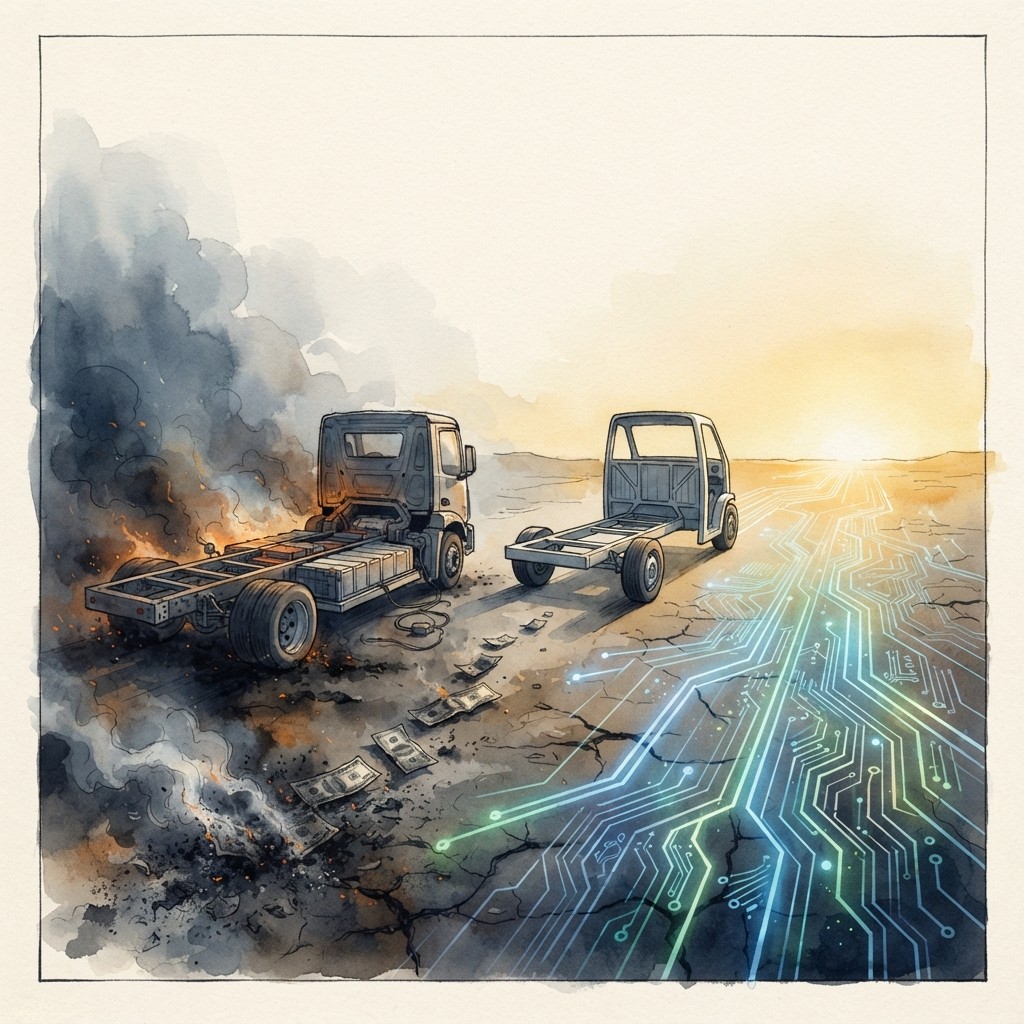
The official story is that Rivian is an electric-truck maker racing Tesla and Ford to scale, and that profitability is just a matter of building enough vehicles. It's a manufacturing problem. It's really a wedge problem. The trucks are the cost of admission to prove that the most valuable thing Rivian built was never sheet metal at all — it was the software stack underneath, and the only real bet on the table is whether someone will pay to license it before the cash runs out.
The trucks are the storefront, not the business
Premium EVs are a brutal way to make money, and Rivian's own filings say so in the bluntest terms a balance sheet allows. In 2022 the company ran a negative gross profit of $3.1 billion — it lost money on the cars before a single dollar of overhead.2 By 2023 that gap had closed to negative $2.0 billion, still upside down.2 Building hand-engineered electric trucks at low volume means tooling costs, battery costs, and factory fixed costs spread across far too few units. The math doesn't work at this scale and was never going to. So what is the $23 billion buying?
It is buying credibility for a different product entirely. Rivian engineered its vehicles around a 'zonal' electrical architecture and a unified software platform — the kind of from-scratch stack legacy automakers have spent billions failing to replicate. The trucks are the proof-of-concept showroom. They demonstrate, in steel you can drive, that the software actually works at automotive scale and safety. That demonstration is the asset. And in June 2024, someone showed up to buy it.
Volkswagen didn't buy trucks. It bought the stack.
Volkswagen — a company with more engineers, more factories, and more cash than Rivian will ever have — agreed to pour money into a 50/50 joint venture to use Rivian's software and electrical architecture. That is the whole tell. VW does not need help bending metal. It needs help with the one thing it has demonstrably failed at: building a clean, scalable software platform. The June 2024 announcement put the figure at 'up to $5 billion.'7 By the time the venture, 'Rivian and VW Group Technology, LLC,' formally launched on November 13, 2024, the number had grown to up to $5.8 billion.6 Anyone still quoting '$5 billion' is reading a press release that VW itself superseded.
Here is why the structure matters more than the headline. The money is staged: $1 billion already in as a convertible note, roughly $1.3 billion paid at the JV close, and up to $3.5 billion more expected by 2027 — but only if Rivian hits milestones.6 So the deal is not a rescue. It is an audition with a payment plan. VW funds Rivian to prove the software ports to a non-Rivian vehicle, and each tranche is a vote of confidence Rivian still has to earn. If the wedge works, Rivian becomes the company that gets paid every time a Volkswagen drives off a lot — software margins on someone else's manufacturing. If it stalls, the later billions simply don't arrive.
| Rivian as a truck maker | Rivian as a software-licensing platform | |
|---|---|---|
| The product | R1T, R1S, the EDV van | The zonal architecture + software stack |
| The margin | Negative until ~2023, fragile after | High-margin licensing on others' volume |
| Who scales the metal | Rivian, expensively | Volkswagen, at its own scale |
| The 2024 evidence | $4.75B net loss1 | Up to $5.8B VW commitment6 |
The Amazon deal was always conditional — and that's the warning
Before VW, the proof-point that was supposed to validate the whole thesis was Amazon. The story everyone repeats is a firm order for 100,000 electric delivery vans — a guaranteed B2B anchor that would carry Rivian to scale. The filings tell a quieter, sharper story. The exclusivity clause required Amazon to order only 10,000 vans a year for the first two years; if Amazon never reached 100,000 total, the exclusivity would simply terminate.5 In 2023, Amazon placed exactly the minimum — 10,000 units — and Rivian moved to negotiate exclusivity away.5 The '100,000-van deal' was never an unconditional purchase order. It was an option Amazon was free to walk away from, and largely did.
That matters because it is the pattern. A giant partner signs a headline number; the headline number is conditional; the conditions are what actually govern the outcome. The fleet that did get built is real — over 30,000 vans deployed by mid-2025, delivering more than a billion packages in 2024.11 But 'real and useful' is not the same as 'the firm demand that funds your burn.' The VW deal is structured the same way — staged, milestone-gated — which means Rivian has learned to win these partnerships and has not yet learned to make them unconditional. The whole bet lives in that gap.
“Increase in sales of automotive regulatory credits, alongside cost reductions, drove the improvement.”8
And this is the detail the celebratory coverage skips. Rivian did post a positive gross profit in Q4 2024 — $170 million, its first ever.8 But the 10-K credits the full-year improvement partly to a surge in selling automotive regulatory credits, a cyclical line item that depends on other automakers needing to buy compliance, not on Rivian's own unit economics turning durably profitable.8 The company guides to only 'modest gross profit' for all of 2025.8 The flywheel isn't spinning on its own yet. It's being pushed.
The honest counter: maybe it's just a money pit with a good story
The fair objection is that 'they're not a truck company, they're a software company' is exactly what every cash-incinerating hardware startup says when the hardware math stops working. It is the most convenient possible reframe, and skepticism is warranted. A single licensing partner — VW — is not a market; it's a customer, and a customer who has structured every payment to be revocable. Strip away the narrative and you have a company that has burned $23 billion, holds $5.3 billion, and lost $2.6 billion of net cash in 2024 alone.1 At that pace the runway is measured in a couple of years, not a couple of decades.
But the counter to the counter is the trajectory, and the trajectory is the one genuinely encouraging fact. The annual net loss has fallen every year — $6.75B, then $5.43B, then $4.75B21 — gross margin has crossed from deeply negative to barely positive, and a sophisticated industrial buyer chose to raise its commitment from $5 billion to $5.8 billion rather than walk.6 None of that proves Rivian wins. It proves the race is close. The bet is structurally sound only if the VW and Amazon ramps validate the software wedge fast enough to outrun the deficit — and Rivian is narrowing that race without having yet won it.
Some of the most expensive products a company builds aren't meant to make money — they're meant to prove a capability someone else will pay to use. Rivian's trucks are a $23 billion demonstration that its software works at automotive scale; the actual business is licensing that stack to VW and anyone who follows. The strategic test is unforgiving and simple: does the licensing revenue arrive before the demonstration bankrupts you? Two cautions. First, a partner's headline number means nothing until you read the conditions — Amazon's '100,000 vans' was an option, not an order, and most of VW's $5.8 billion is milestone-gated. Second, beware a first profit built on regulatory credits or one-time lines; it flatters the income statement without proving the underlying machine works. The wedge is only real when someone pays for it on terms they can't take back.
Rivian raised approximately $13.7 billion in one of the hottest IPOs of 2021 — $11.9 billion from the initial 153 million shares priced at $78, with the remainder unlocked when underwriters exercised their overallotment option in full — closing its first day of trading at $100.73 a share on a market cap of roughly $86 billion.910434 Most of that money is gone now, converted into factories, vehicles, and a software platform that a German giant decided was worth paying for. That conversion is either the smartest thing the company ever did or a beautifully narrated way to run out of cash. The difference comes down to timing — whether the licensing revenue compounds faster than the deficit. Rivian spent $23 billion to ask the market one question, and the market is finally starting to answer it: not whether the truck is any good, but whether anyone will buy the thing inside it before the lights go out.
Bet-Sizing Worksheet
Most bets fail on size, not on direction — right call, ruinous stake. This worksheet forces the three numbers that matter: how much of the bankroll is on the table, how strong the conviction really is, and whether the worst case is survivable. Blank, it stops you betting the company on a hunch; filled, it reverse-engineers the story's wager so you can judge whether it was bold or reckless.
Included, filled and blank, in the Bet Casebook. See the set → · Preview the blank →
Sources
Where this comes from — the filings, records, and reporting behind it.
- 1Rivian FY2024 10-K: net loss $4,746 million; accumulated deficit $23,305 million as of Dec 31, 2024; net change in cash -$2,563 million in 2024; cash and restricted cash ending balance $5,294 million; total revenues $4,970 million; 49,476 vehicles produced and 51,579 delivered in 2024.
- 2Rivian FY2022 net loss $6,752 million; FY2023 net loss $5,432 million; FY2022 negative gross profit $(3,123) million; FY2023 negative gross profit $(2,030) million; FY2023 loss from operations $(5,739) million; FY2023 capital expenditures $(1,026) million; liquidity at end of Q4 2023 $9,368 million cash/equivalents/short-term investments.
- 3Rivian's November 2021 IPO gross proceeds were approximately $11.9 billion before commissions; IPO price was $78/share; shares opened on Nasdaq under RIVN and closed the first day at $100.73, a 29% rise; at the fully diluted valuation the company was valued at over $77 billion.
- 4Rivian's S-1/A Amendment No.3 (Nov 5 2021) and S-1MEF (Nov 9 2021) establish the IPO share price of $78 and the additional 20.7 million shares registered for sale by underwriters; the original S-1 was filed Oct 1 2021.
- 5Amazon ordered 100,000 Rivian electric delivery vans as part of its Climate Pledge announced in 2019; by mid-2025 Amazon had over 30,000 vans deployed in the U.S.; Amazon's Rivian fleet delivered more than 1 billion packages in 2024. The exclusivity clause required Amazon to order 10,000 EDVs per year; after Amazon placed only the minimum 10,000-unit order in 2023, Rivian entered negotiations to terminate exclusivity.
- 6The Rivian–VW joint venture ('Rivian and VW Group Technology, LLC') launched November 13, 2024 as a 50/50 partnership; VW's total planned investment was revised upward to up to $5.8 billion (from an initial $5 billion announced June 2024); VW had already invested $1 billion as a convertible note; an additional ~$1.3 billion was paid at JV close; remaining up to $3.5 billion expected by 2027 contingent on milestones.
- 7VW's original June 2024 announcement stated the initial deal size at up to $5 billion; the JV structure gave VW a 50% equity stake; $2 billion was to be deployed in fiscal 2024; additional equity tranches of $1 billion each in 2025 and 2026 were contingent on milestones.
- 8Rivian's Q4 2024 gross profit of $170 million was 'primarily driven by improvements in variable costs, revenue per delivered unit, and fixed costs' and the 10-K explicitly attributes the full-year improvement also to 'increase in sales of automotive regulatory credits' — a one-time or cyclical revenue line, not purely vehicle unit-economics improvement. Rivian expects 'modest gross profit' for full year 2025.
- 9Rivian raised $13.7 billion of gross proceeds from its IPO in November 2021, after the underwriters' overallotment option was exercised in full on 175,950,000 total shares at $78 per share.
- 10Rivian's first-day closing price was $100.73, a 29.14% rise from the $78 IPO price, giving it a market cap of $85.9 billion at close; the opening price on day one was $106.75.
- 11Amazon had more than 30,000 Rivian vans on US roads as of June 2025, having added 10,000 units in the first six months of the year; Amazon's Rivian fleet delivered more than one billion packages in 2024.
Weighing outside help with a decision like this? Hiring a commercial due diligence provider
More like this — beyond Rivian
New Strategically analyses as they publish: the defining moves in business, checked against the record. No noise, and one click to leave.