Pairs with the Bet-Sizing Worksheet — a ready-to-use strategy tool. Included in the Bet Casebook →
“How much does this bet commit before anybody outside the company acts on it?”
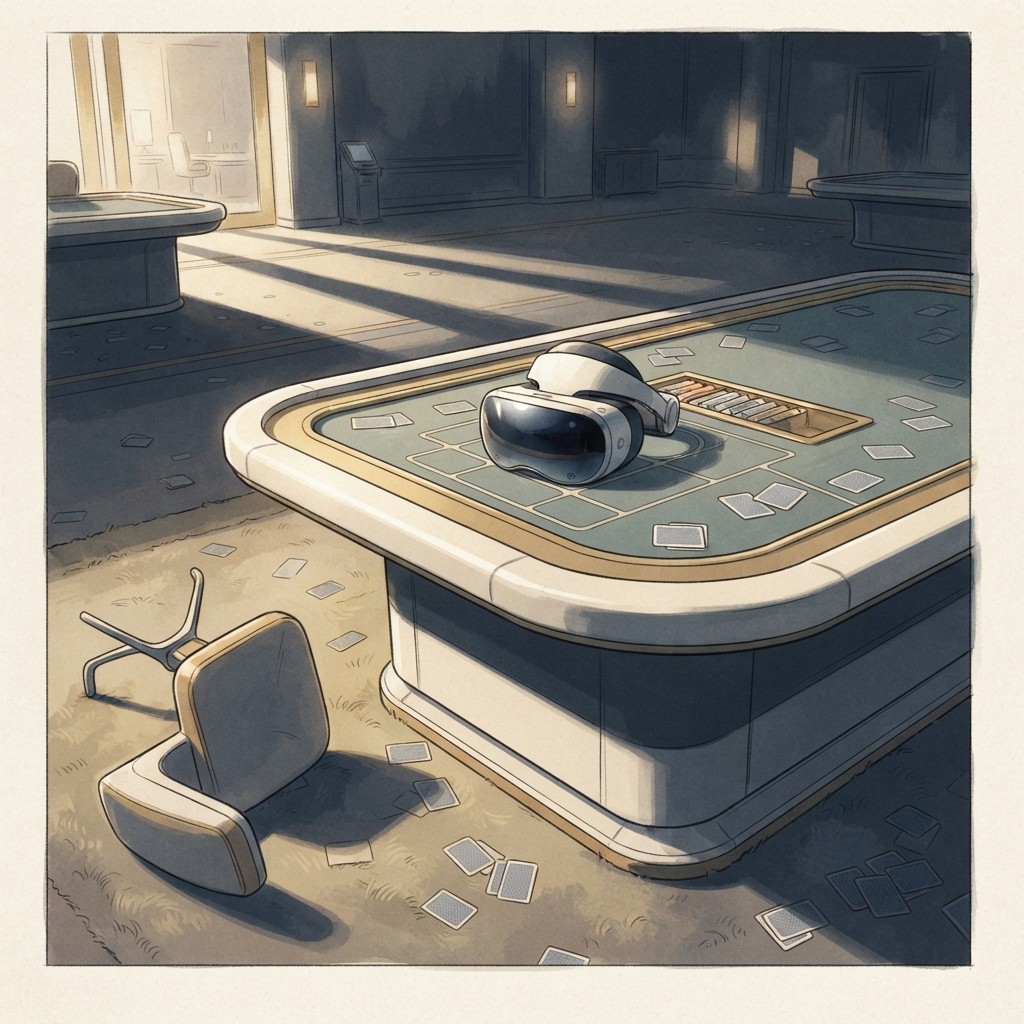
On February 2, 2024, you could walk into an Apple Store, hand over $3,499, and walk out with a computer you wore on your face.1 It scanned your eyes, mapped your hands, painted apps in the air around your kitchen, and rendered your own face on its outer screen so other people could pretend you weren't wearing it. It was, by almost any technical measure, a marvel — and the most ambitious thing Apple had shipped since it strapped a phone to the internet. The pre-order shipments sold out in about eighteen minutes.4 Eleven months later, Apple had quietly stopped building it.
The official story is that the era of spatial computing had arrived — a new platform, the way the iPhone was a new platform, with a long ramp ahead of it. The truer story is that Apple placed an enormous bet on the next form factor of computing, ran the first real market test, and got back an answer it did not want. The headset works. The platform thesis is the thing that didn't.
What Apple was actually betting on
Vision Pro was Apple's first genuinely new product category since the Apple Watch in 2015, and Apple was careful never to call it a VR headset — it called it a 'spatial computer.'3 That word choice was the whole bet in miniature. A headset is a peripheral; a computer is a platform you build a decade on. The team behind it had been at work since 2015, when Apple acquired the augmented-reality firm Metaio and stood up a secret group under Mike Rockwell that would spend roughly eight years building toward the 2023 reveal.2 This was not a side project. It was Apple positioning the device every previous platform shift had taught it to fear missing: the one that comes after the phone.
Here is the mechanism that makes a platform bet rational. Apple's entire flywheel runs on a screen people carry everywhere — the apps, the services, the cut of every transaction. The terror, for a company that size, is that the next screen arrives and someone else owns it. So you build the expensive, uncompromised version first, seed it with developers, and let cost fall over years until the masses can afford the thing the early adopters proved out. That playbook built the iPhone. The unspoken assumption underneath it is the one that broke: that people want a computer on their face at all.
The launch pop that wasn't demand
The sell-out headlines were real and almost entirely uninformative. Apple moved up to 200,000 units in the two-week pre-order window, and the first allocation vanished in eighteen minutes.4 But a $3,499 product selling out its initial batch tells you only that Apple's superfans showed up — exactly the people guaranteed to buy a first-generation Apple anything. The question a platform bet has to answer is what happens after the faithful are served. The answer came fast. Apple's internal target for 2024 was 700,000 to 800,000 units; through the third quarter it had shipped roughly 370,000, with full-year estimates converging somewhere in the 420,000–500,000 range — well short.5 The curiosity gap between the eighteen-minute sell-out and the year-end miss is the whole story: the first wave bought it, and the second wave never came.
| The launch pop | The full year | |
|---|---|---|
| Headline | Sold out in ~18 minutes | Production halted by end-2024 |
| Who bought | Apple's earliest adopters | Almost nobody after them |
| Units | Up to 200,000 in pre-order | ~370,000–500,000 for the year |
| Against target | Beat initial shipment estimates | Missed the 700,000–800,000 goal |
Supply tells the same story more bluntly than any analyst note. Apple cut production through mid-2024, and by reports some component factories had suspended new output as early as May — months after launch. Suppliers built enough parts for only about 500,000 to 600,000 headsets total, and first-generation manufacturing was halted by the end of 2024.6 You do not stop building the future. You stop building inventory you can't sell.
The tell wasn't the sales — it was the org chart
A missed sales target on a first-gen product is survivable; Apple has the patience and the balance sheet to lose money on a category for years. The harder signal came in March 2025, when Tim Cook took Mike Rockwell — the man who had built the Vision Products Group from a Metaio acquisition into a shipping device — and reassigned him to rescue Siri.7 Read that move as an executive does. The scarcest resource at any company is the attention of its best builders, and Apple had just decided that its best spatial-computing mind was more urgently needed fixing a voice assistant. You move people toward your real priorities. A founding VP pulled off the product he founded is not a vote of confidence in the platform. It is a reallocation.
“Vision Pro's founding leader was moved to head the Siri rebuild; a deputy was left to run the headset hardware team.”7
And the roadmap behind him went quiet. As of mid-2026 no new Apple Vision headset is reported to be in active development; Bloomberg's read is that a next-generation Vision Pro is unlikely before 2028 or 2029, while analyst Ming-Chi Kuo says Apple has pivoted toward AI smart glasses instead.8 The thesis didn't change from 'computing moves to your face' to 'computing stays on your desk.' It changed from a heavy, sealed headset to a light pair of glasses — the same destination, a radically different vehicle. Vision Pro, in that light, looks less like the platform arriving and more like a very expensive proof-of-concept that told Apple which road not to take.
Wasn't this exactly how the iPhone started?
The strongest defense of Vision Pro is that every platform looks like a failure in year one. The original Apple Watch was a confused luxury object before it found its purpose; the first iPhone was expensive, missing apps, and dismissed by serious people. Patience is Apple's superpower, the argument goes — give it three generations and a price cut and the curve bends. That objection is fair, and partly right. A first-gen halo product missing its number is not, by itself, a verdict.
But the analogy hides the part that matters. The iPhone's problem in 2007 was cost and software catalog — both of which fall predictably over time. Vision Pro's problem is different in kind: it asks you to seal off your eyes and your face from the room, and no price cut fixes the friction of putting on a headset to do what your phone already does. The clearest evidence is the catalog itself. At launch Apple announced more than 600 native visionOS apps alongside over one million compatible iPhone and iPad apps running in a compatibility window — meaning the overwhelming majority of the advertised catalog was existing software repurposed for the new screen, not spatial software written for the new medium.9 That is the difference between a platform and a very good screen mirror, and it is why the second wave of buyers never materialized — sales volume dropped roughly 80 percent in Q2 2024 versus Q1, and Tim Cook himself called the device 'not a mass-market product.'10 When the early adopters are served and the experiences built specifically for the device are thin, demand has nowhere to go. The org-chart move and the suspended roadmap suggest Apple reached the same conclusion.
The discipline isn't whether you place the bet — it's whether you can tell the difference between a launch pop and real demand, and whether you'll act on the answer before sunk cost ossifies into strategy. Apple did the unsentimental thing: it built the uncompromised version, ran the test, read a result it didn't like, and reallocated its best builder rather than defending the narrative. The tell that a company has stopped believing its own thesis is never the press release — it's the org chart. Watch where the talent goes, not where the marketing points. A new category is a hypothesis dressed as a product; the only honest response to a failed first test is to ask whether the form factor was wrong, not just the price.
Apple spent roughly eight years and a fortune in engineering to learn something it could not have known any cheaper: that the next computing platform, if there is one, probably isn't a thing you bolt to your skull. Vision Pro was never a flop in the way a bad product is a flop — it was the most expensive market-research instrument the company has ever fielded, and it returned a clean signal. The bet on spatial computing didn't fail. The bet on the headset did, and Apple was clear-eyed enough to spend the device proving the difference.
Bet-Sizing Worksheet
Most bets fail on size, not on direction — right call, ruinous stake. This worksheet forces the three numbers that matter: how much of the bankroll is on the table, how strong the conviction really is, and whether the worst case is survivable. Blank, it stops you betting the company on a hunch; filled, it reverse-engineers the story's wager so you can judge whether it was bold or reckless.
Included, filled and blank, in the Bet Casebook. See the set → · Preview the blank →
Sources
Where this comes from — the filings, records, and reporting behind it.
- 1Apple Vision Pro was announced June 5, 2023 at WWDC23 and went on sale February 2, 2024 at a starting price of $3,499 (256GB). Storage tiers: 512GB for $3,699, 1TB for $3,899.
- 2The Technology Development Group (later Vision Products Group) was founded by Mike Rockwell in 2015 following Apple's acquisition of Metaio. The team developed Apple Vision Pro over approximately eight years before the 2023 announcement.
- 3Apple Vision Pro is the company's first new major product category since the Apple Watch in 2015, and Apple markets it as a 'spatial computer' rather than a VR headset.
- 4Launch pre-order shipments sold out in 18 minutes; Apple sold up to 200,000 units in the two-week pre-order window (Jan 19–Feb 2, 2024). Initial shipment estimates from analysts ranged from 60,000–80,000 units.
- 5Apple's internal 2024 sales target was 700,000–800,000 units. Actual shipments through Q3 2024 were approximately 370,000 units; full-year 2024 estimates converged around 420,000–500,000 units — well below target.
- 6Apple abruptly reduced Vision Pro production in mid-2024 and halted first-gen manufacturing by end of 2024. Suppliers produced enough components for 500,000–600,000 headsets; some component factories suspended new production as early as May 2024.
- 7In March 2025, Tim Cook reassigned Mike Rockwell from leading the Vision Products Group to heading Apple's Siri rebuild, after Cook reportedly lost confidence in AI chief John Giannandrea. Paul Meade was appointed to lead the Vision Pro hardware team.
- 8As of mid-2026, no new Apple Vision headset is in active development. Bloomberg's Mark Gurman reports a next Vision Pro is unlikely before late 2028 or 2029; analyst Ming-Chi Kuo says Apple has pivoted to AI smart glasses instead.
- 9Apple Vision Pro launched with more than 600 native visionOS apps and over one million compatible iPhone and iPad apps running in a compatibility window.
- 10Apple Vision Pro sales volume dropped approximately 80% in Q2 2024 compared to Q1 2024, with a significant number of buyers returning the headset; Tim Cook acknowledged the device was for early adopters and 'not a mass-market product.'
Weighing outside help with a decision like this? Hiring a commercial due diligence provider
More like this — beyond Apple
New Strategically analyses as they publish: the defining moves in business, checked against the record. No noise, and one click to leave.