Pairs with the Bet-Sizing Worksheet — a ready-to-use strategy tool, filled for Pfizer. Included in the The Bet Casebook →
On March 17, 2020, with the world locking its doors, Pfizer and a small German biotech named BioNTech signed a letter of intent to build a vaccine against a virus nobody had yet named in a 10-K.1 The story told ever since is one of nerve: Pfizer's CEO turned down government R&D money, handed his scientists 'an open checkbook,' and risked around $2 billion of the company's own cash on a technology that had never produced an approved human vaccine.6 It worked. Two years later the company posted the largest revenue figure in its 175-year history. The bet looks, in hindsight, like the boldest single wager in modern pharma.
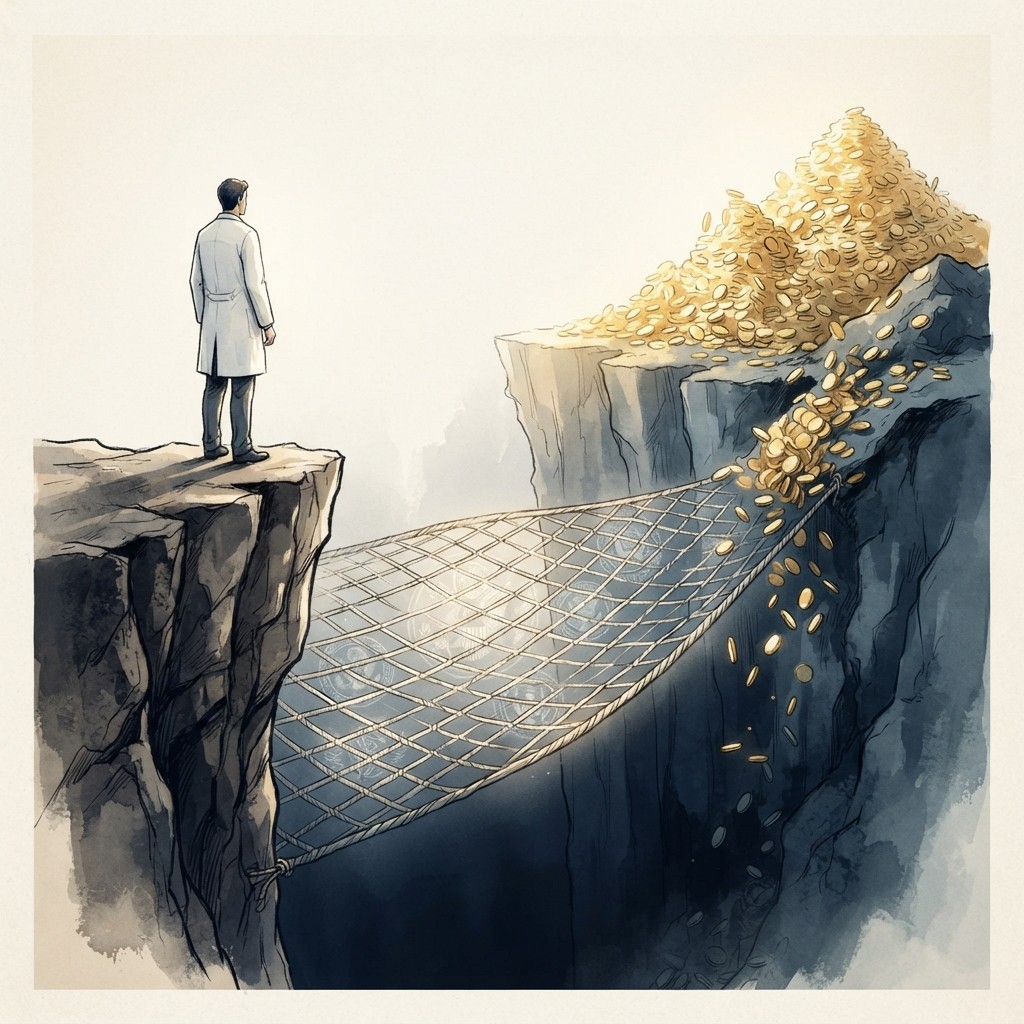
It was bold. But the popular framing — Pfizer alone, in the wilderness, betting the company — leaves out the quietest and most important clause of the deal. Pfizer refused the government's R&D money. It did not refuse the government's order book. And the order book is where the real risk went to die.
Pfizer turned down the funding, not the guarantee
Albert Bourla's decision to decline Operation Warp Speed's development cash was genuine, and it was strategic. He wanted his scientists free of federal reporting requirements and the company free of being a political prop — to keep Pfizer, in his words, 'out of politics.'6 Moderna made the opposite call and took substantial federal development funding — nearly $1 billion in R&D support plus a supply contract — through Operation Warp Speed. So when Pfizer says it self-funded the science, that part is true. But there are two distinct risks in launching a new drug: will it work, and will anyone buy it. Pfizer kept the first. It quietly handed the second to the U.S. Treasury.
Before a single dose shipped — before the vaccine even had an emergency authorization — the U.S. government had committed to advance-purchase contracts totaling $5.97 billion for 300 million doses.7 That is the number the heroic narrative skips. The $2 billion of 'at-risk' development spending is real, but it is dwarfed by a demand guarantee three times its size, signed by a customer that legally cannot run out of money. The science could still have failed. The market never could. A government had pre-bought the entire output of a factory that did not yet exist.
| Pfizer kept it | Government absorbed it | |
|---|---|---|
| Will the science work? | Yes — declined R&D funding | No |
| Will it manufacture at scale? | Yes — built capacity at risk | No |
| Will anyone buy the doses? | No | Yes — $5.97B pre-ordered for 300M doses |
| Political and reporting exposure | Avoided by design | — |
This is the real shape of the bet, and it is more interesting than the legend. Pfizer did not gamble in the casino sense — it took a scientific wager whose downside was, by design, financially contained. That is not a knock on the science, which was extraordinary; the Pfizer-BioNTech program ran from a March 2020 letter of intent to UK authorization on December 2, 2020 — roughly eight and a half months.111 It is a correction to the economics. The most de-risked part of the whole enterprise was the part everyone celebrates as the gamble.
“I gave them an open checkbook... I wanted to keep Pfizer out of politics.”6
A $100 billion year that was never a $100 billion business
The guarantee paid off spectacularly. Pfizer's revenue went from $41.7 billion in 2020 to $81.3 billion in 2021 to $100.3 billion in 2022 — an all-time record, and the first time any company in Big Pharma history had crossed $100 billion in annual sales.29 Two products did most of the lifting: the Comirnaty vaccine at $37.8 billion, and the Paxlovid antiviral at $18.9 billion in its first full year.3 Strip those out and Pfizer was a perfectly good, perfectly normal drug company. With them, it was briefly the most important corporation in the world.
Here is the thesis, plainly: the windfall was a one-cycle event, not a platform shift. The mechanism that produced $100 billion — a once-in-a-century pandemic plus a government buying doses for an entire population — was, by definition, non-recurring. A pandemic's first year creates demand that the second year cannot, because the population only needs the initial course once. Pfizer management knew the slope was negative. They simply could not feel how steep it was.
The cliff was steeper than Pfizer's own pessimism
In January 2023, Pfizer told investors what it expected the descent to look like, and it was already bracing for pain: full-year 2023 revenue of $67–$71 billion, with Comirnaty down 64% to around $13.5 billion and Paxlovid down 58% to around $8 billion.5 That guidance was the company's realistic, internal read — not a rosy one. And the year still came in below it. By October, Pfizer cut guidance by $9 billion.5 Full-year 2023 revenue landed at $58.5 billion, a $41.8 billion drop — 42% — versus 2022.4
The most telling line in the 2023 results is not a revenue number; it is a write-off. Pfizer booked a $6.2 billion non-cash charge for COVID inventory it could not sell — $5.0 billion of Paxlovid, $1.2 billion of Comirnaty.4 That is the precise opposite of a guaranteed order book. In 2020 a government had pre-bought doses that did not exist. By 2023 Pfizer was making doses no one would buy. The same demand that had been underwritten on the way up was simply gone on the way down — and demand that evaporates does not write you a check for the unsold stock.
The market drew the obvious conclusion. Pfizer's stock fell more than 40% in 2023, one of the worst showings of any large pharma that year, and its market value fell from a 2021 peak of nearly $350 billion to roughly $157 billion by mid-2024 — more than half of it gone.8 Investors had, for a while, paid for a $100 billion company. They had funded a temporary one.
Wasn't this still a brilliant bet?
The fair objection is that this reads as too cynical. Pfizer did take real scientific and manufacturing risk; the mRNA platform had never produced an approved human vaccine, and the program could have failed on safety, efficacy, or scale at any point in those eight months. Declining R&D funding to move faster was a genuine call, and the vaccine saved an enormous number of lives. All true. The point is not that the bet was bad — it was extraordinary. The point is what kind of bet it was. Pfizer took a de-risked one: real scientific risk, near-zero demand risk, with a sovereign buyer guaranteeing the upside. And the durable lesson lives in the asymmetry. A demand guarantee that floors your downside in year one does nothing to floor it in year three, when the demand itself is the thing that disappears. The government insured the launch. Nobody insured the cliff.
When a single event lifts a business to a record, the test is not how high it went but what created the height. Ask: would this revenue recur if the event didn't? A pandemic, a stimulus check, a supply shock, a viral moment — each can pre-sell an entire cycle of demand, and each pulls that demand forward rather than expanding it. Treat a windfall as a one-time injection of cash to convert into a durable franchise (new pipeline, acquisitions, fixed cost base sized to the after, not the during) — never as a new run-rate to plan around. Pfizer's $6.2 billion inventory write-off is what it costs to mistake a wave for a tide: you keep manufacturing for a demand curve that already crested.
Pfizer made one of the great scientific wagers of the century and was right to make it. But the wager it gets credit for — lonely, self-funded, betting the company — is not quite the one it placed. It kept the risk that it would work and gave away the risk that anyone would buy, and for one astonishing cycle the arrangement printed money. The cliff that followed wasn't a failure of nerve or of science. It was the arithmetic of a guarantee that only covered the climb. A government will pre-buy your launch. It will not pre-buy your second act.
Bet-Sizing Worksheet
Most bets fail on size, not on direction — right call, ruinous stake. This worksheet forces the three numbers that matter: how much of the bankroll is on the table, how strong the conviction really is, and whether the worst case is survivable. Blank, it stops you betting the company on a hunch; filled, it reverse-engineers the story's wager so you can judge whether it was bold or reckless.
Included, filled and blank, in the The Bet Casebook. See the set → · Preview the blank →
Sources
Where this comes from — the filings, records, and reporting behind it.
- 1Pfizer and BioNTech signed a letter of intent on March 17, 2020 to commence the joint COVID-19 vaccine development program (Project Lightspeed); both companies had a pre-existing mRNA influenza vaccine partnership.
- 2Pfizer FY2022 revenues were $100,330 million (all-time high); FY2021 revenues were $81,288 million; FY2020 revenues were $41,651 million.
- 3Full-year 2022 Comirnaty revenues were $37.8 billion (a 3% increase vs. 2021); Paxlovid revenues were $18.9 billion in its first full year on market; combined COVID products drove Pfizer past $100 billion in total 2022 revenues.
- 4Full-year 2023 revenues totaled $58.5 billion, a decrease of $41.8 billion (42%) versus 2022, driven primarily by decline in Comirnaty and Paxlovid revenues; full-year 2023 included a non-cash charge of $6.2 billion for inventory write-offs ($5.0B Paxlovid, $1.2B Comirnaty).
- 5Pfizer's January 2023 guidance projected full-year 2023 revenues of $67–$71 billion, with Comirnaty at ~$13.5 billion (down 64%) and Paxlovid at ~$8 billion (down 58%); by October 2023 guidance was cut by $9 billion to $58–$61 billion.
- 6Bourla stated Pfizer declined U.S. government R&D funding to free scientists from bureaucratic reporting requirements; he gave them 'an open checkbook' and wanted to keep Pfizer 'out of politics.' The investment was described as 'at least $1.5 billion' in November 2020.
- 7Pfizer did not accept federal R&D funding through Operation Warp Speed, but did receive advance purchase contracts totaling $5.97 billion for 300 million doses — materially de-risking demand. Separately, BARDA had for years invested in the mRNA platform used by both Pfizer and Moderna.
- 8Pfizer's market cap fell to approximately $157 billion by mid-2024, less than half its 2021 peak of nearly $350 billion; Pfizer stock fell more than 40% in 2023, making it one of the worst-performing large pharma stocks of that year.
- 9Pfizer became the first company in Big Pharma history to break $100 billion in annual sales in 2022.
- 10Albert Bourla said on Face the Nation (September 13, 2020): 'I gave them an open checkbook so that they can worry only about scientific challenges, not anything else. And also, I wanted to keep Pfizer out of politics, by the way.' — a single continuous statement in the same interview answer.
- 11The UK MHRA granted authorization of the Pfizer/BioNTech COVID-19 vaccine on 2 December 2020, making the UK the first country in the world to have a clinically approved coronavirus vaccine for supply.
More like this — beyond Pfizer
New Strategically analyses as they publish: the defining moves in business, checked against the record. No noise, and one click to leave.