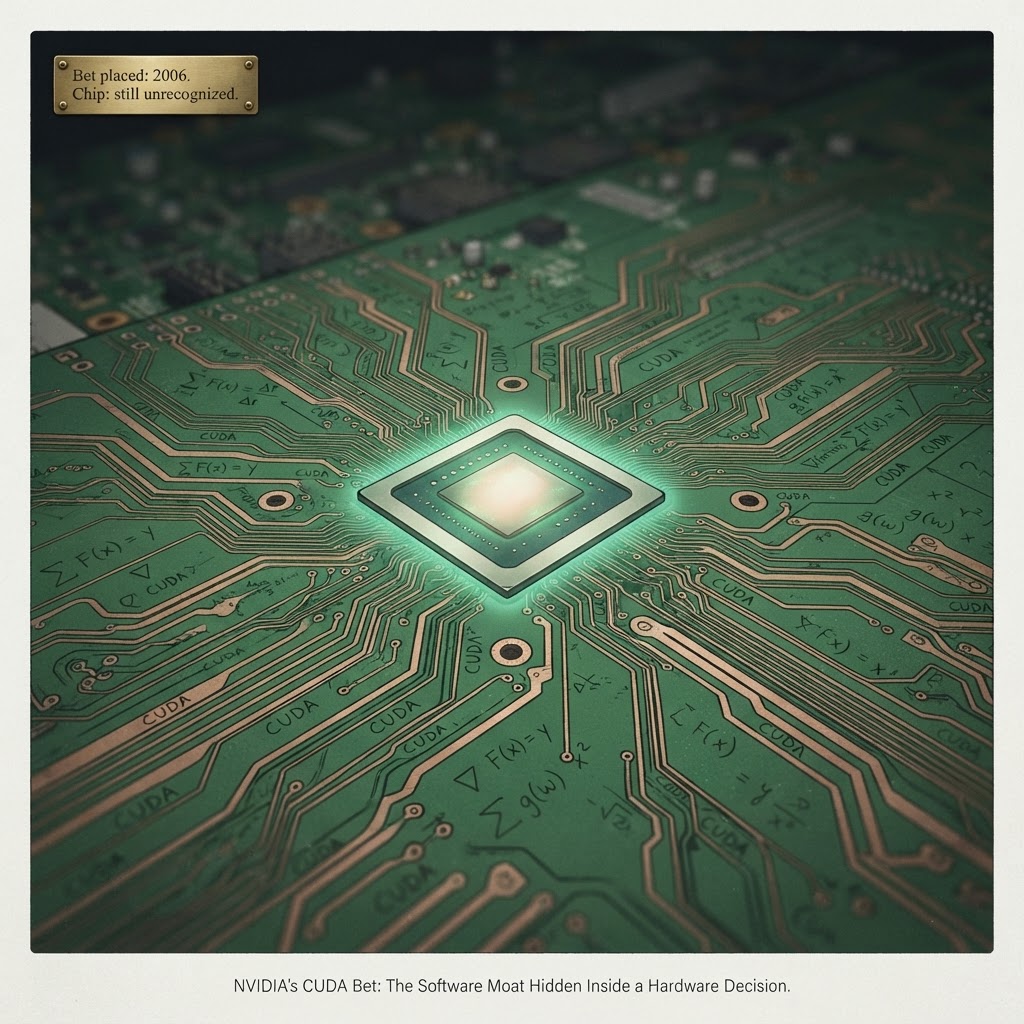
Almost no one wanted the thing Nvidia spent a decade building. That was the point — and the discipline most companies mistake for luck.
Pairs with the Bet-Sizing Worksheet — a ready-to-use strategy tool, filled for Nvidia. Included in the The Bet-the-Company Casebook →
In 2006, Nvidia made a decision that, by every near-term financial measure, was a mistake. It began baking expensive general-purpose computing capability into graphics chips whose customers — gamers — neither needed it nor would pay for it. It built a software platform, CUDA, to let programmers run ordinary code on those chips. 1 And then it waited. Not a quarter. Not a year. The better part of a decade, while the cost sat on the books and the payoff sat in the future. The lesson of Nvidia isn't that it saw the future. Plenty of people saw parallel computing coming. The lesson is that Nvidia was willing to look wrong for ten years — and could afford to. 3
The bet, stated plainly: not a press release but a recurring tax, paid quarter after quarter for a customer who hadn't shown up
A graphics chip is, underneath the pixels, a massively parallel calculator: thousands of small cores doing simple math at once. Jensen Huang's wager was that this architecture wasn't merely good for drawing triangles — it was good for any problem you could break into thousands of parallel pieces. The catch was brutal: in 2006, almost no commercially important problem looked like that. Scientific computing was a niche; machine learning was an academic backwater. So Nvidia was paying, every quarter, to solve a problem the market hadn't yet posed. The expense wasn't a one-time R&D line that analysts could look past. It was structural and recurring — every gaming GPU now carried silicon and software overhead for a non-gaming market that didn't exist, dragging gross margin in service of a customer who hadn't shown up. 3 Quarter after quarter, Nvidia chose worse economics today to own a market that might never arrive. That is the real texture of an existential bet: not a press release, but a decade of self-imposed tax.
The vindication nobody at Nvidia scheduled: the spark came from outside the company, and the market arrived all at once
The turn came from outside the company entirely, which is the part most retellings get wrong. In 2012, a neural network called AlexNet shattered an image-recognition benchmark — and it had been trained on Nvidia GPUs, largely because GPUs were the cheapest path to the massive parallel math the model required, and CUDA was already there, mature, waiting. 2 The market Nvidia had been quietly funding into existence suddenly existed, violently. Researchers piled in, then startups, then the largest companies on earth. By the 2020s, generative AI had turned Nvidia GPUs into the single scarcest resource in technology, and Nvidia crossed first a trillion and then several trillion dollars in value. 4
The interpretation: the moat is the years, not the chip: rivals can match the silicon but not retroactively make researchers spend a decade in your ecosystem
The lazy version of this story is 'Nvidia made fast chips at the right time.' The accurate version is more uncomfortable and far more useful: Nvidia's durable advantage is the switching cost of a decade of accumulated software. A rival can match the transistors — fast parallel silicon is hard but not impossible, and several well-funded competitors are making it. What a rival cannot do is retroactively make the world's AI researchers have spent ten years writing CUDA code, building CUDA libraries, and training students on CUDA. The hardware won the race; the software won the war, and the war is the part that compounds. Every new model written against CUDA deepens the moat for free.
This distinction matters because it changes what 'catching Nvidia' even means. Pundits who frame the contest as a chip-versus-chip benchmark are measuring the wrong layer. The contest is at the ecosystem layer, where Nvidia has a decade's head start that its rivals can only erode slowly, one painful porting effort at a time. That is why a competitor can ship a chip that benchmarks well and still struggle to win customers: the customer's real cost isn't the silicon, it's rewriting and re-validating years of work that already runs on CUDA.
The honest objection to all of this is luck. Wasn't Nvidia simply fortunate that a few researchers grabbed its gaming cards in 2012, and that generative AI happened to need exactly the kind of math GPUs do? Partly, yes — Nvidia did not invent deep learning and could not have scheduled AlexNet. But luck is the wrong frame, because luck is what you call preparation when you weren't the one who prepared. Nvidia had spent six years making sure that when any massively parallel problem became important, its hardware would be the cheapest, most available, best-documented way to attack it. It couldn't know the trigger would be image recognition rather than computational finance or physics simulation. It only had to be certain that some trigger would come, and to be the obvious destination when it did. That isn't a lottery ticket; it's building the only umbrella in town and waiting for rain you're confident will fall. The randomness was in the timing and the spark. The readiness was manufactured, deliberately, over a decade.
| Layer | Can a rival replicate it? | How long would it take? |
|---|---|---|
| The silicon (fast parallel chips) | Yes, eventually | A few product cycles |
| The CUDA software platform | Partially | Years of tooling and libraries |
| The trained developer base | No — it's already invested elsewhere | A generation of researchers |
| The library ecosystem built on CUDA | No — it compounds against newcomers | Grows faster than a rival can close it |
What separates a bet from a gamble: the difference is whether the waiting is spent compounding something durable or merely hoping
It's tempting to file Nvidia under 'visionary risk-taking' and move on. But that misreads the discipline involved, and it's worth being precise because the wrong lesson — 'make bold bets' — gets companies killed. A gamble bets on an outcome you cannot influence. A bet-the-company move invests, ahead of demand, in a capability you can build, so that when the market finally arrives you're the only one ready. The distinguishing feature isn't risk appetite; it's whether the waiting period is spent compounding something durable or merely hoping. Nvidia spent its decade building developer mind-share and an ecosystem — assets that grew more valuable the longer the payoff was delayed. And, crucially, it could afford the wait: a healthy gaming business funded the bet the entire time. An existential bet still needs a paying present to survive into its future.
Three conditions separate Nvidia's bet from a reckless one. First, invest in the layer rivals can't retroactively copy — for Nvidia, developer ecosystem, not silicon. Second, fund the wait from a profitable core, so 'looking wrong' never becomes 'going broke.' Third, recognize that vindication, when it comes, arrives vertically — so make sure your supply, not just your strategy, can scale the instant demand appears.
Nvidia's real achievement was temporal, not technical. The vision was shared; the conviction to hold it — through a decade of skeptical analysts and a non-existent market — was not. That patience, more than any single chip, is why a company once known for gaming graphics now sits at the center of the most important build-out in technology.
Bet-Sizing Worksheet
Most bets fail on size, not on direction — right call, ruinous stake. This worksheet forces the three numbers that matter: how much of the bankroll is on the table, how strong the conviction really is, and whether the worst case is survivable. Blank, it stops you betting the company on a hunch; filled, it reverse-engineers the story's wager so you can judge whether it was bold or reckless.
Included, filled and blank, in the The Bet-the-Company Casebook. See the set → · Preview the blank →
Sources
Where this comes from — the filings, records, and reporting behind it.
- 1Nvidia launched CUDA in 2006, making its GPUs programmable for general-purpose parallel computing beyond graphics; many observers were skeptical of the investment at the time.
- 2In 2012, AlexNet (Krizhevsky, Sutskever, Hinton, University of Toronto) won the ImageNet challenge, trained on two Nvidia GTX 580 GPUs via CUDA, cutting the error rate to ~15.3% from ~25-26% - making Nvidia GPUs the standard for training neural networks.
- 3Nvidia executives have said building compute into gaming cards made products more expensive and that it took roughly ten years before Wall Street believed the CUDA investment was worth anything (Bryan Catanzaro, VP of applied deep learning research).
- 4Nvidia was valued under $10 billion in 2012; it later crossed $1 trillion (2023) and then several trillion dollars in market value amid AI demand.
More like this — beyond Nvidia
New Strategically analyses as they publish: the defining moves in business, checked against the record. No noise, and one click to leave.