Pairs with the Cross-Subsidy Map — a ready-to-use strategy tool. Included in the The Cross-Subsidy Casebook →
In February 2026, a company with an annual revenue run rate above $350 million raised $16 billion and was valued at $126 billion.3 That company is Waymo. It runs more than 400,000 autonomous rides a week across six U.S. cities and delivered 15 million trips in a single year.8 By any operational measure, it is no longer a science experiment. By any financial measure, it still loses money the way a small country runs a deficit - and someone has to keep covering it.
The story being told is that Waymo has graduated. It now has a marquee outside-investor list - Andreessen Horowitz, Fidelity, Silver Lake, Sequoia - and a $126 billion price tag to prove the market believes.3 What that story quietly skips is who actually wrote most of the check, and what the parent's books look like underneath. Alphabet led the round as 'majority investor.'3 Waymo isn't graduating off Alphabet's balance sheet. It's being funded harder.
The losses aren't shrinking - they're at a record
Waymo lives inside Alphabet's 'Other Bets' segment, the line item where the moonshots go to be funded and to bleed. The comforting narrative is that this bucket has been getting cheaper - that Alphabet imposed discipline and the losses are tapering off. The filings say the opposite. Other Bets lost $6.08 billion in 2022, dipped to $4.10 billion in 2023, then climbed back to $4.44 billion in 2024 and jumped to $7.52 billion in 2025.5 That isn't a glide path to break-even. It's a U-turn, and the second leg is steeper than the first.
The dip to a $4.10 billion loss in 2023 is the number often cited by those who argue Other Bets is getting healthier. But in January 2023, Alphabet moved DeepMind out of Other Bets and into corporate costs, recasting prior periods.[[cite:s9]] So part of the 2023 'improvement' wasn't a moonshot getting cheaper - it was an expensive one being lifted out of the segment entirely. Compare 2022 to 2025 and the underlying trend is unambiguous: the bets are costing more, not less.
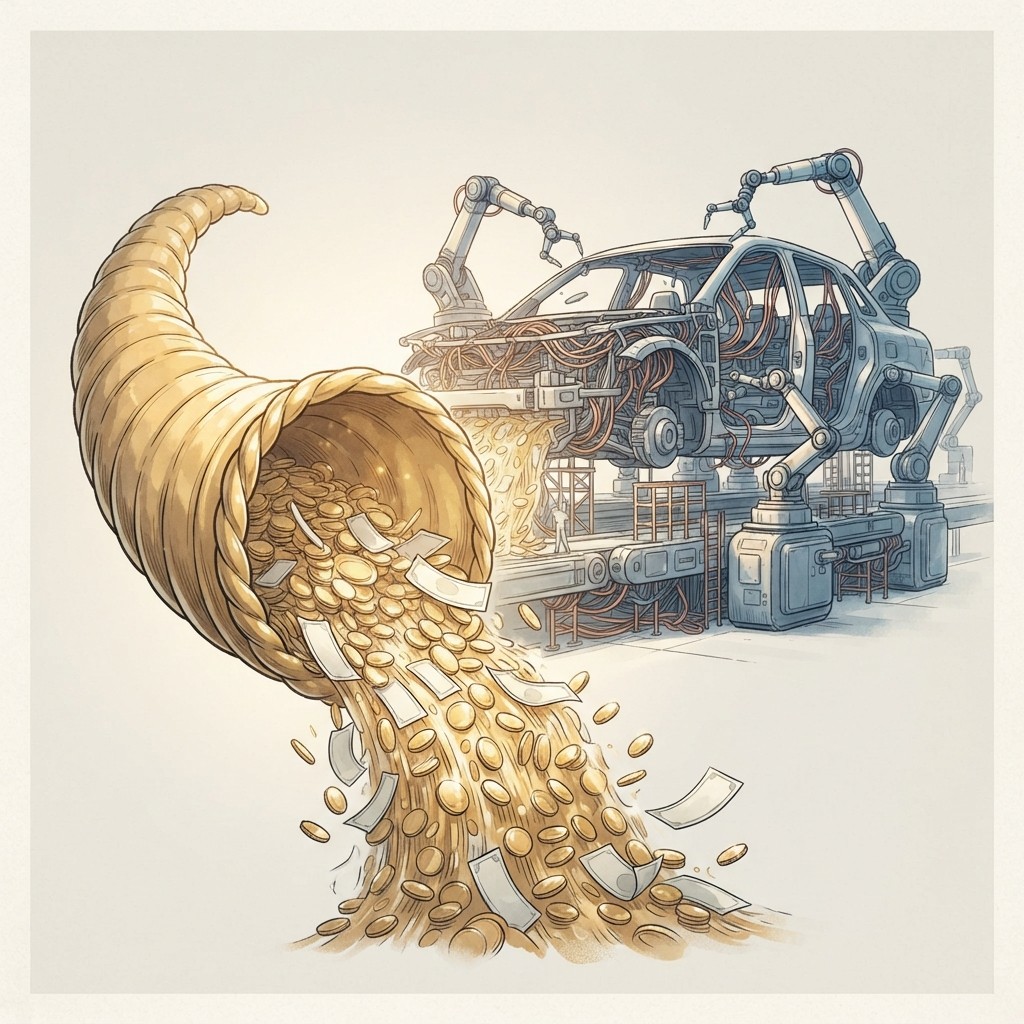
The mechanism here is older than Alphabet and has a name: cross-subsidy. One business throws off enormous, durable profit, and that profit is quietly diverted to fund a business that cannot yet pay for itself. Google's search-advertising engine is the cash cow; Other Bets is the pasture it pays for. Standard Oil did it across regions. Gillette's name became synonymous with it across the razor and the blade — even if historians have since noted the original loss-leader framing was more myth than fact.11 Alphabet does it across time - present profits buying a shot at a future industry. The elegance is that the loss-making side never has to face the market's verdict until it's ready, because the profitable side keeps the lights on indefinitely.
| What Waymo is worth | What Waymo earns / costs | |
|---|---|---|
| Headline number | $126B post-money valuation | Revenue run rate above ~$350M |
| Source | Waymo's own announcement | Press reporting, unnamed sources |
| 2025 segment result | — | Other Bets lost $7.52B |
| Who funds the gap | — | Alphabet, as majority investor |
A $126 billion valuation built on $350 million of revenue
Here is the gap that defines the whole bet. Waymo's revenue was reported at an annual run rate 'above $350 million' as of December 2025 - and even that figure comes from reporting that cites unnamed sources, not from any Alphabet filing.6 Against that, a $126 billion valuation.3 That is a price-to-revenue ratio that doesn't describe a business so much as describe a belief: that the rides will scale by orders of magnitude, that the cost per trip will collapse as the fleet and the software amortize, and that 400,000 rides a week becomes 4 million, then 40 million.8 The valuation isn't paying for the revenue. It's paying for the slope of the curve the revenue is on.
And that is exactly why the cross-subsidy can't relax. To justify $126 billion, Waymo has to grow into it - more cities, more vehicles, more sensors, more depots, more of everything that costs money before it makes money. The October-2024 era raise of $5.6 billion was already 'majority provided by Alphabet.'2 The February-2026 round is $16 billion.3 The check isn't getting smaller as Waymo matures. It's getting bigger, because maturing is the expensive part. The parent is funding acceleration, and acceleration burns more fuel than idling did.
“Other Bets: revenue of $400 million and an operating loss of $1.17 billion.”4
Isn't this just Alphabet placing a smart, affordable bet?
The fair objection is that none of this is a problem. Alphabet's core throws off so much cash that a few billion a year of Other Bets losses is rounding error - a cheap call option on owning autonomous transportation. And bringing in Andreessen Horowitz, Fidelity, Sequoia and the rest does something real: it puts an external, market-tested price on the asset, so Alphabet is no longer the only party deciding what Waymo is worth. That's a genuine graduation. The bet looks affordable because, relative to Google's profit engine, it is.
The honest counter is that 'affordable' is a statement about the parent, not the bet. The cross-subsidy is sustainable precisely as long as search advertising keeps minting money - and that engine now faces its own pressure as AI assistants reshape how people ask questions and where the answers come from. A cross-subsidy is only as durable as the cow. Strip away the parent's profit and Waymo's standalone economics are a $126 billion valuation sitting on roughly $350 million of revenue and billions in annual cash burn.65 The outside money validates the story but doesn't yet fund the gap - Alphabet still does. The bet pays off only if Waymo compresses that gap faster than the parent's ability, or willingness, to keep paying erodes.
A funding round and a high valuation feel like proof a venture has arrived. They aren't. They're a bet on a curve - the line where revenue rises to meet cost. Until that line crosses, an outside-investor round mostly re-prices the option; it doesn't pay the bills. The discipline is to watch two numbers, not one: the valuation everyone celebrates, and the operating loss nobody quotes. When a moonshot's revenue is growing slower than its losses are widening, a bigger round isn't graduation - it's the cross-subsidy getting deeper. The danger is mistaking the size of the check for the health of the business.
Waymo has done the hard, almost unimaginable thing: it built a real autonomous-driving business that moves real people, hundreds of thousands of times a week, and convinced the toughest investors on earth to price it at $126 billion. What it has not yet done is stop needing Google's ad money to do so. The $16 billion round isn't the moment the experiment paid for itself. It's the moment Alphabet decided the experiment was worth funding harder - a bigger bet, not a cheaper one. The genius of a cross-subsidy is that it can run for as long as the cow is healthy. The risk is the same sentence, read the other way.
When one business quietly pays for another
Cross-Subsidy Map
A map of the hidden plumbing inside a multi-line business: the cash-cow donor, the loss-making recipient it props up, and the strategic reason the subsidy exists. Use it to see who is really paying for what, and how exposed the whole structure is if the donor weakens. Blank to map your own portfolio's internal transfers; filled as the worked example of a business where one line secretly carries another.
Included, filled and blank, in the The Cross-Subsidy Casebook. See the set → · Preview the blank →
Sources
Where this comes from — the filings, records, and reporting behind it.
- 1Alphabet's Other Bets segment posted $1.648 billion in revenue and a $4.444 billion operating loss for full-year 2024, per the FY2024 10-K.
- 2Waymo, classified as a consolidated VIE within Other Bets, received $4.8 billion in funding in Q3 2024 and an additional $860 million in October 2024, for a total of $5.6 billion, with the majority provided by Alphabet.
- 3Waymo raised a $16 billion investment round in February 2026, valuing the company at $126 billion post-money; the round was led by Alphabet (described as the 'majority investor') alongside Andreessen Horowitz, Fidelity, Silver Lake, Tiger Global, T. Rowe Price, Dragoneer, DST Global, Sequoia, Kleiner Perkins, and GV.
- 4Alphabet's Q4 2024 earnings release, filed as Exhibit 99.1 to an 8-K, shows Other Bets Q4 2024 revenue of $400 million (vs. $657 million in Q4 2023) and an operating loss of $1.17 billion (vs. $863 million in Q4 2023).
- 5Other Bets segment operating losses by year from Alphabet 10-K filings: $5.28B (2021), $6.08B (2022), $4.10B (2023), $4.44B (2024), $7.52B (2025) — not a steadily declining trend.
- 6As of December 2025, Waymo had achieved an annual revenue run rate above $350 million, according to people familiar with the matter cited by Bloomberg-sourced reporting.
- 7Wolfe Research estimates Alphabet has invested approximately $30 billion in Waymo since inception; this is an analyst estimate, not a figure disclosed in Alphabet SEC filings.
- 8In 2025, Waymo delivered 15 million trips and provided more than 400,000 rides per week across six major U.S. metropolitan areas, according to Waymo's own blog post announcing the February 2026 funding round.
- 9DeepMind was moved out of Other Bets and into Alphabet corporate costs beginning January 2023, with prior periods recast — materially affecting year-over-year Other Bets financial comparisons.
- 10Google's search advertising share is projected to decline as AI-native challengers reshape how users find information, with AI-powered search tools capturing 12–15% of global search market share in 2025, up from roughly 5–6% at the start of the year.
- 11The Gillette razor-and-blade loss-leader narrative is historically contested: academic research shows Gillette maintained high razor prices throughout its patent years (1904–1921) and only adopted something closer to the cheap-handle strategy after patents expired.
More like this — beyond Alphabet (Google)
New Strategically analyses as they publish: the defining moves in business, checked against the record. No noise, and one click to leave.