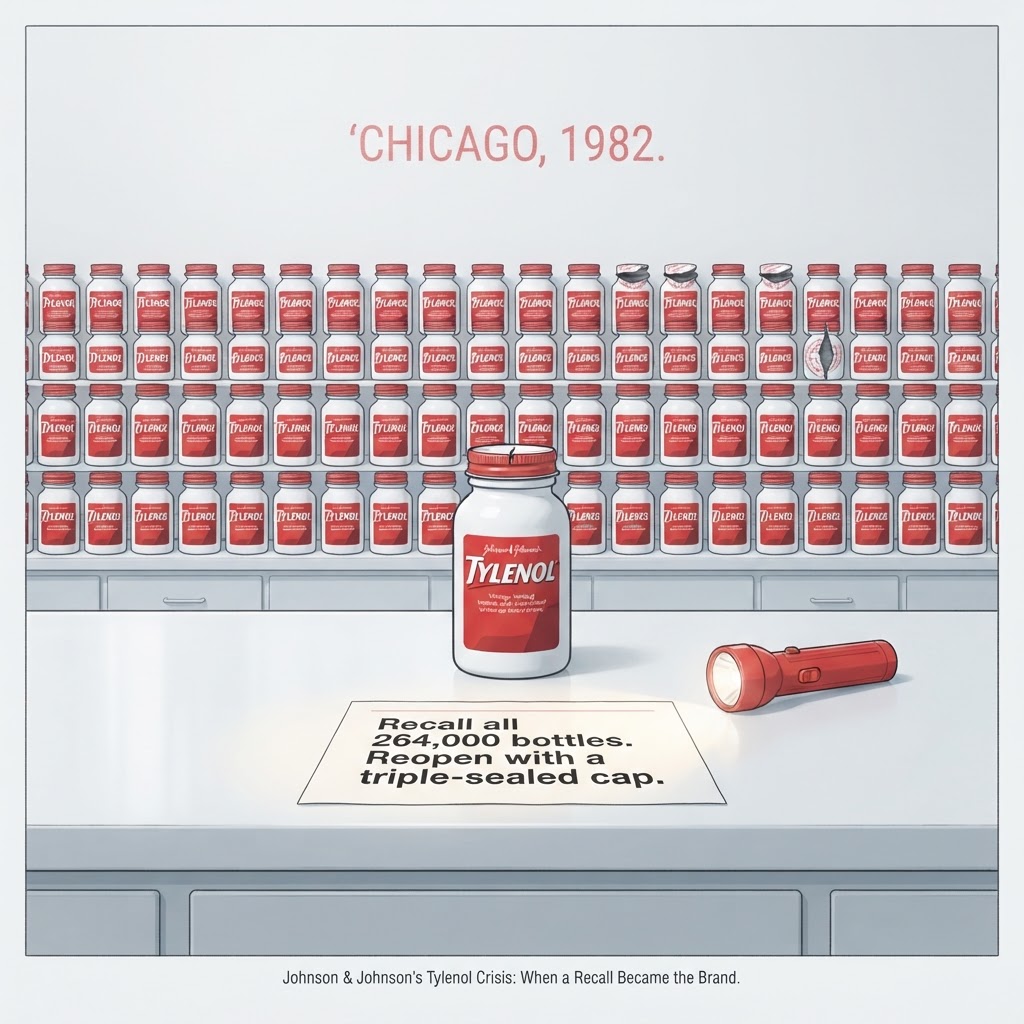
A trusted painkiller had become a murder weapon, and the company that made it had a clean legal escape. It refused to take it - and that refusal became the most studied decision in crisis management.
Pairs with the Crisis Response Playbook — a ready-to-use strategy tool, filled for Johnson & Johnson. Included in the The Crisis Response Casebook →
In the fall of 1982, seven people in the Chicago area died after swallowing Extra-Strength Tylenol capsules that someone had laced with cyanide.1 The terror was total: a trusted household painkiller had become a murder weapon, the poisonings were random, and no one knew how many more tampered bottles were out there. For Johnson & Johnson, the maker of Tylenol, it was the kind of crisis that ends brands. And here is the remarkable thing - J&J had a defensible escape route. The tampering had happened on store shelves, not in its factories; the company could credibly have argued it wasn't to blame and limited its response. It chose the opposite. It pulled roughly 31 million bottles from shelves nationwide, absorbed a loss of about $100 million, and told the public everything it knew.2 Four decades later, the Tylenol response is still taught as the gold standard of crisis management - and the reason it worked is the most counterintuitive lesson in the discipline: the most profitable response to a crisis is the one that refuses to think about profit.
What separates a crisis response from ordinary problem-solving: the crisis is a trust problem wearing a liability problem's clothes
A crisis response is what a company does in the compressed, high-stakes window when something has gone catastrophically wrong and the whole world is watching how it reacts. What makes it distinct from normal management is that the long-term outcome is determined less by the crisis itself than by the response to it - as one adviser to J&J put it, the company concluded it would be judged not on what caused the problem, but on how it responded.4 That single reframe is the entire discipline. In a crisis, the instinct of most organizations - and their lawyers - is to minimize liability: deny fault where possible, limit the recall to affected lots, control the narrative, protect the balance sheet. This instinct is precisely backwards, because it optimizes for the wrong thing. It treats the crisis as a legal and financial problem to be contained, when it is actually a trust problem to be resolved, and trust does not respond to careful liability management. It responds to evident, costly good faith.
Why spending $100 million was the cheap option: when you measure the right asset, the expensive choice is the bargain
The genius of J&J's response was recognizing that the $100 million recall, which looked like an enormous cost, was in fact the cheapest available option once you measured the right thing. The asset under threat wasn't a quarter's earnings; it was the trust of every consumer who had ever put a J&J product in their body or their child's. That trust was worth vastly more than $100 million, and it was evaporating by the hour. By recalling every bottle nationwide - not just the affected region, not just suspect lots, but all of it - J&J sent an unambiguous signal that it would spend whatever it took to protect the public, even from a threat it hadn't created.2 That signal was the product. A cautious, legally-optimized response would have saved money and destroyed the brand; the expensive, safety-first response spent money to save the only thing that actually mattered. The company also communicated relentlessly and openly - working with the press and authorities, warning the public, refusing to hide - because in a trust crisis, transparency is not a risk to be managed but the mechanism of repair. People forgive a company that is visibly, expensively on their side. They do not forgive one that appears to be protecting itself.
| The defensive instinct | J&J's response | |
|---|---|---|
| Frames the crisis as | A liability problem | A trust problem |
| Recall scope | Minimal - affected lots only | Total - 31M bottles nationwide |
| Communication | Controlled, cautious | Transparent, proactive |
| Optimizes for | Short-term cost | Long-term trust |
| Typical outcome | Saves money, loses the brand | Spends money, saves the brand |
The reinvention: turning the response into a comeback: fixing the vulnerability turns a defensive scramble into a leadership position
The final move is what elevates the Tylenol story from 'handled a crisis well' to 'wrote the playbook,' because J&J didn't just respond - it reinvented the product to make the crisis impossible to repeat. About 43 days after the first deaths, it reintroduced Tylenol in triple-sealed, tamper-resistant packaging, an innovation so sensible it became the industry standard and reshaped how every over-the-counter medicine and food product is sold to this day.3 This converted a defensive scramble into a leadership position: the company most associated with the poisonings became the company that made tampering far harder for everyone. The market rewarded it. Rather than dying - as many analysts predicted - the brand rebounded to its former strength within about a year, vindicating every dollar of the recall.3 The crisis that should have killed Tylenol instead became the foundation of its reputation for safety, which is the deepest paradox of great crisis response: handled correctly, the worst moment in a brand's history can become the source of its greatest trust.
Three principles carry over from 1982 to any crisis. First, frame it as a trust problem, not a liability problem - optimize for the relationship with the public, not the short-term cost, because the relationship is worth more than any recall. Second, over-respond visibly: a response that looks proportionate to your lawyers looks inadequate to a frightened public, and evident, costly good faith is what rebuilds trust. Third, fix the underlying vulnerability so the crisis can't recur, turning your response into a credible promise. The hardest part is acting before you have to - J&J wasn't legally required to recall everything, which is exactly why doing it meant so much.
The Tylenol response endures as the gold standard not because J&J was lucky, but because it understood a truth most companies discover only in hindsight: in a crisis, the company isn't really deciding how to handle a product problem. It's deciding, in front of everyone, what kind of company it is. J&J decided it was the kind that would spend $100 million it didn't legally owe to protect people it would never meet - and that decision, which looked like the expensive option, turned out to be the bargain of the century.
The crisis & reinvention set
Crisis Response Playbook
A playbook for a crisis already in motion: who decides, which plays fire on which trigger, and what gets said to whom. It replaces panic and the all-hands meeting with a pre-agreed sequence each person can run alone. Blank to pre-load before a crisis hits; filled as the worked example reconstructing the plays the story's team ran — and the ones they should have.
Included, filled and blank, in the The Crisis Response Casebook. See the set → · Preview the blank →
Sources
Where this comes from — the filings, records, and reporting behind it.
- 1In September-October 1982, seven people in the Chicago area died after taking Extra-Strength Tylenol capsules laced with cyanide; the tampering occurred after the product reached store shelves.
- 2Johnson & Johnson (via McNeil) recalled about 31 million bottles of Tylenol nationwide - then the largest such recall in U.S. history - at a retail value of roughly $100 million, prioritizing public safety over the financial loss.
- 3On November 11, 1982 (about 43 days after the first deaths), J&J reintroduced Tylenol in triple-sealed, tamper-resistant packaging; sales rebounded within about a year, and the response became a classic business-school case.
- 4An adviser to J&J at the time, Alan Hilburg, summarized the firm's stance: it concluded it would be judged not on what caused the problem but on how it responded.
More like this — beyond Johnson & Johnson
New Strategically analyses as they publish: the defining moves in business, checked against the record. No noise, and one click to leave.