Pairs with the Crisis Response Playbook — a ready-to-use strategy tool, filled for UBS. Included in the The Crisis Response Casebook →
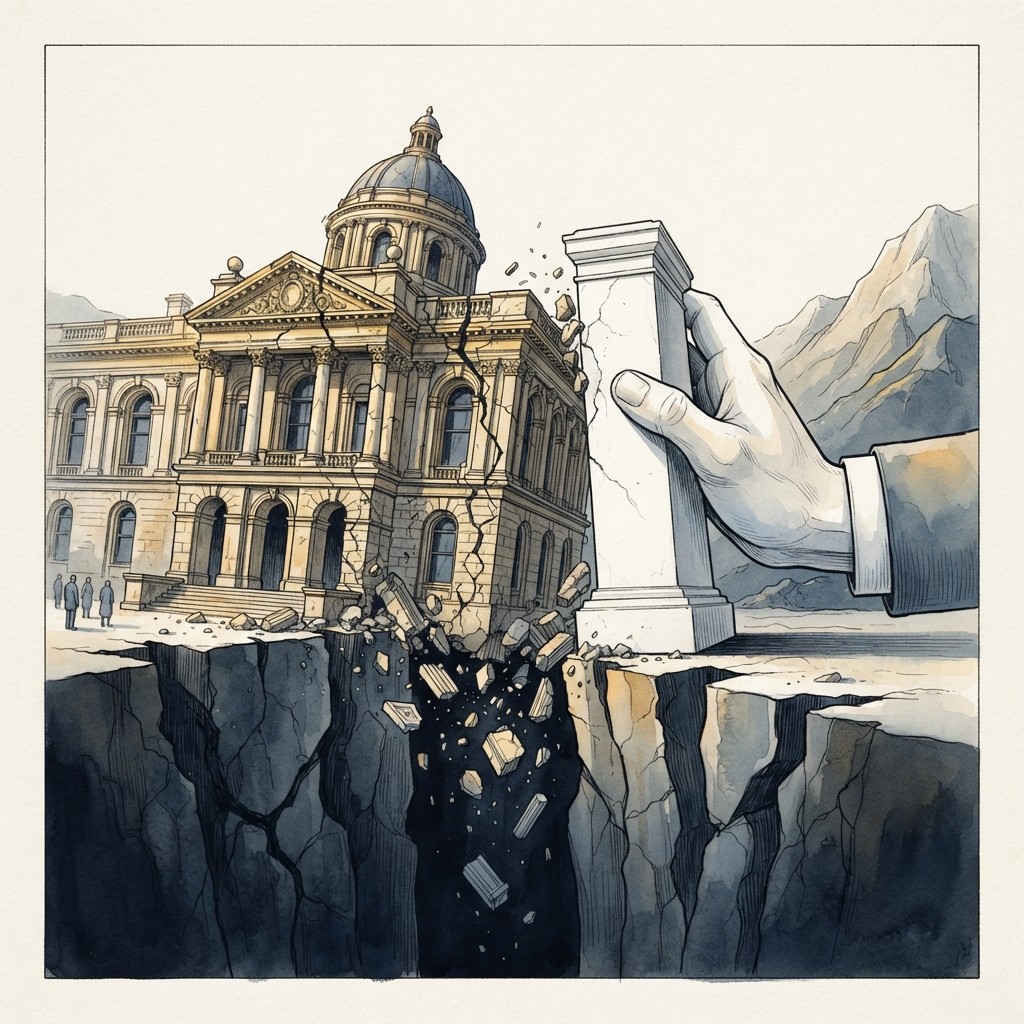
On the morning of October 16, 2008, the most important decision about the future of UBS was not made inside UBS. It was made by the Swiss Federal Council and the Swiss National Bank, who announced CHF 6 billion of state capital and a loan of roughly $54 billion to lift the bank's most poisonous securities off its books and into a special fund built for the occasion.1 The bank that is remembered as having weathered the storm did not, in any meaningful sense, weather it. A government caught it before it hit the ground.
The popular story is that UBS was a strong institution that took losses, restructured, and pulled through on the strength of its franchise. Almost every load-bearing word of that is wrong. By the time the rescue arrived, UBS's leadership had already been hollowed out, its losses ran past $45 billion, and the plan that saved it was not a UBS plan at all — it was a Swedish one, borrowed by the Swiss state and applied to a bank that could no longer save itself.6
The decapitation came first, the rescue came later
Resilience narratives need a captain at the wheel. UBS had emptied the bridge long before the wave hit. Group CEO Peter Wuffli left in July 2007 — replaced overnight by his deputy, Marcel Rohner — months before the world had a name for what was coming.5 Then, on April 1, 2008, UBS pre-announced a quarterly net loss of about CHF 12 billion and some $19 billion of writedowns on US real estate and structured credit, alongside a CHF 15 billion rights issue and the news that Chairman Marcel Ospel would not seek re-election. His successor was the bank's General Counsel, Peter Kurer.3 All of that happened in spring — six months before the October bailout. The official memory compresses these events into a single autumn crisis with management heroically at the helm. The record shows a board that had already changed its CEO and was changing its chairman while the building was still on fire.
“The fees we receive… Marcel Ospel will not stand for re-election; the Board proposes Peter Kurer as Chairman.”3
Strip away one more myth while we're here: UBS did not get rich making bad American loans. Its own SEC-filed legal brief states the bank originated only about $1.5 billion of more than $5 trillion in US residential mortgages between 2005 and 2007 — and originated no subprime loans at all.6 It did not poison the well. It bought the poisoned water by the tanker-load — warehousing other people's mortgage-backed securities and CDOs until they detonated on its balance sheet. The losses were not a manufacturing defect. They were a buying decision.
The state had the plan ready before UBS knew it needed one
Here is the detail that quietly demolishes the resilience story. The SNB did not improvise a rescue in October when UBS came begging. It began planning one in March 2008 — after Bear Stearns collapsed — while UBS was still insisting it could raise its own capital.2 By the time the bank actually needed saving, the saviour had been rehearsing for months. The structure they reached for was not Swiss genius; it was a Swedish import. Economic historian Tobias Straumann at the University of Zurich attributes the two-pronged design — government recapitalization plus a 'bad bank' to quarantine the toxic assets — directly to Sweden's banking crisis of the 1990s, a template Switzerland consciously copied.8 The mechanism that 'UBS used to survive' was an off-the-shelf state playbook the bank's own executives did not author and could not have executed.
| The remembered version | The record | |
|---|---|---|
| Who steered the survival | UBS management | Federal Council, SNB, the banking regulator |
| When the plan was made | October 2008, under pressure | Drafted from March 2008, after Bear Stearns |
| Whose design | UBS restructuring | Sweden's 1990s bad-bank model |
| The losses | About $38 billion | More than $45 billion |
| State role | A backstop UBS leaned on | The reason UBS still exists |
How a near-death turned into a profit — and a legend
The rescue worked by separation. The SNB stood up a stabilization fund, committed to fund it up to a ceiling of $60 billion, and covered 90% of each asset transfer with a loan while the fund itself put up 10% as equity.2 UBS handed over its worst paper; the state held it at arm's length until the panic passed and prices recovered. That recovery is the whole reason this episode gets misremembered. The StabFund absorbed $38.7 billion of UBS's toxic assets on the back of a $25.8 billion SNB loan, and as those distressed securities clawed back value, the SNB ended up with a $5.4 billion windfall — $1.6 billion of it pure interest. In October 2013, UBS bought the fund back for about $3.76 billion.7 SNB board member Thomas Jordan called the rescue 'both appropriate and absolutely necessary.'2 He was right on both counts — but 'necessary' is the operative word the legend forgets.
This is how a near-death becomes a triumph in the retelling. Because the StabFund eventually turned poison into profit, the rescue stopped looking like a rescue and started looking like a clever bet — and a clever bet implies someone clever made it. The mind reaches for the bank. But the profit accrued to the SNB, not to UBS, and the bet was the state's to place. The happy ending didn't prove UBS was strong. It proved the assets were merely illiquid, not worthless — which is precisely why a patient sovereign balance sheet could afford to wait when a panicked private one could not.
Wasn't surviving at all the proof of resilience?
The fair objection is that this reads as too neat — that plenty of banks got state help in 2008, and what distinguished UBS was that it absorbed a $45 billion gut-punch and kept its wealth-management franchise intact rather than being broken up or nationalized outright.6 There's truth in that. The bank did not vanish; it kept its core, paid the state back, and bought its own bad assets home five years later. But survival is not the same as self-rescue. UBS supplied the patient; Switzerland supplied the surgery, the operating theatre, and the plan — drawn up months in advance and copied from Stockholm. The honest version is not that UBS did nothing, but that its single most important act of resilience was being headquartered in a small, rich country whose central bank had decided, well before October, that this particular bank was too central to fail. That is a fact about Switzerland, not about UBS.
When a rescued company later thrives, the survival narrative almost always migrates to the company — because a happy ending wants a protagonist. The test for whether that narrative is real is simple: follow the upside. If the patient profited from its own recovery, call it resilience. If the rescuer did — here, a $5.4 billion windfall that landed at the SNB, not UBS — then the story you're being told about institutional strength is really a story about sovereign capacity, relabeled. The eventual profit doesn't validate the bank. It launders the bailout.
UBS is held up as a case study in how a great bank endures a crisis. It is actually a case study in something more uncomfortable: how a state with a ready plan, a deep balance sheet, and a stake in a single institution's survival can catch a falling giant — and then watch the giant take the credit. The formula was good. The recapitalization, the quarantined bad bank, the patient hold until prices healed: textbook, because it was literally a textbook, written in Sweden a decade earlier. What UBS contributed to its own survival was the one thing no strategy memo lists: a home. The most expensive lesson of 2008 wasn't that strong banks endure. It was that a bank's deepest moat can be the country it happens to stand in.
Crisis Response Playbook
A playbook for a crisis already in motion: who decides, which plays fire on which trigger, and what gets said to whom. It replaces panic and the all-hands meeting with a pre-agreed sequence each person can run alone. Blank to pre-load before a crisis hits; filled as the worked example reconstructing the plays the story's team ran — and the ones they should have.
Included, filled and blank, in the The Crisis Response Casebook. See the set → · Preview the blank →
Sources
Where this comes from — the filings, records, and reporting behind it.
- 1On October 16, 2008, the Swiss Federal Council and SNB announced CHF 6 billion in state capital and approximately USD 54 billion (SNB loan) to transfer UBS's illiquid securities into a special stability fund (StabFund).
- 2The SNB committed to fund StabFund up to USD 60 billion (ceiling); it covered 90% of each asset transfer via loan and 10% as StabFund equity. The rescue was deemed 'both appropriate and absolutely necessary' by SNB board member Thomas Jordan. The SNB began planning the rescue after Bear Stearns collapsed in March 2008.
- 3UBS Q1 2008 pre-announcement: net loss of approximately CHF 12 billion; writedowns and losses of approximately USD 19 billion on US real estate and related structured credit positions; CHF 15 billion rights issue announced; Marcel Ospel not to seek re-election, to be succeeded by Peter Kurer.
- 4UBS published an April 18, 2008 shareholder report summarizing causes of losses in the US subprime residential mortgage sector through December 31, 2007, submitted first to the Swiss Federal Banking Commission.
- 5Peter Wuffli (Group CEO) left UBS effective July 6, 2007, replaced immediately by Marcel Rohner (his deputy). Marcel Ospel remained Chairman.
- 6UBS's own SEC-filed legal brief states the bank lost more than USD 45 billion when the housing market collapsed, and that it originated only USD 1.5 billion of more than USD 5 trillion in US residential mortgages 2005–2007 and originated no subprime loans.
- 7The StabFund absorbed $38.7 billion of UBS toxic assets, underpinned by a $25.8 billion SNB loan. The SNB ultimately realized a $5.4 billion total windfall including $1.6 billion in interest. UBS repurchased the StabFund in October 2013 for approximately USD 3.762 billion.
- 8The Swedish 1990s banking crisis — a two-pronged model of government recapitalization plus bad-bank asset separation — was the explicit template Switzerland used for the UBS bailout, per economic historian Tobias Straumann, University of Zurich.
More like this — beyond UBS
New Strategically analyses as they publish: the defining moves in business, checked against the record. No noise, and one click to leave.