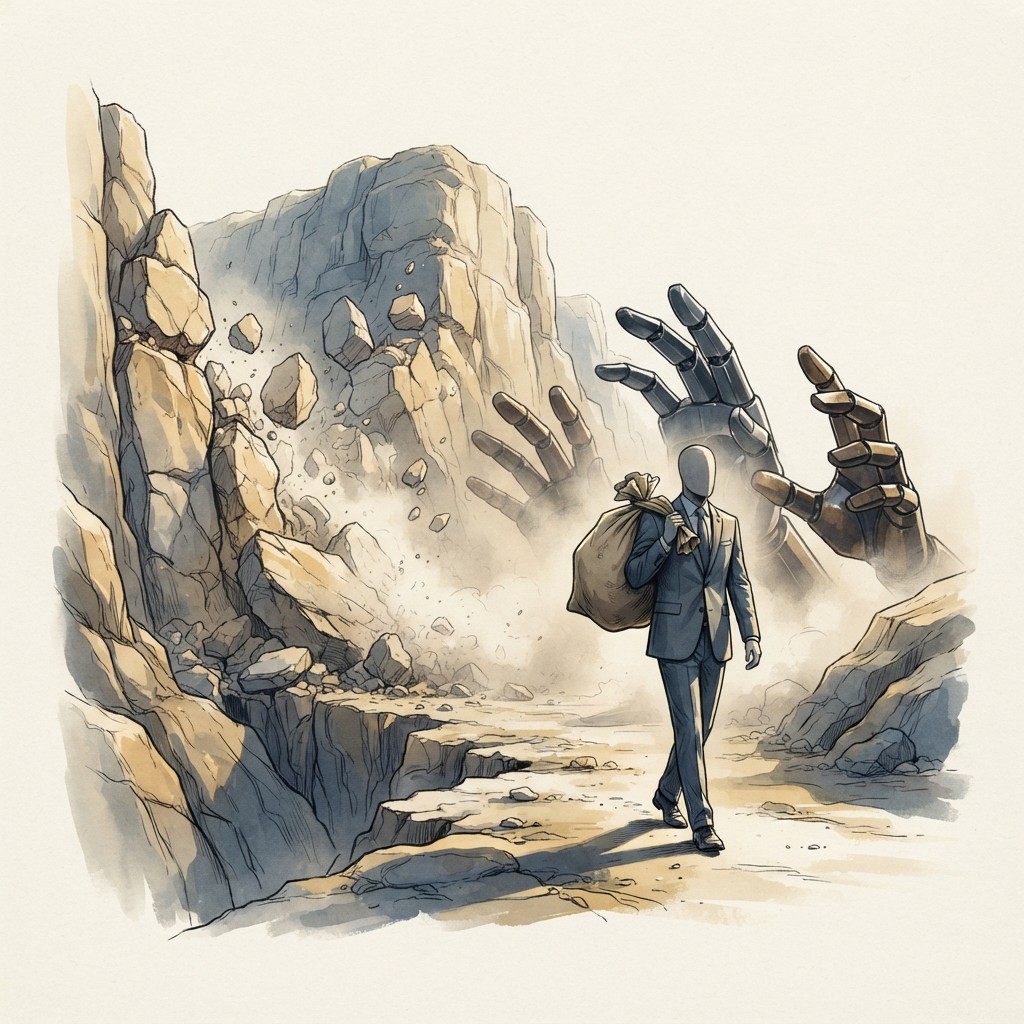
Pairs with the Crisis Response Playbook — a ready-to-use strategy tool, filled for Rio Tinto. Included in the Crisis Response Casebook →
“What is one more quarter of not acting worth?”
On 24 May 2020, Rio Tinto set off a blast in the Pilbara that erased two rock shelters at Juukan Gorge — a site holding evidence of continuous human occupation for more than 46,000 years, among the most significant archaeological places in Australia — to reach the iron ore beneath them.1 Three days later the company issued its first statement. It did not apologise for destroying the caves. It expressed regret that the traditional owners' 'recently expressed concerns' had not come up earlier in discussions.8 That single phrase — recently expressed — is the whole crisis in miniature, because the people it described had been telling Rio the place was sacred for years.
The story that calcified afterward is a redemption arc: a great company made a terrible error, faced the music, and held its leaders to account by removing the CEO and two top executives. It is a clean narrative. It is also wrong at almost every joint. Rio's crisis response wasn't accountability. It was the choreography of accountability, performed only after the people who actually pay the bills demanded a show.
The thesis: investors fired the executives, the board didn't
Here is the plain version a smart friend could repeat at dinner: Rio Tinto did not punish its executives for blowing up Juukan Gorge — it punished its bonus pool, and only swapped that for departures when shareholders said the bonus haircut wasn't enough. The sequence is the proof. In August 2020 the board's review stripped performance bonuses from the three responsible executives but pointedly did not call for them to resign.4 That was the company's preferred outcome: dock the variable pay, keep the team. It held for exactly three weeks.
Then, on 11 September, the three stepped down — and Rio's own filing tells you why, in language no spin doctor would choose voluntarily. The departures came after 'significant stakeholders expressed concerns about executive accountability.'3 In other words, the company tried the bonus cut, the big investors rejected it as insufficient, and only then did the heads roll. The board did not lead the reckoning. It was dragged into one.
“...by mutual agreement... significant stakeholders expressed concerns about executive accountability.”3
Notice the two words doing quiet work: mutual agreement. Not dismissed. Not terminated for cause. Departed by mutual agreement — and the CEO, Jean-Sébastien Jacques, was permitted to keep running the company until a successor was found, no later than 31 March 2021.3 A man held responsible for the company's defining disaster was allowed to stay at the controls for up to six more months. That is not how a firing works. That is how a managed exit works.
The year he was ousted, he was paid the most he ever earned
The pay record finishes the demolition. In 2020 — the year of the blast, the inquiry, and the exit — Jacques received about £13.3 million in total pay and long-term incentive rewards, the highest of his entire tenure, driven by a surge in the value of shares awarded back in 2016.5 Yes, he was denied a performance bonus of roughly £2.7 million as a direct consequence of Juukan Gorge. But he retained unvested long-term incentive awards estimated at around £27 million.5 Set those numbers side by side and the proportion is the point: the company surrendered the £2.7 million it could spare for headlines and quietly protected the £27 million that actually mattered.
| The penalty | The retention | |
|---|---|---|
| The visible number | ~£2.7m bonus forfeited | ~£27m in long-term incentive awards kept |
| 2020 total pay | — | ~£13.3m, the highest of his tenure |
| Nature of exit | — | 'By mutual agreement,' allowed to stay until ~March 2021 |
| Who forced it | The board (bonus cut) | Stakeholders, after the bonus cut was deemed insufficient |
When the 2021 AGM came, shareholders said what they thought of all this without ambiguity. Both the Rio Tinto plc and Rio Tinto Limited remuneration reports were rejected by more than 60% of the vote.5 A remuneration report is non-binding — but a 60% rejection is a verdict. The owners of the company looked at the gap between the punishment and the pay and called it what it was.
The investigation that investigated around the problem
The board review was sold as the company looking hard at itself. It was led by Michael L'Estrange — a Rio Tinto non-executive director, not an outside party.4 The review found 'numerous decisions, actions and omissions over an extended period' and, tellingly, declined to attribute blame to any single individual.4 Diffuse the fault across a system and across a decade, and no one face has to carry it. That is the structural genius of the internal review, and also its tell.
The parliamentary inquiry that followed was not so generous. Its final report concluded that Rio's internal review 'did not fully grapple with the root causes of the Juukan Gorge debacle and its effects.'7 And it surfaced the number that reframes everything: at the time of the hearings, Rio held 1,780 further approvals to destroy Aboriginal heritage sites across the Pilbara.7 Juukan Gorge wasn't a freak accident in an otherwise careful system. It was one detonation in a pipeline of nearly two thousand more, all legally cleared, all waiting.
The choice that was never offered
Here is the mechanism beneath the public relations — the why behind the why. The blast was entirely legal. Rio held a ministerial consent granted in 2013 under Western Australia's Aboriginal Heritage Act 1972, and the Act had no mechanism to reverse that consent even after fresh archaeological work in 2014 confirmed the site's exceptional significance.2 So Rio broke no law. What it broke was the trust of the people whose heritage it was — and it did so by managing what they were allowed to see. The CEO himself testified that four expansion options had been studied in 2012–2013, three of which would have preserved the caves. Only the destructive one was put in front of the traditional owners at the relevant 2013 meeting.6
And the owners couldn't have fought it anyway. Their land-use agreement with Rio contained a clause preventing them from opposing the ministerial application — a contractual gag built years before the blast.6 This is why the crisis response could be so cosmetic: the problem was never one bad blast that better PR could heal. It was a decision architecture that withheld the saving alternatives, then bound the only objectors to silence. A board review run by an insider was never going to grapple with that, because that was the company.
But didn't three executives and the chairman actually leave?
The fair objection is that real consequences did land. The CEO, the head of iron ore, and the corporate relations chief all went. The chairman, Simon Thompson, later resigned in March 2021 citing ultimate accountability.8 Compared with the corporate norm — a press release, a 'lessons learned,' and business as usual — that is meaningful turnover, and it would be cynical to wave it away as pure theatre.
Two facts blunt the defense. First, the consequences were reactive: every one of them followed pressure, not conscience. The board's first instinct was to keep the team; departures came only after investors forced the issue. Second, the consequences were softened on the way out — the managed exit, the protected £27 million, the highest pay of the CEO's tenure delivered the same year. Accountability that arrives only when owners demand it, and that quietly preserves the money while sacrificing the title, is a different species from accountability freely given. It is the appearance of a price, paid in the currency that costs least.
Every crisis response sheds something visible — a bonus, a title, a press conference of regret. The signal isn't what leaves; it's what's quietly kept. Rio shed a £2.7m bonus and three job titles while protecting ~£27m in incentive awards and an internal review that named no one. So when you read a company's response to disaster, run two tests. Did the consequences come from conviction or from coercion — would they have happened without investors, regulators, or cameras forcing them? And of everything at stake, what was actually surrendered versus merely displayed? The cheapest thing to give up in a scandal is the thing that makes the best headline. The expensive thing usually survives intact.
Rio Tinto destroyed something 46,000 years in the making, and then performed a crisis response so fluent that much of the world filed it under 'accountability' and moved on. But the company's own documents tell the truer story: a non-apology, a bonus cut offered in place of resignations, departures forced by shareholders, a managed exit, the richest paycheck of a CEO's career in his final year, and an internal review the inquiry said missed the root cause. The blast was legal. The cover was thorough. The one thing Rio never managed to manufacture was the only thing the moment required — and you cannot focus-group your way to accountability you were dragged into.
When the response becomes the story
Crisis Response Playbook
A playbook for a crisis already in motion: who decides, which plays fire on which trigger, and what gets said to whom. It replaces panic and the all-hands meeting with a pre-agreed sequence each person can run alone. Blank to pre-load before a crisis hits; filled as the worked example reconstructing the plays the story's team ran — and the ones they should have.
Included, filled and blank, in the Crisis Response Casebook. See the set → · Preview the blank →
Sources
Where this comes from — the filings, records, and reporting behind it.
- 1Rio Tinto destroyed two ancient rock shelters at Juukan Gorge on 24 May 2020 to expand its Brockman 4 iron ore mine; the site showed evidence of continuous human occupation for over 46,000 years and was of the highest archaeological significance in Australia.
- 2Rio Tinto received ministerial consent to destroy the Juukan Gorge caves in 2013 under Western Australia's Aboriginal Heritage Act 1972; the Act contained no mechanism to reverse or amend the decision even after new archaeological information emerged in 2014 confirming the site's exceptional significance.
- 3Rio Tinto CEO Jacques, Iron Ore head Salisbury, and Corporate Relations head Niven stepped down 'by mutual agreement' on 11 September 2020, following the 24 August 2020 board review, after 'significant stakeholders expressed concerns about executive accountability'; Jacques was permitted to remain until a successor was found or 31 March 2021, whichever was earlier.
- 4The board review, led by Rio Tinto non-executive director Michael L'Estrange (not an external party), found 'numerous decisions, actions and omissions over an extended period,' did not attribute blame to a single individual, and recommended systemic governance changes; it also stripped performance bonuses from the three executives but initially did not call for their resignation.
- 5CEO Jacques received £13.3 million (approximately $18.6 million) in total pay and long-term incentive rewards in 2020 — the highest of his tenure — driven by a surge in the value of unvested shares awarded in 2016; he was denied a ~£2.7 million performance bonus as a consequence of Juukan Gorge, but retained long-term incentive awards estimated at ~£27 million. Both Rio Tinto plc and Rio Tinto Limited remuneration reports were rejected by more than 60% of votes at the 2021 AGM.
- 6CEO Jacques testified to the parliamentary inquiry that four mine expansion options were reviewed in 2012–2013, three of which would have preserved the Juukan caves, but only one option — the destructive one — was presented to PKKP at the relevant 2013 meeting. The PKKP's land-use agreement with Rio also contained a clause contractually preventing them from opposing the Section 18 application.
- 7The parliamentary inquiry's final report concluded that Rio Tinto's internal board review 'did not fully grapple with the root causes of the Juukan Gorge debacle and its effects'; the inquiry also found that Rio held 1,780 further approvals to destroy Aboriginal heritage sites in the Pilbara at the time of the hearings.
- 8Rio Tinto's first public statement after the May 24 blast (issued May 27) apologised only that PKKP's 'recently expressed concerns' had not arisen during discussions; PKKP publicly rejected that characterization on June 5, saying the significance of Juukan Gorge had long been emphasised to the company. Rio's board chair Simon Thompson later resigned in March 2021, citing ultimate accountability.
Weighing outside help with a decision like this? Hiring a supply chain strategy consultant
More like this — beyond Rio Tinto
New Strategically analyses as they publish: the defining moves in business, checked against the record. No noise, and one click to leave.