Pairs with the Crisis Response Playbook — a ready-to-use strategy tool, filled for JPMorgan Chase. Included in the Crisis Response Casebook →
“What is one more quarter of not acting worth?”
On a Friday in March 2008, Bear Stearns told the Federal Reserve it could not meet its obligations the next morning.3 By Sunday it had a buyer. The headline that hardened into legend was a single number: JPMorgan bought a Wall Street institution—one whose stock had traded at $172 a little over a year earlier—for $2 a share.19 It is one of the most quoted figures in the history of the crisis, and almost everything it implies is wrong. Dimon didn't lowball Bear. He didn't set the price. And eight days later he agreed to pay five times more.
The official story is that Jamie Dimon was the crisis's coolest operator, swooping in to scoop up distressed empires at fire-sale prices. The truer story is that the government carried him to the table, set the floor on what he paid, built a vehicle to absorb the assets he didn't want, and then watched a decade of legal liability land on his balance sheet for sins committed before he ever owned the buildings.
“The $2, quite frankly, the government decided.”9
The $2 was a leash, not a bargain
The thing to understand about that $2 is that it was never really JPMorgan's number. Bear's own chief executive said the figure came from regulators, and that the two banks had been discussing a higher price before the government intervened to set the floor.9 The math behind the legend is also softer than it sounds: Bear had already collapsed from $172 in early 2007 to roughly $30 in the days before the deal—it had lost the overwhelming majority of its value before anyone from JPMorgan walked in.9 The $2 wasn't the price of a healthy company stolen cheap. It was the price of a corpse, set deliberately low so that nobody could call the rescue a reward for failure. Then it didn't even hold. By March 24, the merger had been amended to about $10 a share, and JPMorgan bought 95 million newly issued Bear shares at that same price to lock the deal down.2 The bold $2 acquisition quintupled inside a week, because the original price had been a political instrument, not a valuation.
| Jan 2007 | Before the deal weekend | March 16, 2008 | March 24, 2008 | |
|---|---|---|---|---|
| Price per share | $172 | ~$30 | ~$2 | ~$10 |
| What it reflected | Peak | Already-failed firm | Government-set floor | Renegotiated terms |
| Who set it | The market | The market | Fed/Treasury negotiators | JPMorgan and Bear |
Even the assets came with a government parachute
Here is the detail the legend never includes. JPMorgan did not actually want Bear's mortgage portfolio—the toxic core of why Bear was dying. So the New York Fed built a special-purpose vehicle, Maiden Lane LLC, to take roughly $30 billion of those assets off the table. The funding tells you exactly who was carrying whom: a $29 billion senior loan came from the Fed, and a $1 billion subordinated loan came from JPMorgan—and that JPMorgan tranche bore losses first.4 That structure is the whole 2008 story in miniature. The Fed put up 97% of the money to absorb the assets, and JPMorgan put up a thin slice that stood in front of the Fed's slice when losses arrived. It was a rescue dressed as a deal. JPMorgan wasn't the predator; it was the only buyer the government could find, and it had to be coaxed in with a structure that quarantined the worst of what it was buying.
WaMu wasn't a negotiation. It was an auction at a wake.
Six months later the pattern repeated with the other famous trophy. JPMorgan is often described as having shrewdly bought Washington Mutual for $1.9 billion. But there was no negotiation with WaMu's management, because by September 25, 2008 there was nothing left to negotiate with. WaMu's banking operations had been seized; JPMorgan acquired the deposits, assets, and certain liabilities from the FDIC out of receivership.5 And the structure cut the same way Bear's had: WaMu's holding company, its senior and subordinated creditors, and its preferred stock were explicitly excluded and left to fend for themselves.5 What JPMorgan bought was the clean half—5,400 branches across 23 states and a deposit base that would make it the nation's second-largest branch network, expected to add more than fifty cents a share to 2009 earnings.5 The government, again, did the hard part: it killed the patient first, then sold JPMorgan the organs it wanted. This is what crisis acquisitions actually look like—not a bold raider, but a regulator clearing a body and a single buyer taking delivery.
The trophies came with the previous owner's crimes
And then the deals kept charging. In November 2013, JPMorgan signed a $13 billion settlement—at the time the largest the U.S. government had ever reached with a single entity—resolving civil claims over mortgage-backed securities packaged and sold by JPMorgan, Bear Stearns, and Washington Mutual before 2009.610 The cruel part for JPMorgan was the allocation. The conduct being punished was overwhelmingly the previous owners': its CFO noted JPMorgan typically accounted for 20% or less of the losses on the securities at issue, and Dimon said the bank never anticipated paying for Bear Stearns's prior losses at all.7 Stretch the lens out and the whole crisis-era legal tab exceeded $19 billion, with Dimon's 2015 shareholder letter putting about 70% of it on Bear and WaMu conduct that predated the acquisitions.8 When you buy a firm out of a fire, you buy the fire's history too—and history files lawsuits.
But surely a giant bank for $1.9 billion is still a steal?
The fair objection is that this reads too cynically—that JPMorgan still ended up with a national branch network, a deposit base, and a seat at the center of American banking that it could not have built organically for any price. That's real, and it's why the deals weren't a mistake. But it misses what JPMorgan itself concluded. The man who made the call is on record refusing to make it again: Dimon said he would not do a Bear Stearns-type deal, and that he doubted his board would even let him take the phone call.8 That is not the voice of someone who thinks he stole two empires for pocket change. It is the verdict of someone who learned that the sticker price was the smallest number in the deal—that the real cost arrived years later, in legal envelopes, for conduct he never authorized. The acquisitions were strategically sound and financially punishing at the same time. Both things are true, and only one of them made the headlines.
Distressed deals look cheap because the headline price is just the down payment. The real consideration is everything that travels with the asset: the litigation, the regulatory tail, the obligations the seller's history will eventually invoice you for. JPMorgan paid roughly $10 a share for Bear and $1.9 billion for WaMu, then paid more than $19 billion in legal costs—most of it for sins committed before the deals closed. So before you 'win' a fire sale, price the fire, not just the building. And ask the question Dimon learned to ask: who set this price, and what are they trying to get rid of? If a regulator is handing you the bargain, the bargain has a reason—and the reason is the part you're actually buying.
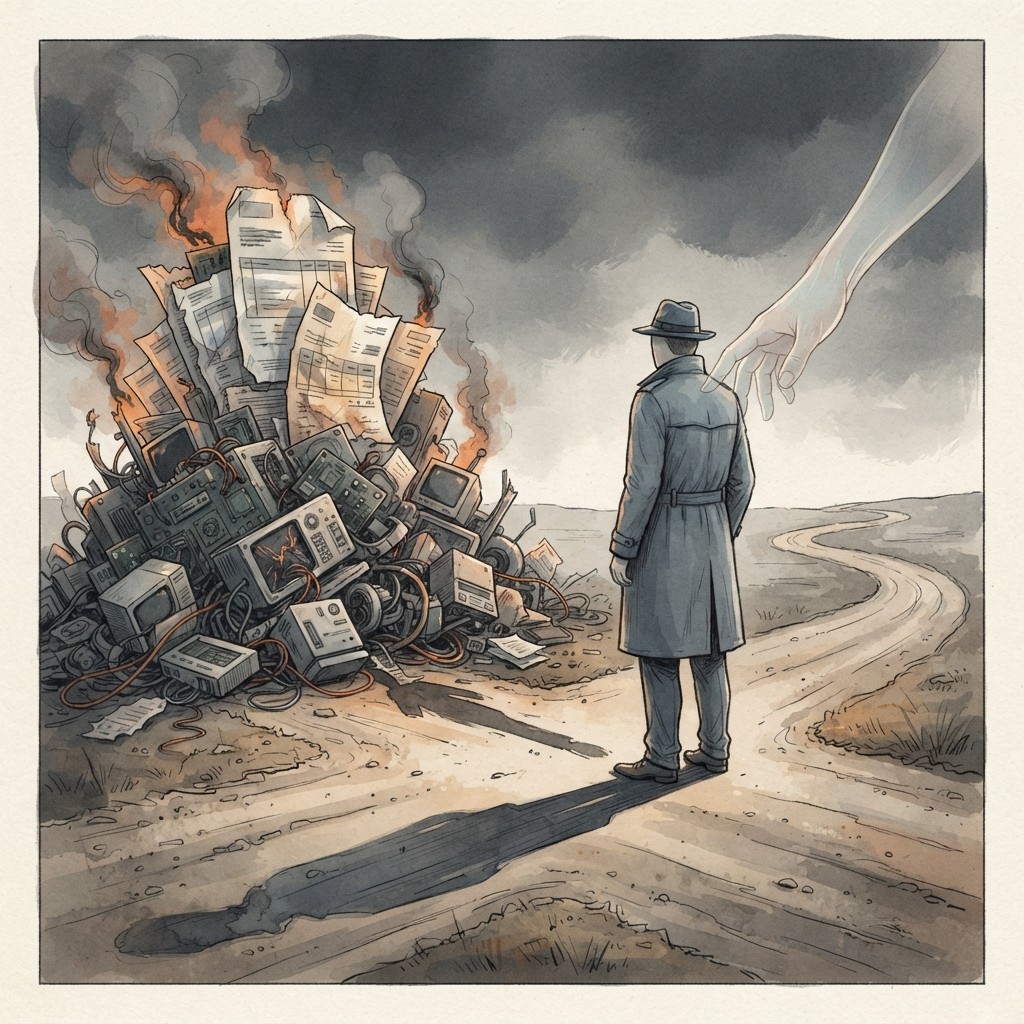
JPMorgan's 2008 is remembered as the story of the bank that played the crisis better than anyone. The accurate version is quieter and stranger: a bank that the government walked to a price it didn't set, propped up with a vehicle to hold the assets it feared, handed two institutions whose worst conduct it would spend a decade paying for—and that, given the chance to do it all again at the same prices, said no. The lesson isn't that Dimon was brilliant or that he was used. It's that in a true crisis there are no clean trophies. There are only bodies, and the only buyer in the room inherits everything the body did before it died.
When the deal of the decade comes with a catch
Crisis Response Playbook
A playbook for a crisis already in motion: who decides, which plays fire on which trigger, and what gets said to whom. It replaces panic and the all-hands meeting with a pre-agreed sequence each person can run alone. Blank to pre-load before a crisis hits; filled as the worked example reconstructing the plays the story's team ran — and the ones they should have.
Included, filled and blank, in the Crisis Response Casebook. See the set → · Preview the blank →
Sources
Where this comes from — the filings, records, and reporting behind it.
- 1On March 16, 2008, JPMorgan Chase announced it would acquire Bear Stearns at an exchange ratio of 0.05473 JPM shares per BSC share, equating to approximately $2 per share based on the March 15 closing price, with both boards unanimously approving.
- 2On March 24, 2008, JPMorgan Chase and Bear Stearns announced an amended merger at 0.21753 JPM shares per BSC share—up from 0.05473—reflecting approximately $10 per share, and JPMorgan purchased 95 million newly issued Bear shares (39.5% of post-issuance shares outstanding) at that same price.
- 3On March 14, 2008, the Federal Reserve Board authorized the FRBNY to extend a bridge loan of $12.9 billion to Bear Stearns through JPMorgan Chase Bank N.A., secured by $13.8 billion in Bear assets, under Section 13(3) of the Federal Reserve Act. Bear had notified the Fed on March 13 that it could not meet obligations the following day.
- 4Maiden Lane LLC purchased approximately $30 billion in Bear Stearns assets using a $29 billion senior loan from the FRBNY and a $1 billion subordinated loan from JPMorgan Chase, with JPMorgan's tranche bearing losses first. The FRBNY created the LLC to facilitate JPMorgan's acquisition of Bear Stearns after JPMorgan expressed concern about absorbing Bear's mortgage portfolio.
- 5On September 25, 2008, JPMorgan Chase acquired all deposits, assets, and certain liabilities of Washington Mutual's banking operations from the FDIC for approximately $1.9 billion; the holding company's senior/subordinated debt and preferred stock were explicitly excluded. The acquisition was expected to add more than $0.50 per share to JPMorgan earnings in 2009 and create the nation's second-largest branch network with 5,400 branches in 23 states.
- 6On November 19, 2013, JPMorgan Chase reached a $13 billion settlement—the largest with a single entity in U.S. history at that time—with the DOJ, state AGs, FDIC, NCUA, and FHFA, resolving civil claims arising from RMBS activities by JPMorgan, Bear Stearns, and Washington Mutual. The settlement comprised $9 billion in cash (including a $2 billion civil penalty) and $4 billion in borrower relief.
- 7JPMorgan CFO Marianne Lake stated that conduct at Bear Stearns and WaMu prior to acquisition accounted for the lion's share of costs in the 2013 settlement, with JPMorgan 'typically accounting for 20% or less of total losses' on the securities at issue. Dimon said the bank 'did not anticipate that we'd be paying anything for prior losses for Bear Stearns.'
- 8JPMorgan's total mortgage- and crisis-related legal tab exceeded $19 billion, with Dimon's 2015 shareholder letter attributing 70% of that figure to Bear Stearns and WaMu conduct predating acquisition; Dimon stated he would not pursue a Bear Stearns-type deal again and doubted his board would allow it.
- 9Bear Stearns CEO Alan Schwartz stated publicly that 'The $2, quite frankly, the government decided,' and that JPMorgan and Bear had been in discussions about a higher price before regulators set the $2 figure. Bear's stock had traded at $172 in January 2007, $93 in February 2008, and approximately $30 in the days immediately before the March 16 announcement.
- 10The DOJ confirmed the $13 billion settlement was the largest with a single entity in American history, covering RMBS packaged, marketed, sold, and issued by JPMorgan, Bear Stearns, and Washington Mutual prior to January 1, 2009; the agreement did not release individuals from civil or criminal prosecution.
Weighing outside help with a decision like this? Hiring a supply chain strategy consultant
More like this — beyond JPMorgan Chase
New Strategically analyses as they publish: the defining moves in business, checked against the record. No noise, and one click to leave.