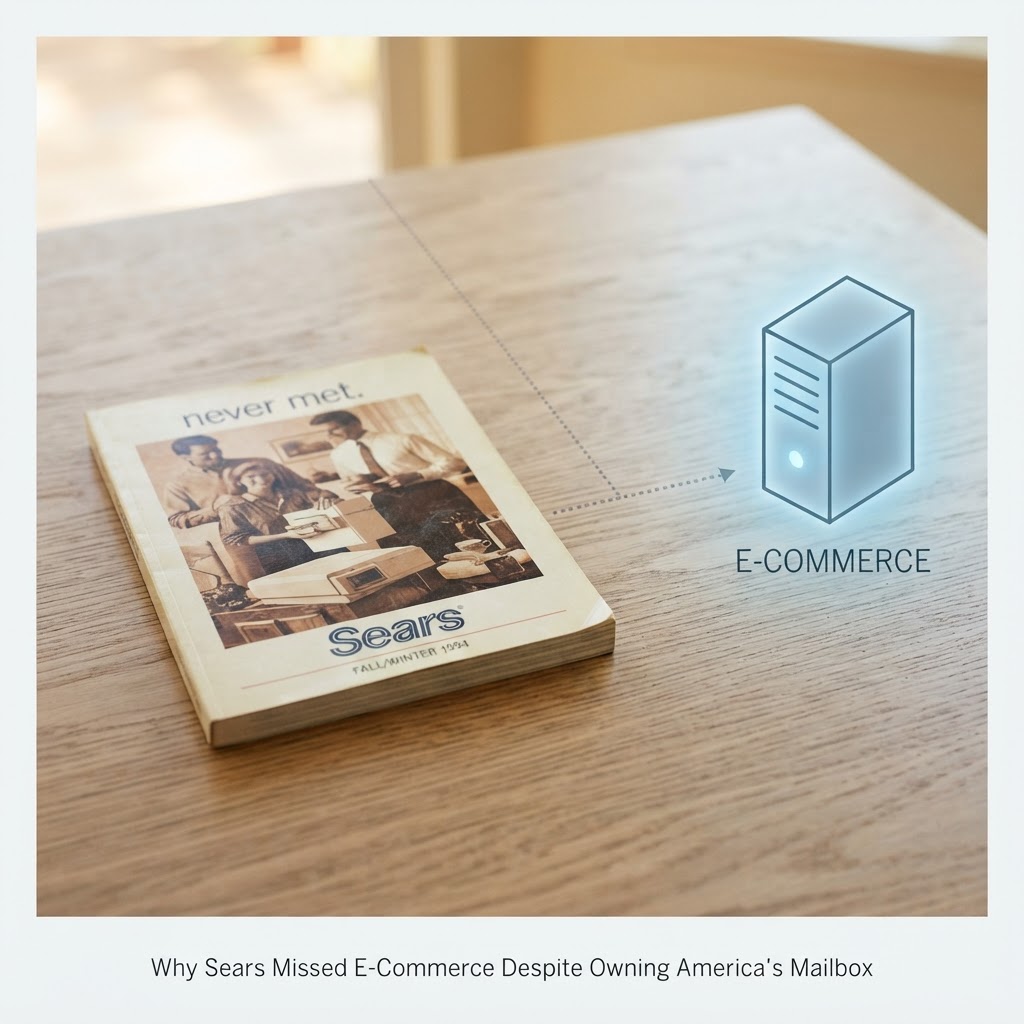
Pairs with the Counterfactual Timeline Builder — a ready-to-use strategy tool, filled for Sears. Included in the The Counterfactual Casebook →
In 1997, you could buy a Craftsman wrench on the internet from sears.com.6 Amazon was still mostly a bookstore. The company that built America on shipping merchandise to people who never set foot in a store was, by any reasonable measure, ahead - it had been selling things online since 1984, when it co-founded a service called Prodigy with IBM and CBS that let people shop from a screen before the World Wide Web existed.5 Two decades later Sears filed for Chapter 11.1 The puzzle isn't why Sears was slow. It wasn't. The puzzle is how a first mover with a half-century logistics head start managed to arrive at e-commerce empty-handed.
The official story is that Sears was a sleepy old retailer that didn't see the internet coming and got run over by Amazon. Almost every part of that is wrong. Sears saw the internet early, invested in it, and even pioneered features - in-store pickup for online orders - before Macy's or Target.7 What it lost wasn't the idea. It was the machine that would have made the idea pay.
The head start was real, and it was bigger than anyone remembers
Strip away the hindsight and look at what Sears actually had. A catalog business that had shipped goods to remote America for a century, with a distribution network purpose-built to fulfill a single item to a single household.2 Decades of customer names, addresses, and buying histories - the most valuable asset in direct retail before anyone used the word 'data.' And the nerve to bet on screens early: Prodigy launched in 1984 as a joint venture called Trintex, offering online shopping a full decade before the browser.5 When the web did arrive, Sears moved fast on it - sears.com informational in 1996, transactional Craftsman commerce in 1997, the Wishbook online in 1998, and by December 1999 the site ranked the fourth fastest-growing shopping destination in the country.6 This is not the résumé of a company that missed the wave. It's the résumé of a company that should have owned it.
The decision that hollowed out the head start
Here is the move that decided everything, and it happened four years before the first online sale. On January 25, 1993, Sears announced it would discontinue the 'big book' catalog as part of a brutal restructuring - 113 stores closed, 50,000 jobs gone, on the back of a $3.9 billion loss the prior year, the largest a North American retailer had ever posted.4 On paper it was disciplined. The catalog ran thin margins and high distribution costs, and cutting it freed capital for a struggling core. What that math left out was that the catalog wasn't just a money-loser to be amputated - it was the spine of everything that made one-to-one selling possible: the fulfillment network, the warehouses tuned to ship single items, and above all the living, updated record of who bought what. Kill the catalog and you don't just stop printing a book. You let the customer lists go stale and you tear out the logistics built to deliver a wrench to a doorstep.
This is the counterfactual that matters. Had Sears kept the catalog operation breathing - even shrunk, even unprofitable on its own line - it would have walked into 1997 with the two things e-commerce most desperately needs and most struggles to build: a current customer database and a single-item fulfillment network. Instead, when it launched online retail, it had to rebuild fundamental pieces from scratch.7 Amazon spent a fortune and a decade constructing exactly what Sears had thrown away. Sears spent the same decade rediscovering it. The infrastructure that should have compounded a head start into dominance had been dismantled to flatter a quarter.
| On the income statement | Off the income statement | |
|---|---|---|
| What was cut | An 8%-margin catalog line | The single-item fulfillment network |
| What it freed | Capital for the core stores | — |
| What it quietly killed | — | Current customer data, updated buyer lists |
| Visible in 1993 | Yes | No |
| Visible in 1997 | — | Painfully - rebuilt from scratch |
Wasn't killing the catalog just sound discipline?
The fair objection is that 1993 management was right by the numbers in front of them. A retailer bleeding $3.9 billion does not get to keep a low-margin, capital-hungry distribution operation out of sentiment for what it might someday become.4 The web did not yet exist as a consumer marketplace; betting on it would have looked like funding a hobby with money the company didn't have. That is a real defense, and it is why this is a genuine fork rather than an obvious blunder. But notice what it concedes: the case for cutting the catalog rests entirely on what was legible in 1993, and the case against it rests on an asset - customer data and single-item logistics - that no 1993 spreadsheet had a line for. The honest counter is harder to dismiss: even after 1997, Sears kept innovating online and still failed, which suggests the catalog wasn't the only wound. Later management treated the company partly as real estate to be liquidated - property, plant, and equipment fell from $9 billion in 2007 to $2.6 billion in 2016, even as e-commerce got its champion in Eddie Lampert.8 So 1993 didn't doom Sears by itself. It removed the one structural advantage that might have made every later mistake survivable.
The catalog's customer database and single-item fulfillment network were invisible on every income statement - they looked like the cost of a low-margin business, not an asset. Their true value was latent: it would only appear in 1997, the moment e-commerce required exactly those capabilities. The trap is structural. When you cut a low-margin operation, you can see the margin you save. You cannot see the optionality you destroy, because optionality has no line item. Before you amputate the unglamorous logistics arm, ask not 'what is this earning?' but 'what does this let us do next that a rival would pay billions to replicate?' Sears had the answer in its warehouses and threw it out to flatter a quarter.
“When Sears killed the catalog it dismantled the distribution infrastructure and failed to keep updated customer lists; when it launched e-commerce in 1997 it had to rebuild fundamental elements from scratch.”7
Sears did not invent the catalog - Montgomery Ward got there in 1872, and Sears merely scaled the model better than anyone alive.3 But scaling it taught Sears the one thing the internet would eventually demand: how to put a single object in a single person's hands, fast, without a store between them. That knowledge was sitting in its warehouses and its customer files in 1993, fully formed, waiting for a world that arrived four years later. The tragedy of Sears is not that it failed to imagine e-commerce. It imagined it before almost anyone. It just demolished the machine that would have let it win - and spent the next twenty-five years trying to rebuild from memory what it had once owned outright.
Counterfactual Timeline Builder
A one-page canvas that runs two histories side by side: what actually happened, and the alternative that died at the fork. You pin the divergence point, trace each branch forward, and name the assumption that decided which one came true. Blank, it disciplines hindsight into a testable counterfactual instead of a what-if; filled, it shows the story's road-not-taken with enough rigor to argue about.
Included, filled and blank, in the The Counterfactual Casebook. See the set → · Preview the blank →
Sources
Where this comes from — the filings, records, and reporting behind it.
- 1Sears Holdings Corporation and 52 affiliates filed voluntary Chapter 11 petitions on October 15, 2018 in the U.S. Bankruptcy Court for the Southern District of New York.
- 2Sears, Roebuck and Co. was formally incorporated/renamed on September 16, 1893; the company began as a mail-order catalog company and opened its first retail locations in 1925; through the 1980s it was the largest U.S. retailer.
- 3Montgomery Ward established the modern mail-order industry in 1872, predating Sears; Richard Sears published his first catalog in 1886/1887 from the R.W. Sears Watch Company, with the general merchandise catalog regularized by 1893–1894.
- 4The company announced on January 25, 1993 it would close 113 stores, terminate 50,000 workers, and discontinue the 'big book' catalog; in 1992 Sears posted a $3.9 billion loss, the largest ever from a North American retailer; the catalog's distribution costs had become prohibitive as sales and profits declined.
- 5Prodigy was founded February 13, 1984 as Trintex — a joint venture of CBS, IBM, and Sears, Roebuck and Company — and offered online shopping before the World Wide Web; IBM and Sears ultimately sold their stakes in 1996 for $200 million after investing more than $1 billion in the service.
- 6Sears launched an informational sears.com in 1996; launched its first e-commerce venture (Craftsman Tools on sears.com) in 1997; put the Wishbook online in 1998; and by December 1999 sears.com was ranked the fourth fastest-growing shopping site (Nielsen//NetRatings).
- 7When Sears killed the catalog in 1993 it dismantled the distribution infrastructure and failed to keep updated customer lists; when it launched e-commerce in 1997 it had to rebuild fundamental elements from scratch. Sears.com nonetheless pioneered in-store pickup for e-commerce orders before Macy's or Target, and offered virtual fitting-room tools.
- 8Sears had 2,705 stores at its peak in 2011. Eddie Lampert was described by reporting as an early and ardent e-commerce advocate — some Sears store managers reportedly griped he favored online over stores — yet the company's property, plant, and equipment value fell from $9 billion in 2007 to $2.6 billion in 2016, indicating a capital liquidation strategy ran parallel to e-commerce investment.
More like this — beyond Sears
New Strategically analyses as they publish: the defining moves in business, checked against the record. No noise, and one click to leave.