Pairs with the Counterfactual Timeline Builder — a ready-to-use strategy tool, filled for Bayer-Monsanto. Included in the The Counterfactual Casebook →
On June 7, 2018, Bayer wired the money and took ownership of Monsanto, paying $128 a share for a total enterprise value of about $63 billion once Monsanto's debt was rolled in.1 It was the boldest move in the 155-year history of the company that invented aspirin. Here is the number that tells you how it went: by mid-2026, the entire Bayer group — pharma, crop science, consumer health, the whole thing — was worth roughly $44 billion on the market.7 Bayer had paid more for one business than the entire company would later be worth. That is not a setback. That is value destruction on a scale that rewrites the textbook.
The story everyone tells is that Bayer was unlucky: it bought a great agriculture company and then a wave of Roundup cancer lawsuits arrived out of nowhere and sank it. Almost every part of that is misleading. The lawsuits were a known risk. The agriculture business was already under pressure. And the financial structure was fragile before a single jury was empaneled. The litigation didn't cause the disaster. It detonated a charge that Bayer's own deal had already planted.
The thesis is simple, and it is not the popular one: Bayer's Monsanto deal was not a black-swan accident but a compounding strategic miscalculation — a 44% premium for a declining asset, financed with debt that starved the rest of the company, with a litigation tail that advisers had flagged and management chose to discount.
The premium that bought a problem
Start with the price, because the price is where the error lived. Bayer's first written proposal, in May 2016, was $122 a share. Monsanto's board rejected it, and Bayer kept raising until it reached $128 in the definitive agreement signed that September — a 44% premium over Monsanto's undisturbed share price.23 A 44% premium is the market's way of saying you are paying for a future the seller doesn't believe in. To justify it, Monsanto's crop business had to grow and the promised synergies had to land. Neither held. The core of Monsanto's revenue was glyphosate — the active ingredient in Roundup — a commodity herbicide whose pricing power was eroding as generics flooded in. Bayer paid a control premium for an asset whose best years were arguably behind it, and then promised investors the difference would be made up in efficiency.
“We are creating a global leader in agriculture... the transaction is expected to be accretive to core earnings per share in the first full year after closing.”2
Those promises — accretion in year one, around $1.5 billion in annual synergies by year three — were the load-bearing beams of the whole rationale.2 When they failed to land, there was nothing underneath the premium but debt and hope.
How an all-cash deal quietly mortgaged the future
The structure made everything worse. This was an all-cash transaction, which meant Bayer had to raise tens of billions in financing rather than hand Monsanto shareholders stock and share the risk. To clear regulators, it also had to sell off businesses generating €2.2 billion in annual sales to BASF for about €7.6 billion — surrendering revenue precisely to win permission to take on more debt.4 The result was a company carrying an enormous loan against an asset that was supposed to throw off cash and instead began throwing off lawsuits. Every euro servicing that debt was a euro not spent on Bayer's pharmaceutical pipeline — the side of the business with the real growth and the real margins — at exactly the moment its blockbuster drugs were aging toward their patent cliffs. The crop deal didn't just risk the crop division. It quietly rationed capital across the entire firm.
| The popular narrative | What the structure shows | |
|---|---|---|
| Why it failed | Surprise Roundup lawsuits | A premium price for a declining business, financed by debt |
| The asset bought | A great agriculture leader | A commodity glyphosate business losing pricing power |
| The litigation | An unforeseeable black swan | A risk advisers had flagged before close |
| The damage | Confined to crop science | Capital rationed across the whole company, pharma included |
The lawsuits that were never a surprise
And then the bill for the litigation arrived — not as a one-time hit but as an open-ended liability that keeps growing. Bayer has paid out over $11 billion in earlier settlements, and the matter is still not closed. In February 2026 it announced a further $7.25 billion class settlement to resolve current and future non-Hodgkin lymphoma claims — and that deal had only preliminary court approval as of March 2026, not final sign-off.5 You can read the strain in Bayer's own books: glyphosate litigation provisions that stood at €6.5 billion in late 2025 jumped to €9.6 billion with the new settlement, lifting total litigation provisions to €11.8 billion, with roughly €5 billion in payouts expected in 2026 alone.6 This is the tell. A truly unforeseeable risk gets priced once and absorbed. A foreseeable one keeps reopening, because the buyer never set aside enough to close it. Bayer is still discovering the size of a problem it inherited eight years ago.
Goodwill impairment is the most honest line in any acquisition gone wrong, because it is the company conceding in writing that it overpaid. By the third quarter of 2024, Bayer had amortized or written down €12.9 billion of Crop Science goodwill since the Monsanto deal — including a €3.6 billion write-down in Q3 2023 and a further €3.3 billion in Q3 2024.8 Popular coverage tends to seize on one quarter's headline number. The accumulated figure is the real story: nearly €13 billion of the purchase price marked down as never having existed.
Wasn't this just bad luck with American juries?
The honest objection is that the litigation outcome really was surprising — that American product-liability verdicts are notoriously unpredictable, that regulators in many countries still hold glyphosate is safe to use, and that Bayer to this day maintains the chemical does not cause cancer.5 All true. No model would have nailed the exact jury awards. But that is the wrong test. The question for due diligence was never 'will we win every case?' It was 'can the deal survive a plausible bad litigation scenario at this price and this debt load?' And the answer, visible at signing, was no. The premium left no margin for error; the all-cash structure left no shock absorber; the synergy case had to perform flawlessly just to break even. The litigation didn't have to be a surprise to be fatal — it only had to be possible. A deal that can only work if everything goes right is not a bold bet. It is a fragile one wearing a bold bet's clothes.
The fatal flaw in most disastrous acquisitions isn't the risk that materializes — it's the price that left no room for any risk to materialize. A 44% premium financed by debt is a bet that the future will go right, with no second line of defense if it doesn't. Before paying up, run the deal through the plausible bad case, not the base case: if the synergies slip, the core business softens, and a known liability comes due all at once, does the structure still stand? If the answer is 'only if all three behave,' you haven't bought an asset. You've bought leverage on optimism. The buyer who survives is the one who priced the deal to absorb the surprise — not the one who assumed there wouldn't be one.
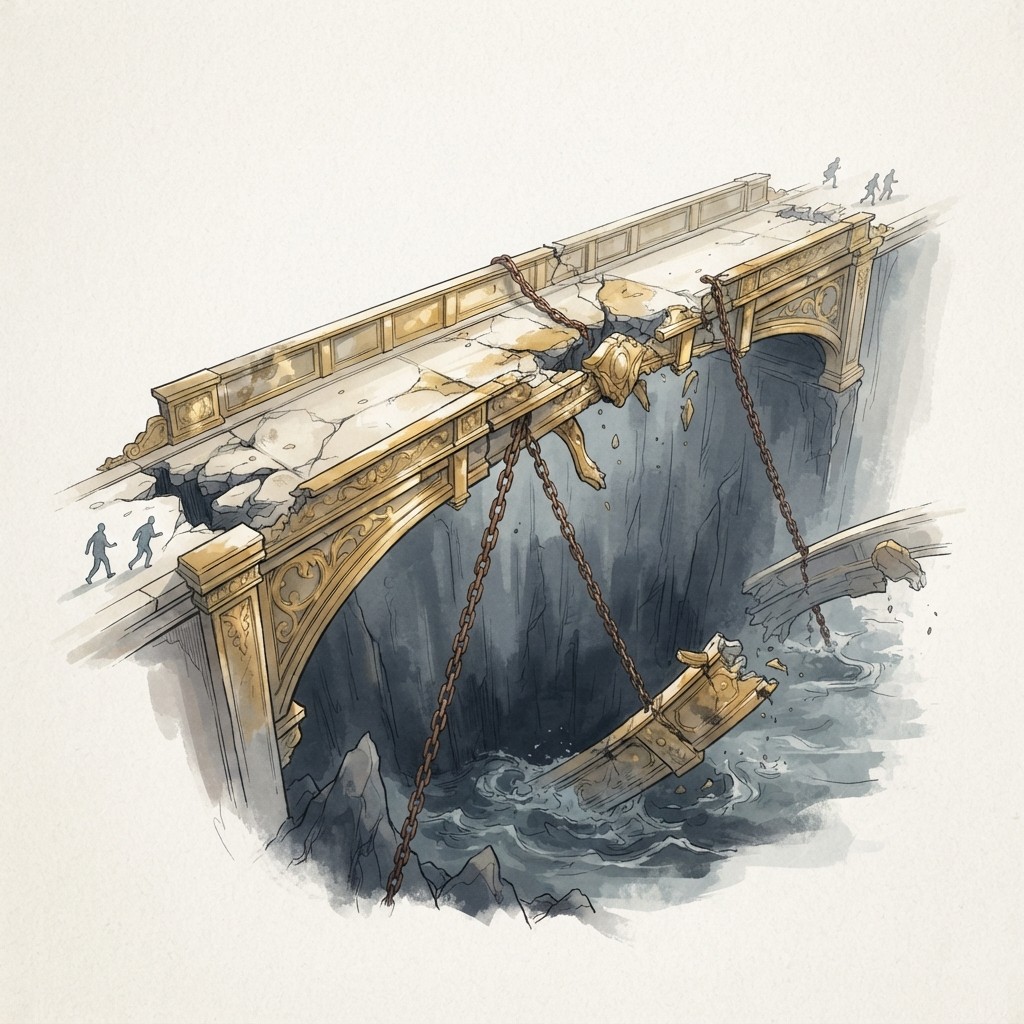
There is a clean way to see the whole thing. Bayer set out to buy the world's leading agriculture company and instead bought the most expensive lesson in modern M&A: that the premium you pay is the safety margin you give away. The lawsuits get the headlines, but they were the spark, not the fuel. The fuel was a price that assumed nothing would go wrong, financed by debt that ensured everything else would. Bayer paid $63 billion to own Monsanto outright — and then watched the market decide the combined company was worth less than that one purchase alone.7 The deal didn't out-run its risks. It out-ran its judgment, and it has spent eight years discovering what that costs.
When a single decision swallows a company
Counterfactual Timeline Builder
A one-page canvas that runs two histories side by side: what actually happened, and the alternative that died at the fork. You pin the divergence point, trace each branch forward, and name the assumption that decided which one came true. Blank, it disciplines hindsight into a testable counterfactual instead of a what-if; filled, it shows the story's road-not-taken with enough rigor to argue about.
Included, filled and blank, in the The Counterfactual Casebook. See the set → · Preview the blank →
Sources
Where this comes from — the filings, records, and reporting behind it.
- 1Bayer closed the Monsanto acquisition on June 7, 2018, paying $128 per share; total enterprise value was approximately $63B including Monsanto's assumed debt as of February 28, 2018.
- 2The definitive merger agreement was signed September 14, 2016 at $128/share all-cash, representing a 44% premium to Monsanto's undisturbed May 9, 2016 share price; the enterprise value at announcement was stated as $66B including net debt.
- 3Bayer's first written proposal to Monsanto was made May 10, 2016 at $122/share; after several rejected offers Bayer raised its bid to $128 before Monsanto accepted.
- 4In connection with regulatory approval, Bayer agreed to divest businesses generating EUR 2.2B in 2017 sales to BASF for an aggregate base price of EUR 7.6B (~$9B); DOJ conditional approval was received in May 2018.
- 5Bayer's $7.25B Roundup class settlement to resolve current and future non-Hodgkin lymphoma claims received preliminary approval from the 22nd Judicial Circuit Court of Missouri on March 4, 2026; Bayer does not admit liability and maintains glyphosate does not cause cancer.
- 6As of September 30, 2025, Bayer's total provision and liabilities for glyphosate litigation stood at €6.5B; the 2026 class settlement announcement increased that provision to €9.6B for glyphosate alone (total litigation provisions rising to €11.8B). Bayer expects ~€5B in litigation-related payouts in 2026.
- 7Bayer shares had lost close to 80% of their value since the Monsanto deal closed in June 2018; as of June 24, 2026, Bayer's market cap was approximately $44.2B — less than the $63B enterprise value paid for Monsanto alone.
- 8Total Crop Science goodwill amortization/impairment since the Monsanto acquisition (2018) reached €12.9B as of Q3 2024, including a €3.3B goodwill write-down in Q3 2024 alone and a €3.6B write-down in Q3 2023, both disclosed in Bayer's official quarterly statements.
More like this — beyond Bayer-Monsanto
New Strategically analyses as they publish: the defining moves in business, checked against the record. No noise, and one click to leave.