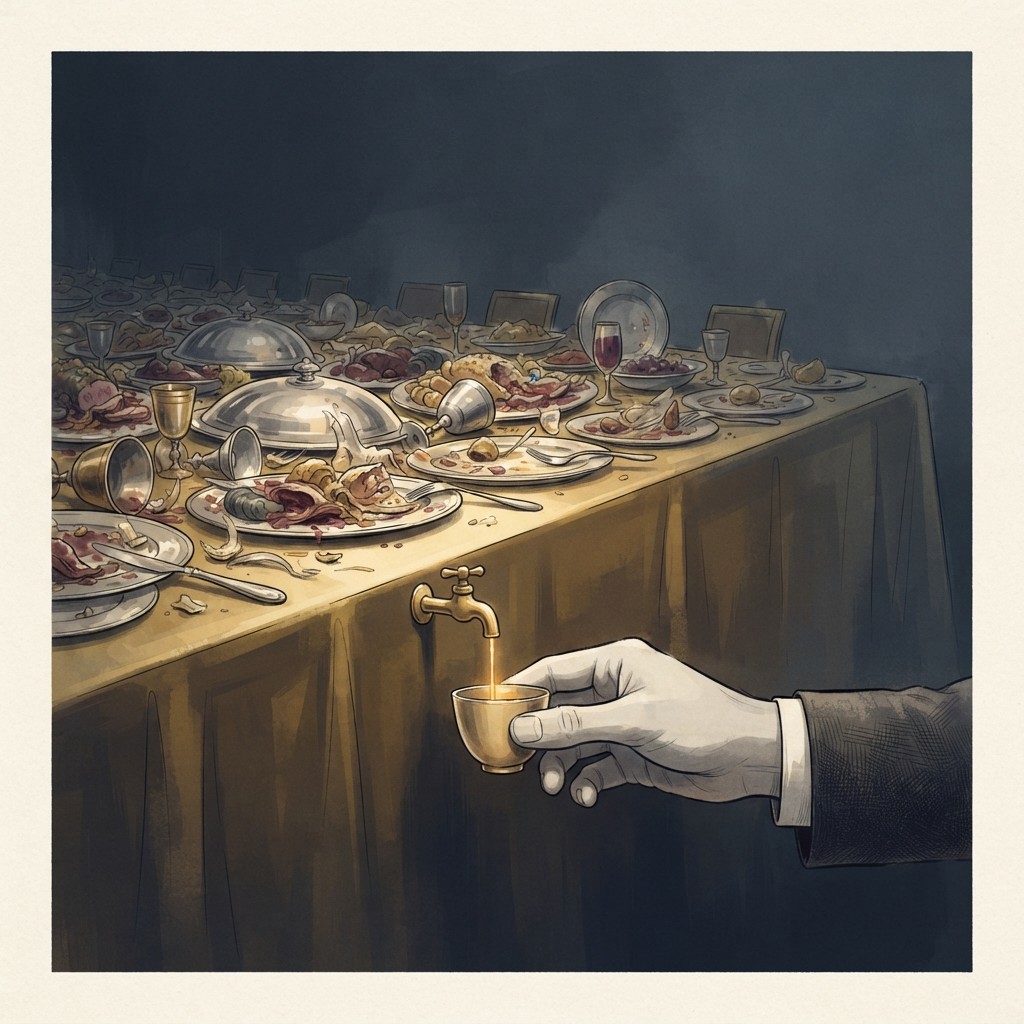
Pairs with the Cannibalization Decision Tree — a ready-to-use strategy tool. Included in the Cannibalization Choice Casebook →
“Should you launch the thing that takes revenue from your best business?”
By the autumn of 2015, more than half of everything Yum Brands sold ran through China - 57% of revenue and 54% of operating profit in a single quarter.6 It was the crown jewel: thousands of KFCs and Pizza Huts in the fastest-growing restaurant market on earth. So Yum did the thing nobody does with a crown jewel. It gave it away. On October 31, 2016, every Yum shareholder woke up owning a brand-new, separate company - Yum China - delivered as a dividend, one share for one share.2 Yum kept nothing of the operation it had spent two decades building. It kept one thing instead: a 3% cut of every order.1
The story everybody tells is simple. Tainted-chicken scandals scared customers, sales cratered, and Yum bailed out of a market that had turned toxic. It's a clean narrative, and it's mostly wrong. Yum didn't flee China. It re-engineered itself - and chose to harvest a thin, certain royalty over a fat, volatile operation it could no longer stomach owning.
The trade: half the revenue for a sliver that never moves
Here is the move stripped to its bones. Before the split, Yum owned and ran the China business - and so it owned all of China's swings: the boom years, the scandal quarters, the currency risk, the cost of building every new store. After the split, Yum owned a franchise contract. Yum China would pay a license fee of 3% of system sales to use the KFC, Pizza Hut, and Taco Bell names.1 No stores to build, no supply chain to police, no consumer panic to absorb. Just a check that arrives whether China is booming or apologizing on state television.
The accounting confirms how lopsided the giveaway was. When Yum later explained the move to the SEC, it disclosed that the spinoff removed 51% of its revenues - but only 27% of its operating profit and 33% of its total assets.4 Read that twice. China was a revenue monster that punched well below its weight on profit and capital. Yum was handing over a business that ate a disproportionate share of its balance sheet and produced a disproportionately small share of its margin. The headline 'they gave away half the company' is true on the top line and misleading everywhere it matters.
| Headline impression | What the filing showed | |
|---|---|---|
| Revenue removed | Half the company | 51% of revenues4 |
| Operating profit removed | Half the profit | 27% of operating profit4 |
| Total assets removed | Half the balance sheet | 33% of total assets4 |
| What Yum kept | Nothing | A 3%-of-sales license fee, forever1 |
An operator earns the spread between sales and costs - and absorbs every shock to either. A pure franchisor earns a thin, near-fixed percentage of the top line and lets someone else carry the stores, the staff, the suppliers, and the scandals. Yum kept 3% of China's sales1 while shedding a business that held a third of its assets4 - converting its most volatile segment into its most predictable one.
An activist got a board seat, and days later the jewel was for sale
Why now, and why this? The proximate trigger wasn't a tainted chicken. It was a boardroom. The plan to separate China arrived days after Keith Meister - founder of the hedge fund Corvex Management, which held nearly 5% of Yum - was appointed to Yum's board.5 Meister had been pressuring the company to break itself apart; fellow investor Daniel Loeb had also taken a large stake and pushed for a strategic reset, though he had not specifically endorsed a spinoff. Meister put a number on the prize: he argued the split could lift Yum's stock by $16 a share — an investor's assertion made at the Sohn Investment Conference in May 2015.59 Scandal was the weather that softened management's resistance; the activist was the front that finally moved the system. A board that might have defended an integrated China for another decade folded the integrated structure within days of letting one of its critics inside the room.
“OSI was not a major supplier... termination caused minimal disruption to menu offerings.”7
That quote is the tell. The 2014 Shanghai Husi episode - the undercover footage of improper food handling at a meat supplier - did real damage; it hit sales for four of the last five quarters before the announcement.6 But Yum's own filing says the offending supplier 'was not a major supplier' and that cutting it caused 'minimal disruption.'7 The reputational hit was wildly disproportionate to the operational hit. The scandal terrified consumers far more than it actually broke the business - which is precisely why it works so much better as a public narrative than as the real explanation. The real explanation lives in a board appointment and a royalty rate.
Wasn't this just a panicked exit dressed up in finance?
The honest objection is that the distinction is academic - that whatever the filings say, a company hit by scandal for four of five quarters6 and then jettisoning that exact business is, functionally, fleeing. It's a fair point, and the scandal clearly mattered. But notice what an exit would have looked like: a fire sale, a discount, a buyer extracting a distressed price. That is not what happened. As the spinoff completed, Primavera Capital and Ant Financial agreed to invest $460 million into Yum China - $410 million and $50 million respectively - with Primavera's Fred Hu becoming Yum China's chairman.8 You do not get marquee outside capital and a named chairman walking into a business you are abandoning. You get them walking into a business someone believes in. Yum wasn't dumping a liability. It was spinning off an asset it had decided to own differently - through a contract instead of a balance sheet.
And the structure betrays the intent. A panicked exit doesn't keep 3% of every future sale forever.1 A franchisor transformation does. By converting its operating stake into a royalty, Yum captured China's future upside without China's future volatility - the cleanest possible version of having the cake and licensing it too.
Yum's real choice wasn't 'keep China or quit China.' It was 'own China's swings or rent China its name.' Inside one company, the most volatile segment infects the whole valuation - investors discount the stable parts because of the unstable one, and the conglomerate trades below the sum of its pieces. Splitting lets each business be priced for what it actually is: a fast-growing operator priced as a growth story, a thin-but-certain royalty stream priced as an annuity. The lesson for any multi-segment business: when one unit carries most of the risk, you may be worth more by separating the risk than by managing it. An activist's $16-a-share claim was a bet that the market would pay more for two clean profiles than for one muddy one.
Yum gave away the operation that made it famous in China and kept the only thing it actually wanted: a number. Three percent of every bucket of chicken and every pizza, arriving on schedule, immune to the next scandal, the next currency move, the next undercover camera in a supplier's freezer.1 The brand stayed in China; the risk left Yum's books.4 It was never a retreat. It was Yum deciding that the best way to own the world's biggest restaurant market was to stop running restaurants in it - and to start collecting the toll instead.
Cannibalization Decision Tree
A decision tree for the moment the new thing threatens the cash cow: is the disruption real, will someone else do it if you don't, and can you afford to bleed your own margin to own the future? Blank to run on your own line; filled as the worked example tracing how the story's incumbent chose to cannibalize — or flinched and got cannibalized.
Included, filled and blank, in the Cannibalization Choice Casebook. See the set → · Preview the blank →
Sources
Where this comes from — the filings, records, and reporting behind it.
- 1Yum! Brands announced its intention to separate into two independent publicly traded companies on October 20, 2015, with Yum China to become a franchisee paying a license fee of 3% of system sales for KFC, Pizza Hut and Taco Bell in China.
- 2On October 31, 2016, Yum! Brands completed the spin-off of its China business through a dividend of all issued and outstanding Yum China common stock to YUM shareholders of record as of October 19, 2016; each YUM shareholder received one share of Yum China for each share of YUM held. No vote of YUM shareholders was required.
- 3The Yum! Brands Board of Directors formally approved the China separation on September 26, 2016, with the separation expected after the close of business on October 31, 2016, and Yum China to begin trading on NYSE under 'YUMC' on November 1, 2016.
- 4The spinoff removed 51% of Yum Brands' revenues, 27% of its operating profit, and 33% of its total assets on a pro-forma FY2015 basis, qualifying it as a 'discontinued operation' representing a strategic shift with a major effect on operations and financial results under FASB ASC 205-20-45-1B.
- 5The plan to spin off Yum's China business came days after activist investor Keith Meister — founder of hedge fund Corvex Management, which owned nearly 5% of Yum — was appointed to Yum's board; Meister and Daniel Loeb had both been pressuring the company to reorganize. Meister claimed the spinoff could boost Yum's stock price by $16 per share.CNBC, Yum Brands plans to separate China business ↗ · 2015-10-20
- 6China contributed 57% of Yum Brands' total revenue and 54% of its operating profit in Q3 2015, and the business had been hit by a food scandal at a meat supplier, hurting sales for four of the last five quarters before the spinoff announcement.CNBC, Yum Brands plans to separate China business ↗ · 2015-10-20
- 7On July 20, 2014, an undercover report televised in China depicted improper food handling by supplier Shanghai Husi Food (a division of OSI Group); Yum's own SEC filing states OSI 'was not a major supplier' and that termination caused 'minimal disruption to menu offerings,' yet the scandal 'triggered extensive news coverage in China that has shaken consumer confidence and impacted brand usage,' with disproportionate impact on KFC and Pizza Hut given their category-leading positions.
- 8Primavera Capital Group and Ant Financial Services Group agreed to invest $410 million and $50 million respectively (total $460 million) in Yum China concurrent with the spinoff completion; Primavera founder Dr. Fred Hu was named Yum China's Non-Executive Chairman.
- 9Keith Meister said the spinoff of Yum's China business could generate an additional $16 a share in value for Yum shareholders.
Weighing outside help with a decision like this? Hiring a corporate strategy consultant
More like this — beyond Yum Brands
New Strategically analyses as they publish: the defining moves in business, checked against the record. No noise, and one click to leave.