Company profile
SEC EDGAR ↗- Industry
- Retail-Eating Places
- Listed
- NYSE: YUM
- Incorporated
- NC
- Headquarters
- Louisville, KY
- Fiscal year end
- Dec 31
Financials
FY2025- Revenue
- $8.21B
- Net income
- $1.56B
- Total assets
- $8.20B
| Fiscal year | Revenue | Net income | Total assets |
|---|---|---|---|
| FY2025 | $8.21B | $1.56B | $8.20B |
| FY2024 | $7.55B | $1.49B | $6.73B |
| FY2023 | $7.08B | $1.60B | $6.23B |
| FY2022 | $6.84B | $1.32B | $5.85B |
| FY2021 | $6.58B | $1.57B | $5.97B |
| FY2020 | $5.65B | $904.0M | $5.85B |
Reported fiscal years from SEC filings (10-K) — SEC EDGAR ↗. Stratrix is a strategy publication, not a real-time financial data service.
Decisions on record
3 verified Decision Records on Yum Brands, and the casebook each one belongs to.
| Fork date | Decision type | What Yum Brands chose | Where it stood | The story | Casebook |
|---|---|---|---|---|---|
| 1987 | Market-Entry Gambit | Localize managers and supply chain | KFC's 11,648 China stores generated $8.5 billion and net profit climbed 10% to $911 million (2024) | Read the story → | Market-Entry Gambit Casebook → |
| 2015 | Cannibalization Choice | Spin off, keep 3% royalty | Primavera Capital and Ant Financial agreed to invest $460 million into Yum China (2016) | Read the story → | Cannibalization Choice Casebook → |
| 2016 | Asset-Light Bet | Become pure-play franchisor | Over 15,400 units in mainland China — roughly a quarter of the footprint on one licensee paying 3% (2024-12) | Read the story → | Asset-Light Bet Casebook → |
Videos on Yum Brands
Run one of these yourself
The decisions Yum Brands faced, as kits you can run.
Each pack takes one of these decisions and gives you the framework, a deck for the room, a model that resolves to one number, and the sourced cases behind it. $499, one-time.
Boundaries of the FirmThe Asset-Light BetWhich parts of the business should you stop owning?See the pack →Decision ForksThe CannibalizationShould you launch the thing that takes revenue from your best business?See the pack →Growth & PortfolioThe Market EntryHow fast can this actually be done?See the pack →
The analyses
The Asset-Light Operator · Boundaries of the Firm
Yum Owns Almost No Restaurants. Its Biggest Bet Is on One Company It Can't Control.
Yum Brands franchised its way to 97% of 63,000 restaurants and called it a pure-play royalty machine. But roughly 25% of those units sit inside Yum China — a single licensee paying 3%, not a franchisee Yum can replace. The diversification is real. The concentration is too.
8 min
The Cannibalization Choice · Growth & Portfolio
Yum Traded 51% of Its Revenue for a 3% Royalty on China, With an Activist at the Table
The story is that food scandals chased Yum out of China. The filings tell a colder one: Yum gave away 51% of its revenue to keep a 3%-of-sales license fee — and an activist got a board seat days before the announcement.
8 min
The Market-Entry Gambit · Growth & Portfolio
KFC Won China by Becoming Less American, Not More
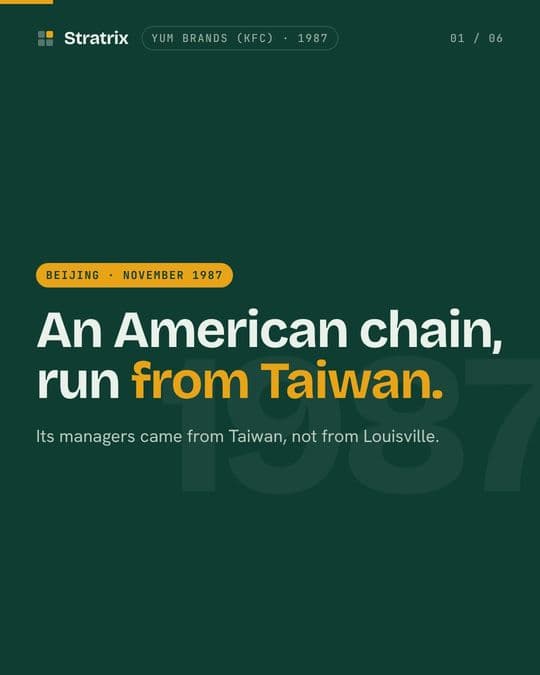
Everyone thinks KFC conquered China by selling America. It did the opposite — it hired Taiwanese managers over Americans, built its own supply chain from scratch, and ran Beijing 1987 as a lab. By 2024, KFC's 11,648 China stores threw off $8.5 billion.
8 min