Pairs with the Cannibalization Decision Tree — a ready-to-use strategy tool. Included in the The Cannibalization Choice Casebook →
On May 3, 2024, ExxonMobil closed a deal that more than doubled its position in a single oil field. It paid for Pioneer Natural Resources almost entirely in its own stock, took on 1.4 million net acres in the Permian Basin holding an estimated 16 billion barrels of oil equivalent, and set itself a target of pumping roughly 2 million barrels a day from that one basin by 2027.2 This was not the move of a company quietly preparing to exit the oil business. It was the move of a company building a longer runway for it — and writing the largest check it had cut for anything since its 1999 Mobil merger.9
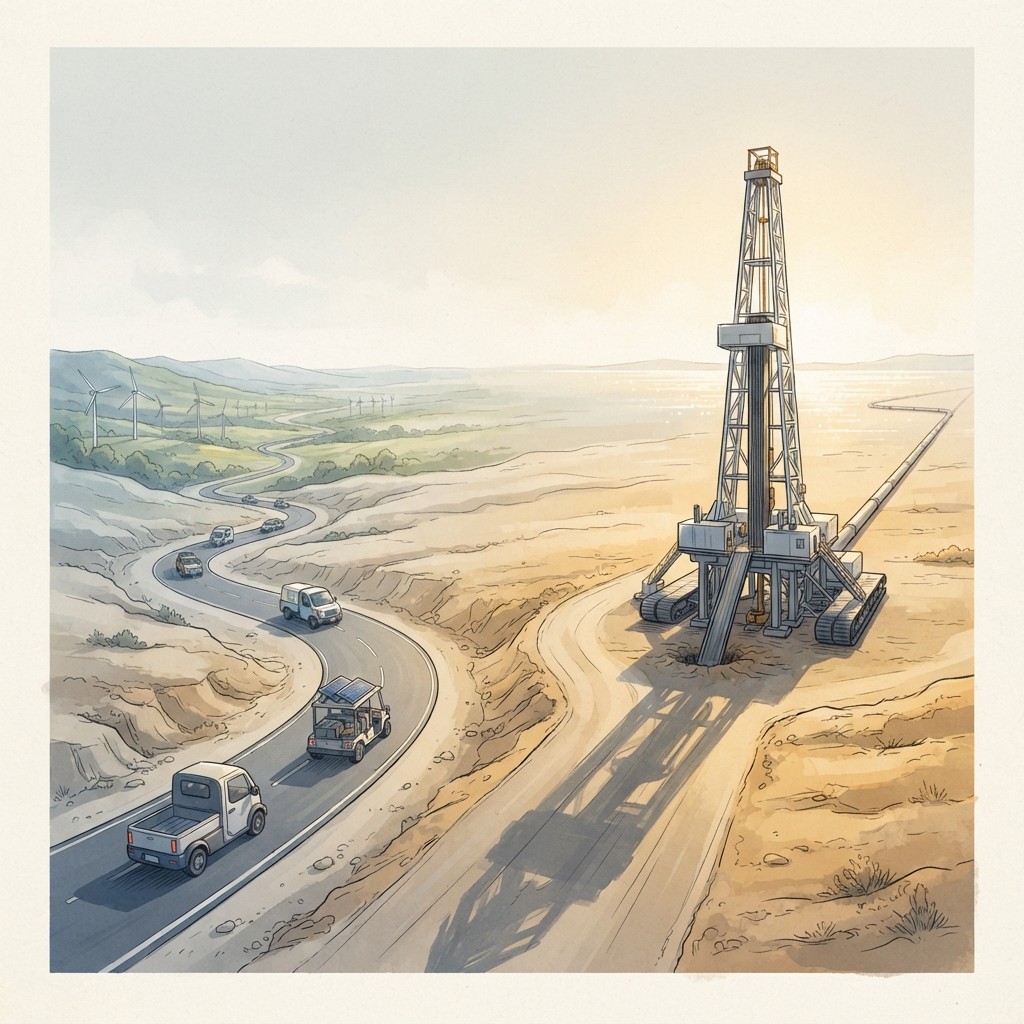
The official story of the 2020s is that the energy majors are becoming energy companies: hedging into wind, solar, and hydrogen, managing oil into a graceful sunset. ExxonMobil declined the costume. Where rivals diversified to look transition-ready, Exxon concentrated. It is not pivoting away from oil. It is wagering, with tens of billions of dollars and a decade of plans, that the world will keep needing barrels long after the most aggressive transition timelines say it shouldn't.
A wager dressed as a production target
Read Exxon's December 2025 plan as a bet, not a forecast. It targets 5.5 million boe/d of total upstream production by 2030, lifts its earnings-growth outlook to $25 billion and cash-flow growth to $35 billion against a 2024 baseline, and projects something like $145 billion in cumulative surplus cash at $65 real Brent — and crucially, it promises all of this with no increase in capital spending.4 That last clause is the whole tell. The plan does not say 'we will spend more to grow.' It says 'we will pump more, more cheaply, from assets we already own.' The Pioneer barrels are some of the lowest-cost in North America; Guyana's offshore fields are among the cheapest new oil on earth. By 2025, those advantaged assets — the Permian, Guyana, and LNG — already made up 59% of production, up about seven points in a single year.5
Here is the mechanism, worked down. Most companies facing a possibly-declining market diversify to spread risk. Exxon did the opposite: it lowered its break-even cost so far that it can survive a low-price, low-demand world that bankrupts higher-cost producers. If oil demand falls slowly, Exxon wins on volume. If it falls fast, the marginal barrel disappears first — and the marginal barrel belongs to someone else, not to the company sitting on 16 billion barrels of the cheapest reserves in the lower 48.2 The bet isn't that demand stays high forever. The bet is that Exxon is standing last in line to be cut.
| The diversifier's play | Exxon's play | |
|---|---|---|
| Strategy | Spread into renewables, hedge the downside | Concentrate into the lowest-cost barrels |
| Bet on demand | Falls fast — get out early | Outlasts the aggressive timelines |
| Where it wins | If the transition is fast | If the transition is slower than promised |
| The hidden risk | Underinvesting in still-needed oil | An accelerated demand collapse |
The numbers say the engine still runs
Skeptics tend to assume the oil business is already in managed decline. Exxon's own results say otherwise. In 2024 it earned $33.7 billion, spent $27.6 billion on capital and exploration, and handed shareholders $36.0 billion — more than all but five companies in the entire S&P 500.6 In 2025 net production hit 4.7 million boe/d, its highest in more than forty years, with the Permian alone setting an annual record at 1.6 million and Guyana clearing 700,000 gross barrels a day.5 You do not return more cash to owners than 495 of the 500 largest American companies by accident, and you do not set a four-decade production record while sunsetting. The transition narrative and Exxon's cash flow statement are telling two different stories, and only one of them clears.
“Highest level of production in more than 40 years.”5
And the low-carbon hedge? It exists. The 2030 plan keeps growing capex for carbon capture, hydrogen, lithium, and biofuels. But the proportion stays small against upstream oil and gas, and Exxon itself concedes those businesses depend on 'continued technological progress, stable policy support, and timely rule-making and permitting' — three conditions outside its control.4 Translation: Exxon will play the low-carbon game when others are paying for the field, but it will not bet the company on it. The hedge is real; it is just not large enough to be a pivot. It is the option, not the strategy.
What the plan doesn't put on the slide
The strongest version of Exxon's critics is not 'oil is dead' — it's a question about candor. The internal logic of the bet is more coherent than its detractors admit: low-cost barrels are exactly what survives a shrinking market. But the same plan that meticulously models $145 billion of surplus cash at $65 Brent does not model, with anything like the same prominence, what happens if demand collapses faster than the company assumes.4 That asymmetry is not new behavior. A peer-reviewed study of 187 of the company's climate communications found that 83% of its internal documents acknowledged climate change as real and human-caused, while only 12% of its public advertorials did — and a follow-up in Science found Exxon's own scientists' warming projections from 1977 onward were as accurate as academia's.8 The pattern was never ignorance. It was a gap between what was known privately and what was emphasized publicly. The 2030 plan, modeling the upside in granular detail and the downside far more lightly, rhymes with that older habit.
This is also a company that, in January 2024, sued two of its own shareholders to block a climate resolution — reportedly the first time a major corporation sued investors over such a thing — and kept the suit alive even after they withdrew the resolution. The chilling effect worked: by the 2025 proxy season there were no climate resolutions on the ballot for the first time in at least a decade.7 You don't sue your own owners into silence about a risk you're confident is small. The aggression is itself information about how contestable Exxon believes the bet to be.
When a market might shrink, the instinct is to diversify away from it. But there's a second, less obvious move: drive your cost so low that you survive the shrinkage and your higher-cost rivals don't. Demand destruction always eats the marginal unit first — the expensive barrel, the inefficient plant, the high-cost supplier. If you own the cheapest capacity, a falling market can paradoxically consolidate it around you. The catch: this only works if you've genuinely modeled how fast the floor could fall, not just how high the ceiling could rise. A low-cost position survives a slow decline beautifully and a sudden one not at all — and the difference between the two is the part most worth disclosing, which is exactly the part that tends to go missing from the slide.
ExxonMobil's strategy is not denial of the energy transition. It is a colder calculation: that the transition will be slower, messier, and longer than its loudest forecasters claim, and that the cheapest barrels on earth will be the last ones the world stops buying. On its own terms, the bet is rational — perhaps the most rational version of staying in oil that exists. The unsettled part is not whether Exxon understands the downside. It is whether anyone reading the plan is meant to. The company built a magnificently engineered machine for a world that needs oil for one more decade. The only question it hasn't answered out loud is what the machine is worth if that decade arrives early.
When a company bets on the future it prefers
Cannibalization Decision Tree
A decision tree for the moment the new thing threatens the cash cow: is the disruption real, will someone else do it if you don't, and can you afford to bleed your own margin to own the future? Blank to run on your own line; filled as the worked example tracing how the story's incumbent chose to cannibalize — or flinched and got cannibalized.
Included, filled and blank, in the The Cannibalization Choice Casebook. See the set → · Preview the blank →
Sources
Where this comes from — the filings, records, and reporting behind it.
- 1ExxonMobil announced merger with Pioneer Natural Resources on October 11, 2023 as an all-stock transaction valued at $59.5 billion equity ($253/share); total enterprise value including net debt was approximately $64.5 billion.
- 2ExxonMobil closed the Pioneer acquisition on May 3, 2024, more than doubling its Permian footprint; combined acreage of 1.4 million net acres holds an estimated 16 billion boe resource; Permian production more than doubled to 1.3 million boe/d based on 2023 volumes with a target of ~2 million boe/d by 2027.
- 3FTC reached a consent agreement allowing the Pioneer deal to close, with the condition that former Pioneer CEO Scott Sheffield be barred from the ExxonMobil board due to concerns about prior discussions with OPEC members about output levels.
- 4ExxonMobil's December 2025 updated 2030 plan targets 5.5 million boe/d total upstream production, raises earnings growth outlook to $25 billion and cash flow growth to $35 billion (both vs. 2024 baseline), generating ~$145 billion in cumulative surplus cash flow at $65 real Brent — with no increase in capital spending.
- 5Full-year 2025 net production reached its highest level in more than 40 years at 4.7 million boe/d; Permian annual record at 1.6 million boe/d; Guyana exceeded 700,000 gross boe/d; advantaged assets (Permian, Guyana, LNG) represented 59% of production, up ~7 percentage points from 2024. Full-year 2025 cash capital expenditures reached $29.0 billion.
- 6Full-year 2024 earnings were $33.7 billion; capital and exploration expenditures totaled $27.6 billion; ExxonMobil distributed $36.0 billion to shareholders — more than all but five S&P 500 companies. Record production achieved in Permian and Guyana.
- 7ExxonMobil in January 2024 sued shareholders Arjuna Capital and Follow This to block a climate-related shareholder resolution — the first time a major corporation sued investors over such a resolution — and pushed ahead even after the shareholders withdrew it, producing a chilling effect with no climate resolutions on the 2025 proxy ballot for the first time in at least a decade.
- 8Peer-reviewed analysis of 187 ExxonMobil climate communications (1977–2014) found 83% of internal documents acknowledged climate change as real and human-caused, while only 12% of public advertorials did so (81% expressed doubt) — demonstrating public doubt-promotion alongside private scientific acknowledgment. A 2023 follow-up in Science showed ExxonMobil scientists' global warming projections from 1977–2003 were as accurate as academic and government scientists' projections.
- 9The Pioneer acquisition was the largest transaction by ExxonMobil since its acquisition of Mobil in 1999.
More like this — beyond ExxonMobil
New Strategically analyses as they publish: the defining moves in business, checked against the record. No noise, and one click to leave.