Pairs with the Asset-Light vs Asset-Heavy Comparator — a ready-to-use strategy tool, filled for Shopify. Included in the The Asset-Light Operator Casebook →
A merchant signs up for a $39-a-month plan, opens a store, and feels like they've armed themselves against the empire. They have their own domain, their own brand, their own customer list - everything Amazon would have swallowed. But every time a customer checks out, a different meter quietly runs. Shopify Payments takes a cut. Shopify Capital may have funded the inventory.11 Shop Pay is holding the card on file. The merchant pays $39 to the rebel cause and a sliver of every single sale to the arms dealer - and the arms dealer's revenue from those slivers, $6.5 billion in 2024, dwarfs what it makes selling the rifles.1
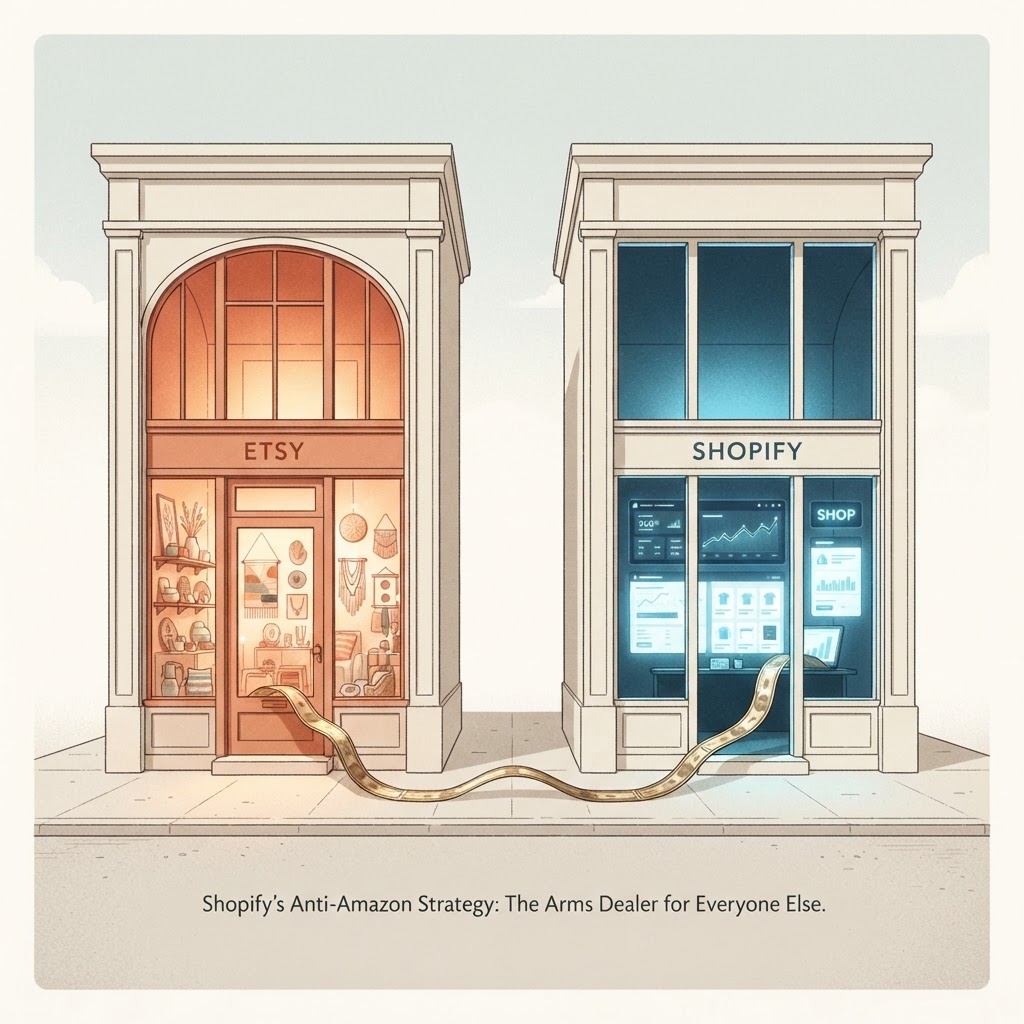
The official story is that Shopify is the anti-Amazon. The line that launched a thousand decks is the one Lütke became known for: 'Amazon is trying to build an empire, and Shopify is trying to arm the rebels.'6 It is one of the great strategic reframes - a neutral toolmaker that never competes with its own customers, never owns the shelf, never takes the brand. The reframe is mostly true. It is also, increasingly, a costume the empire wears.
“Amazon is trying to build an empire, and Shopify is trying to arm the rebels.”6
The arms dealer's real genius was never neutrality
Amazon's model is to own everything between the buyer and the product: the marketplace, the search bar, the reviews, the logistics, the customer relationship. A merchant who sells on Amazon is renting access to Amazon's customers, and Amazon learns exactly what sells before launching its own version. Shopify inverted the whole thing. It sells the picks and shovels and keeps none of the gold - the merchant owns the storefront, the domain, the buyer's email. That genuine difference is why the 'arm the rebels' metaphor stuck: structurally, Shopify cannot cannibalize a merchant the way Amazon can, because Shopify never sees a marketplace it could favor itself in. It is asset-light by design - software at a 50% gross margin, no warehouses, no inventory, no risk on any single product.1
But notice where the money actually comes from. Subscriptions - the $39-a-month rifle - are not the business. In 2024, Merchant Solutions, the bucket that contains Shopify Payments, Capital, Tax, and the rest, brought in $6.5 billion of Shopify's $8.88 billion in total revenue.111 The genius was never selling the weapon. It was attaching a toll to every shot fired. Shopify Payments processed roughly 62% of the platform's GMV in 2024, which means the arms dealer is now paid as a percentage of how successful its rebels become.9 On $292.3 billion in GMV, that percentage is an empire of its own.1
| The arms dealer (the story) | The tax collector (the economics) | |
|---|---|---|
| What it sells | Software subscription | A cut of every transaction |
| Revenue 2024 | Subscription Solutions | $6.5B Merchant Solutions |
| Scales with | Number of merchants | GMV — how big each merchant gets |
| Relationship to merchant | Neutral toolmaker | Financial intermediary holding the card |
The two years Shopify forgot it was asset-light
If the arms-dealer thesis ever cracked, it cracked in logistics. Between 2019 and 2022, Shopify did the one thing an asset-light arms dealer is never supposed to do: it tried to build the war machine itself. It bought the warehouse-robotics firm 6 River Systems in 2019,10 then in May 2022 paid $2.1 billion for the fulfillment startup Deliverr - its largest acquisition ever - to stand up a logistics network that would compete head-on with Amazon's own fulfillment empire.5 It was an attempt to match Amazon asset-for-asset, and it was exactly the move the strategy was built to avoid.
It lasted barely a year. In May 2023, Shopify abruptly reversed: it sold the entire logistics business to Flexport in exchange for a 13% equity stake - notably, not cash - and on the same day announced it was cutting 20-23% of its workforce.35 The deal closed weeks later, on June 6.4 An asset-light company had spent billions buying assets, then handed them off and took paper in return rather than admit a write-down in cash. The episode is the clearest evidence that 'arm the rebels' is a discipline, not a law of nature - the moment Shopify tried to fight Amazon on Amazon's terms, the math collapsed and it retreated to the one game it actually wins: software and the toll on top of it.
If everyone is armed, is anyone really a rebel?
The sharpest objection to the whole thesis came not from Amazon but from the strategy's own admirers. The 'arm the rebels' phrase wasn't even Lütke's invention - analyst Web Smith traced its Shopify usage back to Rails creator David Heinemeier Hansson, and warned that arming rebels has a long history of arming whoever wins next.7 Packy McCormick put the deeper problem most cleanly: Shopify hands the identical arsenal to every merchant, so no single merchant gains an edge over any other. When every rebel is armed, none really is - and a force that arms everyone equally isn't a liberator, it's a tax on the entire battlefield.8
The fair steelman in Shopify's favor is that this is precisely the point of being asset-light: a tax on commerce is a wonderful business if the commerce is real and the rails are genuinely the best way through. Shopify exceeded 12% of U.S. e-commerce by GMV and posted 24% GMV growth in 2024 - its highest in three years - while throwing off a 22% free-cash-flow margin.12 That is not a company struggling to justify its cut. But the metaphor is doing quiet work it can no longer support. Shopify Payments, Capital, Balance, and Tax don't just arm the merchant - they sit between the merchant and their own money, which is what an intermediary does, not a toolmaker. The line that once described a neutral ally now describes a financial layer extracting a growing share of merchant economics. Same picks and shovels. Different relationship to the gold.
The arms-dealer position is one of the strongest in business: sell infrastructure, take none of the product risk, scale with your customers' success. But it carries a slow gravity. The same scale that makes you indispensable also lets you attach financial products - payments, lending, the float - between your customer and their cash, and each one is more profitable than the tools you started with. The trap is that the neutrality is the moat: the moment merchants feel taxed rather than armed, the metaphor that protected you becomes the one used against you. The discipline isn't refusing to monetize the transaction. It's making sure the toll stays cheaper than the road being the genuinely best way through - because rebels who feel taxed eventually look for a new arms dealer.
Shopify still tells the better story Amazon can't tell: it does not compete with the people it sells to, and on a marketplace that matters enormously. But strategy is revealed by where the money lands, and the money has migrated from the rifle to the toll on every shot. The arms dealer that swore it would never build an empire built something subtler - an empire that doesn't own the shelf, only a percentage of everything that crosses it. The rebels still hold their own brands and their own customers. They just pay tribute on the way out the door, and the tribute, compounded across $292 billion, is starting to look a lot like a crown.
When the toll matters more than the product
Asset-Light vs Asset-Heavy Comparator
A side-by-side matrix that pits owning the assets against renting or orchestrating them, dimension by dimension. Blank to weigh your own model choice; filled as the worked example showing why the story's company went capital-light — or planted its money in concrete and steel.
Included, filled and blank, in the The Asset-Light Operator Casebook. See the set → · Preview the blank →
Sources
Where this comes from — the filings, records, and reporting behind it.
- 1Shopify's FY2024 10-K filed with the SEC: total revenues $8,880 million (26% YoY); Merchant Solutions revenues grew from $5.2 billion (2023) to $6.5 billion (2024), a 25% increase; GMV $292.3 billion, a 24% YoY increase; gross profit $4,472 million (50% margin).
- 2Shopify Q4 and Full-Year 2024 press release (filed as Form 6-K): GMV growth of 24% YoY in 2024, 'highest GMV growth in three years'; Q4 free cash flow margin 22%; Q4 revenue growth accelerated to 31%; Shop Pay GMV grew 50%; U.S. e-commerce market share exceeded 12%.
- 3Shopify entered a definitive agreement on May 3, 2023 to sell the majority of its logistics business (including Deliverr and related assets) to Flexport in exchange for a 13% equity interest in Flexport (incremental to existing stake); the sale completed June 6, 2023.
- 4Shopify completed the sale of Shopify Logistics to Flexport on June 6, 2023, receiving stock representing a 13% equity interest incremental to its existing stake.
- 5Shopify acquired Deliverr for $2.1 billion (announced May 2022, its largest acquisition ever); then sold it to Flexport less than one year later (May 2023), also announcing a 20–23% workforce reduction simultaneously. The acquisition was described by multiple analysts as opposed at the time and the reversal as 'abrupt'.
- 6Tobi Lütke is widely quoted saying: 'Amazon is trying to build an empire, and Shopify is trying to arm the rebels.' The Globe and Mail (Feb 2021) confirmed Lütke used this Star Wars metaphor explicitly; the Seattle Times (May 2020) placed the quote's public circulation to approximately October 2019. No primary transcript with an exact date has been located.
- 7Web Smith (2PM) argued in February 2020 that the 'arming the rebels' phrase, as applied to Shopify, was coined by Ruby on Rails creator David Heinemeier Hansson — not Lütke — and that the strategy carries long-term risks analogous to historical 'arm the rebels' geopolitical failures.2PM (2pml.com), No. 345: The Arming Of The Rebels ↗ · 2020-02-03
- 8Packy McCormick (Not Boring, Jan 2021) adversarially refuted the 'arm the rebels' thesis: because Shopify gives the same tools to every merchant, no single merchant gains a competitive advantage — making Shopify a tax on commerce rather than a rebel-empowering force. 'When every rebel is armed, none really is.'
- 9Shopify Payments (Gross Payments Volume) processed 62% of Shopify's GMV in Q3 2024, up from 58% a year earlier, per CFO Jeff Hoffmeister; full-year 2024 GMV penetration is reported at roughly 62%.
- 10Shopify announced in September 2019 and completed in October 2019 the acquisition of 6 River Systems, a Waltham, Massachusetts warehouse-fulfillment robotics company, for approximately US$450 million in cash and stock.Shopify Inc., Shopify to Acquire 6 River Systems ↗ · 2019-09-09
- 11Shopify Capital is a financing program offering merchant cash advances and loans to eligible merchants, repaid as a percentage of daily sales, which merchants may use to invest in inventory and marketing; Shopify Balance is a free financial account that lets merchants manage their money from the Shopify admin.
More like this — beyond Shopify
New Strategically analyses as they publish: the defining moves in business, checked against the record. No noise, and one click to leave.